

Top Tweets for #UserOps

@RialoHQ 3) Banded Reputation & Staking. Paymasters deposit collateral to Bundlers and enforce strict verification rules (validatePaymasterUserOp). If an app's Paymaster submits invalid UserOps or spams storage, its stake is slashed—protecting Bundlers while keeping gas pools secure.
1) Account Abstraction (ERC-4337) enables gasless transactions via Paymasters. However, bad actors can exploit this feature—crafting malicious UserOps that drain a Paymaster’s gas sponsorship pool through failed or spam transactions.
@RialoHQ


First, the numbers for the week from @0xBundleBear:
1.06M Active Accounts 10.7M UserOps executed $39,263 in total paymaster spend
Spend fell -22.5% week-over-week on -12.7% fewer UserOps, paymasters are pulling back faster than activity alone justifies.

3 Million Blocks. 3.929M UserOps. 0 Hype.
Today, the @Incentiv_net Mainnet hit a massive stability milestone. This isn’t just a number; it’s a heartbeat. A consistent 5.2s block time across 3M+ blocks proves that the infrastructure isn't just "ready", it’s hardened.

Smart Wallet Accounts adoption has been growing consistently, with over 52.6 million accounts performing at least one UserOps, a good indicator that these accounts are active after deployment.
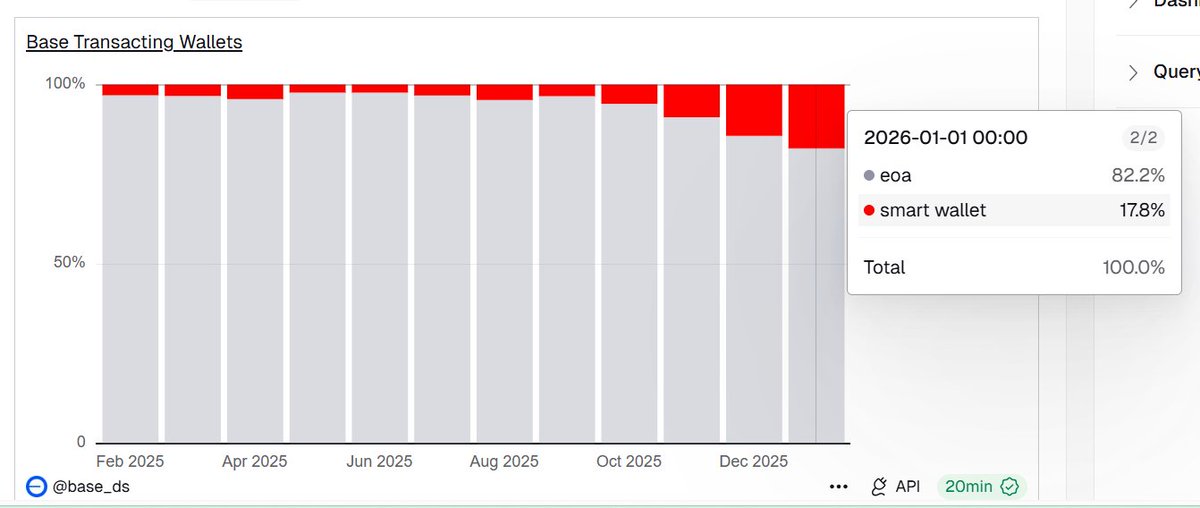
When compared to EOAs (Externally Owned Accounts), Smart Wallets now account for approximately 18% of transacting wallets on @base.
Over the last year, adoption has grown by over 500% YoY, when share of smart wallets was barely 3%.
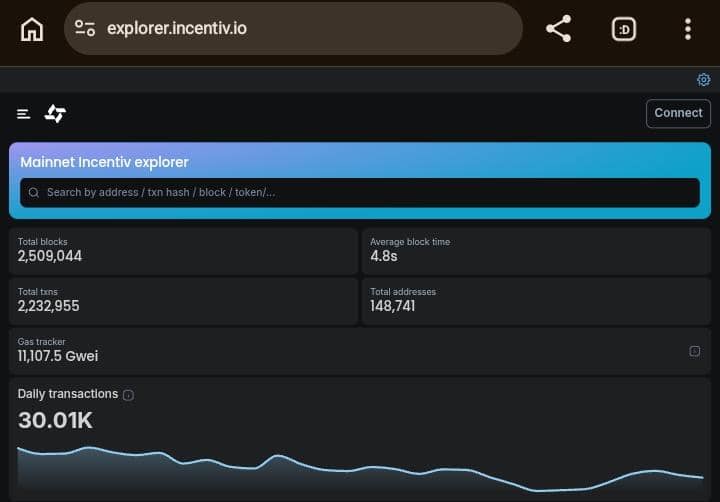
We’ve moved from 23k to 148k addresses in just 30 days. That’s a 538% increase.
Unlike "Patchwork" chains that rely on bot-driven volume, Incentiv’s growth is driven by UserOps. Every transaction is a proof of a real user interacting with the Unified Paymaster.
They said the chain was too quiet.
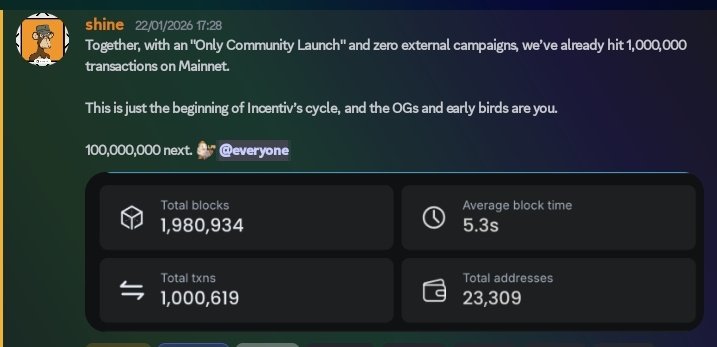
Meanwhile, @Incentiv_net just crossed 1,001,000 Transactions on Mainnet.
(Actually 1.018M+ if you count UserOps).
• No paid marketing.
• No CEX listing.
• Pure organic stress-testing.
Infrastructure ready.
Next stop: EPOCH 1. @shineDUDES


The main barrier in DeFi - is not liquidity, but execution complexity.
When I want to earn yield, I am forced to manually go through the path: Bridge 💨 Swap 💨 Approve 💨 Deposit
In the @superformxyz v2 architecture, this process is handled by SuperBundler. This is the practical implementation of the Intent-Centric Design concept.
So how does this one-signature magic work?
1⃣ From Intent to Execution
Traditional interfaces require confirmation of every step. SuperBundler works differently. I express an intent:
For example, “Deposit 1000 USDC from Base into a vault on Arbitrum”
And the system translates it into a sequence of hooks - modular smart contracts for bridging, swapping, and staking.
2⃣ Single-Signature Architecture
Technically, SuperBundler breaks your strategy into separate operations (UserOps) for each chain.
🔸 These operations are packed into a Merkle Tree.
🔹 The user signs only the root of the tree (Merkle Root).
🔸 This single signature is enough to authorize complex actions across multiple networks at once.
3⃣ The infrastructure is built on account abstraction standards. Smart accounts (ERC-7579) validate the signature through the SuperValidator module. If the signature matches the tree root, SuperExecutor triggers the chain of actions. Either the entire strategy is executed, or nothing is (protection against funds getting stuck midway through a bridge).
4⃣ For the end user, blockchains disappear. SuperBundler acts as an off-chain service that takes care of all transaction logistics. This turns fragmented DeFi into the experience of using a regular banking app, while preserving non-custodial principles.

Stop getting rekt by gas fees just to move your own money. 🤕
1. The old crypto UX:
Approve (Pay) ➡️ Swap (Pay) ➡️ Stake (Pay)
2. The @Incentiv_net UX:
Bundle it all into ONE click. ✅
Real adoption happens when Web3 feels simpler than Web2.
#UserOps #Incentiv #Web3UX #DeFi


From Account Abstracted to Chain Abstracted Wallets
MagicSpend++ builds on Account Abstraction as the foundation for enabling chain abstracted wallets. This allows wallets to upgrade their account abstraction capabilities into chain abstraction by leveraging the existing Paymasters without introducing new entities or account models.
For tokens to enter the Chain Abstracted Balance, they need to be locked in their smart wallets. Users can withdraw funds back to their Externally Owned Accounts (EOAs) after a configurable delay. While locked, the assets remain usable via the smart account on any chain at any time.
Note that this is a one-time step as a part of the SCW onboarding workflow and is not required every time assets must be used. All assets deposited represent the user’s Chain Abstracted Balance (CAB).
This Chain Abstracted Balance can now be spent on any chain via UserOps, just like how you would spend these assets if they were on the chain you are acting on. Paymasters can fund the UserOp on the target chain with not just gas but with additional funds to facilitate the on-chain execution of the UserOp. Paymaster can then claim the funds from the CAB.
Smart wallets can leverage a whitelisted paymaster within Socket’s MOFA, or leverage competing paymasters to enable a larger pool of paymasters and better execution for end users.
Not Cross-chain but Chain Abstraction
Chain abstracted wallets provide various 10x improvements for users:
User asset balances across chains are combined into one Chain Abstracted Balance
Balance is instantly usable anywhere, with zero bridging latency
This is completely different than any cross-chain implementations where wallets integrate bridges like Across, Stargate, etc.
Cross-chain implementations are push-based where users start with a fragmented balance on one chain and “push” their tokens to another. On the other hand, MagicSpend++ is pull-based where the user simply uses an app, and their funds are pulled by the paymaster later. It’s like Credit first, debit later.
This has various implications for the end users.
POWERED BY @SOCKETProtocol
CC : @AiraaAgent

It might didn't come home but still a lot of alpha taken away from @token2049 about @glider__ its growth and its future.
What we learn? (Closed beta)
-> Over $20M in volume.
-> Over 15K active portfolios.
-> 4% of all UserOps on @base
Again, we're talking about a product in closed beta. This is impressive.
The future
The endgame is B2B. Businesses to build on top of Glider. According to @JockinVC, the team is already in touch with DEXs, Wallets, Consumer Platforms who want to use their API and provide solutions to their users.
Glider's building a 3rd column into your wallets.
"Tokens || Collectibles || Portfolios".
An orchestration layer where crypto from any chain, RWAs and Stocks through @plumenetwork and @OndoFinance and stables come together, in one single app. Plus, you'll be able to earn yield.
Glider already held a new funding round which is soon to be announced and I'm pretty confident that there will be another one in the future, as TOKEN2049 was proven as massive success.
Conviction will be rewarded.
gGlide. ♾🦇
From Account Abstracted to Chain Abstracted Wallets
MagicSpend++ builds on Account Abstraction as the foundation for enabling chain abstracted wallets. This allows wallets to upgrade their account abstraction capabilities into chain abstraction by leveraging the existing Paymasters without introducing new entities or account models.
For tokens to enter the Chain Abstracted Balance, they need to be locked in their smart wallets. Users can withdraw funds back to their Externally Owned Accounts (EOAs) after a configurable delay. While locked, the assets remain usable via the smart account on any chain at any time.
Note that this is a one-time step as a part of the SCW onboarding workflow and is not required every time assets must be used. All assets deposited represent the user’s Chain Abstracted Balance (CAB).
This Chain Abstracted Balance can now be spent on any chain via UserOps, just like how you would spend these assets if they were on the chain you are acting on. Paymasters can fund the UserOp on the target chain with not just gas but with additional funds to facilitate the on-chain execution of the UserOp. Paymaster can then claim the funds from the CAB.
Smart wallets can leverage a whitelisted paymaster within Socket’s MOFA, or leverage competing paymasters to enable a larger pool of paymasters and better execution for end users.
Not Cross-chain but Chain Abstraction
Chain abstracted wallets provide various 10x improvements for users:
User asset balances across chains are combined into one Chain Abstracted Balance
Balance is instantly usable anywhere, with zero bridging latency
This is completely different than any cross-chain implementations where wallets integrate bridges like Across, Stargate, etc.
Cross-chain implementations are push-based where users start with a fragmented balance on one chain and “push” their tokens to another. On the other hand, MagicSpend++ is pull-based where the user simply uses an app, and their funds are pulled by the paymaster later. It’s like Credit first, debit later.
This has various implications for the end users.
Acknowledgments
We think MagicSpend++ enables complete chain abstraction, where users don’t have to care where their assets are.
Thank you to the following people for the many discussions, reviews, and idea-sharing that led to the creation of this proposal(in no particular order):
Wilson Cusack, Pierce Harger, Uma pumatheuma, Alex Watts, Partha, Ahmed Al-Balaghi, Sachin Tomar, Ivo Georgiev, Theo Gonella, Derek Chiang, Kristof Gazso, Ankit and Stephane, Kakusan, Bapireddy, Aniket Jindal
@SOCKETProtocol Solving chain abstraction with SOCKET Eco
nursuring @wallchain_xyz
gSocket
gQuack


🦖
Day 67 of learning Blockchain
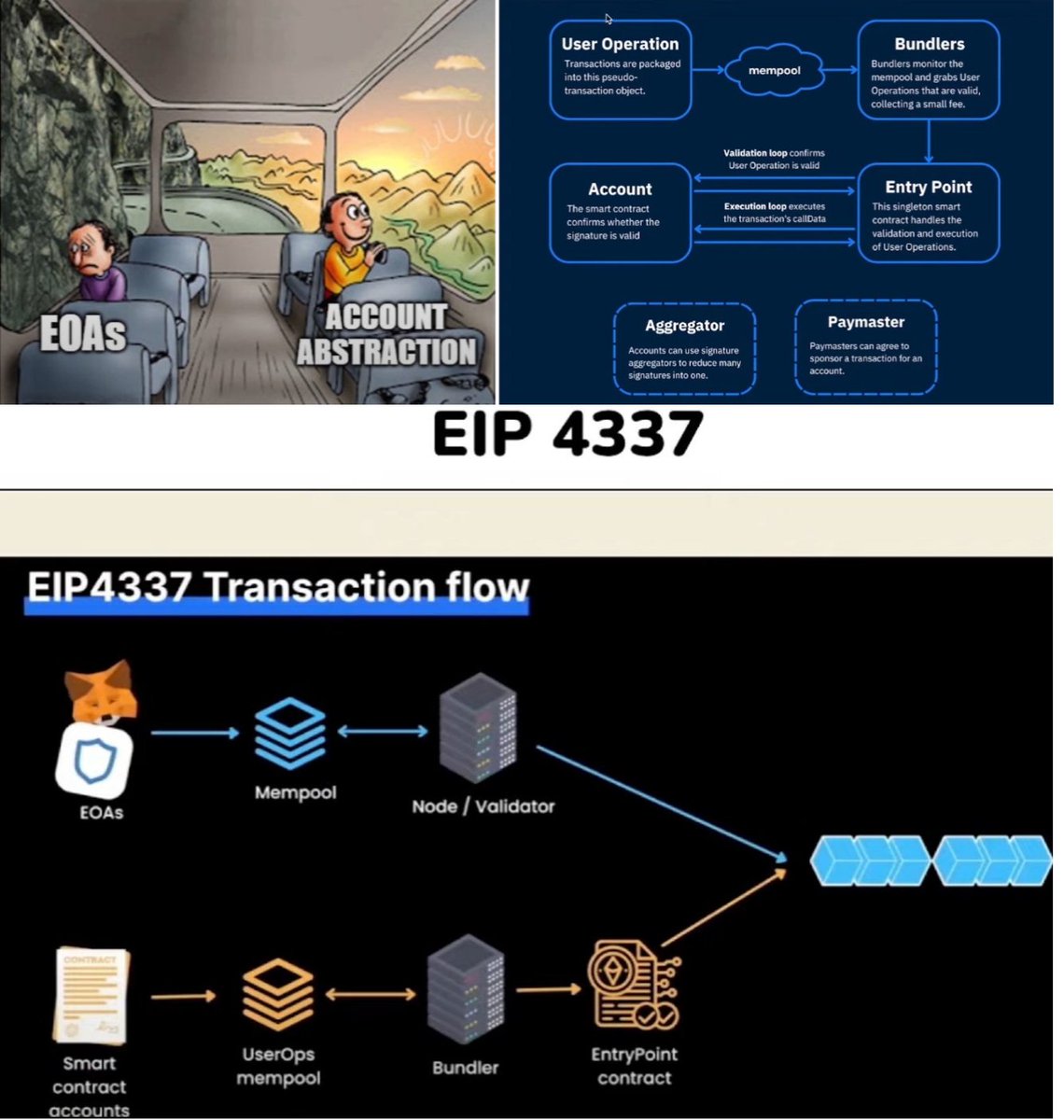
Project 10– Account Abstraction (ERC-4337)🔐
Today I research about:
✅Explored UserOps, EntryPoint, Bundlers & Paymasters
✅Learned why EIP-86 & 2938 failed but 4337 works
✅Compared meta-tx vs AA
Docs done, ready to start coding tomorrow⚡

@SOCKETProtocol CHAIN ABSTRACTED PACKET
To enable the application-centric world, @SOCKETProtocol centers around a structure called the “chain-abstracted packet,” much like how general blockchains revolve around “blocks.” This packet is simply an application-approved execution of requests and responses across networks.
To elaborate on the general architecture pattern for applications in a chain-abstracted and application-centric world:
REQUEST: These are signed off-chain authorisations from the end user. Depending on what the application accepts, this could be userOps, intents, permit2 witness, or any custom type.
RESPONSE: These are signed responses by off-chain actors to help execute the pending
requests on-chain. The combination of a request and response forms an on-chain
actionable unit. The gateway is responsible for selecting the right response for the request in an application-specific manner.
GATEWAY: This is an application-specific lightweight business logic that lives off-chain
but approves on-chain execution (packet) for the application contracts. It allows application developers to write arbitrary logic. The primary goal of the gateway is to create the packet by matching the right request and response and to perform any pre-execution logic.
@SOCKETProtocol is the future of Decentralized Finance.



What is a Chain Abstracted Packet (CAP)?
Think of a Chain Abstracted Packet like a digital envelope that holds:
A request (what the user wants to do)
A response (how to make it happen)
It’s the core unit that powers the @SOCKETProtocol , just like a "block" is the core unit in a blockchain.
Instead of sending transactions to a single chain, apps use CAPs to send actions across any chain, making cross-chain activity smooth and app-first.
Why Is This Important?
To create an application-centric world (where users interact directly with apps, not messy chains), Socket needed a new model.
That’s where CAPs come in — they let apps manage cross-chain actions in a clean, unified way.
What’s Inside a CAP?
1. Request – A signed permission from the user (off-chain).
Like: "Yes, I approve this swap" or "Send this message."
Could be userOps, intents, permit2, or other formats.
2. Response – A signed message from an off-chain actor (a helper) saying:
“I’ve prepared everything. Here’s how to execute it on-chain.”
Together, the request and response = a full, ready-to-run Chain Abstracted Packet.


@TheKiirin Soul Protocol stands out by turning cross-chain coordination into a native experience. With UserOps, it automates execution, syncing, and risk across chains.

@TheKiirin @0xSoulProtocol isn’t just modular, it’s orchestrated. 🔥
By embedding UserOps into its core, Soul enables intent-based automation that spans chains without fragmenting risk or control.

Here’s a fresh thread diving into what VOOI (@vooi_io) is building as a decentralized, cross-chain perpetual DEX aggregator, with a deeper focus on their innovative technology and unique features shaping the future of DeFi trading. 🧵
1. Chain Abstraction Framework
VOOI leverages OneBalance’s chain abstraction toolkit to eliminate the complexity of managing multiple blockchains. Users deposit tokens (e.g., USDT, USDC) into a VOOI Smart Wallet, enabling trading across any supported DEX without bridging or handling native gas fees, streamlining cross-chain operations.
2. Intent-Based Trading Engine
VOOI’s intent-based framework allows users to specify desired trading outcomes (e.g., “buy BTC at $60,000”), and the platform handles the execution details. Powered by advanced algorithms, it optimizes trade routing across multiple DEXs for the best price and minimal slippage.
3. Unified Order Book
VOOI consolidates order books from integrated DEXs like Orderly, SynFutures, and Hyperliquid into a single interface. This provides a comprehensive view of liquidity and market depth, enabling traders to execute orders efficiently without navigating multiple platforms.
4. Gasless Trading with Account Abstraction
By implementing account abstraction, VOOI abstracts away gas fee management. Users pay transaction fees (UserOps fees) from their unified balance, making trading feel seamless and cost-efficient, even across chains with different gas mechanics.
5. Pyth Network Price Feeds
VOOI integrates Pyth Network’s real-time, high-accuracy price feeds to ensure precise pricing for assets like crypto, stocks, forex, and RWAs. This minimizes price discrepancies and supports reliable trading in their Telegram Mini App and Trading Terminals.
6. Permissionless DEX Integration
VOOI’s architecture supports permissionless onboarding of perpetual DEXs, allowing rapid expansion of supported markets. Recent integrations include SynFutures V3’s Oyster AMM and Orderly Network’s omnichain infrastructure, enhancing trading pair diversity.
7. Exotic Asset Trading via Overlay Protocol
Through its partnership with Overlay Protocol, VOOI enables trading of unique perpetuals like blockchain metrics (e.g., BTC dominance), AI indexes, and game skins. This expands DeFi’s scope beyond traditional assets, catering to niche traders.
8. High-Leverage Trading Support
VOOI supports up to 50x leverage on synthetic assets and perpetual contracts across integrated DEXs. This caters to advanced traders looking to amplify returns, with risk management tools like position tracking built into the platform.
9. AI-Powered Automation
VOOI is developing AI-driven trading agents that analyze market data and execute strategies based on user-defined parameters. These agents aim to optimize trades, reduce manual effort, and enhance decision-making in volatile markets.
10. Scalable Multi-Chain Infrastructure
VOOI’s platform supports both EVM and non-EVM networks, with the flexibility to onboard new chains as needed. This ensures long-term scalability and interoperability, keeping VOOI at the forefront of multi-chain DeFi innovation.
Summary
VOOI (@vooi_io) is pioneering a new era of DeFi with its chain-abstracted, intent-based perpetual DEX aggregator. By integrating cutting-edge tech like gasless trading, AI automation, and real-time price feeds, VOOI delivers a seamless, secure, and scalable trading experience across diverse markets. Follow @vooi_io for updates on their journey to redefine decentralized trading!

Most Popular Users

Elon Musk 
@elonmusk
240.1M followers

Barack Obama
@barackobama
118.6M followers

Cristiano Ronaldo
@cristiano
114.4M followers

Donald J. Trump
@realdonaldtrump
111.8M followers

Narendra Modi
@narendramodi
106.9M followers

Rihanna
@rihanna
98.6M followers

NASA
@nasa
92.1M followers

Justin Bieber
@justinbieber
91.7M followers

KATY PERRY
@katyperry
89.9M followers

Taylor Swift
@taylorswift13
83.9M followers

Lady Gaga
@ladygaga
75.4M followers

Virat Kohli
@imvkohli
73.3M followers

Kim Kardashian
@kimkardashian
70.8M followers

YouTube
@youtube
68.6M followers

Neymar Jr
@neymarjr
66.3M followers

Bill Gates
@billgates
65.2M followers

Selena Gomez
@selenagomez
63M followers

The Ellen Show
@theellenshow
62.1M followers

CNN
@cnn
61.7M followers

X
@x
60.6M followers