

Top Tweets for #affinity

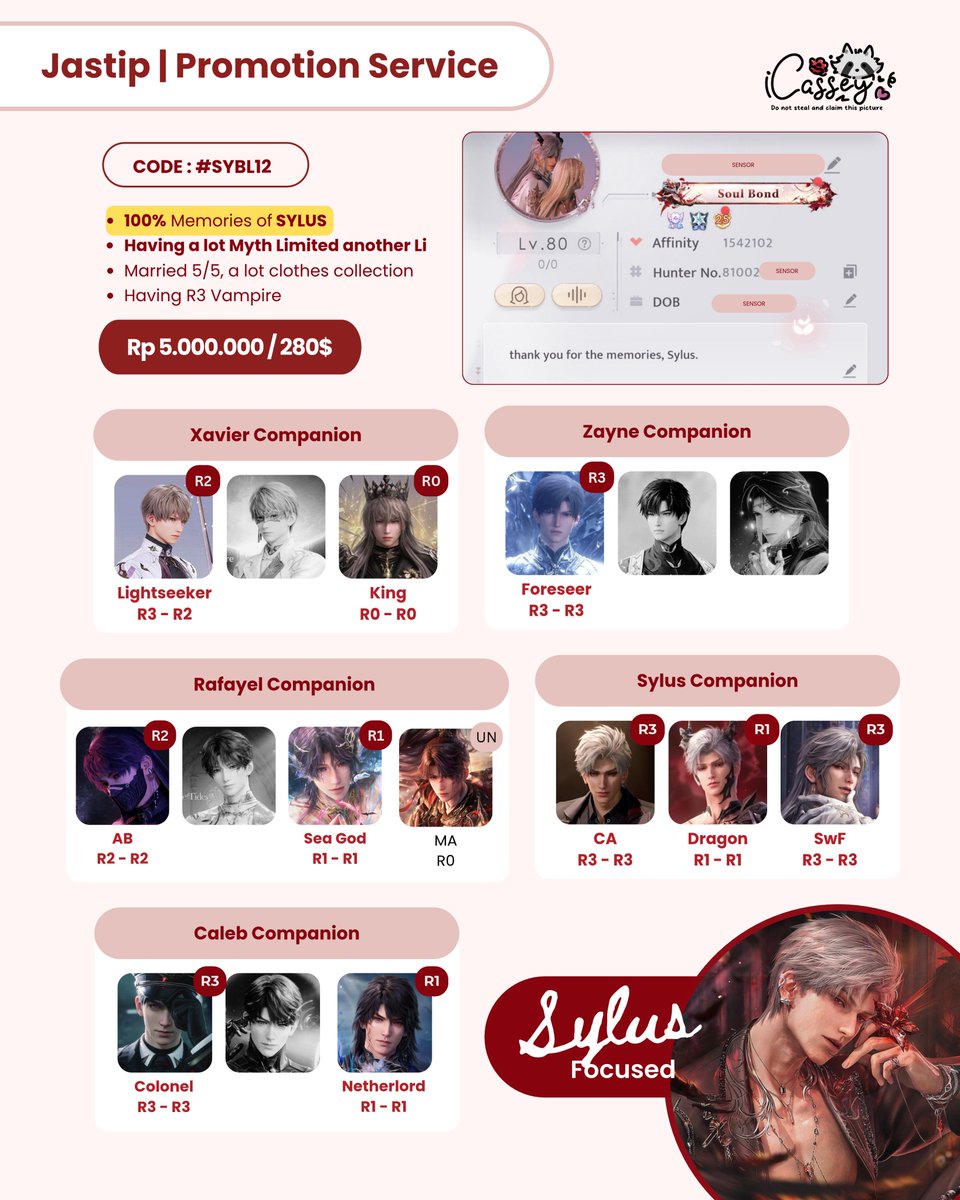
⋆. 𐙚 ˚𝐒𝐘𝐁𝐋𝟏𝟐 - #𝐖𝐓𝐒𝐋𝐀𝐃𝐒 𝐀𝐂𝐂 𝐒��𝐋𝐔𝐒 𝐅𝐎𝐂𝐔𝐒
── .✦ Memories 100% with Sylus, having limited myths other Li, affinity 100 with all, a lot clothes collection, R3 vampire
Price : Rp5.000.000 / $280 「 𝗡𝗘𝗚𝗢𝗧𝗜𝗔𝗕𝗟𝗘 」
➤ DM for details



Hallo semuaaa yang nyari
Gitar Squier Affinity Series Telecaster + Ampilifier
Masih adaa yaaa yang mau nanya nanya lebih jelas boleh dm yaa 🙌🏻
Haii,adakah yang cari?
Gitar Squier Affinity Series Telecaster (Slick Silver) + Ampilifier
5.5jt All In (Nego)
📍bandung
💌 yang mau bisa dm ya


@nephophilenas Thanks for your comment
The tool that surprised me most this year is Claude, i could connect Claude to Figma, Canva, and Affinity via MCP connectors,
I make changes on design directly from Claude to my design tools
It's crazy i can't lie
How about you?

Measuring the information budget of cross-target antibody affinity generalization: a robust cross-target wall, and why structure reaches developability but not affinity
1. The paper argues that cross-target antibody affinity generalization hits an informational ceiling: most ranking-relevant variation is target-specific interaction (I), not a transferable antibody-intrinsic component (T). It formalizes this as a transfer ceiling ρmax = sqrt(T/(T+I)) and shows that, under leakage-free antigen splits, models converge to this “budget” rather than improving with architecture.
2. A key technical contribution is a noise-corrected, censoring-aware estimator of the transfer ceiling. Unlike naive variance decompositions (which are biased downward by measurement noise), it subtracts replicate-estimated noise and handles right-censoring (e.g., non-neutralizing IC50 values) via expectation-maximization. On deterministic synthetic ground truth, it recovers the noise-free ceiling within ±0.0003.
3. On real, leakage-free cross-antigen evaluation (GRABS v1.1; antigens clustered and split by MMseqs2 to prevent near-duplicate leakage), every method family collapses to ~0 cross-target within-held-out-antigen Spearman on well-powered targets (n≥30 variants). Structure GNN: −0.03; ESM-2 sequence: −0.03; boosted trees: −0.02; retrieval: +0.01; cofolding confidence: −0.01.
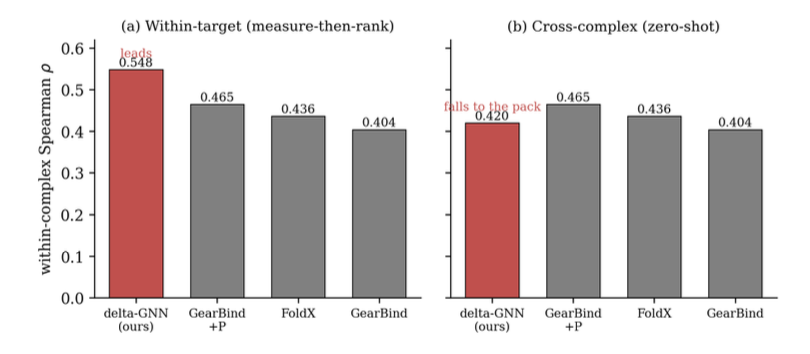
4. The negative result is not “structure models are weak” in general: within a sampled target (measure-then-rank), structure helps rank variants. On SKEMPI 2.0 within-complex ranking, their delta-siamese GVP GNN reaches Spearman 0.548, ahead of GearBind+pretrain (0.465) and FoldX (0.436). But when an entire complex is withheld, the structure model drops to ~0.42 and no longer leads—consistent with a cross-target wall.
5. A controlled ablation suggests the within-target signal captured by their structural GNN is largely antibody-intrinsic rather than interface-driven: removing antigen nodes leaves performance essentially unchanged (interface contribution Δρ between −0.01 and +0.02 across multiple panels). For this model class, the paratope–epitope interface adds little ranking signal beyond antibody features.
6. The “information budget ladder” quantifies how synthetic setups can overstate transferability. Absolut! (deterministic lattice oracle) yields a high ceiling (~0.81). But switching to real predicted structures in an off-lattice oracle (Boltz-2 complexes scored by contacts or ipTM) roughly halves the ceiling to ~0.44–0.46, with observed cross-target ranking approaching that ceiling and collapsing under permutation controls.
7. Real crossed assay panels show the target-specific interaction is genuine, not an artifact of noise or censoring. In CATNAP HIV breadth (with ~55% right-censoring), noise/censoring correction changes the interaction only modestly (~5%), leaving a breadth ceiling around 0.59–0.68. In SARS-CoV-2 RBD escape (continuous), the ceiling is even lower (~0.32) and robust to plausible measurement noise.
8. The paper highlights a two-tier transfer regime: ranking a characterized antibody across new targets has a higher ceiling than predicting a novel antibody from sequence alone (design setting). On CATNAP, characterized-antibody transfer reaches ~0.59, while novel-antibody prediction from sequence (even with ESM-2) is capped around ~0.44—quantifying an additional “design penalty” beyond model capacity.
9. Structure’s “reach” is mapped beyond affinity: it helps properties governed by 3D surface geometry, but not sequence-dominated traits. On the Jain 2017 clinical-stage panel, exposed hydrophobic surface area (a structural descriptor) predicts hydrophobicity-driven aggregation (HIC ρ=0.53; SGAC-SINS ρ=0.45), while charge-driven self-association/polyreactivity is better captured by sequence charge descriptors (e.g., PSR ρ=0.39) with no structural gain. Humanness is also sequence-dominated; weighting non-human motifs by structural exposure adds ~nothing.
10. Practical takeaway: deploy affinity models as measure-then-rank, not zero-shot cross-target predictors. In retrospective acquisition simulations, model-guided selection recovers top binders ~6× more efficiently than random at a 300-measurement budget (and ~8× with uncertainty-guided acquisition). An external check on AlphaSeq reproduces the same within/cross dichotomy: within-lineage ranking works (~0.38), cross-lineage transfer collapses (~0).
📜Paper: https://t.co/qNpnTZKkwH
#ComputationalBiology #ProteinEngineering #Antibodies #MachineLearning #StructuralBiology #GeometricDeepLearning #Benchmarking #DrugDiscovery #Bioinformatics
GRABS: A content-addressed antibody-antigen binding-affinity dataset with predicted structures and a leak-free benchmark
1. The paper introduces GRABS, a curated antibody–antigen binding-affinity dataset designed to prevent a subtle but common failure mode in ML datasets: silent feature/label misalignment that can create spurious “generalization” performance.
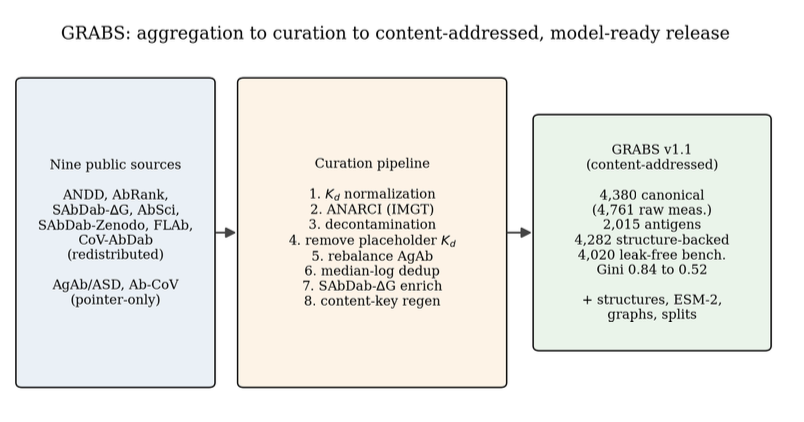
2. GRABS consolidates nine public sources into one schema; seven sources are redistributable and yield 4,380 canonical antibody–antigen records (median-collapsed from 4,761 raw measurements), each with paired VH/VL sequences, an antigen sequence, and an experimentally measured Kd (stored in normalized molar units and log10 space).
3. A key innovation is content addressing: every record’s artifacts are keyed by md5(VH+VL+antigen)[:10]. Structures, graphs, and feature vectors are joined by this content key rather than row order, making it hard to accidentally shuffle features away from the correct labels.
4. The integrity guarantee is auditable and non-circular: for 4,282/4,282 structure-backed records, graph node channels are decoded back into sequences and re-hashed, matching the filename content key (100% pass rate). ESM-2 embeddings are also validated by independent re-embedding (cosine similarity 1.000).
5. The dataset is “structure-ready”: for 4,282 records GRABS ships Boltz-2 predicted antibody–antigen complexes, per-residue ESM-2 embeddings (esm2 t33 650M, layer 33), geometric residue graphs (GVP-style), and a 2,616-dimensional per-complex feature vector, plus Boltz confidence metrics (iPTM/PTM/pLDDT).
6. Curation is a major contribution: records are filtered to keep only quantitative experimental affinity measurements (SPR/BLI/ITC/ELISA/curated literature), remove implausible Kd values (outside 1e-15 to 1e-2 M), validate and IMGT-renumber VH/VL with ANARCI, decontaminate mislabeled antigens (e.g., antibody domains), remove placeholder/threshold constants, and deduplicate repeated (VH,VL,antigen) triples via median log10(Kd).
7. GRABS explicitly addresses target concentration: after rebalancing/downsampling deep-mutational-scan-heavy sources, the per-antigen inequality drops (Gini 0.84 → 0.52). The most frequent antigen becomes HER2 at 16.6% of records (vs a single influenza hemagglutinin strain at 52% in the raw pool).
8. The benchmark is designed to be leakage-resistant: antigens are clustered with MMseqs2 (id ≥0.8, cov ≥0.8), and five-fold CV is grouped by antigen cluster so near-duplicate antigens are held out together. The “leak-free benchmark” subset contains 4,020 records spanning 1,752 antigens in 549 clusters.
9. A central validation result: a previously observed strong cross-target signal (pooled R2 ≈ 0.415) is shown to be an artifact from misalignment-mediated source/batch leakage in a positionally indexed feature store. With content-key regeneration, performance collapses (pooled R2 ≈ −0.2), indicating the earlier “generalization” was not real.
10. Under the leak-free antigen-cluster protocol, cross-target ranking of variants for a held-out antigen falls to the noise floor (within-held-out-antigen Spearman ρ ≈ 0) across model families (sequence, structure GNN, folding-confidence baselines). Predicted structure provides no advantage, and pooled correlations mainly reflect learning antigen-specific mean offsets rather than variant ranking.
11. The authors position GRABS for leakage-free benchmarking and within-target “measure-then-rank” affinity maturation workflows, not for zero-shot prediction on antigens absent from training. They also caution that predicted complex interfaces can be unreliable on truly novel complexes, recommending confidence-based filtering for interface-sensitive use.
📜Paper: https://t.co/MNv7emUkQH
#CompBio #Bioinformatics #MachineLearning #DeepLearning #Antibodies #ProteinEngineering #StructuralBiology #Datasets #Benchmarking #Reproducibility
STORM: A lightweight structure-free model for binding affinity prediction
1 STORM (Similarity Transfer from Observed Reference Molecules) is a structure-free binding affinity predictor designed to be fast enough for massive virtual screens and frequent updates as new experimental data arrives, without requiring 3D complex structures, MSAs, or heavy foundation-model embeddings.
2 The central idea is to exploit transferable “similar molecules → similar affinities” signals across targets by ensembling many small MLPs that each fuse different protein and ligand representations, rather than betting on one representation or one large model.
3 Model design: 15 independently trained early-fusion MLP components (about 20M parameters total) with a simple shared head; components get 1–2 “votes” in a weighted ensemble, and predictions can optionally be refined with an inference-time graph smoothing step based on ligand fingerprint similarity.
4 Inputs are intentionally lightweight and structure-free. Ligands use 9 RDKit/scikit-fingerprints feature sets (e.g., Morgan, RDKit path, atom pair, topological torsion, Avalon, pharmacophore, Klekota–Roth, PubChem, and RDKit/Mordred descriptors). Proteins use UniProt-linked annotations and identifiers (GO, InterPro, hashed target ID, species), plus a target-blind option.
5 Training objective combines (a) pointwise Huber loss on pActivity and (b) within-assay pairwise Huber loss on activity differences, normalized by assay variability. This explicitly trains the model to rank compounds within the same assay, aligning with practical prioritization use cases.
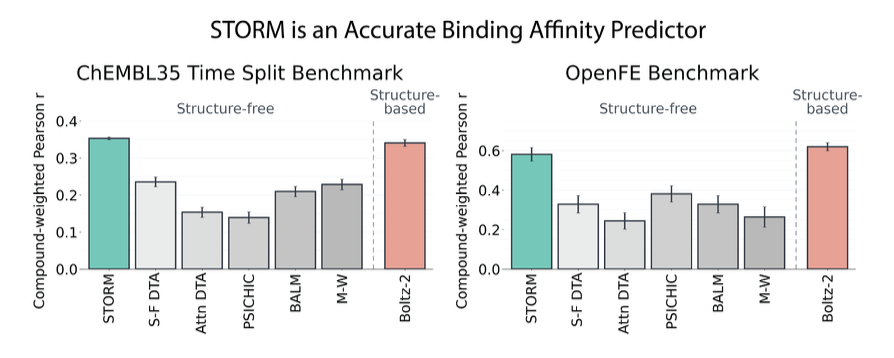
6 Benchmarking on four public evaluations (ChEMBL35 time split, OpenFE, FEP+4, CASP16): STORM outperformed five retrained structure-free baselines across all comparisons, and was comparable to (or better than) the cofolding model Boltz-2 in compound-weighted within-assay Pearson correlation.
7 Head-to-head with Boltz-2 (local matched evaluation): on ChEMBL35 time split STORM reached Pearson r ≈ 0.355 vs Boltz-2 ≈ 0.303, while on OpenFE/FEP+4/CASP16 correlations were broadly comparable. This suggests much of the affinity signal can be captured without explicit structure modeling for these benchmarks.
8 The compute gap is the practical point: STORM inference was timed at ~17.9 microseconds per prediction on an NVIDIA L4, versus ~45 seconds per ligand for Boltz-2 in a no-MSA timing configuration; STORM training finished in under half an hour on L4, versus an estimated ~270,000 L4-equivalent GPU hours to pretrain Boltz-2.
9 Ablations indicate the gains come from representation diversity and inclusion of protein features: a diverse 15-component ensemble beat 15 repeated fits of the strongest single component, and matched controls showed protein inputs and ligand-representation diversity materially improve ChEMBL35 performance.
10 Adaptation to new targets: target-specific fine-tuning (with L2-SP regularization) improved held-out compound correlation on all three targets tested that were absent from training, including a case (ALPK1) where ~80 support compounds moved performance from near-zero to substantially higher correlation.
📜Paper: https://t.co/Cmjg3zxlQU
#ComputationalBiology #DrugDiscovery #BindingAffinity #MachineLearning #Cheminformatics #Bioinformatics #VirtualScreening #QSAR #ProteinLigand #AIinScience

🎯 أنواع شرائح الجمهور:
الاهتمامات (Affinity):
مثل: محبي الجمال – المهتمين بالصحة – عشاق التقنية.
نوايا الشراء (In-market):
مثل: أشخاص يبحثون عن "عيادة أسنان" أو "زراعة أسنان".
القوائم المخصصة (Custom Segments):
تستهدف بها كلمات أو مواقع أو تطبيقات يزورها المستخدم.
البيانات الخاصة (Customer Match):
تستهدف عملاء سابقين بناءً على بياناتهم (إيميلات – أرقام).
الجماهير المشابهة (Similar Audiences):
أشخاص يشبهون عملاءك الحاليين.

What a film! I see why Speed had a particular affinity with this documentary. The parallels are insane. It was like watching @slipperrz tell a story of his time with Speed 50 years from now. W Speed
Haii,adakah yang cari?
Gitar Squier Affinity Series Telecaster (Slick Silver) + Ampilifier
5.5jt All In (Nego)
📍bandung
💌 yang mau bisa dm ya
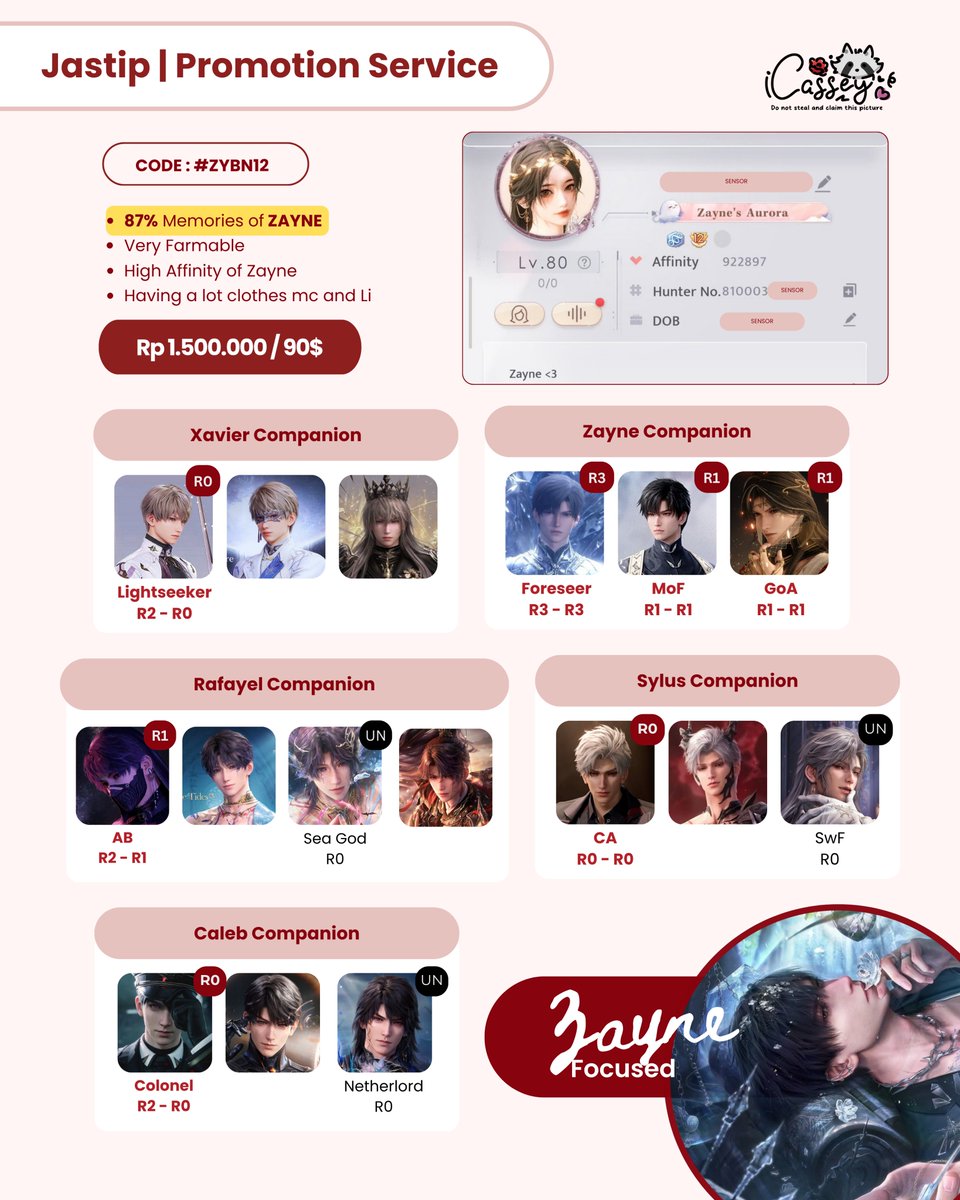
⋆. 𐙚 ˚𝐙𝐘𝐁𝐍𝟏𝟐 - #𝐖𝐓𝐒𝐋𝐀𝐃𝐒 𝐀𝐂𝐂 𝐙��𝐘𝐍𝐄 𝐅𝐎𝐂𝐔𝐒
── .✦ Memories 87% with Zayne, very farmable, high affinity of Zayne, having a lot clothes collection of MC and Li
Price : Rp 1.500.000 / 90$ 「 𝗡𝗘𝗚𝗢𝗧𝗜𝗔𝗕𝗟𝗘 」
➤ DM for details



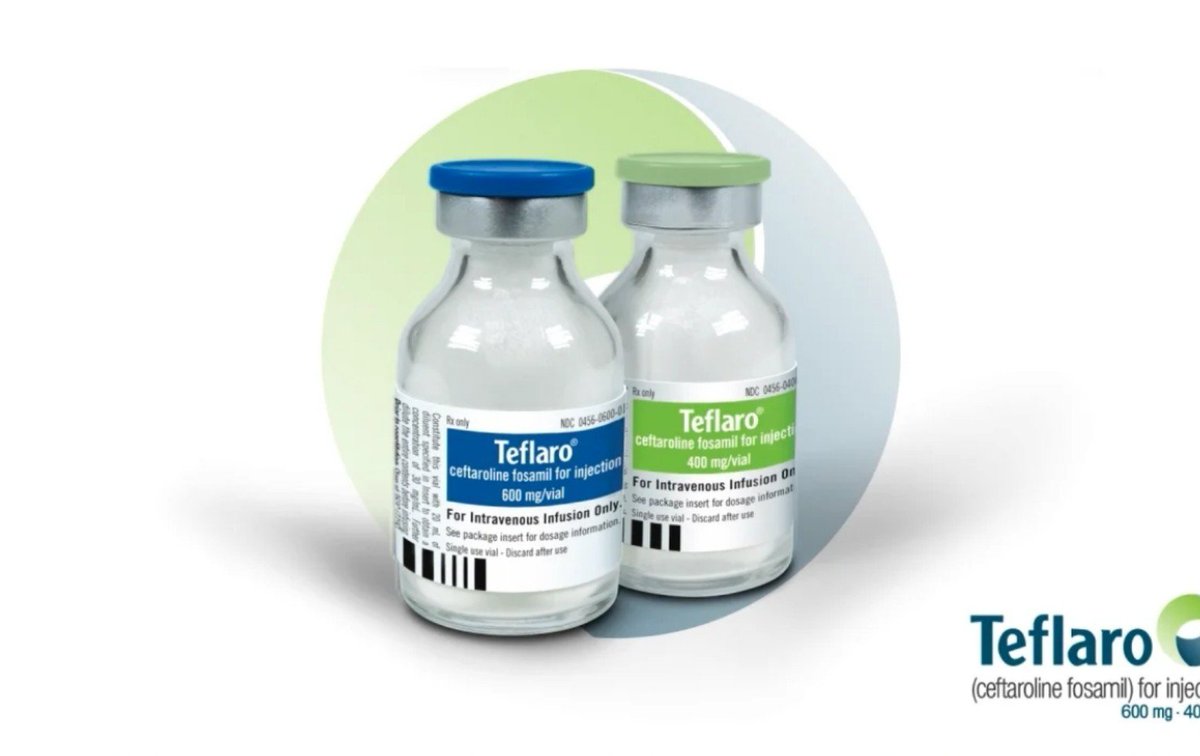
@karim_685 @d411w2 @raiban4185 @Madihealth2026 @kh505043 B) High binding affinity for PBP2a (as a fifth-generation cephalosporin, it uniquely targets and binds strongly to the altered penicillin-binding protein 2a found in MRSA, allowing it to inhibit cell wall synthesis).

https://t.co/ErFXS8z7Je does Ceftaroline uniquely achieve its coverage against MRSA?
A) Inhibiting protein synthesis (50S subunit)
B) High binding affinity for PBP2a ..
C) Disrupting the bacterial cell membrane
D) Blocking folic acid synthesis
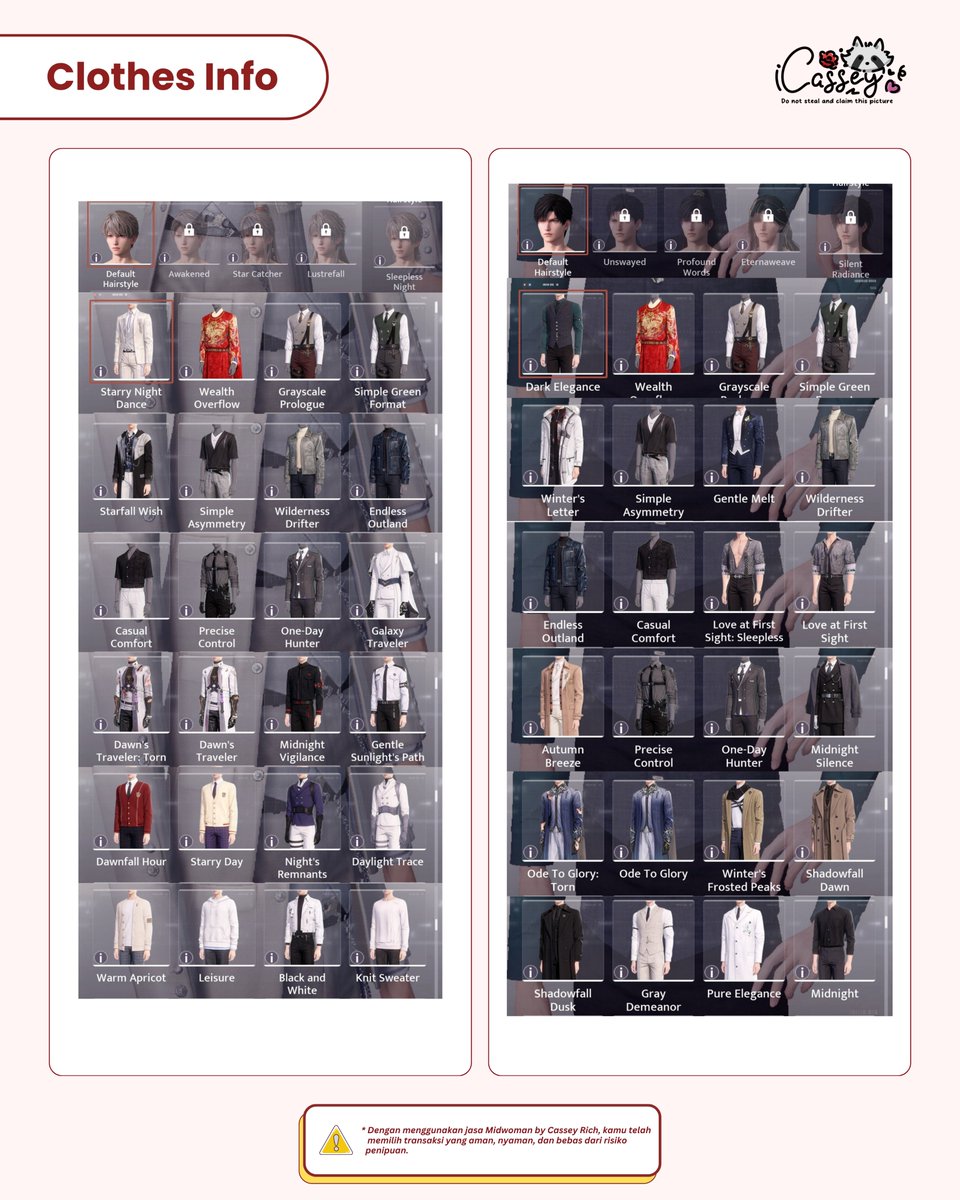
⋆. 𐙚 ˚𝐂𝐋𝐁𝐍𝟏𝟏 - #𝐖𝐓𝐒𝐋𝐀𝐃𝐒 𝐀𝐂𝐂 𝐂��𝐋𝐄𝐁 𝐅𝐎𝐂𝐔𝐒 (𝐒𝐄𝐌𝐈 𝐒𝐘𝐋𝐔𝐒)
── .✦ Memories 71% with Caleb, semi Sylus, affinity 100+ with Caleb & Sylus, having all standart myth
Price : Rp 800.000 / $45 「 𝗡𝗘𝗚𝗢𝗧𝗜𝗔𝗕𝗟𝗘 」
➤ Detail? Wa: 0881082899403



@Solarchi_ Affinity with Metal
1/1
https://t.co/jqqShOdPDV

Happy Sunday!
I created a video on YouTube on how to slice artboards in Affinity Designer
You can check it out
On my YouTube channel, I share tips on how to be a better designer.
https://t.co/22AS9YUhbl

Happy Sunday!
I created a video on YouTube on how to slice artboards in Affinity Designer
You can check it out
On my YouTube channel, I share tips on how to be a better designer.
https://t.co/22AS9YTJlN

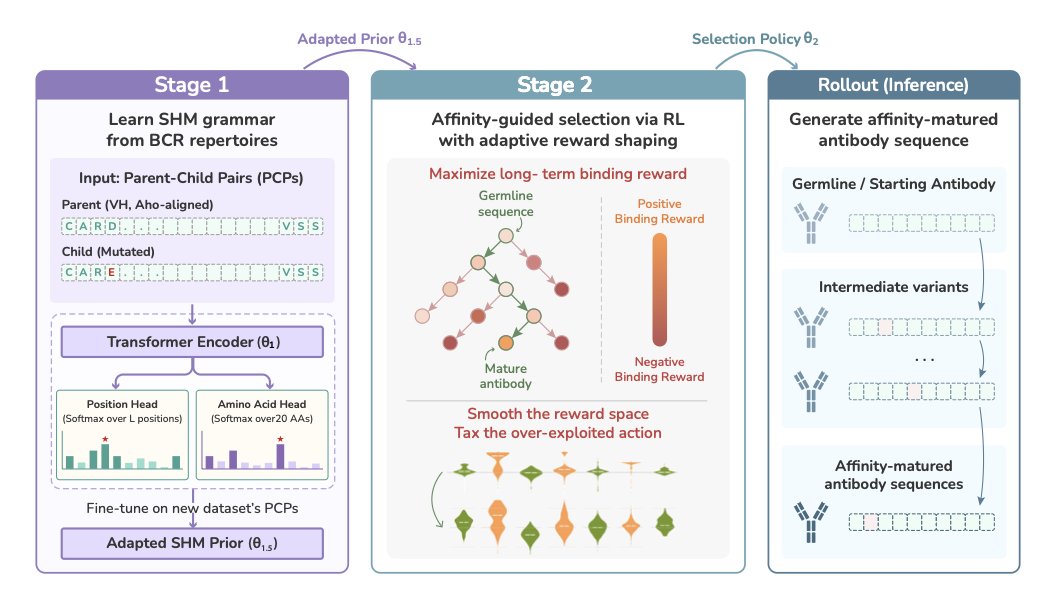
iGC: Antibody Optimization via Reinforcement Learning over a Learned Somatic Hypermutation Prior
1. The paper frames antibody affinity maturation as a sequential decision process and implements it as a two-stage system: learn how SHM generates mutations (a prior), then learn how selection favors antigen binding (an RL policy), while keeping the policy biologically plausible via KL regularization to the SHM prior.
2. Stage 1 (mutation prior): a Transformer is trained on parent–child mutation events from B-cell lineage trees to model single-step mutation actions (position, amino-acid substitution) conditioned on the full VH sequence (Aho-aligned). This full-sequence formulation targets “where to mutate” and “what to mutate to” jointly, capturing long-range context beyond k-mer hotspot models.
3. On SHM mutation prediction (Tang human BCR dataset, ~506k parent–child pairs), the learned prior more than doubles the strongest baseline on mutation-site prediction: pos@1 = 11.929% vs 5.307% (best baseline DASM mutation×selection). Joint top-1 accuracy (site+AA) is 4.864% vs 2.153% next best, indicating most gains come from better site targeting rather than substitution identity.
4. Stage 1 also includes domain adaptation to the target affinity-maturation dataset (GCReplay, mouse IGHV1-2 background). This reduces cross-species artifacts (notably a spurious FR4 bias from human-to-mouse J-gene shift) and improves alignment with empirical region targeting (e.g., FR4 argmax distribution drops near the empirical rate after adaptation).
5. Stage 2 (affinity-guided selection): the adapted SHM prior initializes an RL policy over single-mutation actions and remains as a frozen KL anchor. RL is trained offline on logged clonal trajectories with per-mutation binding rewards derived from deep mutational scanning (DMS), optimizing cumulative reward over multi-step rollouts under a fixed mutation budget.
6. A key issue addressed: direct optimization of raw DMS rewards causes policy collapse (overusing a few high-reward substitutions or drifting into “safe” framework mutations). The paper introduces Reward–Tax Meta-Gradient (RTMG): RewardNet learns a smoothed benefit signal from reward + context, while TaxNet learns a sequence-dependent penalty based on evolutionary prevalence and SHM accessibility; their difference defines a learned meta-reward.
7. RTMG is trained via a bilevel/meta-gradient setup: auxiliary networks (RewardNet/TaxNet) are updated through the effect of the meta-reward on a differentiable “probe” policy update, with constraints that preserve fidelity to measured binding signals and sequence-probability scores; the deployed policy is then updated with REINFORCE+KL using the detached meta-reward.
8. On GCReplay candidate generation (mutation budgets k=2..7), iGC targets a reward–diversity balance rather than reward alone. Compared to RL with raw reward (high reward but low diversity), iGC achieves the best or near-best reward×diversity (“Prod”) across top-N selection cutoffs (Top100/Top30/Top10 best; Top20 second-best), indicating less collapse while retaining strong affinity gains.
9. The final RL-tuned policy retains SHM hallmarks: 57.0% of iGC-predicted mutation positions fall in WRC hotspots (vs 2.0% random background), and predicted mutability remains correlated with the S5F SHM mutability model (Pearson 0.474). This supports the claim that KL-anchoring + RTMG can optimize binding without discarding SHM-consistent mutation structure.
10. Generalization test (held-out germinal centers): when entire lineage trees are unseen during training, iGC can exactly rediscover positive-reward sequences observed only in the test set—110 of 799 across k=2..4 (32.0% at k=2; 10.9% at k=3; 5.9% at k=4)—suggesting the policy is not purely memorizing training lineages.
📜Paper: https://t.co/UZvthbV5Zf
#ComputationalBiology #AntibodyEngineering #ProteinDesign #ReinforcementLearning #Immunology #MachineLearning #DeepLearning #SHM #AffinityMaturation

@VeteszHub One of the most beautiful women ever rendered in a game; she shares an affinity with Shadowheart from Baldur’s Gate that makes her incredibly sweet and irresistible. Truly a great choice.

What Elon is expressing is the wide ranging White European stock's affinity to Nazi ideology and justifying its actions because "Jews wronged them".
This is supremacy and simultaneously puts them in a position to be tools for Zionism living out the caricature drawn out for them.

Elon Musk posted this AI-generated image of Anakin, Padmé, Luke, and Leia ruling the Galactic Empire with the caption, "This is what they stole from us."
And I have to ask, what the fuck does that even mean?
Apparently, there's a growing trend called "Anakin-posting," where people use Anakin Skywalker to express frustration with institutions, authority, and feeling betrayed by the system. Which, okay, I can understand that interpretation of the character. Anakin was absolutely manipulated and failed by people he trusted.
But coming from Elon Musk? The richest man in the world? A guy who owns one of the largest social media platforms, runs multiple massive corporations, and has enormous political influence? Buddy, you're not some helpless kid being screwed over by the establishment. You're practically the establishment itself.
And there's something especially weird about using Anakin for this argument because Star Wars is pretty fucking clear about what happens when someone allows fear, anger, and resentment to consume them. Anakin doesn't overthrow a corrupt system and liberate the galaxy. He helps establish an even more oppressive one.
So I'm back to my original question. What exactly does Elon think was stolen from him? Because the image he's celebrating is literally a family sitting on the throne of a fascist Empire.


@TriggerCoder @themerit0crat @MoneroOcean Better to explain the actual constraints to let people make an informed decision. RandomX relies on dynamic code execution, hardware AES & large dataset (light mode skips it but runs slower). WASM = no native JIT, AES or FP rounding & no huge pages or thread affinity. Inefficient
Bioactivity foundation model for hit identification and hit-to-lead optimization from sequence data
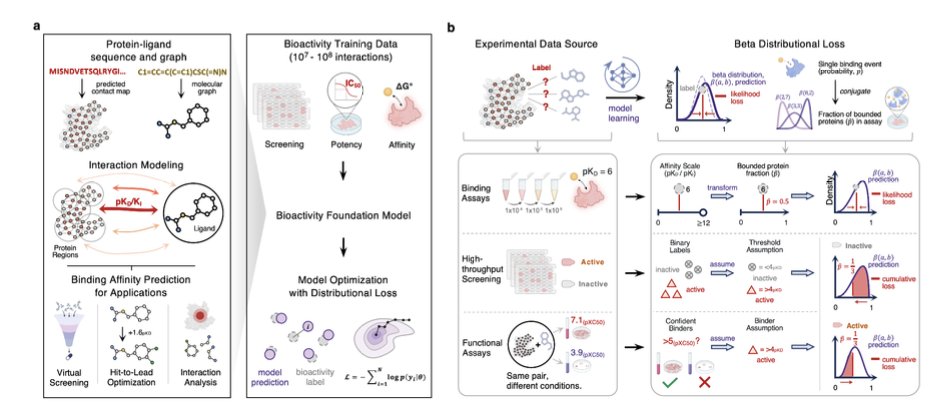
1. The paper presents PSICHIC+, a sequence-first bioactivity foundation model that predicts a full probability distribution (a beta distribution) over binding affinity from only protein sequence and ligand SMILES, enabling learning directly from large, heterogeneous bioactivity archives rather than relying on curated-only regression sets or binarized classification labels.
2. Core technical idea: distributional learning unifies mixed supervision types. Exact Ki/Kd values are mapped to a normalized 0–1 activity scale and trained via beta likelihood, while binary/thresholded evidence (IC50/EC50-derived labels, HTS active/inactive calls, and synthetic negatives) trains the probability of exceeding an activity threshold using the beta CDF—so coarse labels provide signal without forcing artificial point estimates.
3. PSICHIC+ is trained on ~82 million protein–ligand records (Papyrus-derived), spanning ~4,900 proteins and ~6.1 million ligands, plus multiple sources of negatives (model-generated decoys, ZINC20 decoys, and cross-target negatives based on low Foldseek similarity). This scale is used to build a single model intended for broad zero-shot deployment.
4. A key robustness mechanism is source-aware reliability modeling through concentration regularization. The model outputs both an expected activity and a concentration parameter (κ = α + β) that controls distribution width; κ is softly constrained by data-source “quality tiers” so noisy sources (HTS labels, synthetic negatives) are discouraged from producing overconfident (too-narrow) distributions.
5. Zero-shot hit identification (no target-specific training) improves early enrichment on virtual screening benchmarks. Under a 90% sequence-identity exclusion protocol, PSICHIC+ outperforms PSICHIC regression and classification variants on DUD-E and DEKOIS 2.0, with the biggest gains in early-retrieval metrics (e.g., DUD-E EF5% 13.3 vs 5.6 for regression and 10.8 for classification; BEDROC 0.51 vs 0.10 and 0.34).
6. Despite using only sequence/SMILES, PSICHIC+ is competitive with (and on DUD-E, exceeds) a large set of structure-based virtual-screening pipelines, highlighting a practical regime where structure-free, high-throughput scoring can match docking/scoring workflows when structures are missing or throughput dominates.
7. For hit-to-lead optimization (analog ranking), PSICHIC+ provides both a point estimate and a usable confidence proxy: prediction error increases as concentration decreases (reported Pearson r = 0.52 between error and inverse concentration), making κ a practical triage signal for deciding which designs merit synthesis/assay or more expensive computation.
8. On FEP-style benchmarks (JACS and Merck; 16 target assays), PSICHIC+ achieves mean Pearson r ~0.52 at ~1.34 ms per protein–ligand pair on an A100 GPU; Boltz-2 reaches ~0.60 but at ~20 s per pair. The paper argues this creates a distinct accuracy–throughput operating point for library-scale screening and rapid design iteration.
9. The work also introduces a concentration-modulated PSICHIC+–Boltz-2 ensemble: PSICHIC+ contributes more when its κ is high and less when κ is low. This raises mean correlation to ~0.68, approaching FEP+ (~0.74) on the evaluated benchmarks, while avoiding the need for high-resolution protein structures and remaining far cheaper per pair than physics-based workflows.
10. In lab-in-the-loop simulations (iterative propose–label–retrain) on Mpro, USP7, D2R, and TYK2 with a fixed budget (e.g., 360 labels), distribution-guided acquisition (greedy or UCB using mean and beta standard deviation) recovers more top-1% compounds than RF/MLP/GP baselines in most settings; for USP7, iterative retraining improves top-hit recovery from 35.6% (static zero-shot) to 64.4% under the same budget.
📜Paper: https://t.co/y8KX7EeXmc
#ComputationalBiology #DrugDiscovery #MachineLearning #Bioinformatics #VirtualScreening #ActiveLearning #FoundationModels #ProteinLigand #Cheminformatics #AIforScience

@logorn_gadum So we get to play as H4 Elites.
Just not in H4. I can’t be too mad about that because Certain Affinity was behind H2A MP so they probably wouldn’t have had as much resources as 343
Last Seen Hashtags on Sotwe
Most Popular Users

Elon Musk 
@elonmusk
240M followers

Barack Obama
@barackobama
118.6M followers

Cristiano Ronaldo
@cristiano
114.4M followers

Donald J. Trump
@realdonaldtrump
111.7M followers

Narendra Modi
@narendramodi
106.9M followers

Rihanna
@rihanna
98.6M followers

NASA
@nasa
92.1M followers

Justin Bieber
@justinbieber
91.7M followers

KATY PERRY
@katyperry
89.9M followers

Taylor Swift
@taylorswift13
83.9M followers

Lady Gaga
@ladygaga
75.4M followers

Virat Kohli
@imvkohli
73.3M followers

Kim Kardashian
@kimkardashian
70.8M followers

YouTube
@youtube
68.6M followers

Neymar Jr
@neymarjr
66.3M followers

Bill Gates
@billgates
65.2M followers

Selena Gomez
@selenagomez
63M followers

The Ellen Show
@theellenshow
62.1M followers

CNN
@cnn
61.7M followers

X
@x
60.6M followers