Quadot-Arena (#Quake3 /#QuakeLive + #GodotEngine) Latest Alpha Release is here, feel free to try it out:
https://t.co/34TrXGRWD1
Thanks everyone for testing it, and especially all of you that gave me those lengthy feedback (and videos). Those are the best!
Done in #Godot4
People don't realize that so many layers of pixel shaders with discard is a BAD idea for mobile TBDR GPUs. No GPUs really love discard...
Also if you do this, be sure to render all opaque geometry first. Then render everything with discard, last everything with alpha blend.
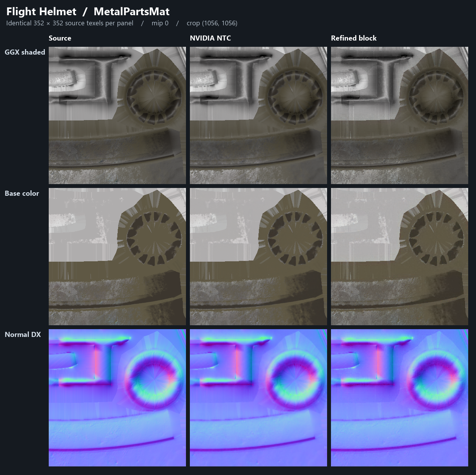
My neural material prototype is now quite close to Nvidia NTC in quality and runs 3.7x faster on Intel XMX cores (both using int8 tensors). 13x compression ration in both. Seems promising. Especially if I do a DP4a version for mobile phones.
Fun fact: I’m implementing <https://t.co/E9nrGI73fx>, a verified MLIR dialect of Timbda-0, “Core Verse,” a highly non-trivial exercise, entirely with qwen3.8-flash-next on my laptop.
From 11 MB with Godot to just 1.45 MB with Defold! 📉
That's an ~87% reduction in build size while still using a full-fledged game engine and building the same game.
This nice experiment showcases why it's so important to choose the right tool for the job.
The developer of Attune eventually went even further, rewriting the game from scratch using just TypeScript and WebGL2.
If you don't need an engine or editing tools, explore what you can achieve with code alone. For larger or more complex games, consider frameworks or game engines with the tools that suit your needs.
There's no one-size-fits-all solution in game development. Luckily, there are plenty of great options.
But if size matters, Defold is hard to beat among engines! 😉
#indiegames #indiedev #gamedev #Defold
ON THIS DAY (November 22, 2011), about 7 years after the game's release, John Carmack releases the source code of the original release of Doom 3, formally referred to as the idTech 4 source code.
#DOOM
A glimpse into the modern #IdTech engine.
This interview doesn't include an engine programmer, but it's still insightful #Engine#gamedev#AAA
https://t.co/Ph0rqzmsGr
LUT is not always a win anymore. ALU has grow much faster than MEM. Especially big LUTs (cache miss) can be slower today than equivalent code with pure ALU. Benchmark old LUT optimizations against modern AVX2 code before committing. Results might be surprising.
New diagram of SDF brick rasterization / ray-marching:
- The yellow contour is the reconstructed surface from SDF samples (cached sparsely in bricks)
- The bounds (AABB) of each brick are rasterized, and then the surface is ray-marched in the fragment shader (via ...
1/
Here's another neural rendering demo for LightweightVK: order-independent transparency.
All of Bistro drawn transparent, 3 ways:
- A-buffer (reference)
- Weighted blended OIT (coarse approximation)
- DFAOIT (CGF 2024): an int8 network as a VK_ARM_tensors/VK_ARM_data_graph or bit-exact VK_KHR_cooperative_matrix. Well...it's four😀
It keeps the 4 nearest fragments of a pixel exactly and the network predicts only the tail behind them: 10x lower error on Bistro than the paper's weights.
The initial demo was made by @rokuz7 and then refactored by me. Porting VK_ARM_data_graph to cooperative matrix was done 100% via Claude (see subsequent commits).
https://t.co/Ty5APImrFg
@dankbaker (Oxide) had nice talks about their fully decoupled texel space shading system. Solves these sampling issues, but has a substantial added cost and complexity. I did a similar proto back in the day.
Paper:
https://t.co/8wgfXCfpAa
REAC23 slides:
https://t.co/qrPwWEeFfy
Dream of creating SNES games?
Over the past week, I've been diving into #snesdev and refining a tutorial along the way.
In 4 short lessons you can go from "HELLO WORLD" to a full SNES game, complete with mouse input, HDMA, color math, and more!
https://t.co/A5kUXNhWOy
Why u should be worlds stupidest person to understand quantum mechanics. Watch my video to learn how did I become one of the greatest stupids in the planet earth
https://t.co/NOpzJMnIKk
We need some crowdsourced help! We're hoping to go to the NVIDIA GTC in DC on Dec 1-3, coinciding with some of the NVIDIA/Jensen committee hearings. If anyone wants to say hi, we'll be out there. We will likely be trying to get some people on camera to talk about thoughts on tech policy, AI policy, data centers, and NVIDIA broadly. Don't hesitate to say hi if you see us at the event, especially if you might be interested in these types of conversations on camera. We're trying to crowdsource some more real-world opinions from actual, normal, non-ExecuLizard people who aren't just CEOs of huge AI companies, so always great to have more voices.
Likewise, if you are someone who has access to non-public information that may be useful for consumer protection purposes, don't hesitate to email us and we can arrange an anonymous way for you to deliver that information.
Orch OR doesn’t need tens of milliseconds of quantum coherence. We said that in early papers but after @anirbanbandyo discoveries we changed and rely on faster, briefer quantum coherence times, e.g, 8 nanoseconds in Kalra paper with interference and slowing into physiological range like EEG, Orch OR can thus account for EEG rhythms which are otherwise not understood.
You’re welcome.
@WojteksGrandson Nvidia had a market cap larger than every county's GDP except China and the US. They're hyping IPOs of companies that have more that twice the losses as total revenue. Dude. Come on.