@matiasgoldberg To be fair, this is assuming completely naive tick state transmission, i.e. no compression, every object interpolating every frame, and so on. Obviously no familiarity with their engine and problem but in general you can really shrink that down in practice.
@WickedMcCat@Jonathan_Blow@TimSweeneyEpic@RyanYanBuilds Maybe this simplifies down in a way I don't really understand, but my intuition is that this wouldn't stop at the root level, and you'd need verification of every dependency and so on. But that might not make any sense. This is why the video would be helpful!
I would appreciate such a video, because my intuition is that—potential proof checking bugs aside—you’d still need to verify that the expressions correspond to what you are intending to actually prove. Or, in other words, the proof checking will successfully check the proof, but it can’t check that the proof itself was expressing the intended concepts correctly.
I agree.
I think a lot of the folks in the "software is solved" camp aren't being bold enough.
If you try to do something really really difficult, well beyond what anyone has previously achieved in the field, you'll see the limitations and opportunities clearly.
Doing some old-school skeletal animation programming with Maria on YouTube/Twitch right now! Come join us:
https://t.co/X9znvjzEFj
https://t.co/YpxJC1RGwo
not trying to be a hater but this is actually a negative signal to me when i'm buying something on facebook marketplace
my brain actively looks for the amateur photos because they make me feel like i'm dealing with an actual human being and not a business or a scammer
the more polished a listing looks the less i trust it
Re "accessibility issue", look, some games just need to be able to do what they are trying to do without people bitching about it all the time. Blind people can't play the game either, is that an accessibility issue? If what you are saying is "you cannot do thing X in your game because then some hypothetical person in the world cannot play it," then the logical conclusion of this is that we will have no video games at all.
Redundant state is another undefeated fault mode of LLM-generated code. AI adds it and then has to keep it in sync, because LLMs are overtrained on slow interpreted web languages, where computing derived state from source data is often expensive.
This is a much bigger problem than its tendency to handle theoretical edge cases, because fail to sync such state is a very common source of bugs.
And there's not much you can do about it. Claude will just ignore direct instructions, and today I had a case of review agent missing it too, which makes it super frustrating. Do you need a review agent for your review agent, or how does it work?
How do I stop Claude (and other LLMs) from doing this - handling edge cases that are impossible and bloating the code.
What I've tried already:
- "don't handle impossible edge cases"
- "if you can think of an impossible edge cases - assert instead of handling it".
It just keeps ignoring both instructions.
Is this an instruction for adversarial code review aka Token Burner 3000?
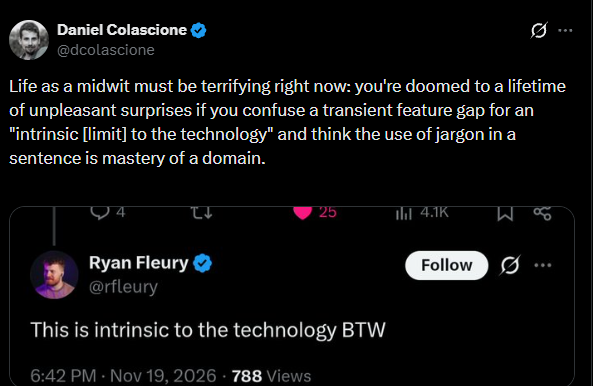
It is "midwittery" to restate ~research consensus (or at least one of several popular views) about obvious limitations of present-day LLM-based AI architecture w.r.t. rigorously solving for constraints (which they do not), which persist to this day, and that they are not arbitrarily generalized intelligence.
Non-thinking and psychotic
Importantly, my point was not that "there is no architecture such that rigorous constraints are satisfied", nor even that such architectures would not employ an LLM somewhere, it was *merely* that current LLM-based systems do not sufficiently satisfy that definition.