

Top Tweets for #authentication

No API keys, separate authentication, or headless browser session.
I also ran the same prompt through my bridge and Antigravity's browser subagent.
Where my bridge took 41 seconds, for the same task the Browser subagent took around 94 seconds.
4/5

Do not reproduce this against production. Validate remediation through installed-release checks, normal authentication behaviour, and a review of access paths to the management plane.
The mechanism is unusually clean: cookie parsing can turn authenticationToken=j:%7B%7D into an empty object, while the XO token provider does not require a string.
CVE-2026-133469 is actively exploited and sits at the Xen Orchestra authentication boundary. For authorised testing, start by scoping reachable management endpoints and deployed releases.

Inventory every management deployment, restrict access to intended operator networks, and review unusual authentication or administrative activity around the patch window.
The flaw is an authentication type-validation failure. REST cookie parsing can convert authenticationToken=j:%7B%7D into an empty object instead of a token string.

@abhi15724 Skipping authentication feels reckless, even in sprint mode.

Vibe coding is fast. Security shouldn't be an afterthought.
Before shipping:
• Validate every input.
• Secure API keys and secrets.
• Add proper authentication.
• Enforce database permissions.
• Test for vulnerabilities.
Build fast. Ship secure. 🔐

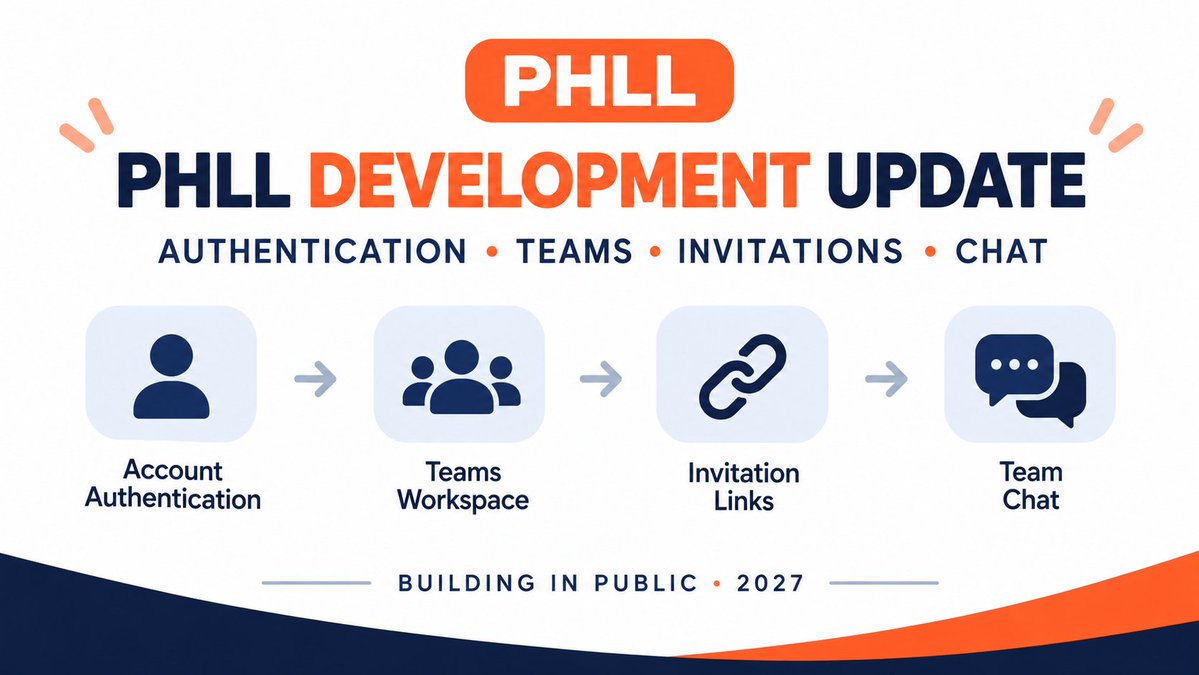
Product Hunt Launch Lab – Development Update
Another productive day working on PHLL!
Today, I focused on building and testing the account system and one of the important parts of the platform: Teams & Collaboration.
Here's what I accomplished:
🔹 User Authentication
Account registration and email confirmation flow.
User login and logout.
Dashboard access after authentication.
🔹 Team Management
Create a new team.
Automatic team owner membership.
Generate invitation links.
Allow new users to join teams through invitation links.
🔹 Team Chat
Successfully tested team messaging.
Team members can join a workspace and communicate through chat.
🔹 Testing & Fixes
Tested the complete journey from account creation to joining a team.
Fixed an issue with team creation.
Successfully tested invitation acceptance and team communication.
What's next?
The core functionality is working, but there's still room for improvement.
I'm now focusing on:
Making team invitations simpler.
Improving the overall Team Workspace design.
Creating a more professional and responsive experience.
Improving invitation management and the onboarding flow.
I'm following a simple approach:
build, test, identify problems, and improve before moving forward.
PHLL is still under development, and I'm sharing selected progress as I build it.
The goal remains the same:
create a useful platform that helps Product Hunt Makers prepare, launch, promote, and grow their products.
More updates coming soon!
#ProductHunt #ProductHuntLaunchLab #PHLL #BuildInPublic #SaaS #IndieHackers #WebDevelopment #MakerCommunity #StartupBuilding

When implementing authentication flow of refresh tokens and access tokens in a react native app, is it safe to store refresh tokens in expo secure store🤔?
#appDevelopment #reactnative


SETTLE progress update.
The foundation is taking shape.
- Lovable Cloud connected.
- Authentication configured.
- Private database tables created.
Next: fixing build errors, building the workspace and integrating the five core features.
#BuildInPublic

Linux server security starts with good practices.
Here are 4 important steps:
1. Keep your system updated.
2. Use SSH key authentication.
3. Configure a firewall.
4. Monitor server activity.
How do you secure your Linux servers?
#LinuxSecurity #SysAdmin

Authentication service handles user authentication.
Payment service manages payment operations.
Different teams can work on different services independently, making development and maintenance more flexible.
easier to build and manage, but as the application grows, maintaining, debugging and scaling it can become complex.
For example, authentication, product management, orders, payments, and other functionalities are managed within one application.

Debugging would make you go from 401 to 403 to 201😭💔
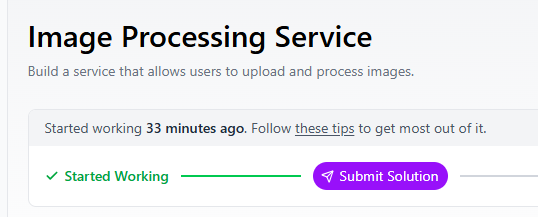
Today, I built the authentication foundation for my image processing service with Spring Boot
Worked on user entities, repos, DTOs, service logic, BCrypt password hashing and the reg endpoint
Also got a practical lesson in Spring Security and how easily configuration issues can block an otherwise working endpoint.

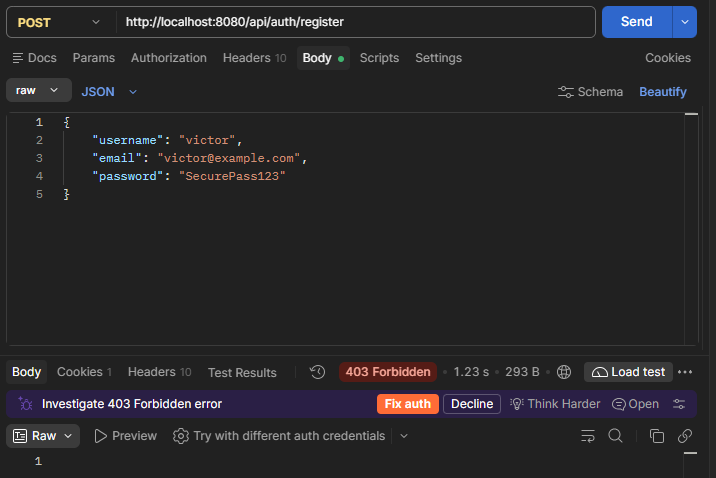
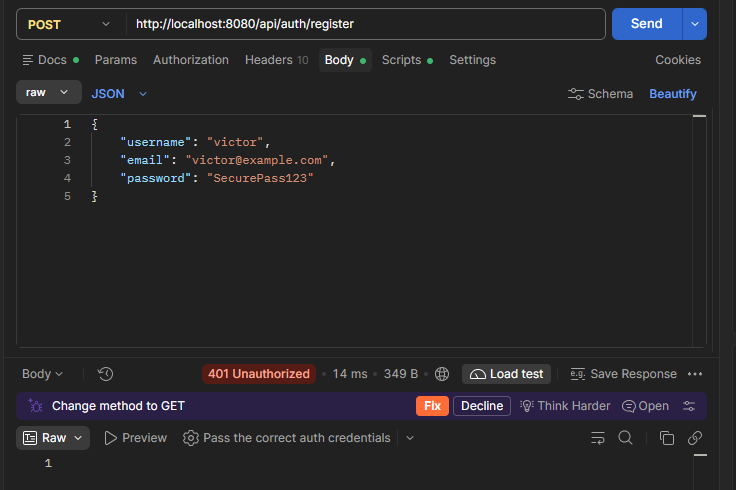
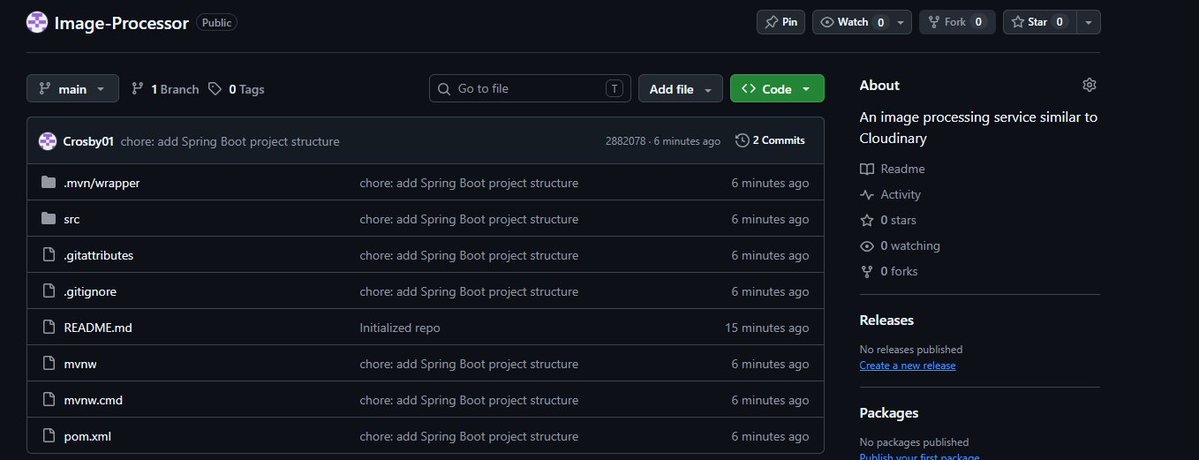
Working on my final intermediate project! It's an image processing app (like Cloudinary)
Also I just realised I haven't contributed very much to my GitHub at all despite coding almost every day for 7 months, but only pushed when projects are complete
Time to change that and LARP max!😂💔

Review administrative and authentication activity around systems in scope. Unexpected privileged access, undocumented configuration changes, or unusual management routes should enter incident triage.
CVE-2026-123890 is an authentication bypass in VMware Directory Service for vCenter. CISA added it to KEV on 2026-11-20 and lists it as exploited in the wild.
Still relevant today. CVE-2026-123890 is an authentication bypass in VMware Directory Service for vCenter. CISA added it to KEV on 2026-11-20 and lists it as exploited in the wild.
The operational impact of an authentication boundary failure is concentrated authority: management visibility and privileged actions become the priority. Segment access while remediation is being scheduled.
CVE-2026-123890 is an authentication bypass in VMware Directory Service, and CISA lists it as exploited in the wild. For defenders, the question is which management paths can reach the vCenter control plane.
Still relevant today. CVE-2026-123890 is an authentication bypass in VMware Directory Service, and CISA lists it as exploited in the wild. For defenders, the question is which management paths can reach the vCenter control plane.

@gabrielxoo Worth adding @tiun_io to the list too. We’re building an integrated platform for SaaS founders with payments, Merchant of Record, billing and authentication

Where do you keep authentication? Backend or frontend?

@Bhushan_Codes Stateless doesn't mean CSRF-proof. It depends on how authentication is handled, especially cookies vs bearer tokens.

Privacy Layers in the Age of Quantum Computing: How Should Rialo Prepare for the Future?
Privacy in blockchain is about much more than simply hiding transaction records.
It involves protecting personal financial information, corporate data, and sensitive authentication details while still allowing authorized parties to verify what they need.
This is one of the reasons why privacy is becoming an increasingly important part of blockchain infrastructure, and why Rialo's approach to native privacy is worth exploring.
But there is one important question we should ask:
Will today's encryption technologies remain secure in the future?
1. How Quantum Computing Could Change the Future of Cryptography
Most blockchains today rely on cryptographic technologies such as public-key cryptography and digital signatures to maintain security.
For example, Elliptic Curve Cryptography (ECC) plays a fundamental role in several major blockchain ecosystems, including Bitcoin and Ethereum.
However, the emergence of sufficiently powerful quantum computers could change the security landscape.
Shor's Algorithm is a quantum algorithm capable of efficiently solving mathematical problems such as integer factorization and discrete logarithms.
This creates a potential threat to widely used cryptographic systems such as RSA and ECC.
For blockchain networks, the consequences could be significant.
Public keys are used to verify transactions, while private keys prove ownership and authorize asset transfers.
If the cryptographic foundations behind these systems become vulnerable, the consequences could extend beyond privacy breaches to the security of digital assets themselves.
Of course, today's quantum computers are not yet capable of carrying out these attacks at a practical scale.
But the important point is that preparing for tomorrow's security threats must begin today.
2. View Keys and the Future of Privacy
One interesting concept in privacy-focused blockchain systems is the View Key.
In general, a View Key allows users to selectively share access to specific information, such as transaction history or account balances, without giving others the ability to control or transfer their assets.
In simple terms, it separates the ability to view information from the ability to move funds.
Imagine a situation where a user wants to keep their financial activity private while allowing a specific institution to review certain transaction records.
This approach could make it possible to balance personal privacy with requirements such as auditing, regulatory compliance, and financial transparency.
However, an important question remains:
Will the cryptographic foundations behind View Keys remain secure in a future shaped by quantum computing?
If a system relies on cryptographic mechanisms vulnerable to quantum attacks, its key management and access-control architecture may eventually need to be redesigned.
Privacy technology should not simply focus on hiding information today.
It should also consider how that information can remain protected in the future.
3. Could Post-Quantum Cryptography Be the Answer?
One potential solution is Post-Quantum Cryptography (PQC).
PQC refers to cryptographic algorithms designed to remain secure against attacks from both classical and sufficiently powerful quantum computers.
Interestingly, this technology is no longer just a theoretical research topic.
In August 2024, the US National Institute of Standards and Technology (NIST) officially published three major post-quantum cryptography standards:
ML-KEM (FIPS 203): Designed for secure cryptographic key establishment.
ML-DSA (FIPS 204): A digital signature algorithm.
SLH-DSA (FIPS 205): A hash-based digital signature algorithm.
These standards represent an important milestone in preparing digital infrastructure for the quantum era.
For blockchain ecosystems, however, replacing existing cryptographic systems overnight would be extremely challenging.
A more practical approach could involve a gradual migration strategy.
For example, networks could initially adopt hybrid cryptographic systems that combine existing algorithms with post-quantum alternatives.
Over time, they could transition toward quantum-resistant infrastructure while maintaining compatibility with existing applications and users.
4. What Could This Mean for Rialo?
Rialo has presented an approach that aims to integrate privacy into the network's underlying execution architecture rather than relying entirely on external middleware.
One particularly interesting component is Rialo Extended Execution (REX).
REX explores protected execution environments where sensitive inputs and intermediate computation data can remain shielded from external exposure while producing verifiable results.
This type of architecture could be especially valuable for applications involving financial information, enterprise data, and sensitive authentication credentials.
However, there is an important distinction to make.
Rialo's publicly available technical descriptions do not establish the specific cryptographic algorithms used by its View Key system or confirm an existing implementation of post-quantum cryptography.
That makes the following questions particularly important for its long-term development:
1. Cryptographic flexibility
Can Rialo's existing cryptographic architecture support the replacement of vulnerable algorithms with quantum-resistant alternatives?
2. Secure key migration
Can View Keys and data-access permissions be safely migrated to new cryptographic standards?
3. Backward compatibility
Can existing applications and encrypted data remain accessible and functional during a transition to new security mechanisms?
4. Long-term execution security
How can protected execution environments and cryptographic verification mechanisms adapt to future security threats?
These are important considerations for any blockchain that aims to make privacy a fundamental part of its infrastructure.
Final Thoughts
Quantum computing may not become an immediate threat to blockchain security tomorrow.
However, the data we create today may still hold significant value many years from now.
Encryption technologies that are considered secure today may eventually require stronger alternatives as computational capabilities evolve.
The next generation of blockchain infrastructure will not compete solely on transaction speed or scalability.
It will also be judged by how effectively it can protect sensitive information over time, selectively disclose data when necessary, and adapt to changing cryptographic standards.
How long can a network protect our data? How much control can users retain over their own information? And how prepared is its architecture for the next generation of security threats?
I believe these questions will become increasingly important in the future of blockchain privacy.
And it will be interesting to see how Rialo's vision for native privacy and protected execution evolves to address the security challenges of the quantum era.
@RialoHQ @RialoKorea @silverwave1000

Review administrative and authentication activity around systems in scope. Unexpected privileged access, undocumented configuration changes, or unusual management routes should enter incident triage.
CVE-2026-123890 is an authentication bypass in VMware Directory Service for vCenter. CISA added it to KEV on 2026-11-20 and lists it as exploited in the wild.

The operational impact of an authentication boundary failure is concentrated authority: management visibility and privileged actions become the priority. Segment access while remediation is being scheduled.
CVE-2026-123890 is an authentication bypass in VMware Directory Service, and CISA lists it as exploited in the wild. For defenders, the question is which management paths can reach the vCenter control plane.

Most Popular Users

Elon Musk 
@elonmusk
239.8M followers

Barack Obama
@barackobama
118.6M followers

Cristiano Ronaldo
@cristiano
114.3M followers

Donald J. Trump
@realdonaldtrump
111.7M followers

Narendra Modi
@narendramodi
106.9M followers

Rihanna
@rihanna
98.6M followers

NASA
@nasa
92.1M followers

Justin Bieber
@justinbieber
91.7M followers

KATY PERRY
@katyperry
89.9M followers

Taylor Swift
@taylorswift13
83.9M followers

Lady Gaga
@ladygaga
75.4M followers

Virat Kohli
@imvkohli
73.3M followers

Kim Kardashian
@kimkardashian
70.8M followers

YouTube
@youtube
68.6M followers

Neymar Jr
@neymarjr
66.3M followers

Bill Gates
@billgates
65.1M followers

Selena Gomez
@selenagomez
63M followers

The Ellen Show
@theellenshow
62.1M followers

CNN
@cnn
61.7M followers

X
@x
60.6M followers