

Top Tweets for #blobcore

Ahead! A Bright Future!
SKULLi
&
Darla the Starla
The adventure no one asked for, on Planet
#Neonika !
#NeonikaABrightFuture #SkulliBranden #OziBones #DarlaTheStarla #Blobcore #3D #art #artfight2025 #smallartist #originalcharacter #oc #Plantale #cartoon #comic








"Holy Neurogenesis Batman,☝️that was BLOBtacular!
Sounds Blobby enough to be a BLOBologist for the #BLOBcore of 🫡engineering. Thats @btc_substance!" ~@spiritzero 😂

As a fellow generative THREE.js coder, I wanted to take some time to highlight some of the INCREDIBLE tech advancements that have made BLOBS possible! This stuff is seriously insane and impressive, it's been very fun to dig into.
While I use the vanilla THREE.js libraries inscribed by @OnChainMonkey, BLOB is built with React Three Fiber, which is similar in concept, but uses libraries inscribed by the BLOB team @nurorealm @Elocremarc, @boppleton and many others. There is a very impressive web of recursion happening behind the scenes to make this art render to quickly and efficiently.
So, what is the primary BLOB (named "Blobby") from each piece made of? In short, it's a Sphere (created with SphereGeometry) of size 1, that is split into 32 segments of both height and width.
So, how does Blobby move and change shape/color? Each pair of nearby width/length segments meet to create Vertexes, which are then manipulated by the GLSL Shader code under the hood.
GLSL is a high-level language for controlling shaders and graphics. In THREE.js, we apply GLSL to an object by adding a ShaderMaterial to it. In short, this Shader code has to answer this question:
"For each vertex/point on the object, how should it's position be manipulated, and what color should it be?"
To manipulate Position, we supply what's called a "Vertex Shader". And to manipulate Color we supply a "Fragment Shader".
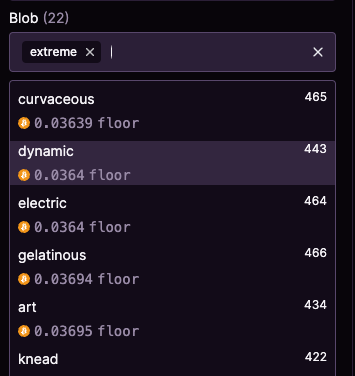
When you look at a blob listing, you'll see a few attributes. For each "Blob" value (ex. extreme, curvaceous, gelatinous, etc) the team has created a Vertex Shader that determines how each point should be manipulated over time.
Likewise for each "Skin" value, there's a corresponding Fragment Shader GLSL segment.
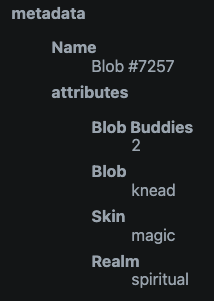
- Lets look at my blob specifically. Blob 7257:
- Mine has the Knead Blob type, which takes the X,Y and Z position of each point, and distorts their values based on a Sine curve, evolving over time.
- For the Skin, mine uses Magic which calculates several different color values based on the elapsed time & positions, and combines them with trig to create beautiful, colorful patterns across the surface.
There's dozens of Blob and Skin types, which are driven by THOUSANDS of lines of custom GLSL shader code. The scope of this, and the effort it took to put on chain, is incredible.
So what's "Realm"? And how did they create the Blob mask? Most people would just use a static image to create the mask. But that wouldn't look realistic in a 3D setting, and would fall flat depending on the angle.
The BLOB team chose to instead construct the mask out of a meticulously calculated set of vertices, and render it using an ExtrudeGeometry. This saves space when compared to a traditional PNG, and vastly improves the interactivity of the Blobs.
The Realm attribute corresponds to a map of color values, which are used to create the Eye and Mask color combination on each blob.
The BLOB Team has also used the most cutting edge ordinals tech to make sure their collection will remain up-to-date and relevant in the future of Ordinals.
- The collection uses the "Sat-1" end point to allow them to update their generator code in the future if required.
- They actually inscribed their metadata for each piece ON-CHAIN, instead of just in a hashlist. Which means that for all eternity, every marketplace and listing will have the correct data.
- They used Parent-Child to connect the collection and prove provenance, which is something that will only become more valuable in the future.
I hope this was interesting or useful to some of you! If you liked it, I have been writing a Gitbook about generative on-chain art, explaining this tech in more detail. check it out! https://t.co/ofAN8Kvetq
To learn more about shaders, the best place to start is the Book Of Shaders: https://t.co/MjbS0rkK4u
Also if you made it this far, I'd appreciate if you took a look at our project's X profile, and collections on MagicEden. https://t.co/AMrM8BmBOy
https://t.co/R5l4rjK31y
Thanks for your time everyone, long live #GenerativeArt!


Holy Neurogenesis Batman, ☝️that was BLOBtacular!
Sounds Blobby enough to be a BLOBologist for the #BLOBcore of 🫡engineering. Thats @btc_substance!
As a fellow generative THREE.js coder, I wanted to take some time to highlight some of the INCREDIBLE tech advancements that have made BLOBS possible! This stuff is seriously insane and impressive, it's been very fun to dig into.
While I use the vanilla THREE.js libraries inscribed by @OnChainMonkey, BLOB is built with React Three Fiber, which is similar in concept, but uses libraries inscribed by the BLOB team @nurorealm @Elocremarc, @boppleton and many others. There is a very impressive web of recursion happening behind the scenes to make this art render to quickly and efficiently.
So, what is the primary BLOB (named "Blobby") from each piece made of? In short, it's a Sphere (created with SphereGeometry) of size 1, that is split into 32 segments of both height and width.
So, how does Blobby move and change shape/color? Each pair of nearby width/length segments meet to create Vertexes, which are then manipulated by the GLSL Shader code under the hood.
GLSL is a high-level language for controlling shaders and graphics. In THREE.js, we apply GLSL to an object by adding a ShaderMaterial to it. In short, this Shader code has to answer this question:
"For each vertex/point on the object, how should it's position be manipulated, and what color should it be?"
To manipulate Position, we supply what's called a "Vertex Shader". And to manipulate Color we supply a "Fragment Shader".
When you look at a blob listing, you'll see a few attributes. For each "Blob" value (ex. extreme, curvaceous, gelatinous, etc) the team has created a Vertex Shader that determines how each point should be manipulated over time.
Likewise for each "Skin" value, there's a corresponding Fragment Shader GLSL segment.
- Lets look at my blob specifically. Blob 7257:
- Mine has the Knead Blob type, which takes the X,Y and Z position of each point, and distorts their values based on a Sine curve, evolving over time.
- For the Skin, mine uses Magic which calculates several different color values based on the elapsed time & positions, and combines them with trig to create beautiful, colorful patterns across the surface.
There's dozens of Blob and Skin types, which are driven by THOUSANDS of lines of custom GLSL shader code. The scope of this, and the effort it took to put on chain, is incredible.
So what's "Realm"? And how did they create the Blob mask? Most people would just use a static image to create the mask. But that wouldn't look realistic in a 3D setting, and would fall flat depending on the angle.
The BLOB team chose to instead construct the mask out of a meticulously calculated set of vertices, and render it using an ExtrudeGeometry. This saves space when compared to a traditional PNG, and vastly improves the interactivity of the Blobs.
The Realm attribute corresponds to a map of color values, which are used to create the Eye and Mask color combination on each blob.
The BLOB Team has also used the most cutting edge ordinals tech to make sure their collection will remain up-to-date and relevant in the future of Ordinals.
- The collection uses the "Sat-1" end point to allow them to update their generator code in the future if required.
- They actually inscribed their metadata for each piece ON-CHAIN, instead of just in a hashlist. Which means that for all eternity, every marketplace and listing will have the correct data.
- They used Parent-Child to connect the collection and prove provenance, which is something that will only become more valuable in the future.
I hope this was interesting or useful to some of you! If you liked it, I have been writing a Gitbook about generative on-chain art, explaining this tech in more detail. check it out! https://t.co/ofAN8Kvetq
To learn more about shaders, the best place to start is the Book Of Shaders: https://t.co/MjbS0rkK4u
Also if you made it this far, I'd appreciate if you took a look at our project's X profile, and collections on MagicEden. https://t.co/AMrM8BmBOy
https://t.co/R5l4rjK31y
Thanks for your time everyone, long live #GenerativeArt!

Polls now closed. Results will be here: https://t.co/snJQOTkfkP
#blobcore
2 provincial by-elections in BC today, both in NDP strongholds.
* Langford-Juan de Fuca (formerly held by John Horgan)
* Vancouver-Mount Pleasant (formerly held by Melanie Mark)
https://t.co/xlE19IxNrz

Most Popular Users

Elon Musk 
@elonmusk
241.5M followers

Barack Obama
@barackobama
119.1M followers

Cristiano Ronaldo
@cristiano
113.5M followers

Donald J. Trump
@realdonaldtrump
111.8M followers

Narendra Modi
@narendramodi
107.2M followers

Rihanna
@rihanna
98.5M followers

NASA
@nasa
92.3M followers

Justin Bieber
@justinbieber
91.7M followers

KATY PERRY
@katyperry
89.5M followers

Taylor Swift
@taylorswift13
83.4M followers

Lady Gaga
@ladygaga
74.9M followers

Virat Kohli
@imvkohli
72.5M followers

Kim Kardashian
@kimkardashian
70.7M followers

YouTube
@youtube
68.8M followers

Neymar Jr
@neymarjr
65.5M followers

Bill Gates
@billgates
64.8M followers

Selena Gomez
@selenagomez
62.5M followers

The Ellen Show
@theellenshow
62.3M followers

CNN
@cnn
61.8M followers

X
@x
60.8M followers