

Top Tweets for #chatdev


Everyone’s talking “AI Agents.” Few have a Roadmap. 🗺️
This 42-page survey is the 𝗖𝗹𝗲𝗮𝗿𝗲𝘀𝘁 𝗕𝗹𝘂𝗲𝗽𝗿𝗶𝗻𝘁 yet — and it’ll save you months of research.
Here are the most valuable 𝘁𝗮𝗸𝗲𝗮𝘄𝗮𝘆𝘀 ↓
》 1. Building Agents (Construction Framework)
Every agent combines 4 modules:
✸ Profile – Roles/personas can be handcrafted, LLM-generated, or dataset-aligned.
✸ Memory – Short-term context vs. hybrid long-term memories.
✸ Planning – From Chain-of-Thought → Tree-of-Thought, with feedback loops.
✸ Action – Internal reasoning + tool use (APIs, DBs, robotics).
》 2. How Agents Learn (Capability Acquisition)
Two paths:
✸ Fine-tuning – Human-labeled, synthetic, or real-world datasets (EduChat, ToolBench, SQL-PaLM).
✸ No fine-tuning – Reflection, debate, trial-and-error, self-driven evolution (Voyager).
⚡ Future progress will hinge more on mechanism design (how agents reflect & evolve) than scaling LLM size.
》 3. Applications Across Domains
The survey maps 100+ projects:
✸ Social Science – Behavioral sims, political/econ models, legal reasoning (ChatLaw).
✸ Natural Science – ChemCrow for lab work, autonomous research assistants, math/education agents.
✸ Engineering – From software (ChatDev, MetaGPT) to robotics (SayCan, Voyager) to industrial automation.
⚡ Agents are moving beyond demos → delivering real-world impact.
》 4. Evaluation
Hardest open challenge. The paper reviews:
✸ Subjective – Human annotation, Turing-style tests.
✸ Objective – Task success, efficiency, human-likeness.
⚡ New benchmarks: AgentBench, SocKET, ToolBench, WebShop, AgentSims.
Expect multi-dimensional benchmarks instead of one-score accuracy.
》 5. Challenges Ahead
Even top systems face roadblocks:
✸ Weak role-playing beyond common personas.
✸ Fragile alignment — safety vs. realism.
✸ Prompt sensitivity & persistent hallucinations.
✸ Knowledge boundaries — agents often “over-know.”
✸ High compute costs for every action.
⚡ Future breakthroughs = smarter architectures + alignment strategies, not just bigger LLMs.
𝗕𝗼𝘁𝘁𝗼𝗺 𝗹𝗶𝗻𝗲: This is the most comprehensive 2025 survey on AI Agents — covering how they’re built, how they learn, where they’re applied, how we test them, and why challenges remain.
📄 Paper link: https://t.co/zofpqBJiyU
≣≣≣≣≣≣≣≣≣≣≣≣≣≣≣≣≣≣≣≣≣≣≣≣≣≣
⫸ꆛ Want to build Real-World AI Agents?
Join My 𝗛𝗮𝗻𝗱𝘀-𝗼𝗻 𝗔𝗜 𝗔𝗴𝗲𝗻𝘁 𝟱-𝗶𝗻-𝟭 𝗧𝗿𝗮𝗶𝗻𝗶𝗻𝗴!
➠ Build Agents for Healthcare, Finance, Smart Cities & More
➠ Master 5 Modules: 𝗠𝗖𝗣 · LangGraph · PydanticAI · CrewAI · OpenaI Swarm
➠ Includes 9 Full Projects
👉 𝗘𝗻𝗿𝗼𝗹𝗹 𝗡𝗢𝗪 (𝟱𝟲% 𝗢𝗙𝗙):
https://t.co/5i2v1fIrhJ

🏆🤖 This 42-Page Survey on AI Agents is a 𝗚𝗼𝗹𝗱𝗺𝗶𝗻𝗲 — it’ll save you months of research.
𝗔𝗿𝗰𝗵𝗶𝘁𝗲𝗰𝘁𝘂𝗿𝗲, 𝗔𝗽𝗽𝗹𝗶𝗰𝗮𝘁𝗶𝗼𝗻𝘀, 𝗘𝘃𝗮𝗹𝘂𝗮𝘁𝗶𝗼𝗻 — all in one place.
Here are the most valuable 𝘁𝗮𝗸𝗲𝗮𝘄𝗮𝘆𝘀 ↓
》 1. Building Agents (Construction Framework)
Every agent combines 4 modules:
✸ Profile – Roles/personas can be handcrafted, LLM-generated, or dataset-aligned.
✸ Memory – Short-term context vs. hybrid long-term memories.
✸ Planning – From Chain-of-Thought → Tree-of-Thought, with feedback loops.
✸ Action – Internal reasoning + tool use (APIs, DBs, robotics).
》 2. How Agents Learn (Capability Acquisition)
Two paths:
✸ Fine-tuning – Human-labeled, synthetic, or real-world datasets (EduChat, ToolBench, SQL-PaLM).
✸ No fine-tuning – Reflection, debate, trial-and-error, self-driven evolution (Voyager).
🔑 Future progress will hinge more on mechanism design (how agents reflect & evolve) than scaling LLM size.
》 3. Applications Across Domains
The survey maps 100+ projects:
🔹 Social Science – Behavioral sims, political/econ models, legal reasoning (ChatLaw).
🔹 Natural Science – ChemCrow for lab work, autonomous research assistants, math/education agents.
🔹 Engineering – From software (ChatDev, MetaGPT) to robotics (SayCan, Voyager) to industrial automation.
⚡ Agents are moving beyond demos → delivering real-world impact.
》 4. Evaluation
Hardest open challenge. The paper reviews:
✸ Subjective – Human annotation, Turing-style tests.
✸ Objective – Task success, efficiency, human-likeness.
New benchmarks: AgentBench, SocKET, ToolBench, WebShop, AgentSims.
👉 Expect multi-dimensional benchmarks instead of one-score accuracy.
》 5. Challenges Ahead
Even top systems face roadblocks:
✸ Weak role-playing beyond common personas.
✸ Fragile alignment — safety vs. realism.
✸ Prompt sensitivity & persistent hallucinations.
✸ Knowledge boundaries — agents often “over-know.”
✸ High compute costs for every action.
Future breakthroughs = smarter architectures + alignment strategies, not just bigger LLMs.
⭐ Bottom line: This is the most comprehensive 2025 survey on AI Agents — covering how they’re built, how they learn, where they’re applied, how we test them, and why challenges remain.
📄 Paper link: https://t.co/zofpqBJQos
≣≣≣≣≣≣≣≣≣≣≣≣≣≣≣≣≣≣≣≣≣≣≣≣≣≣
⫸ꆛ Want to build Real-World AI Agents?
Join My 𝗛𝗮𝗻𝗱𝘀-𝗼𝗻 𝗔𝗜 𝗔𝗴𝗲𝗻𝘁 𝟱-𝗶𝗻-𝟭 𝗧𝗿𝗮𝗶𝗻𝗶𝗻𝗴 — Now Includes MCP!
➠ Build Agents for Healthcare, Finance, Smart Cities & More
➠ Master 5 Modules: 𝗠𝗖𝗣 · LangGraph · PydanticAI · CrewAI · Swarm
➠ Includes 9 Full Projects · Full Code Included
👉 𝗘𝗻𝗿𝗼𝗹𝗹 𝗡𝗢𝗪 (𝟱𝟲% 𝗢𝗙𝗙):
https://t.co/5i2v1fIZ7h


Why Today’s AI Is Broken And How @OpenledgerHQ Fixes It
AI is everywhere, but under the hood it’s unfair, closed, and benefits only a few.
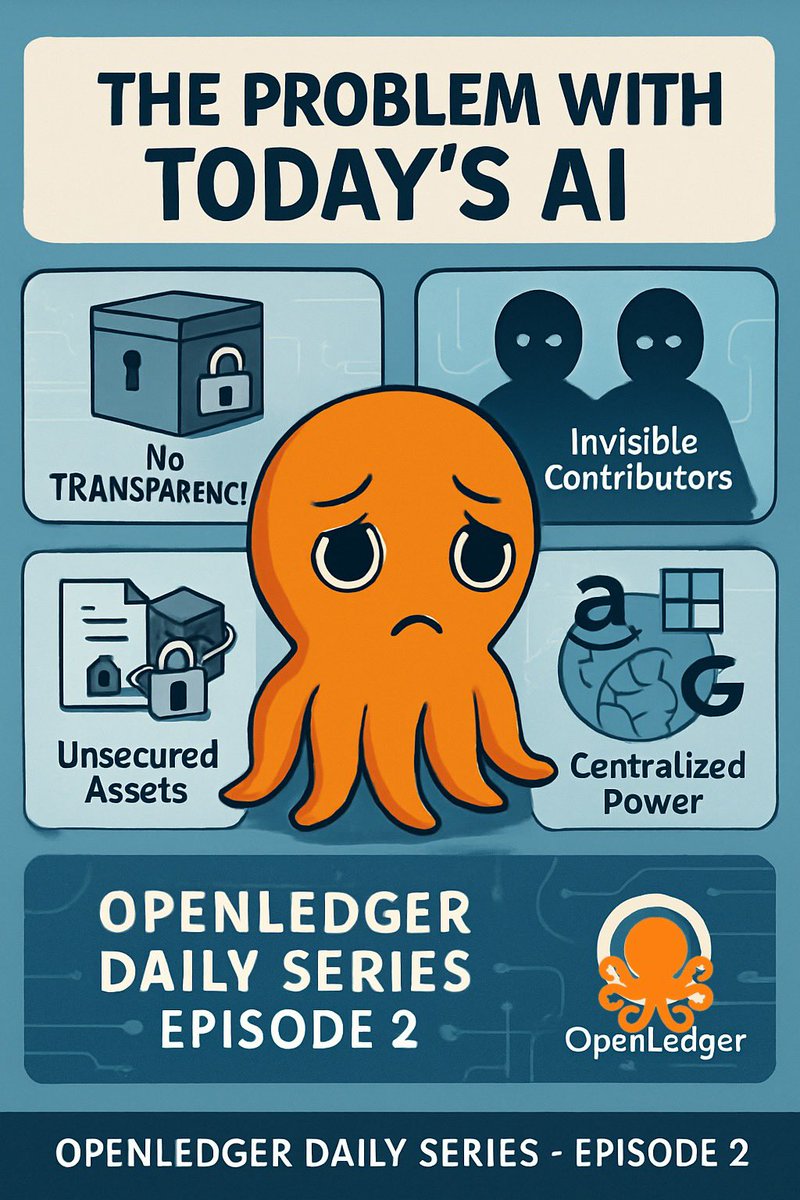
The Problem with Today’s AI
AI feels magical, but right now it’s built in ways that don’t work for most people:
❌ No Transparency
❌ Invisible Contributors
❌ Centralized Power
❌ No Rewards
Let’s break it down.
No Transparency:
Most AI = black boxes.
We don’t know what data it uses or how it decides.
👉 Stat: 85% of AI companies don’t disclose their data sources.
So, can you trust the output? Not really.
Invisible Contributors:
AI learns from millions of posts, books, and images created by us.
But the people behind that data? They get nothing.
👉 GPT-4 was trained on work from millions of humans. Zero paid.
Centralized Power:
The best AI models are owned by just a handful of tech giants.
The top 5 firms control over 90% of advanced language models.
Result? They set the rules. Everyone else is locked out.
No Rewards:
Your data trains their AI.
They profit.
You get nothing.
It’s like building a city with your bricks, but never being allowed to live in it.
The Result:
Right now AI =
•Black boxes nobody can audit
•Free labor from data creators
•Innovation trapped inside corporate walls
•Billions in value captured by a few companies
This isn’t fair. And it’s not sustainable.
Now OpenLedger flips the script:
✅ Transparent AI (all contributions + decisions on-chain)
✅ Contributors get credit and rewards ($OPEN tokens)
✅ Proof of Attribution keeps data + models safe
✅ Community power > corporate control
Example:
You upload a travel dataset 🌍
➡️ Validators check & record it on-chain
➡️ A ChatDev AI agent uses it to build a travel app
➡️ Every time it’s used, you earn $OPEN tokens
➡️ Plus, you help decide how future models evolve
The Big Idea:
AI shouldn’t just serve corporations.
With OpenLedger, it becomes:
•Open
•Fair
•Rewarding for everyone
No more black boxes.
No more invisible work.
No more gatekeepers.
AI must be open-minded & fair.
That is why OpenLedger matters: it turns AI into a true community project where your data counts, your impact shows, and you get paid.
👉 The future stays $OPEN

ChatDev The AI Driven Virtual Software Company
Imagine, creating software that used to take days or even weeks can now be completed in a matter of hours. No joke, this is thanks to a cool technology called ChatDev.
ChatDev is a kind of "software company" whose members are all AI. Each AI has a specific role, such as CEO, CTO, programmer, and tester. They work together in a structured way to create, check, and document software using only the natural language commands we give them.
So, we just give instructions, and the AI automatically chats, assigns tasks, until the software is ready to use. Isn't that exciting? A process that's usually complicated and lengthy becomes much faster and more efficient with the help of these AI agents.


OpenLedger is fixing what Web2 AI broke.
In today’s AI landscape, most systems are:
❌ Centralized
❌ Resource-hungry
❌ Opaque
❌ Built for extraction, not contribution
OpenLedger flips that script with a decentralized swarm of Specialized Language Models (SLMs), AI agents that are:
✅ Collaborative, not competitive
✅ Transparent and traceable
✅ Lightweight but powerful
✅ Governed by community, not corporations
It’s not just another AI platform.
It’s an entire framework for accountable, autonomous AI.
Key innovations:
- Restaking + cryptographic proof keeps agents honest
- Swarm coordination without central servers
- Infini-gram ensures contribution is tracked and credited
- ChatDev-style workflows complete complex tasks in hours, not weeks
This is AI with memory.
AI with morals.
AI with community ownership baked into its core.
OpenLedger isn't here to compete with big tech.
It's here to replace it.


Yo, only 3 days 'til @OpenledgerHQ drops the bomb! 💥 $OPEN’s the real deal, fam! 🐙
Buildin’ a wild digital swarm, like ants & bees vibin’ in sync. 🐝
AI agents runnin’ the show—CEO, coders, testers—chattin’ and shippin’ software with NO humans. 😎 ChatDev’s killin’ it! 🚀
Yap BIG, let’s shape AI’s future with @OpenledgerHQ! 🔥📷


🚀 Only 3 days to go — and the future is getting real.
If you haven’t looked into @OpenledgerHQ yet, now’s the time. 👀
Here’s why $OPEN is more than just a launch:
🧠 AI is no longer just about generating content.
It’s about coordination, autonomy, and real-time collaboration — and OpenLedger is building the infrastructure to make it all work like a perfectly synchronized digital swarm.
🐜 Inspired by nature (yes, ants & bees), OpenLedger enables decentralized systems where AI agents take on distinct roles — from planning to coding — all working in parallel and without constant human oversight.
💬 Take ChatDev for example: a simulated AI dev team where agents act as CEO, engineers, QA testers, and more — all communicating in natural language to ship real code.
🛡 But autonomy without accountability? That’s a problem.
This is where OpenLedger shines — integrating trust layers like EigenLayer to ensure everything stays verifiable, traceable, and aligned with human intent.
⚡️ The next era of AI is collective, decentralized, and aligned.
So… what are you waiting for?
Let’s build it together with @OpenledgerHQ 🐙🔥


gOctos 🐙 CT
Only 4 days left until the big moment for @OpenledgerHQ — if you’re not talking about it yet, now’s the time 👀
Let’s break down why $OPEN is such a big deal:
🧠 AI is evolving — it’s no longer just about generating content.
It’s building, managing, coordinating...
And @OpenledgerHQ is building the infrastructure to make it all work like a digital swarm.
🐜 Inspired by nature (think ants & bees), OpenLedger uses decentralized coordination where each AI agent has a clear role (planning, coding, QA) and operates in parallel, autonomously, and in real-time.
💻 Example? ChatDev
An AI dev company simulation where agents act as CEO, devs, testers — all collaborating via natural language to ship real software without human oversight.
🛡️ But autonomy needs accountability.
That’s where OpenLedger shines — it integrates deeply with decentralized trust layers like EigenLayer to keep AI outputs verifiable, traceable, and aligned with human intent.
So what are you waiting for?
📣 Yap loud. Yap max.
Let’s build the future of AI together with @OpenledgerHQ 🐙🔥


Good morning gOctos
If you’re not shouting about @OpenledgerHQ right now... are you even farming?
Only 4 days left in the OctoSnaps Era on @cookiedotfun
Now’s the time to lock in that mindshare and bag those Snaps
Let’s talk real quick about why $OPEN matters:
AI isn't just generating content anymore.
It's organizing, building, and shipping, autonomously.
@OpenLedgerHQ brings swarm intelligence to AI agents act like digital ants
No CEO. No micromanagement. Just role-based coordination: plan, code, test, ship.
Projects like ChatDev show how this works in action AI agents running full dev cycles through simple language.
But with great autonomy comes the real issue: accountability.
That’s where OpenLedger steps in with onchain memory, traceability, and EigenLayer-backed trust.
Every AI action? Verifiable. Transparent. Built with intent.
This is what real InfoFi looks like: Memory (who did what)
Meaning (what was built)
Momentum (where it’s going)
All tracked. All rewarded. All on https://t.co/QUrvNrjWdY
You already know the vibes..... let’s end Era 1 strong 💪


Openledger serious edge over the usual hype
1. Onchain Credit & Impact
Everyone’s got “contributions” but only @OpenledgerHQ tracks, credits, and actually rewards 1M+ users already, $15M+ raised, and a new $25M fund for AI x Web3 builders. If you’re building or dropping alpha, it’s yours, onchain none of that fuzzy pseudo-reward stuff.
2. Decentralized AI Swarms
Forget the “random agent” meme, Openledger runs coordinated agent swarms inspired by ants/bees, but for AI & devs. Agents run as CEO, coder, QA, building products in parallel, zero micromanage. Like ChatDev agents handle full software pipeline, totally autonomous.
3. Verifiable Trust Layer
EigenLayer + Openledger = deep accountability. No more blackbox AI calls everything agents do is traceable, aligned, and cannot be rug-pulled by some shadow DAO.
Mainnet vibes landing soon, huge campaigns finishing, contributors vibing feels like real ground-up value, not just another airdrop farm.
So, whose edge is the future: true credited data, smarter autonomous AI, or verifiable onchain trust?
#OpenledgerHQ

What do ants, birds, and AI agents have in common?
They all swarm not chaotically, but with stunning coordination.
Unlike humans stuck in meetings and silos, swarms solve complex problems through simple rules… fast.
Now imagine AI doing the same:
👉No waiting for approvals
👉No miscommunication
👉Just autonomous, coordinated execution
@OpenledgerHQ brings this to life with AI agents powered by Specialized Language Models (SLMs).
Think: AI dev teams that ship in hours, not weeks.
Projects like ChatDev make it real.
AI CEO, CTO, coder, tester. All working in sync.
But real autonomy needs real trust.
That’s where EigenLayer steps in, securing AI decisions with cryptographic validation.
This is not just smarter AI.
It’s a smarter way to work.
gOcto🐙


Can swarms teach us how to build better AI?
Nature says yes. And @OpenledgerHQ is taking that lesson seriously.
For centuries, we’ve admired how ants, bees, and birds coordinate complex tasks through simple rules no managers, no meetings, just pure decentralized intelligence.
Now, AI agents are catching up not by copying humans, but by mimicking nature.
Here’s what’s changing:
1. Swarm > Sapiens
Ants solved puzzles better than humans when both were stripped of communication. Why?
✅ Decentralized coordination
✅ No ego, no noise — just efficiency
2. Human Teams Are Bottlenecked
Meetings. Silos. Miscommunication. Delays.
The result? Months of work wasted when requirements shift.
AI agents break this pattern.
3. Rise of Coordinated AI Agents
AI agents inspired by swarm logic can now:
✅ Analyze needs
✅ Assign tasks
✅ Execute in parallel
✅ Optimize on the fly
No waiting. No approvals. Just execution.
4. OpenLedger + SLMs = AI that actually works
@OpenledgerHQ is leading the charge by powering AI agents with Specialized Language Models (SLMs) making them domain-aware, efficient, and fast.
Think less like ChatGPT and more like a laser-focused AI team for software, logistics, or ops.
5. ChatDev: A Software Company Made of AI
CEO, CTO, dev, tester — all roles played by agents.
✅ They plan
✅ They build
✅ They ship
All using structured natural language. All within hours, not weeks.
6. The Next Leap: Unstoppable AI Agents
But with great power comes the need for great governance. That’s where @eigencloud comes in:
✅ Restaking
✅ Cryptographic validation
✅ Decentralized consensus
Together, they ensure unstoppable AI stays aligned with human values.
The future isn’t just AI that works — it’s AI that coordinates, builds, and evolves with purpose.
Let nature show us the blueprint. Let @OpenledgerHQ build it onchain.
@recallnet @JoinSapien @elympics_ai


I keep preaching on the timeline why you should study AI Ecology
What do animals like ants, AI, and @OpenledgerHQ have in common?
They’re all rewriting the rules of teamwork.
Nature’s been running decentralized intelligence for millions of years. Now, AI is catching up and OpenLedger is supercharging the future.
..........<>..........
Ants can solve complex puzzles faster than humans. No talking. No meetings. Just signals, instincts, and cooperation.
This isn’t magic. It’s swarm intelligence, a bottom-up system where simple agents solve big problems together.
AI is finally learning this trick.
Human teams often fail not from lack of skill, but from poor coordination.
Humans have siloed departments, slow decisions, endless Slack pings.
Swarm-inspired AI agents; No silos. No delays. Just fast, parallel action.
..........<>..........
Multi-Agent Systems (MAS) and Ant Colony Optimization (ACO).
These models mimic how ants or birds collaborate, and apply it to AI.
Each AI agent is small, specialized, and autonomous. Together, they move like a smart, adaptable superorganism.
But AI agents today still hit walls, especially with complex or changing tasks.
..........<>..........
That’s where OpenLedger steps in.
Their approach is a Purpose-built application called SLMs. Each one is focused, fast, and effective.
One real-world glimpse: ChatDev, an AI “startup” where agents take on roles like CEO, coder, and tester.
They build full apps in hours. No burnout. No context-switching.
Imagine your dev team, but tireless, collaborative, and always in sync.
...........<>..........
Now picture this in your company:
– Tasks are instantly understood.
– Agents work in parallel.
– Plans adapt in real-time.
– Results come fast.
This isn’t sci-fi. It’s swarm AI + OpenLedger in action.
But there's a catch: What if AI agents evolve too fast? Who keeps them aligned?
EigenLayer, a decentralized layer of governance that acts like referees for AI behavior.
It helps ensure AI remains trustworthy, transparent, and human-aligned.

🥇🏆This 35-Page Paper Is the Ultimate Guide to Multi-Agent AI Collaboration Multi-Agent Systems (MAS) solve what single LLMs can’t: short-term memory limits, no persistence, brittle reasoning.
When multiple LLM agents collaborate—each scoped, specialized, and role-aware—you unlock scalable workflows, structured planning, and emergent https://t.co/hy2Ql6uPHq’s not magic. It’s architecture.
》𝗦𝘁𝗲𝗽 𝟭: 𝗕𝘂𝗶𝗹𝗱 𝘁𝗵𝗲 𝗔𝗴𝗲𝗻𝘁 𝗕𝗿𝗮𝗶𝗻
✸ Every agent has 5 components:
☆ a model (m),
☆ an objective (o),
☆ an environment (e),
☆ input perception (x),
☆ and output action (y = m(o, e, x)).
✸ In real systems, agents also get tools like calculators, web access, or memory modules.
✸ Think of each agent like a uniquely skilled team member — equipped and ready for its mission.
》𝗦𝘁𝗲𝗽 𝟮: 𝗙𝗼𝗿𝗺 𝘁𝗵𝗲 𝗖𝗿𝗲𝘄 — 𝗔𝗴𝗲𝗻𝘁𝘀 𝗶𝗻 𝗮 𝗦𝘆𝘀𝘁𝗲𝗺
✸ A system is not just many agents.
✸ It’s the shared goal (O_collab), the environment (E), and most importantly — the collaboration channels (C).
✸ Channels define how agents talk, plan, debate, and act — just like roles in a company or sections in an orchestra.
☆ The equation: y_collab = S(O_collab, E, x_collab | A, C)
》𝗦𝘁𝗲𝗽 𝟯: 𝗖𝗵𝗼𝗼𝘀𝗲 𝘁𝗵𝗲 𝗥𝗶𝗴𝗵𝘁 𝗖𝗼𝗹𝗹𝗮𝗯𝗼𝗿𝗮𝘁𝗶𝗼𝗻 𝗧𝘆𝗽𝗲
✸ Cooperation – agents help each other toward a shared goal
✸ Competition – agents debate, critique, or challenge one another
✸ Coopetition – a mix: collaborate on some tasks, compete on others
》𝗦𝘁𝗲𝗽 𝟰: 𝗣𝗶𝗰𝗸 𝗮 𝗦𝘁𝗿𝗮𝘁𝗲𝗴𝘆 — 𝗛𝗼𝘄 𝗧𝗵𝗲𝘆 𝗖𝗼𝗹𝗹𝗮𝗯𝗼𝗿𝗮𝘁𝗲
✸ Rule-based – strict logic, like majority voting
✸ Role-based – predefined jobs, like coder, planner, reviewer
✸ Model-based – probabilistic planning, like predicting others’ thoughts (Theory of Mind)
》𝗦𝘁𝗲𝗽 𝟱: 𝗗𝗲𝘀𝗶𝗴𝗻 𝘁𝗵𝗲 𝗖𝗼𝗺𝗺𝘂𝗻𝗶𝗰𝗮𝘁𝗶𝗼𝗻 𝗧𝗼𝗽𝗼𝗹𝗼𝗴𝘆
✸ Centralized – one hub (like a manager), coordinates everyone
✸ Decentralized – agents talk peer-to-peer (more flexible, less fragile)
✸ Hierarchical – layers of control and delegation
》𝗦𝘁𝗲𝗽 𝟲: 𝗖𝗼𝗼𝗿𝗱𝗶𝗻𝗮𝘁𝗲 𝘁𝗵𝗲 𝗢𝗿𝗰𝗵𝗲𝘀𝘁𝗿𝗮 — 𝗢𝗿𝗰𝗵𝗲𝘀𝘁𝗿𝗮𝘁𝗶𝗼𝗻 𝗟𝗼𝗴𝗶𝗰
✸ Static – channels and roles are fixed
✸ Dynamic – agents evolve based on task and context
》𝗥𝗲𝗮𝗹-𝗪𝗼𝗿𝗹𝗱 𝗣𝗮𝘆𝗼𝗳𝗳: 𝗪𝗵𝗲𝗿𝗲 𝗔𝗴𝗲𝗻𝘁𝘀 𝗦𝗵𝗶𝗻𝗲
✸ QA & Reasoning – Debate frameworks like MAD or FORD improve answer quality
✸ Software Dev – Tools like ChatDev or MetaGPT simulate real agile teams
✸ Science & Culture – Simulate social behavior, generate cross-cultural insights
✸ IoT & 5G – Coordinate edge devices and semantic compression for low-latency AI
paper: https://t.co/YZq7sSdOY0
≣≣≣≣≣≣≣≣≣≣≣≣≣≣≣≣≣≣≣≣≣≣≣≣≣≣
⫸ꆛ Want to build Real-World AI agents?
Join My 𝗛𝗮𝗻𝗱𝘀-𝗼𝗻 𝗔𝗜 𝗔𝗴𝗲𝗻𝘁 𝗧𝗿𝗮𝗶𝗻𝗶𝗻𝗴 TODAY!
➠ Build Real-World AI Agents + RAG Pipelines
➠ Learn 3 Tools: LangGraph/LangChain | CrewAI | OpenAI Swarm
➠ Work with Text, Audio, Video and Tabular Data
👉𝗘𝗻𝗿𝗼𝗹𝗹 𝗡𝗢𝗪 (𝟯𝟰% 𝗱𝗶𝘀𝗰𝗼𝘂𝗻𝘁) - 460+ already enrolled:
https://t.co/5i2v1fIrhJ

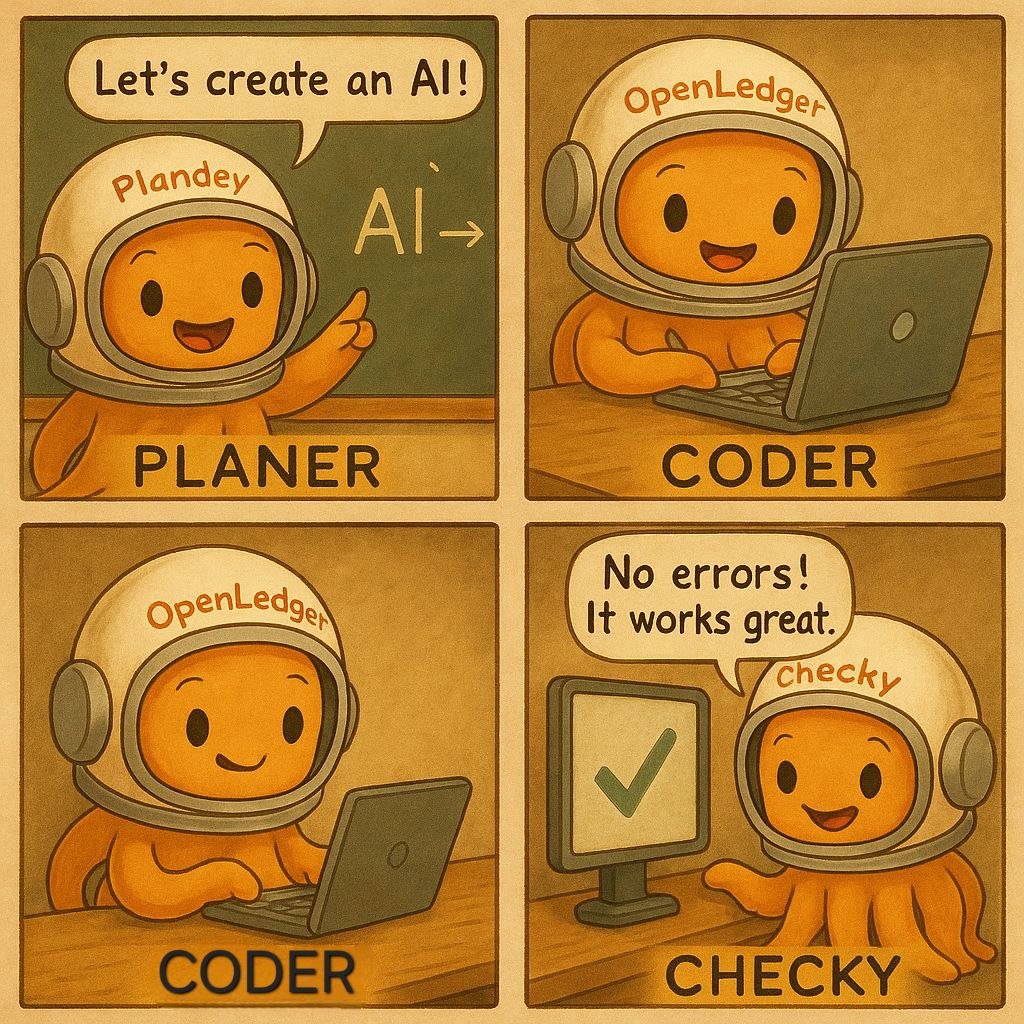
ChatDev Octopus Team @OpenledgerHQ
🐙Planey
Role: Planner
Characteristic: A leader who wears a white helmet and leads everyone
“Let’s make an AI like this!”
Curious and imaginative
🐙 Cody
Role: Coder
Characteristic: Typing passionately in front of a laptop
“Code complete! Let’s run it!”
Quiet but focused
🐙 Checky
Role: Tester
Characteristic: Looking at the monitor and checking carefully
“There are no errors! It works perfectly.”
Detailed and responsible
ChatDev 🐙
Your AI-Building Team in a Box
ChatDev works like a small software company but run entirely by AI agents working as a team.
🔸Planner (Project Lead)
“Let’s build this kind of AI!”
sets the goal and direction
🔸Coder (Developer)
Builds the AI model based on the plan
🔸Tester (QA Engineer)
Checks if it works well and makes improvements
> A café owner wants an AI to recommend menu items.
With ChatDev, the model is built in just a few hours.
All they have to do is make the request!
Why it’s amazing
▪️Fast: AI built in hours, not weeks
▪️No coding required: Anyone can use it
▪️Quality-focused: Always improving through feedback
Integrated with @OpenledgerHQ ’s Model Factory!!
Easy, accessible AI creation for everyone


@Utpalrabhaaa @OpenledgerHQ I’m so excited for Openledger’s swarm intelligence and AI teamwork!
From ant colonies to ChatDev, it’s amazing to see nature-inspired tech in action.
Let’s join this innovative AI revolution together! #OpenLedger #Opnup

@xbbory482 @OpenledgerHQ ChatDev works like a real team by automating AI development processes. @OpenledgerHQ is pushing the boundaries of what's possible.
OpenLedger에서 "코딩 없이 AI 만들기"…진짜 가능해요?
결론부터 말하면 이미 가능하고, 곧 더 쉬워집니다!!
지금은 어떻게 되냐고요?
테스트넷에서는 이미 됩니다!
지금 @OpenledgerHQ 테스트넷 페이지에서
"몇 번 클릭으로 AI 만들기" 기능을 누구나 써볼 수 있어요!!
OpenLedger는 현재 테스트넷 단계에서 Model Factory라는 GUI(그래픽 사용자 인터페이스)를 제공합니다.
코드를 몰라도 누구나 AI 모델 아이디어를 제안하고 생성할 수 있습니다.
"Mint Your Model Madness" 콘테스트(2025년 4월 27일~5월 3일)에서 사용자가 AI 모델을 제안할 수 있어요.
✔️그럼 언제부터 진짜 써볼 수 있을까?
메인넷 출시: 2025년 중반 (6~7월 예상)
1단계: 사용자 제안 → 실제 모델 개발
내가 만든 "HealthConnect AI"가 진짜 의료 모델로 구현되는거죠!! 멋질거 같아요!!
2단계: 누구나 실행 & 공유 가능
내가 만든 AI를 다른 사람이 바로 써볼 수 있음
✔️어떻게 가능한 거야?(핵심기술)
▪️Model Factory:
코딩 몰라도 클릭만으로 AI 모델 생성
▪️OpenLoRA:
GPU 한 대로 수백 개 AI 돌려서 실행 비용 99%↓
→ 학생·자영업자도 부담 없이 사용 가능
▪️ChatDev:
AI들이 팀처럼 기획·개발·테스트 자동 진행
▪️분산 네트워크:
중앙서버 없이 모두가 데이터/컴퓨팅 기여
"OpenLedger는 지금도 AI 만들 수 있고, 곧 누구나 더 쉽게 쓸 수 있게 됩니다."
곧, 진짜로
학생도
카페 사장님도
동네 병원도
동네 아줌마도
자기만의 AI를 만들어 쓰는 시대가 열립니다.
함께 만들고 싶다면 지금 바로 테스트넷부터 들어가보세요!
#OpenLedger #AI민주화 #ModelFactory #PoA #ChatDev

Most Popular Users

Elon Musk 
@elonmusk
240M followers

Barack Obama
@barackobama
118.6M followers

Cristiano Ronaldo
@cristiano
114.4M followers

Donald J. Trump
@realdonaldtrump
111.7M followers

Narendra Modi
@narendramodi
106.9M followers

Rihanna
@rihanna
98.6M followers

NASA
@nasa
92.1M followers

Justin Bieber
@justinbieber
91.7M followers

KATY PERRY
@katyperry
89.9M followers

Taylor Swift
@taylorswift13
83.9M followers

Lady Gaga
@ladygaga
75.4M followers

Virat Kohli
@imvkohli
73.3M followers

Kim Kardashian
@kimkardashian
70.8M followers

YouTube
@youtube
68.6M followers

Neymar Jr
@neymarjr
66.3M followers

Bill Gates
@billgates
65.2M followers

Selena Gomez
@selenagomez
63M followers

The Ellen Show
@theellenshow
62.1M followers

CNN
@cnn
61.7M followers

X
@x
60.6M followers