

Top Tweets for #conditionality

Bank of England
*.*.* Explains rate cuts as a reward for inflation progress.
*.*.* Stresses conditionality and data dependence.
*.*.* Uses minimal text with clear policy sequencing.
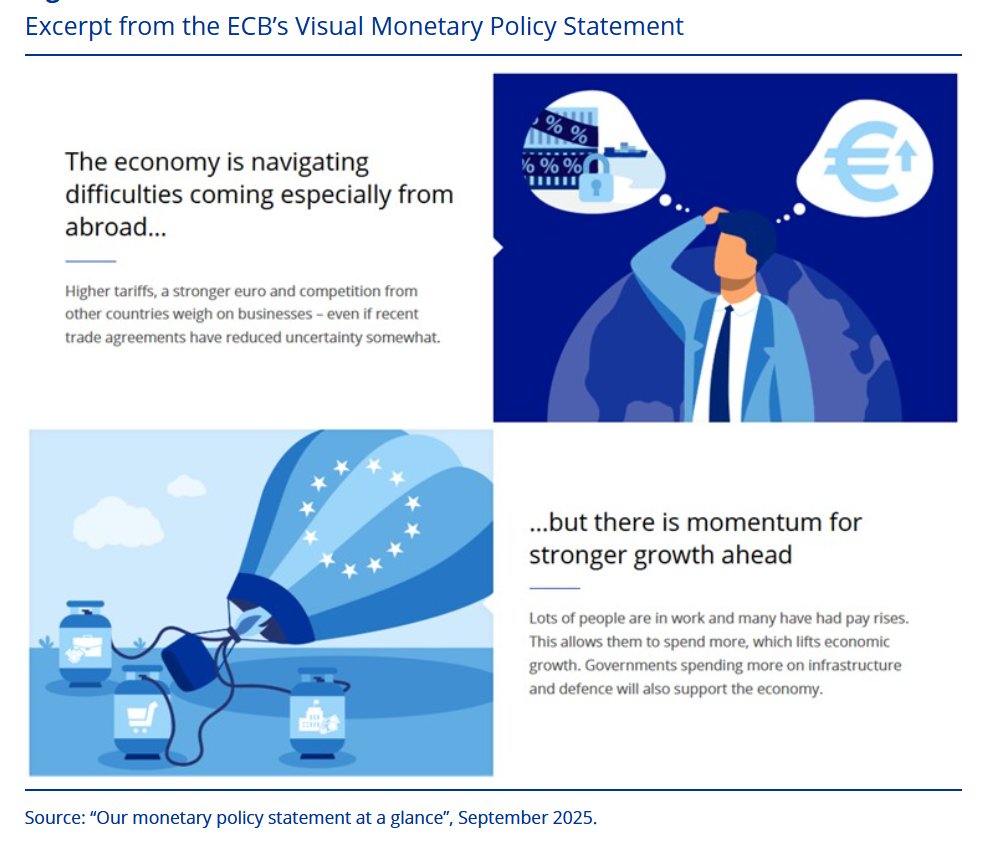
European Central Bank
*.*.* Acknowledges external headwinds while highlighting growth momentum.
*.*.* Connects labor markets, wages, and spending to outlook.
*.*.* Blends reassurance with realism through narrative visuals.
Bottom line:
Monetary policy today is no longer just about interest rates — it is equally about trust, clarity, and how effectively central banks tell their story.


Models generalize relative to environments they’ve seen.
Claims of “general intelligence” ignore this conditionality.
Every generalization is anchored to a distribution.
True progress expands this anchor incrementally, not universally.
An LLM is intelligent only under the right context, format, and constraints.
Remove these, and behavior degrades sharply.
This conditionality is structural, not temporary.
LLMs are powerful pattern engines, not general problem solvers.

. $META – Market Outlook powered by @EdgenTech
Meta Platforms, Inc. (ticker: META) continues to play a foundational role in digital social-platforms, advertising, artificial intelligence, and immersive hardware — a business aligned with long-term themes of AI monetization, social media engagement, and metaverse/augmented-reality infrastructure. Its position (massive global user base, dominant ad-platforms via Facebook/Instagram/WhatsApp, and emerging hardware/AI) provides structural strength, but also leaves it exposed to regulatory/antitrust risk, intense R&D/spending burdens, and valuation risk given high expectations.
On the positive side, Meta’s fundamentals show meaningful tailwinds: solid revenue growth, strong margins, and strategic repositioning (big bets on AI, ads optimization, hardware). At the same time, the stock’s price action suggests cautiousness: analyst targets and technicals suggest upside exists but are not runaway, meaning the next move likely depends on successful execution and favourable macro/industry catalysts rather than pure momentum.
Fundamentals & Business Position
Positives:
Meta achieved last-twelve-months (LTM) revenue growth around ~19.4% and a 3-year average around 13%.
Strong margins: operating margin of ~42.9% and free-cash-flow margin ~30.7%.
Business model: Leader in digital advertising, expanding into AI-driven ad optimisation and hardware (e.g., smart glasses).
Risks:
High expectations/valuation: Even with attractive fundamentals, the stock trades on elevated metrics and much is priced in.
Massive investment burden: Meta is committing very large capital expenditures for AI infrastructure and hardware which increases leverage/operational risk.
Regulatory & macro exposure: As a global tech platform, Meta faces regulatory/regime risk, antitrust scrutiny, and potential ad-demand softness if macro weakens.
Summary:
Meta $META offers exposure to a top-tier technology/social-platform company with structural tailwinds (ad growth, AI monetisation, hardware future). However, the growth potential, while strong, is not without conditionality — much depends on Meta executing its AI/hardware pivot, sustaining ad growth, and managing regulatory/expense headwinds. This stock is likely better suited for investors seeking exposure to secular tech/AI/social trends with risk tolerance, rather than those seeking near-term bargain or deep value.
Technical & Market Structure
Key Points:
Technical sentiment: The stock has seen strong upside in 2025 (~25%+ YTD) but also commentary that tech/AI stocks are increasingly sentiment-driven rather than purely fundamentals.
Valuation/price targets: Some analysts and models suggest further upside: e.g., there is mention of price targets in the ~$800+ range.
Trading context: With large market cap and broad visibility, META is sensitive to macro tech sentiment, ad demand cycles, regulatory shifts, and AI-hardware news.
Outlook (24 H → 7 Days / Near-Term)
Bias: Neutral → Moderately Bullish (conditional)
Upside scenario: If Meta delivers a strong earnings report, shows meaningful AI/hardware monetisation progress, or benefits from an ad-spending rebound, the stock could move toward the ~$800-$900+ range medium-term.
Downside risk: If ad growth disappoints, hardware investments underperform, or regulatory/competitive pressures mount, the stock could retreat toward ~$600-$650 or remain stuck in a range for a period.
Key Triggers to Watch:
Quarterly earnings and guidance: especially ad-revenue growth, AI/hardware segment developments.
AI/hardware announcements (smart glasses, AR/VR, “superintelligence” investments).
Regulatory and antitrust developments in the U.S., EU and other markets.
Macro tech/ad-demand environment: advertising cycles, consumer behaviour, device hardware trends.
EdgenTech Summary:
Meta Platforms $META is a compelling tech/social-platform growth stock with strong structural tailwinds (global ad platforms + AI + hardware evolution). Yet it carries significant execution risk, large capital commitments and elevated expectations. It is appropriate for investors who believe in the long-term AI/social-tech narrative and can tolerate potential volatility; less suited for short-term trades relying purely on momentum or deep value margin of safety.

$IONQ: IonQ Secures Regulatory Approval from the UK Investment Security Unit (ISU) for the Acquisition of Oxford Ionics
COLLEGE PARK, Md.--(BUSINESS WIRE)--IonQ (NYSE: IONQ), the leading commercial quantum computing and networking company, today announced that it has secured UK Investment Security Unit regulatory clearance for the acquisition of Oxford Ionics. All deal conditionality has been satisfied and the company looks forward to closing the deal in the near term.
https://t.co/SR40Oes8Kf


🔮 Intent Potion Brewing: How Mages Cast Trades in Anoma
In the @anoma universe, intents aren’t just technical instructions — they are spells. Casting an intent is like brewing a magical potion: each property of the intent becomes an ingredient that determines the outcome of your spell.
🧪 Ingredients of an Intent Potion:
Urgency (Red Powder)
“I need this swap now!”
Add this to your potion if time matters above all else. The spell will prioritize instant execution, no matter what.
Patience (Green Leaf)
“I can wait for the right conditions.”
Some mages don’t rush. They prefer optimal outcomes over speed. With patience, your intent remains in the market until it finds the best match.
Conditionality (Blue Drop)
“Only if gas < 10 gwei.”
This ingredient adds rules to your spell. Your intent will only be fulfilled if the conditions are met — bringing logic into magic.
Expiration (Black Mist)
“This spell fades after 24h.”
Every potion has a limit. Expiration makes sure your intent doesn’t linger forever if it isn’t matched.
✨ The Spell: Intent-Based Matching
Once your potion is brewed, the protocol acts as the great spellbook. It combines your potion with others in the marketplace. Urgent liquidity meets patient capital, conditional swaps find matching rules, and efficient trades happen across networks — automatically.
This is intent-centric magic: instead of telling the system how to do things step by step, you simply declare what you want. The magic handles the rest.
🧙 Why This is Revolutionary
In traditional finance, time is simplified: interest rates, maturity dates, futures contracts. But intents let us mix urgency, patience, conditions, and expiration into unique “potions.”
It creates new market efficiencies.
It allows participants with opposite needs to meet naturally.
It makes trading feel more human — or more magical.
⚡ Forget dull spreadsheets and contracts. The future of finance is brewed in cauldrons, not drafted in boardrooms.
👉 So, mage, what potion would you brew for this week’s ?
#intentsjam @thekerukeion


The Temporal Arbitrage of Intent: How Intent-Centric Architectures Reshape Economic Time
Traditional finance has long treated time as a simple dimension, reducing its complexity to interest rates and delivery dates. In reality, economic intent is a rich phenomenon, structured by temporal characteristics like urgency, duration, conditionality, and expiration. The advent of intent-centric architectures, such as the Anoma protocol, unlocks a powerful new mechanism: the temporal arbitrage of intent, promising to reshape how we optimize economic interactions.
At its core, intent possesses several temporal dimensions that legacy systems ignore. Urgency differentiates an immediate need for capital from a patient, long-term goal. Duration defines the intended timeframe of an action, from a 30-day stake to a 5-year hedge. Conditionality ties intents to specific events and deadlines, such as selling an asset only if its price hits a target by a certain date. Finally, Expiration acknowledges that all desires are transient and opportunities are time-bound.
This nuanced reality is lost on current financial systems. Monetary tools like the Federal Reserve's forward guidance are a crude attempt to manage future market intent, relying on aggregate data and imprecise communication. They cannot capture the detailed, conditional preferences of millions of individual actors. In contrast, an intent-centric system, by allowing users to express their full preferences in a machine-readable format, can directly read and react to the market's true state.
These new protocols act as sophisticated "temporal matchmakers." Consider a user needing immediate liquidity against a future-maturing asset (urgent intent) and another user with idle capital seeking a guaranteed future return (patient intent). Instead of forcing them through costly intermediaries like banks, the protocol can directly identify their complementary temporal needs and facilitate a "time-value swap." It efficiently discovers the true market price for shifting value across time, enabling temporal arbitrage.
The macroeconomic implications are profound. An economy built on expressed intent generates a high-fidelity, real-time signal of collective desire, replacing the lagging indicators that currently guide policy. This could enable new, adaptive monetary mechanisms that are algorithmically tuned to the market's observable state, fostering a more resilient and responsive economic fabric.
Ultimately, this marks a fundamental paradigm shift: from crudely pricing the use of money over time to directly matching the temporal nature of intent itself. By allowing the market to perform temporal arbitrage, these new architectures promise not just greater efficiency, but a more transparent and stable foundation for global economic coordination.


The Temporal Arbitrage of Intent: How Anoma Redefines Time in Economic Value
In traditional economics, time is treated as linear and simplified: interest measures the duration of loans, futures contracts lock in delivery dates, and derivatives hedge against specific timelines.
But what if time were more than just a straight line?
This is what Anoma’s intent-centric architecture proposes: to reveal the temporal structure of economic desires and enable markets to trade not just value, but the time-dynamics of human intention.
The Temporal Nature of Intents
Unlike money, intents carry complex temporal characteristics:
⏱️ Urgency: I need liquidity now.
🕰️ Duration: I can wait weeks or months.
🔄 Conditionality: Only if a certain event occurs.
⌛ Expiration: Valid until a specific date.
These dimensions are rarely expressed in today’s financial systems, where time is reduced to interest rates, deadlines, or expiration dates.
The Federal Reserve Example
The Federal Reserve, through forward guidance, tries to shape expectations about future policy, essentially an attempt to trade with markets in the currency of anticipated intent.
But this approach is crude: it is indirect, one-sided, and heavily dependent on interpretation by market participants.
The Power of Intent Markets
With @anoma , intents can be expressed explicitly and processed natively by the protocol.
This opens the door to markets that reconcile different temporal needs:
-An actor with patient capital can provide liquidity to someone with urgent needs.
-Investors can create conditional orders valid only within specific time windows.
-Long-term projects can attract resources without being bound to fixed interest rates set by intermediaries.
Here emerges the temporal arbitrage of intent: optimizing economic desires distributed across time, far beyond the efficiency achieved by interest rates or futures contracts.
New Forms of Economic Efficiency
When markets account for the full dimensionality of time, new possibilities arise:
🔧 Fairer liquidity allocation, matching urgency vs. patience.
🌍 Economic resilience, as temporal conditions can be reconfigured dynamically.
🚀 Web3-native financial innovation, moving beyond the models of central banks and Wall Street.
The economy is no longer just about “how much” and “when” in monetary terms, it becomes about who wants what, under which temporal conditions, and how collective coordination can reconcile those intents.
Conclusion
The concept of temporal arbitrage of intent is more than a technical innovation: it is a paradigm shift.
Anoma turns time into a first-class economic asset, enabling intents to be traded in their full temporal richness.
This opens the door to forms of economic coordination that were simply impossible in transaction-based systems.
✨ In the economy of the future, time is not a cost. Time is intent.
@anoma
@thekerukeion
@AnomaPay


The Future of Money Runs on Intents 🦐❤️
Think about it: today’s financial systems reduce time to a blunt tool. Interest rates, futures, expiration dates... all designed to manage something far more complex than they can capture.
Anoma flips this on its head.
Instead of treating time and coordination as rigid structures, Anoma builds on intents, expressions of what participants want to happen.
🌍 Why does this matter?
Because intent unlocks layers of economic coordination that traditional systems can’t touch:
⏳ Urgency vs. patience → express whether you need liquidity now or later.
🔄 Conditionality → trade only if certain circumstances are met.
🛡️ Permanence or temporality → make commitments that last… or expire naturally.
In today’s world, central banks attempt to “guide” the market by signaling intent. But it’s indirect, inefficient, and often misses the mark. With Anoma, intent is on-chain, explicit, and actionable.
The result?
Smarter allocation of resources.
True peer-to-peer trust (anchored in cryptography).
A system where coordination feels natural not imposed.
Anoma isn’t just rethinking how crypto works. It’s showing us how the economy itself could evolve when desires, conditions, and time are directly expressed on-chain.
This is more than finance. It’s the foundation for a new kind of trust system. And it’s only just beginning.
@anoma
@thekerukeion
@intrenche1


With its intent centric architecture, Anoma is unlocking a new wave of applications that were previously impossible in Web3. By focusing on what you want instead of the specific steps to achieve it, the protocol allows for optimized and private solution finding. This approach enables complex functions like multiparty coordination, native crosschain settlement, and seamless AI agent integration.
@anoma model also introduces a revolutionary concept, temporal arbitrage. While traditional finance reduces time to a simple cost, Anoma embraces the full spectrum of temporal desires, from urgency and duration to conditionality and expiration. This new layer of coordination is set to spawn entirely new categories of applications, and I'm excited to see what emerges with Anoma

While most blockchains are designed for simple transactions, @anoma is built for intents. This isn't just about how a trade happens, but what you want to achieve and when. This focus on desire and conditionality introduces a new layer of coordination called temporal arbitrage, where time itself becomes a tradable currency.
Imagine a market where you can express not just a simple buy or sell order, but the urgency, duration, or specific conditions of your desire. Anoma unlocks this full spectrum of temporal needs, allowing for optimized, private, and efficient solution finding.
The lore of the shrimps hearing the whispers of intent speaks to this core idea, the @Shrimpers_nft has taken the lead, It's not magic, but the raw power of desire, woven into the very fabric of the blockchain. This allows for new efficiencies across time, creating a system that truly understands and acts on your goals.


Intent shows us a deeper truth:
value isn’t just money it’s time itself. Urgency, patience, conditionality, and expiration all shape how we really want to act, yet traditional finance flatten these dimension into interest rate or delivery date.
@anoma change this. By enabling explicit intent market, we can finally express and trade our temporal preferences immediate liquidity for future delivery, patient capital for urgent need.
This is the temporal arbitrage of intent: a new design space for coordination, efficiency, and freedom that goes beyond what central banks or monetary policy can ever achieve. It’s not just a financial innovation, it’s an invitation to reimagine the economy itself.
#weeklyidea #comunityevent


Temporal Arbitrage of Intent – Unlocking the Hidden Dimension of Value
In most financial systems, time is treated like a straight line. Borrow money today, pay it back tomorrow—with a bit of interest for the privilege of waiting. Or set a fixed date to buy or sell an asset in the future. This works—but it flattens one of the richest dimensions of human economic behavior: how people value the timing of their actions.
In reality, our intentions are not static. They breathe, expand, contract, and shift with context.
A seller might want to offload an asset immediately before an event—willing to take a discount.
A buyer might be willing to wait, but only if the price improves over time.
A lender may only want to provide funds if certain conditions are met—or if repayment is structured to align with seasonal income.
Some intents even expire—ceasing to exist if not acted upon at a precise moment.
This complexity is largely invisible in traditional finance. Interest rates, maturity dates, and expiration times are blunt instruments. They don’t capture urgency, conditionality, or dynamic preferences in a way that markets can trade on.
Enter @anoma
Anoma’s intent-centric architecture doesn’t just record what people want to do—it encodes when, under what conditions, and with what degree of urgency or patience. This transforms time itself into a tradeable asset.
Here’s how:
Urgent intents can be satisfied faster by paying a premium—creating instant liquidity for those who value time over price.
Patient participants can earn higher returns by waiting or providing capital under specific temporal conditions.
Conditional or event-driven intents can be matched in ways traditional exchanges or interest models can’t even express.
This is Temporal Arbitrage of Intent—a market-driven mechanism where timing preferences themselves become a source of value. The result? Smarter capital allocation, better liquidity for those who need it most, and a dynamic marketplace that functions beyond the static timelines imposed by banks or monetary policy.
In this world, time is no longer a background setting—it’s a currency of its own, shaping how value flows through an economy.
@thekerukeion

1/ Intent, unlike money, exists in time with traits like urgency, duration, and conditionality. Traditional finance sees time simply—interest rates or futures contracts. @anoma intent-based system reveals a richer temporal structure for economic desire.

While most blockchains are designed for simple transactions, @anoma is built for intents. This isn't just about how a trade happens, but what you want to achieve and when. This focus on desire and conditionality introduces a new layer of coordination called temporal arbitrage, where time itself becomes a tradable currency.
Imagine a market where you can express not just a simple buy or sell order, but the urgency, duration, or specific conditions of your desire. Anoma unlocks this full spectrum of temporal needs, allowing for optimized, private, and efficient solution finding.
The lore of the shrimps hearing the whispers of intent speaks to this core idea, the @Shrimpers_nft has taken the lead, It's not magic, but the raw power of desire, woven into the very fabric of the blockchain. This allows for new efficiencies across time, creating a system that truly understands and acts on your goals.
A new chapter in Web3 is on the horizon, powered by the synergy between @anoma and @Shrimpers_nft.
Anoma provides the core technological foundation, a powerful new way to transfer value. @Shrimpers_nft meanwhile, is building the world you will want to explore, the community and lore that will make this more than just a transaction. the @Shrimpers_nft official collection is not yet available for minting. Any link or collection you find is a fake. The real work is in progress. Get ready, because when this level of tech meets this kind of culture, something truly special is about to happen.
As a loyal sloth, i am ready for the WL with my SHRIMP farm. Anoma Solvers Handle Robust Intent Matching Protocols @anoma SHRIMP


⏳ The Temporal Arbitrage of Intent
In traditional finance, time = interest rates & futures.
But intent isn’t just money — it’s urgency, patience, conditionality, and expiry.
@anoma unlocks markets where participants can trade across time itself — urgent liquidity for patient capital, short-lived needs for long-term flows.
This isn’t just efficiency… it’s a new dimension of economic coordination.
Stay Intent. 🌀
#Anoma #Intent #Web3


people are benchmarking TPS and liquidity again
meanwhile @anoma is shipping a coordination layer where the atomic unit becomes intent over raw tx
intent has time baked in: urgency, duration, conditionality, expiry unlocking temporal intent arbitrage, cross-domain matching, and MEV-minimized settlement
decentralized OS vibes for web3: one app, any chain, simple UX without chain-hopping
tge on the horizon, energy feels real, watching this core get forged in public

Temporal Arbitration of Intention
An innovative concept from the Anoma system that goes beyond traditional finance
allowing people to express intentions, urgency, duration, conditionality, and expiration
transforming the economy by valuing human time and desires
This creates new possibilities for organizing the economy more efficiently
adapting to human needs in a flexible and innovative way
I found the idea quite innovative, as it places human desires at the center of the economy
@anoma organizes the economy and focuses on people's intentions based on what YOU want
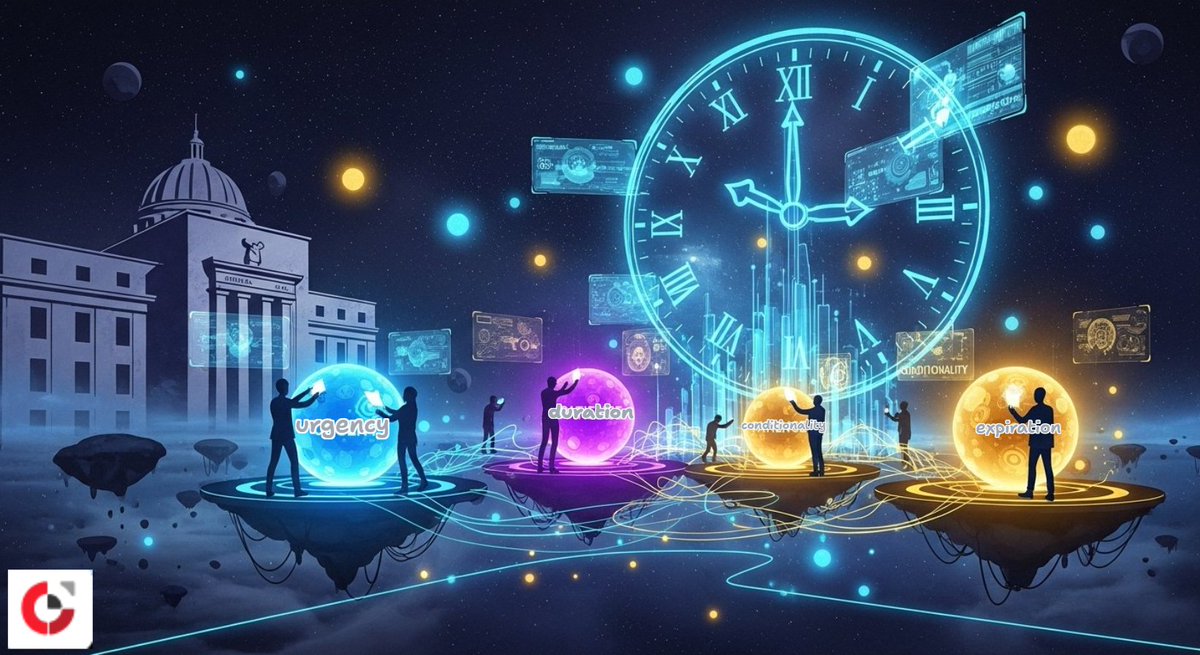

The Temporal Arbitrage of Intents is a brilliant dive into how intent, with its temporal layers, urgency, duration, conditionality, and expiration could transform economic systems. Unlike traditional finance, which treats time as a flat variable (think loan terms or futures contracts), @anoma intent-based architecture lets participants express nuanced preferences, like trading urgent liquidity for future delivery. This “temporal arbitrage” could unlock efficiencies the Federal Reserve’s clunky forward guidance can’t touch, matching needs across time with precision.
Imagine a startup needing cash now and an investor wanting delayed returns, Anoma could pair them seamlessly, reducing friction in markets like venture capital or supply chains.
It’s a decentralized, participant driven approach that challenges central banks’ grip on economic time.
But I’m curious: how might Anoma handle the complexity of millions of intents?
Could misstated urgencies lead to gaming the system?
And how would this mesh with existing financial tools like options?
Love the vision here, it’s a fresh take on economic coordination!
What’s your take on scaling this or its impact on specific sectors?


Time is money, you know that, right?
However, the traditional finance system treats time as a single linear dimension, presenting it as a commodity to bet against or charge rent on, rather than treating it as an entity with personal preferences and conditions.
The traditional finance system utilises metrics such as interest rates and futures contracts to measure the time value.
Although today's DeFi landscape has offered users a better system, it is still missing one thing, which is capturing combinations of constraints of users(under what conditions will a user want a transaction to occur)
Anoma helps solve all these by bringing an entirely different approach to economic coordination and efficiency.
Where, through @anoma intent-based architecture, the user's intent is prioritised for execution, these intents can include attributes such as urgency, conditionality, duration, and expiration.
The possibility for users to trade across these time preferences(under what conditions exchanges occur) is what we can refer to as "The Temporal Arbitrage of Intent".

Trends for you
Most Popular Users

Elon Musk 
@elonmusk
239.8M followers

Barack Obama
@barackobama
118.6M followers

Cristiano Ronaldo
@cristiano
114.3M followers

Donald J. Trump
@realdonaldtrump
111.7M followers

Narendra Modi
@narendramodi
106.9M followers

Rihanna
@rihanna
98.6M followers

NASA
@nasa
92.1M followers

Justin Bieber
@justinbieber
91.7M followers

KATY PERRY
@katyperry
89.9M followers

Taylor Swift
@taylorswift13
83.9M followers

Lady Gaga
@ladygaga
75.4M followers

Virat Kohli
@imvkohli
73.3M followers

Kim Kardashian
@kimkardashian
70.8M followers

YouTube
@youtube
68.6M followers

Neymar Jr
@neymarjr
66.3M followers

Bill Gates
@billgates
65.1M followers

Selena Gomez
@selenagomez
63M followers

The Ellen Show
@theellenshow
62.1M followers

CNN
@cnn
61.7M followers

X
@x
60.6M followers