* 🇺🇸 * 🇪🇺 *🇺🇸 * 🇪🇺 * 🇺🇸 * 🇪🇺 * 🇺🇸 * 🇪🇺*
New companies dominate US stocks. But what about Europe?
and
what conclusions can we draw from these findings?
A chart I quoted earlier showed that companies joining the S&P 500 since 1990 now account for around 70% of the index. Many of the largest are technology companies.
@FT_Economics asked whether we could do a similar analysis for Europe.
So I did.
I examined the 50 largest companies in the STOXX Europe 600, looking at three things:
* When were they founded?
* Which sectors dominate?
* Which countries have the largest weights?
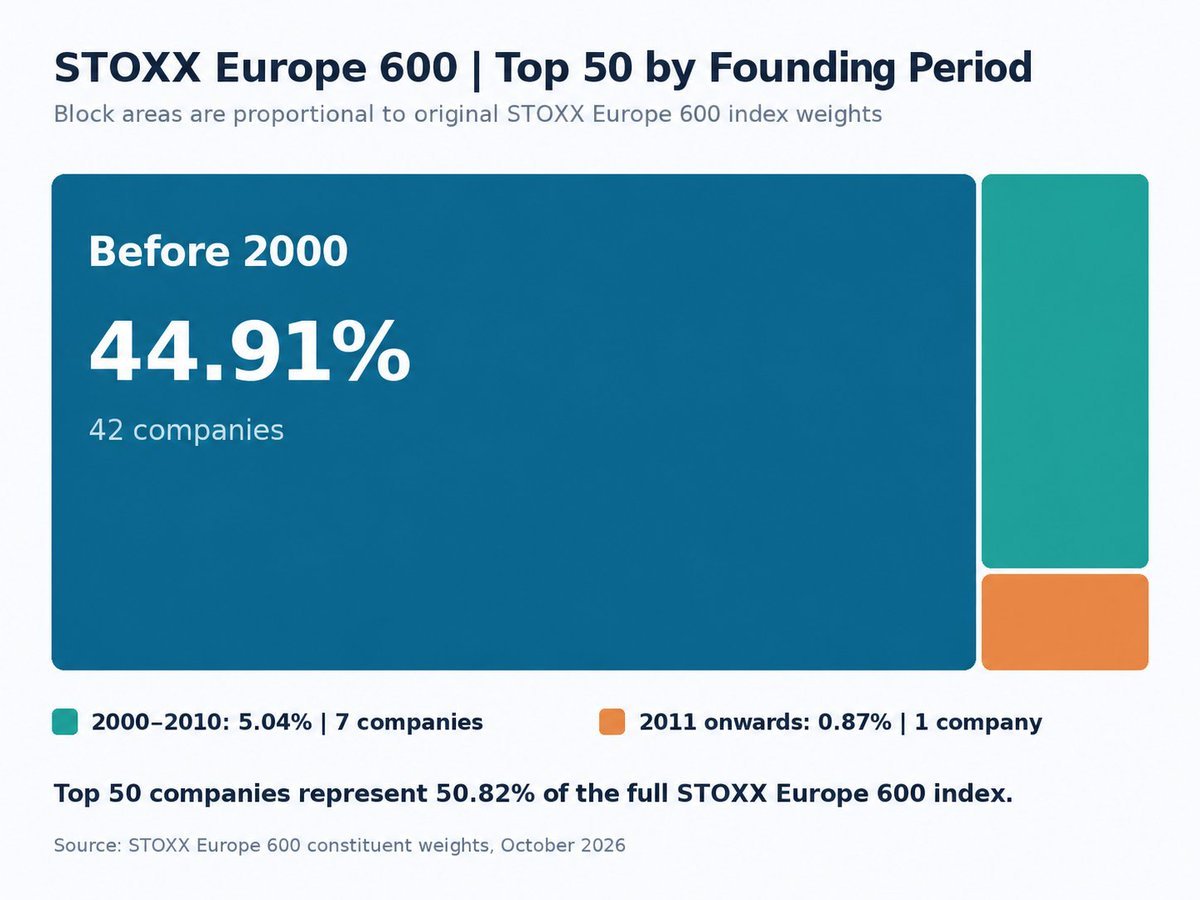
These 50 companies alone represent 50.82% of the entire STOXX Europe 600. The results reveal an interesting picture of Europe's stock market.
Let's start with company age
How old are Europe's largest companies?
The results are striking
Of the 50 largest companies in the STOXX Europe 600
* Before 2000: 42 companies 44.91% of the full index.
* 2000–2010: 7 companies 5.04%.
* 2011 onwards: Just 1 company 0.87%.
In other words, companies founded before 2000 account for almost 45% of Europe's entire 600-company index, even though we examined only the top 50.
Europe's largest listed businesses are still dominated by companies with long histories.
Important: The US chart measures when companies joined the S&P 500. My European analysis uses founding dates. For companies formed through mergers, the formation date of the combined company is used in selected cases.
.
70% of the S&P 500 joined after 1990
This chart shows the share of the S&P 500 by the decade each company joined the index.
70% of the current index weight comes from companies that joined since 1990.
Visible companies by era:
1957: Exxon
1958–79: Intel
1980s: Apple
1990s: Microsoft, Cisco, Micron
2000s: Amazon, Alphabet, Nvidia
2010s: Meta, AMD, Broadcom
2020s: Tesla
Important: Companies that joined after 1990 are heavily concentrated in technology, electronics, and now AI. Older industrial and energy names still exist in the index, but they make up a much smaller share of total market value today.
Source: @ember_energy
TY
The other map that crosses the Black Sea refers to the Caspian-Black Sea-Europe Green Energy Corridor (Azerbaijan–Georgia–Romania–Hungary). It plans ~1,120 km submarine HVDC cables from Georgia’s coast to Romania, with a total target of 3.9 GW and the first line aimed for 2032.
https://t.co/0hAGxAUqpj
.
Azerbaijan is building a new green energy highway to Europe, under the Black Sea
The Caspian–Black Sea–Europe Green Energy Corridor will carry renewable electricity (solar, wind and hydro) from Azerbaijan through Georgia, then via a submarine cable under the Black Sea to Romania and Hungary.
* Estimated cost: €22.1 billion
* Total capacity: ~4 GW (three 1.3 GW lines)
* First power expected in 2032, full capacity by 2040
* Target export: up to 20 billion kWh per year to Europe by 2040
* Feasibility study is already done. Final investment decision is targeted for 2029. This is Azerbaijan’s biggest step yet to become a major green electricity exporter to the EU.
Bulletin hydrologique hebdomadaire – Situation hydrologique du fleuve Sénégal au 17 sept. 2026, OMVS
Bakel, Matam, Podor, Manantali en baisse ou stable, côte à Saint Louis est en hausse
https://t.co/P7TORup5Uo
.
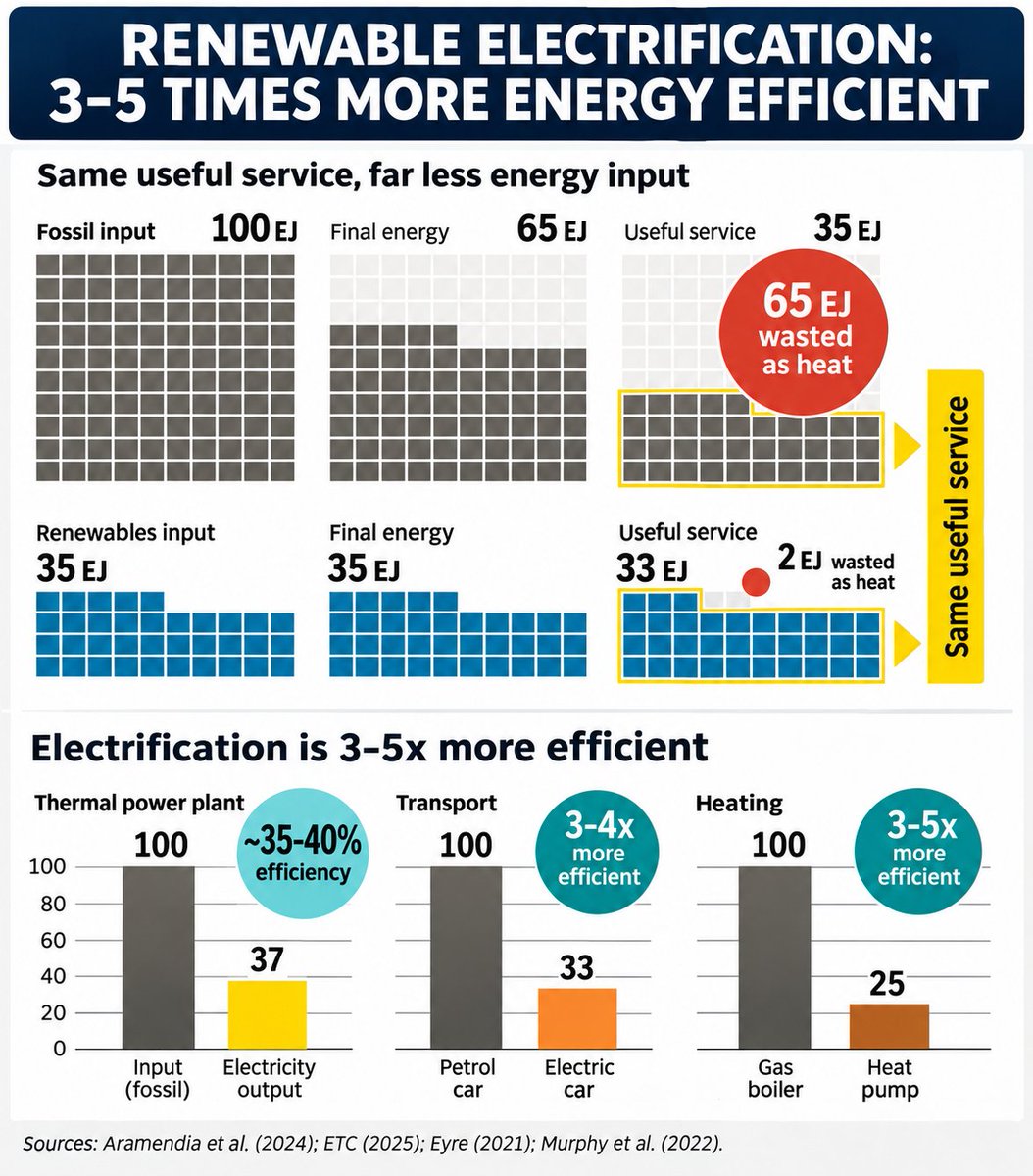
RENEWABLE ELECTRIFICATION: 3–5 TIMES MORE ENERGY EFFICIENT
Renewable electrification can deliver nearly the same useful service with far less energy.
* Fossil fuels: 100 EJ of energy input delivers 35 EJ of useful service, with 65 EJ lost as heat.
* Renewable electrification: 35 EJ of input delivers 33 EJ of useful service, with only 2 EJ lost as heat.
The efficiency advantage is striking:
* Thermal power plants convert only around 35–40% of fossil fuel energy into electricity.
* Electric cars are 3–4 times more energy efficient than petrol cars.
* Heat pumps are 3–5 times more efficient than gas boilers.
The key message here....
Electrification is not just about replacing fossil fuels. It is about delivering the same services while using dramatically less energy.
Sources: @EnergyInstitute
.
New data…
Negative electricity prices are becoming more common across Europe.
The number of hours with negative power prices has risen sharply in several countries between 2022 and 2024, and early 2026 data shows the trend continuing in some markets
--- Spain stands out with a dramatic jump, reaching ~700 hours in 2026 so far.
--- Germany, the Netherlands, Belgium and France also saw strong increases, with hundreds of negative-price hours in 2024.
--- Poland, Lithuania and the UK followed a similar upward pattern, though at lower absolute levels.
--- Ireland remains the clear exception, with relatively few negative-price hours.
Negative prices typically appear when renewable generation (especially solar and wind) is high and demand or export capacity is limited. The rapid growth in these hours reflects both rising renewable penetration and the growing challenge of balancing supply in high-renewables systems.
Source: @IEA
.
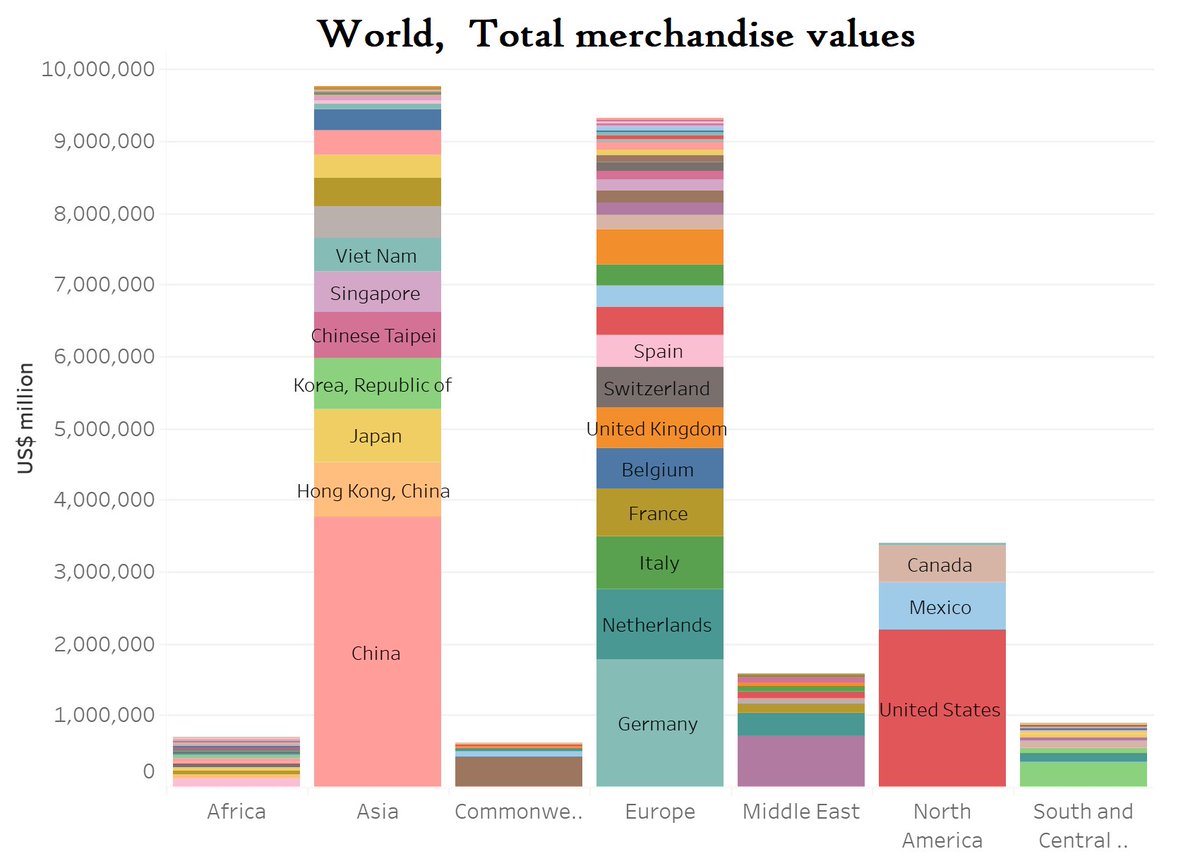
Nice chart: who actually exported the goods in 2025
World merchandise exports: $26.3 trillion.
China alone: $3.77 trillion.
That is more than the United States ($2.19T) and Germany ($1.76T) put together, and bigger than every country in North America combined.
The Asia bar is basically China, then Hong Kong, Japan, Korea, Taiwan, Singapore, Vietnam. The Europe bar looks almost as tall, but a lot of that is EU countries selling to each other.
Strip out intra-EU trade and extra-EU exports are about $3.0 trillion.
Source: @wto
.
Global built-up areas are projected to expand dramatically by 2050
Urban expansion is accelerating worldwide, with the total built-up area expected to grow by over 50% in the next 25 years!!!
Interestingly, high-income and upper-middle-income countries continue to dominate the largest share of this physical footprint, while low-income nations show a much slower horizontal expansion rate.
Source: @WorldBankGroup
🇦🇿🇹🇷🇦🇿🇹🇷🇦🇿🇹🇷🇦🇿🇹🇷
“The TANAP of Electricity” is officially signed.
On 10 November 2026 at COP31 in Antalya, Türkiye, Azerbaijan, Georgia and Bulgaria signed a Strategic Partnership Agreement on Clean Energy. Turkish Energy Minister Alparslan Bayraktar calls it the TANAP of electricity.
The goal is clear: move renewable electricity generated in Azerbaijan (and potentially the wider Caspian region) along the Azerbaijan–Georgia–Türkiye–Bulgaria route into European markets. It focuses on grid integration, cross-border clean power trade, secure transmission and long-term regional energy cooperation. The countries plan to start by using and upgrading existing infrastructure rather than building everything from scratch, with an initial capacity target of around 1 GW.
This builds on work started in 2024 and an MoU signed in Baku in April 2025. It is a concrete political step toward positioning Türkiye as a cleaner energy transit hub, similar to its role with natural gas via TANAP.
On the speculation that it may never materialize: There has been legitimate caution. Earlier analyses flagged open questions around financing, realistic capacity, and delivery timelines. Some observers noted that while the political framework is advancing, commercial structures, detailed feasibility work, and funding still need to be locked in before major construction can begin. Related gas infrastructure has also faced financing headwinds in Europe. Signing the agreement is progress, but it is still an early-stage project rather than a fully financed, shovel-ready corridor.
.
Striking…
Refusals to deceased organ donation remain very high in some countries
The 2024 data show large differences across countries in the share of families refusing deceased organ donation.
Top 10 highest refusal rates
1. Bangladesh 90%
2. Kazakhstan 87%
3. Oman 84%
4. Türkiye 81%
5. Qatar 76%
6. South Africa 73%
7. Malaysia 71%
8. Thailand 69%
9. Switzerland 66%
10. Dominican Republic 64%
What about more populous countries?
Among countries with other larger populations, refusal rates are also striking:
- Germany — 49%
- United Kingdom 42%
- United States 31%
- Mexico 29%
- Spain 23%
- Italy 34%
This means the challenge is not limited to specific countries. In several large-population countries, family refusal is still a major barrier to deceased organ donation.
Improving awareness, trust, and communication with families is critical to increase organ donation.
Source: GODT 2024
🇰🇷🇰🇷🇰🇷🇰🇷🇰🇷
MAJOR BREAKTHROUGH FOR THE WORLD!
South Korea’s solar-powered aircraft stayed in the sky for over 7 days!
South Korea announced a major aerospace achievement on ***November 11, 2026***
Its solar-powered unmanned aircraft, EAV-4, completed a nonstop flight lasting 170 hours and 5 minutes during August 18–25.
That is more than 7 days without landing or refueling, breaking South Korea's previous record by over three times and ranking second worldwide behind Airbus's Zephyr.
Why does this matter?
--- Flying at 20 km: These aircraft can operate in the stratosphere as pseudo-satellites, supporting communications, surveillance and disaster monitoring.
--- Solar power day and night: Solar panels generate electricity during the day, while batteries keep the aircraft flying at night.
--- Real-world applications: During the flight, EAV-4 demonstrated wildfire detection and tracking using advanced cameras.
--- Next-generation aviation: South Korea also unveiled plans for a ₩1.09 trillion project to develop four prototypes of a five-seat hybrid vertical takeoff aircraft by 2032.
South Korea is pushing beyond chips, smartphones and cars, and into the future of aerospace technology.
Source: @with_KASA