

Top Tweets for #conserve3

🦇HIGHLIGHTS from #Conserve3🦇
Lovely #bat graphic here from @jason_hideki summing up #conservation actions in forests in Okinawa #Japan. Great presentation for #WBTC1

5/5 #WBTC1 #Conserve3
Conservation actions we recommend based on our results ⬇️
1) reduce understory thinning
2) don’t 🪓 forests along streams
3) retain more old-growth forests and snags to promote more 🌳 cavities
4) don’t 🪓 Apr to early Aug when 🦇 are🤰🏻🤱🏻


Animals that feed on nectar are nectarivorous.
#WBTC1 #Conserve3
Researcher Guillermo Vázquez talks about how artificial light at night #ALAN affects nectarivorous bat, Geoffroy's tailless bat.
Read about his study, done using captive #bats
https://t.co/GP7cOHgLYJ

1 #WBTC1 #Conserve3
#Light_pollution caused by anthropogenic sources of artificial light at night (#ALAN) is a global conservation issue because it disrupts the circadian system of animals, causing negative effects on their behavior, physiology, and ecological interactions.


Great presentation to learn more about conservation actions to protect 🦇species in the #Conserve3 sesion of the #WBTC1
5/5 #WBTC1 #Conserve3
Conservation actions we recommend based on our results ⬇️
1) reduce understory thinning
2) don’t 🪓 forests along streams
3) retain more old-growth forests and snags to promote more 🌳 cavities
4) don’t 🪓 Apr to early Aug when 🦇 are🤰🏻🤱🏻
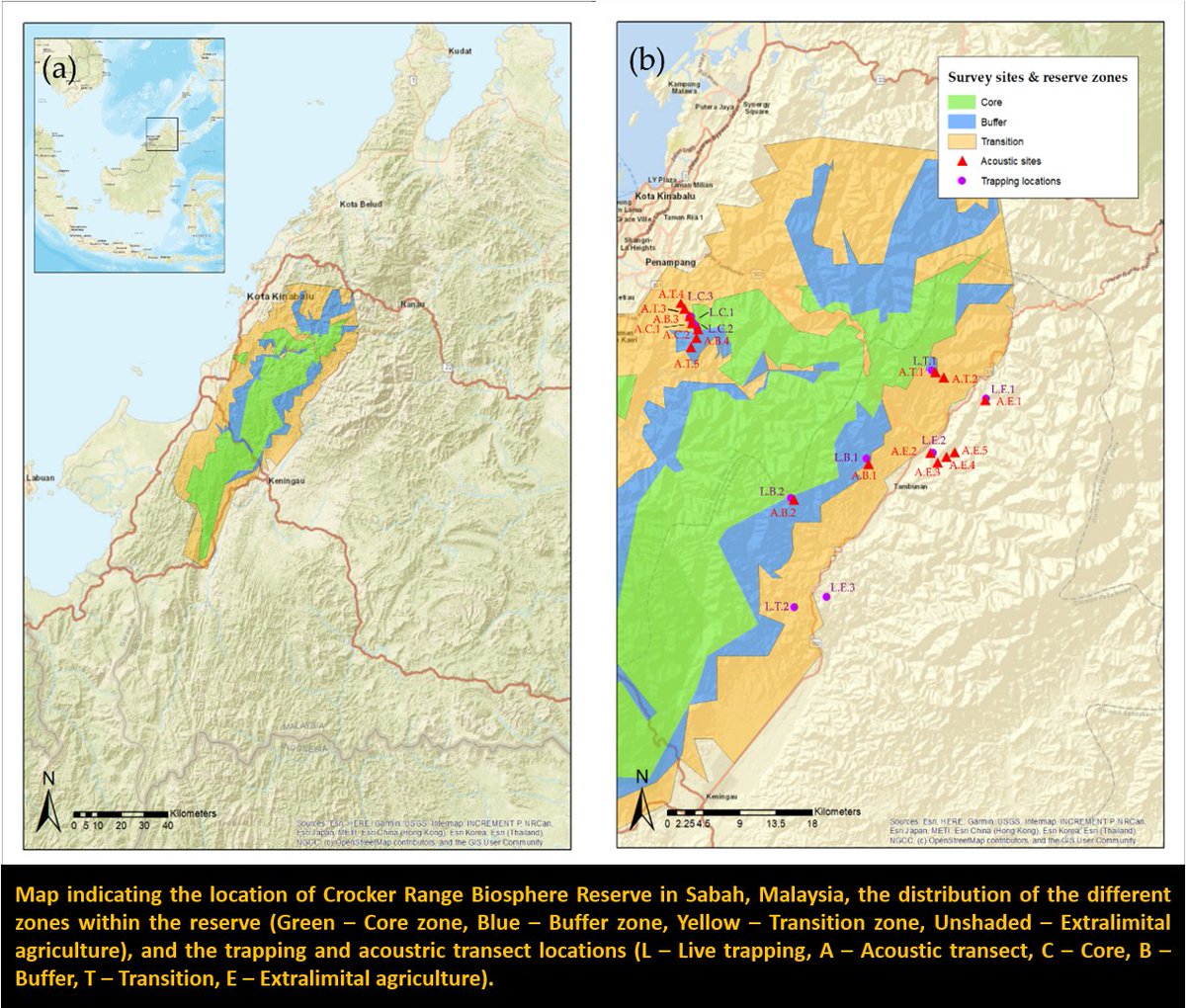
#WBTC1 #Conserve3 Bat researcher, @isham_azh talks about the protection of bat diversity in various functional zones of Biosphere Reserves.
Read about the study based in Crocker Range Biosphere Reserves (CRBR), Sabah, Malaysia.
https://t.co/XZg0GDFH07

1/5 #WBTC1 #Conserve3 Biosphere reserves buffer protected habitats with zones of limited use, but do these zones protect🦇diversity? We surveyed🦇in core, buffer, transition and extralimital zone in Crocker Range Biosphere Reserves (CRBR), Sabah, Malaysia. https://t.co/vNJMinh7KQ
5/5 #WBTC1 #Conserve3
Conservation actions we recommend based on our results ⬇️
1) reduce understory thinning
2) don’t 🪓 forests along streams
3) retain more old-growth forests and snags to promote more 🌳 cavities
4) don’t 🪓 Apr to early Aug when 🦇 are🤰🏻🤱🏻
4/5 #WBTC1 #Conserve3
Finally able to find natural maternity roosts, we assessed our data and prior records. ♀ tube-nosed and whiskered 🦇s are likely in their sensitive repro period (🤰🏻🤱🏻) from Apr to early Aug. Whiskered 🦇data in particular still needed
3/5 #WBTC1 #Conserve3
Whiskered 🦇s were harder to track, but also solitary except for maternity 👩👧👦
🌳cavity-specialist & ALL roosts were directly on streams in forests >70 yo despite other seemingly available habitat.
Maybe specific habitat needs are why this 🦇 is so rare?
2/5 #WBTC1 #Conserve3
Solitary tube-nosed 🦇s roosted mostly in understory🍃
Maternity colonies 👩👧👦 roosted higher and more often in 🌳 cavities. Avg colony size ~6 (2–15). 🦇s switched roosts near daily even when in colonies & all roosts were in forests 30+ yo

1/5 #WBTC1 #Conserve3 Hello from Okinawa 🇯🇵!
We tracked #endangered Ryukyu tube-nosed 🦇 and #criticallyendangered Yanbaru whiskered 🦇 roosts to guide forestry & #conservation of these endemic forest #bats.
日本語訳は返信にあります!

#WBTC1 #Conserve3
Bats are susceptible to infections by microscopic parasites, coccidians. @Yangochiroptera studied the presence of coccidia in Guatemalan bats.
Check it out -
https://t.co/exVjOPw80K

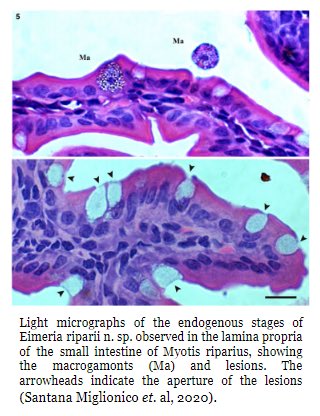
1/5 #WBTC1 #Conserve3 Guatemalan bat populations are understudied regardless of its importance in ecosystems. Coccidians are common parasites amongst vertebrates and can cause asymptomatic to severe infections which can lead to a health risk in free living populations. 🦇 are



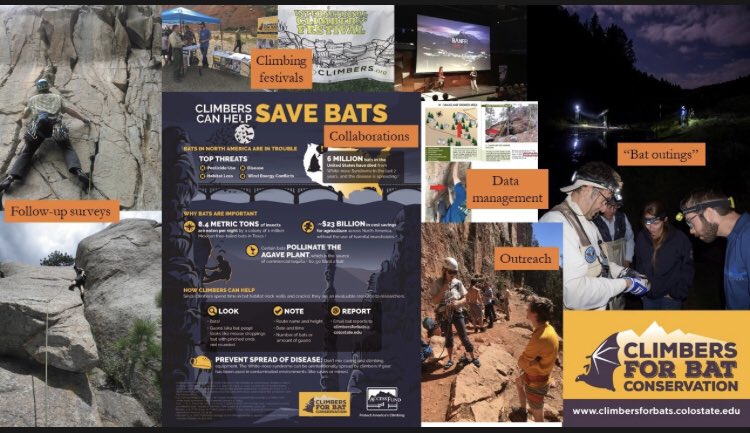
5/5 #WBTC1 #Conserve3 Next steps: online data portal for data submission; visit routes where climbers have seen 🦇; engage with climbers at festivals and show them bats; and collaborate with climbing orgs! See a 🦇while climbing, let us know! email: [email protected]
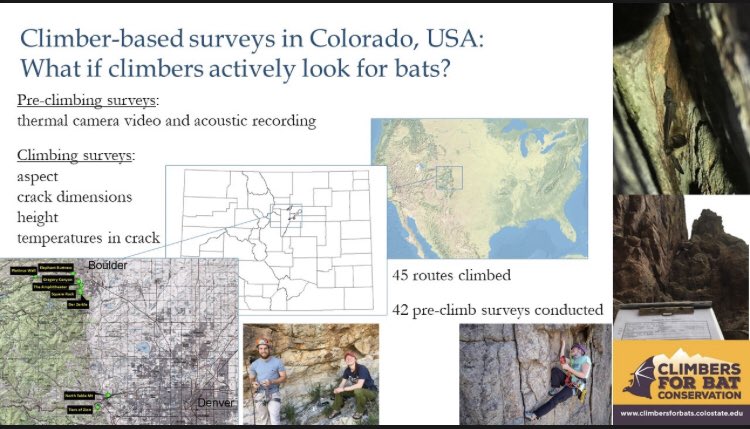
4/5 #WBTC1 #Conserve3 What if you hire climbers to look for bats? 50 km W of Denver, Colorado, USA. Pre-climbing surveys and climbing surveys. 42 pre-climb surveys, 45 climbing. 2 🦇 found: Myotis evotis, Eptesicis fuscus. 1cm cracks, east-facing, 10–12m high
3/5 #WBTC1 #Conserve3 Climbers see 🦇in natural rock roosts. Currently 70 records from 12 states, UK, Bulgaria, Norway. Most are of single 🦇, but a few of 100s and 1000s of bats. We now have climbers as surveyors and ambassadors for 🦇conservation.
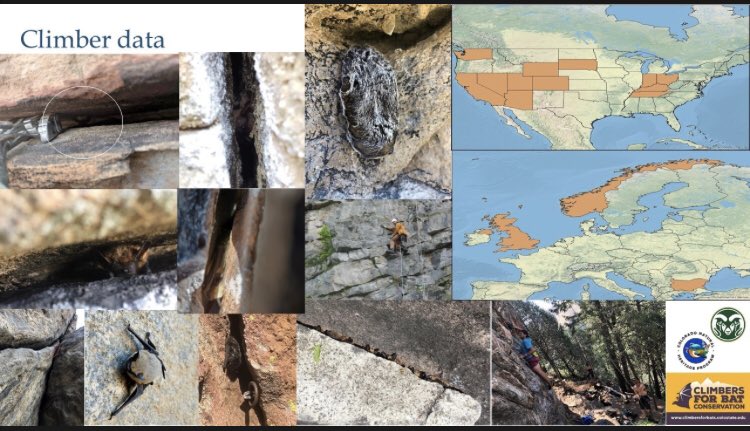
2/5. #WBTC1 #Conserve3 Climbers for Bat Conservation is a collaboration among #climbers, biologists, and land managers (@SOGES_CSU, @accessfund, @USFWS, @petzl_fondation, @COParksWildlife, @WGFD) to understand where bats roost and where populations might be.

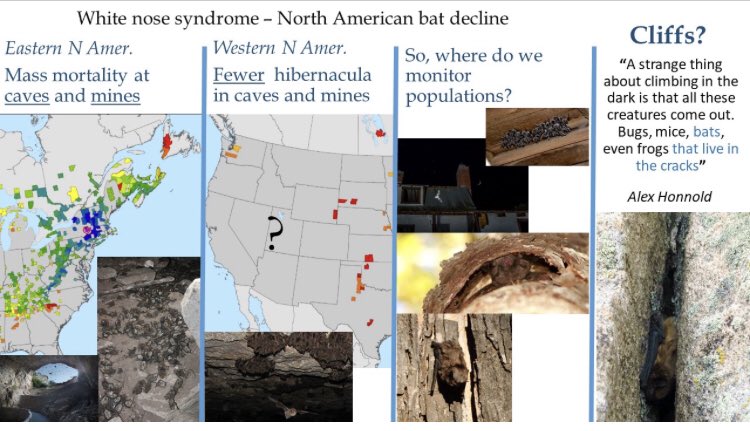
1/5. #WBTC1 #Conserve3. I’m Rob Schorr @ColoradoStateU. When WNS hit eastern NAmer, #bats mortality was obvious. When WNS hit western NAmer, mortality was much less obvious. Fewer cave/mine hibernacula in the West. Where should biologists monitor 🦇? Maybe cliffs! 🤔
Animals that feed on nectar are nectarivorous.
#WBTC1 #Conserve3
Researcher @g_vazquezd talks about how artificial light at night #ALAN affects nectarivorous bat, Geoffroy's tailless bat.
Read about his study using captive #bats
https://t.co/GP7cOHgLYJ
1 #WBTC1 #Conserve3
#Light_pollution caused by anthropogenic sources of artificial light at night (#ALAN) is a global conservation issue because it disrupts the circadian system of animals, causing negative effects on their behavior, physiology, and ecological interactions.
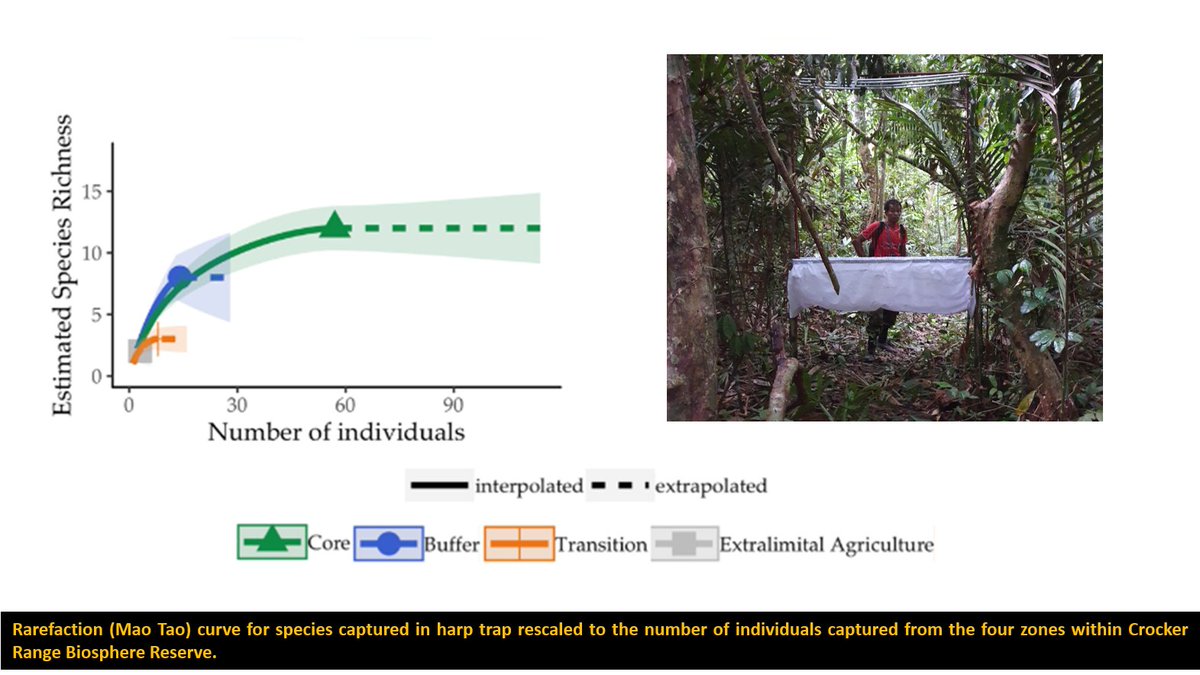
5/5 #WBTC1 #Conserve3 🦇 ensembles differ in response to use zones in tropical biosphere reserves. Forested zones (core and buffer) must be retained for forest-interior spp., but other zones are as important for other ensembles. Collectively, these zones protect 🦇 diversity.
4/5 #WBTC1 #Conserve3 Forested zones (core and buffer) protect sensitive forest-dependent species. Pteropodids were captured across all zones but higher diversity and abundance recorded from extralimital zones.

3/5 #WBTC1 #Conserve3 There was variability in 🦇 activity & call structures from all 4 zones. Forest-interior 🦇 dominated core while open space 🦇 dominated transition and extralimital zones. Edge-foraging 🦇 detected in all zones except the core. See https://t.co/7LaMF3mxW5

2/5 #WBTC1 #Conserve3 We captured 30 🦇 species. 23/30 species were exclusively captured in the forested zones (core and buffer). Capture using harp trap was greater in forested zone (core & buffer). Mist net captures was greater in transition and extralimital.


Last Seen Hashtags on Sotwe
snapchat
Seen from United States
incest drunk
Seen from Malaysia
çankaya
Seen from United States
TWallFoundation
Seen from United States
firfam
Seen from United States
ebonyincest real
Seen from United States
AIart
Seen from Japan
anxiouspanda
Seen from Turkey
DesigningtheFuture
Seen from United States
candid()********************** +filter:native_video
Seen from Ukraine
Most Popular Users

Elon Musk 
@elonmusk
241.7M followers

Barack Obama
@barackobama
119M followers

Cristiano Ronaldo
@cristiano
114.4M followers

Donald J. Trump
@realdonaldtrump
111.9M followers

Narendra Modi
@narendramodi
107.2M followers

Rihanna
@rihanna
98.7M followers

NASA
@nasa
92.4M followers

Justin Bieber
@justinbieber
91.8M followers

KATY PERRY
@katyperry
90M followers

Taylor Swift
@taylorswift13
83.9M followers

Lady Gaga
@ladygaga
75.4M followers

Virat Kohli
@imvkohli
73.4M followers

Kim Kardashian
@kimkardashian
70.9M followers

YouTube
@youtube
68.8M followers

Neymar Jr
@neymarjr
66.4M followers

Bill Gates
@billgates
65.2M followers

Selena Gomez
@selenagomez
63.1M followers

The Ellen Show
@theellenshow
62.3M followers

CNN
@cnn
61.8M followers

X
@x
60.7M followers