

Top Tweets for #cyberHealth

Bipul is 100% on the money here re: (1) attacker economics changing, (2) detection window shrinking and (3) resilience mattering more than ever.
These issues are also true for personal #cyberhealth, and more consequential for business leaders.
1. Attacker economics - individuals (especially executives) used to be non-viable. With AI, that equation clears. This is even more true with AI's ability to reason that you're linked to a more valuable asset, your employer.
2. Detection windows shrinking - critical service providers (Google, Telcos, Apple) are not equipped to respond to an incident at this speed. AI-driven comprises will rampage a personal stack while you chat with a bot orf wait on hold.
3. Resilience - is your password management near perfect to quarantine a compromised credential? Is your recovery a Hotmail you havent checked in years? Among others, these are questions vital to getting answered BEFORE an attack happens

"Will AI cause Armageddon?" is the wrong question.
The discussion about the threats that AI might pose has taken on an apocalyptic tone: will it extinguish life on Earth? Will it destroy humanity? It won’t, but it poses some far more real dangers to us all—right now, not in some imagined future. In the next couple of years, we are likely to face a new wave of rampant, pervasive cyberattacks and cybercrime.
As the recent series of attacks by AI agents show, we no longer need to speculate about whether AI can conduct cyberattacks. It can. The important question now is what happens when attacks that once required skilled human beings can be conducted by machines, at machine speed and machine scale.
For most of cybersecurity’s history, we have built defenses around an unstated assumption: the attacker is human. A person—or a team—has to inspect a system, find a weakness, exploit it, see what happens and decide what to do next. That takes time. Detection therefore buys time. Defenders spot an intrusion and respond before the attacker gets much further.
Frontier AI attacks that assumption.
An agent does not need to sleep. It can inspect code, probe a network, hit a barrier, devise another approach and try again. Make a thousand copies and they can work against a thousand targets at once. Allow agents to share what they learn and hacking begins to change from a human-scale activity into a machine-scale one.
At Rubrik, we are seeing part of this transformation firsthand. Through our participation in Anthropic’s Project Glasswing, one lesson became clear. AI is not necessarily creating new vulnerabilities. It is collapsing the cost and time required to discover them.
That changes the economics of cybersecurity.
Modern software may contain thousands of small imperfections. Most lead nowhere. A few, combined in the right sequence, open a path through a supposedly secure system. Historically, finding those chains required talented people, lots of time and some luck. Frontier models can increasingly do the searching themselves, discovering paths through complex systems that humans might never find.
This is what makes complacency about the new threat so dangerous.
In 1998 a group of hackers appeared before Congress and warned that the rapidly expanding internet contained vulnerabilities capable of producing enormous disruption. There was no single cyber Armageddon. Instead North Korea crippled Sony Pictures. WannaCry raced through more than 200,000 computers in roughly 150 countries, disrupting hospitals and factories. NotPetya began as a Russian attack on Ukraine and caused about $10 billion in damage worldwide. Ransomware shut down Colonial Pipeline and disrupted fuel supplies across the American east coast.
It would be strange to look at that history and conclude that the warnings were overblown. The catastrophe did not arrive as one spectacular event. Cyber insecurity became a permanent condition.
Now imagine that condition at machine speed.
That is why “Will AI cause Armageddon?” is the wrong question. A hospital whose systems are encrypted, a bank that loses control of its identities, or a company that cannot recover its data doesn’t care much whether civilization remains intact. The question is whether AI can make attacks faster, cheaper, more sophisticated and vastly easier to replicate.
We are beginning to get the answer.
Cyber-defense therefore has to change as well. For years the industry has concentrated on prevention and detection: keep the attacker out and, failing that, spot him quickly. Both remain essential. But when attacks operate at machine speed, detection may no longer buy enough time. Intrusion, exploitation and damage can begin to collapse toward the same instant.
Companies must assume that some attacks will succeed. They need to be able to recover just as fast.
The answer is not less AI. It is more AI on the defensive side: continuously hunting vulnerabilities, watching identities and data, detecting abnormal behavior, patching weaknesses and helping restore compromised systems. Machine-speed attacks require machine-speed defense.
There has always been an asymmetry in cybersecurity. An attacker has to be right once. A defender has to be right every time. AI makes that imbalance more dangerous because attackers do not need permission, compliance reviews or perfect systems. They need only find one opening—and now they can search for it continuously, cheaply and at an enormous scale.
Criminal groups and hostile governments will use this technology. They would be foolish not to.
The first generation of cybersecurity was built to stop human beings sitting at keyboards. That world has ended. The next attack may be launched by thousands of agents, moving at a speed no human team can match.
If the hackers are becoming machines, our defenses must become machines too.
From a #cyberhealth perspective, Instinct is a hard no.
On the positive side, their policy is 100% forthcoming.
However, the access they require comes with responsibility I would not bestow on any company.
For those who desire speed or the "current thing" if you want to be on the bleeding edge, be prepared to bleed from time to time...


Anyone know who is behind Instinct? Are folks not concerned about privacy, security?

Another day and more firms who don't invest in employee #cyberhealth are eating it.
THIS. IS. PREVENTABLE.

GOOGLE WARNS OF HACKING CAMPAIGN TARGETING WALL STREET
Google says ransomware hackers have targeted dozens of major U.S. financial firms using phone-based social engineering to steal employee credentials.
Hackers created fake IT helpdesk websites targeting firms including Blackstone, Apollo, KKR, TPG, CME Group, Moody's, Bridgewater and Bain Capital.
Google said some victims paid ransoms, though it did not identify them. The campaign relied on convincing employees to reveal passwords and MFA codes rather than advanced hacking techniques.

There is a #cyberhealth angle to this story. Wes was contacted on LinkedIn by the extortionist.
Poor LinkedIn config and lack of security training.
@mikebelshe score 1 point for your company LinkedIn policy :)

A co-founder of Fortress Investment Group was revealed to be an alleged target in a $1 billion extortion plot.
https://t.co/O1mf7O5aeS

Uusin Tivi-lehden kolumnini. Aihe josta kävin hiljattain Tukholmassa puhumassa #kyberterveys #cyberhealth

I love the research from @nickgraynews! Calling attention to an important #cyberhealth topic. Without addressing every detail in his post, two counterpoints:
1. Generally speaking, the "it takes 30 seconds to pierce that" premise misunderstands 95% of attacks. Nick's research capabilities are the wrong hurdle. Top of criminal funnel is incredibly automated. Friction disqualifies you from that funnel. For ~95% of people, relative excellence is the goal, not 'bulletproof.' Attackers business model dictates they move on to easier targets. I still believe this advice is relevant to the top 5%.
2. For the higher net worth category, where we specialize, there is an implicit assumption of a single residence. This is almost never the case. His research is correct that bureaucracy does not favor anonymity. However, license, voting registration, etc can all remain on a previous doxxed address rather than converting over to the new private one. (I do agree is RETROACTIVELY making a home private is minimally effective. Data does not go back in the toothpaste tube. My comments apply to purchasing a new home).
Overall, agree with @eastdakota. Tactical advice: use a trust > authorized signer who is NOT you or a family member. Ideally an attorney with ACP.
DMs open if you want to go deeper privately :)

Should you buy your house in a trust or an LLC?
I spent a week researching this and read through everyone's comments on my original post
The answer is: Probably not
I'll tell you what I found. Note that this applies to Austin, Texas so ymmv for other locations
I talked to my real estate attorney, got quotes from a trust attorney, and ran the math and stats with various LLMs
The answer I kept landing on is that a trust solves a much smaller problem than people think and you give up real money to get it
Here's what I found
(1) Your name is only hidden from Zillow
If you make a trust or an LLC to buy your house, congratulations. Zillow and Redfin and the easy "owner lookup" sites won't show your name. But it takes about 30 seconds to pierce that.
Your County Clerk office likely has a free public website. You type in any name and it pulls up every deed that person ever signed, including ones where they signed "as trustee." So if a deed said "Cliffside Oaks Trust" but the trustee signed as their real name, anyone searching that name finds the house instantly.
I tested this on a few well-known people in Austin who I knew bought their houses in trusts. I found their addresses in a couple of clicks.
The trust didn't hide them at all. It just hid them from the lazy version of the search.
The fix is to use a "nominee trustee," usually an attorney, whose name goes on the deed instead of yours. That works. But it costs a bit more, there's more paperwork to manage, and there's a bigger problem coming in point 2.
(2) Permits get filed under your real name
This is the one that surprised me most.
When you do any work on the house, the contractor pulls a permit with the city. HVAC, electrical, water heater, roof, pool, or any type of addition. The permit application usually requires the property owner's real name and contact info, and that becomes public record.
I have a friend in Houston who spent a lot of money on a privacy LLC. Then he had an HVAC tech come out, the tech filed the permit under my friend's actual name, and the whole privacy structure was instantly defeated. That document that the HVAC technician files is now public forever.
You can fight this by always requiring contractors to file under the trust name. But you have to remember every single time, with every contractor, for every job, for as long as you own the house. That sounds a little annoying to me.
(3) Driver's license data is for sale
Your driver's license is linked to your home address. In Texas, the DPS sells that data to data brokers. I haven't personally bought a record, but multiple people told me it's in the $5 range, and Texas is one of the more permissive states about this.
So even if your deed is clean, even if your permits are clean, your DL still ties your name to your address. And every data broker has it.
The same thing applies to voter registration (public record in Texas), vehicle registration, and your insurance billing address. There are six or seven independent leak vectors and the deed is just one of them.
(4) Using a PO box for everything is the only real fix, and I'm not doing it
If I really wanted to scrub our address, I'd need to put a commercial mail-forwarding address (not a USPS PO box, because DPS won't accept those for a driver's license) on:
- My driver's license
- Voter registration
- Vehicle registration
- Banking and insurance billing
- Amazon and every package delivery
- Every online account I've ever made
And then I'd have to keep it that way. Forever.
If I buy something from a random Instagram ad, that company likely sells my customer data, and the address gets back into a broker's database somewhere. So I'd also need a data-broker scrubbing service running constantly.
That's a real lifestyle. People do it. Billionsiares do it! But I'm not going to. Which leads me to my final point…
(5) I'm just not that important
I don't own crypto. I don't have stalkers. I'm semi-public on the Internet but not the kind of public where someone is likely going to drive to my house and say something mean to my face.
The people who actually need this level of privacy are crypto whales, maybe judges, and people with active threats.
I am, thankfully, none of those
So if I were buying a house tomorrow, I'd buy it in my own name.
I'd file the homestead exemption and keep a few thousand dollars a year in property taxes I would have otherwise lost. Plus I'd avoid the upfront legal fee for the trust and all the paperwork for a thin charade of ownership.
Here are a few critiques I expect, and my answers. Please correct me if I'm wrong!
(1) "What about asset protection if you get sued?"
A revocable trust gives you zero protection from creditors. Zero. The grantor (you) can pull the assets back, so a court can too. Only an irrevocable trust offers asset protection, and irrevocable means you actually give up control of the asset, which is a much bigger decision than people realize. If asset protection is your goal, a trust isn't the right tool. An umbrella insurance policy is.
(2) "What about probate and your family if something happens to you?"
This was the strongest argument for a trust and I took it seriously. Texas has independent administration, which makes probate way simpler than in California or New York. And Texas allows a Transfer-on-Death Deed for about $25 that lets the house pass directly to a spouse or heir without probate at all. So the "avoid probate" benefit of a trust is real but small in Texas, and there's a $25 alternative that does most of the same work.
(3) "Just use a Wyoming or New Mexico anonymous LLC."
This came up a lot on replies to my original post. The pitch is: form an anonymous LLC in a state that doesn't require listing the members, register it as a foreign entity in Texas, and put the house in that. It is real privacy on the deed. The deed shows the LLC name, the LLC's home state doesn't publish who owns it, and a casual search dead-ends.
But in Texas there's a big tax cost bc you lose the homestead exemption.
The Texas homestead exemption is a property tax break for people who live in their home as their primary residence. You file a one-page form with the county appraisal district, and it knocks a chunk off your taxable value (the school district portion alone is $100,000 off the assessed value as of 2024) and caps how much your appraised value can go up each year at 10%, no matter what the market does.
On a 2M house in Austin, that's worth roughly a few thousand dollars a year, and the savings scale up from there. On a 5M house in a fast-appreciating neighborhood, the 10% cap alone can be worth tens of thousands of dollars a year once a few years of appreciation compound.
LLCs don't qualify. Texas law requires the property to be owned by a "natural person" (or a qualifying trust with very specific language). The second you put the house in an LLC, the exemption goes away. You also pick up annual franchise tax filings, registered agent fees, and a more complicated refinance and resale process forever.
And the LLC still doesn't fix the permit, driver's license, voter, or insurance leaks I described above.
So you're paying ongoing money and giving up real tax benefits to fix one of seven leak vectors.
Now, if you live in a state without a homestead exemption (or with a small one), the math is very different and the anonymous LLC route might actually make sense.
Florida, Texas, and a handful of other states have meaningful homestead protections that punish you for moving the house out of your personal name.
California, New York, and most of the country don't, so the tax cost of an LLC is much lower there. Run your own numbers for your own state before copying anyone's playbook, including mine.
If you're thinking about doing this for your own house, the question to ask yourself is: am I going to go all the way? PO box on the driver's license, scrubbers running, every contractor briefed, every permit reviewed?
If yes, the trust is one piece of a real strategy.
But if no, the trust by itself is mostly theater, and you're paying real money for the costume.
The end! Good luck and not legal advice etc
I love the research @nickgraynews! Calling attention to an important #cyberhealth topic. Without addressing every detail, two counterpoints:
1. Generally speaking, the "it takes 30 seconds to pierce that" premise misunderstands 95% of attacks. Nick's research capabilities are the wrong hurdle. Top of criminal funnel is incredibly automated. Friction disqualifies you from that funnel. For ~95% of people, relative excellence is the goal, not 'bulletproof.' Attackers business model dictates they move on to easier targets. I still believe this advice is relevant to the top 5%.
2. For the higher net worth category, where we specialize, there is an implicit assumption of a single residence. This is almost never the case. Your research is correct that bureaucracy does not favor anonymity. However, license, voting registration, etc can all remain on a previous doxxed address rather than converting over to the new private one. (I do agree is RETROACTIVELY making a home private is minimally effective. Data does not go back in the toothpaste tube. My comments apply to purchasing a new home).
Overall, agree with @eastdakota. Tactical advice: use a trust > authorized signer who is NOT you or a family member. Ideally an attorney with ACP. As you know, happy to go deeper privately :)
AI shouldn’t modify your browser environment in the dark.
Whether we call it spyware or not, the pattern is clear: agentic systems are crossing boundaries humans never approved.
#Cyberhealth governance is no longer optional.

LISTENING IN: Privacy Researcher Finds Anthropic’s Claude Desktop App Installs Undisclosed Native Messaging Bridge
DO YOU HEAR ME NOW?
A detailed technical analysis published by privacy and security researcher Alexander Hanff has raised serious concerns about Anthropic’s Claude Desktop application for macOS. Hanff, whose work is frequently referenced by Chief Privacy Officers and cybersecurity professionals, discovered the issue while auditing Native Messaging helpers on his own MacBook.
According to the blog post, installing the Claude Desktop app automatically deploys a Native Messaging manifest file named com.anthropic.claude_browser_extension.json into the support directories of multiple Chromium-based browsers.
This occurs even for browsers the user has never installed or does not use!
The manifest file references a local binary located inside the https://t.co/wOrSj0VaXG bundle at /Applications/Claude.app/Contents/Helpers/chrome-native-host. This binary functions as a bridge that allows pre-authorized browser extensions to communicate directly with the Claude Desktop app outside the browser’s sandbox, operating at full user privilege level via standard input/output.
Key technical findings include:
•The bridge pre-authorizes three specific Chrome extension IDs.
•It is designed to remain dormant until activated by one of those extensions.
•The manifest files are automatically recreated every time the Claude Desktop app launches, making permanent removal difficult.
•Installation activity is logged in ~/Library/Logs/Claude/main.log, with timestamps confirming the files were written regardless of whether the browsers were present or supported.
Hanff notes that the silent installation without user disclosure or consent is the central issue.
Privacy, Security, and Potential Legal Implications.
Corporations should not only note this but assume this is taking place.
The researcher characterizes the behavior as “pre-installed spyware capability” for several reasons:
•No clear notification or opt-in is provided to users during installation.
•The process modifies configuration files across multiple browser vendors and creates directories for non-existent browsers.
•Once active, the bridge could potentially expose authenticated web sessions (e.g., banking, email, or health portals), read decrypted page content, or enable automation.
•The generic naming and automatic re-creation obscure the mechanism, resembling “dark patterns.”
Hanff further contends that the practice may violate Article 5(3) of the EU’s ePrivacy Directive, which requires explicit consent before storing or accessing information on a user’s device.
In response, he has issued a formal Cease and Desist letter to Anthropic, demanding that the company update the app to require explicit user opt-in (for example, only after the corresponding Chrome extension is installed) within 72 hours, or face further legal action.
This revelation highlights ongoing challenges in the AI industry as companies develop increasingly “agentic” tools that require deep system and browser access.
While such technical bridges are sometimes necessary for advanced functionality, transparency, documentation, and user control are considered essential by privacy advocates.
Anthropic as expected has not issued a public statement addressing the specific allegations.
Users who have installed Claude Desktop on macOS are advised be sure they like this idea.
I sure don’t.
Alexander Hanff’s full technical analysis: https://t.co/GSNNLeL81S

Love how fired up Mike is about this topic! More CEOs should care about employee #cyberhealth.
If you’re a security or business leader, thinking about how personal risk can spill into the enterprise, get in touch with us
Cc: @cyber_health_co

The fact is that people are bad at security.
Back when I ditched @linkedin , I decided to create a fake account just to see how the hackers can do what they do. I have a fake profile, fake pic, fake job history. From time to time I just keep adding people until LinkedIn tells me I have to wait a few days. At first it was a little slow, but once you've built a few connections, the acceptance rate gets better and better. And LinkedIn has done nothing despite my obviously fake account.
I've accumulated hundreds of friends now - almost entirely from crypto security companies - our competitors. People are people. They accept the invites, even when it is someone they don't know. Sales people send me messages. Recruiters try to recruit me. Engineers ask me if we worked on particular projects together. Executives and managers seem to be most anxious to accept my fake friendship.
All of these people should know better. But they are human, it's not their fault. Like moths to the flame, they accept my potentially dangerous connection.
On the good news side, my fake profile has zero friends that are active bitgo employees. That's not because @bitgo people are necessarily smarter (well they probably are!), but mostly because we banned them from linked in and protected them from themselves.
#banlinkedin

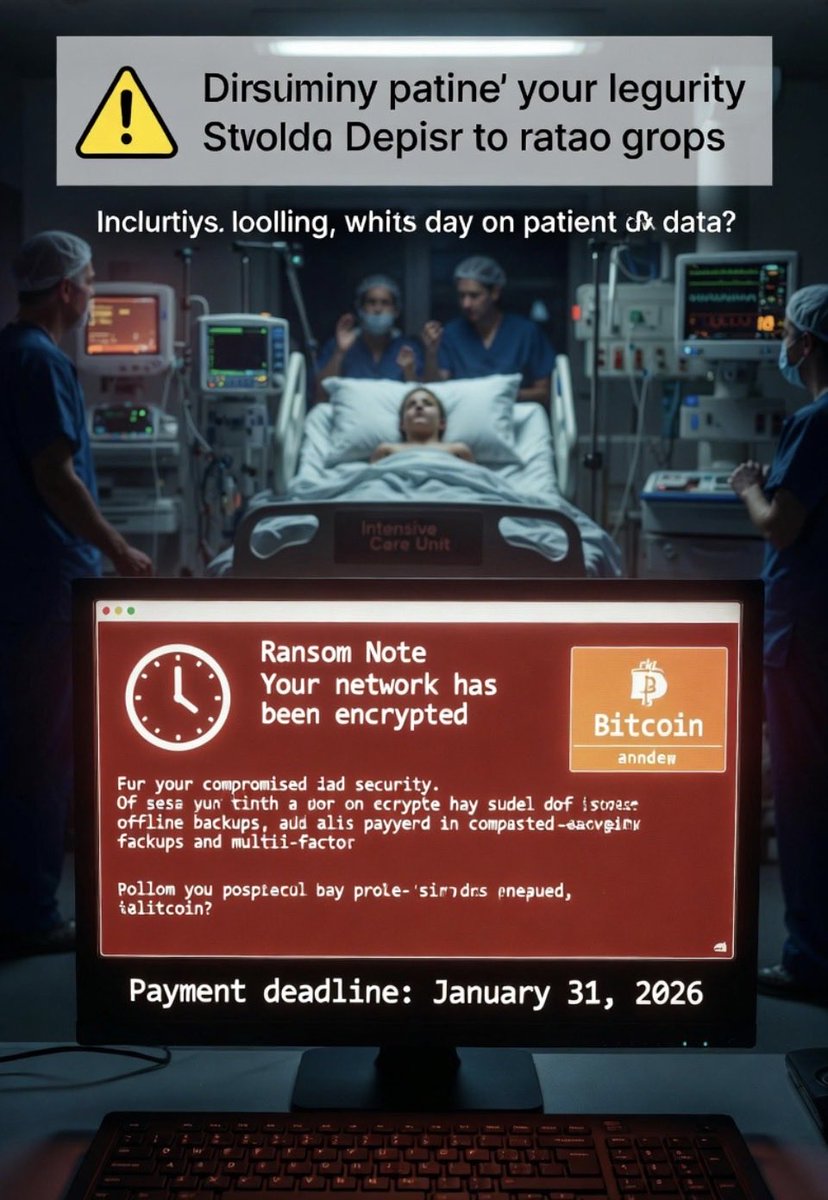
2026: Ransomware hits healthcare hardest — 27 incidents in Jan alone. Average ransom demand up 40%. Patient data & kids in ICU at risk.
#OpChildSafe: Zero tolerance — offline backups, MFA everywhere, segment networks.
Protect the vulnerable.
🕊️🔥 #Ransomware #CyberHealth
Easy #cyberhealth win #33: Turn off all email notifications on @Spotify
Why: We're passionate about reducing notification noise and prevent unnecessary data collection about your habits and engagement.
Steps: Spotify on iOS > Account > Settings and Privacy Notifications > Uncheck ALL email notifications

Easy #cyberhealth win #29: Remove your birthday and anniversary date from @opentable
Why: A potential gesture from OpenTable or a partner restaurant is not worth the permanent surrender of this information. You can't take it back
Steps: Opentable > Profile > About You > Important Dates > Birthday > scroll all the way up above Jan and all the way up above 1 > repeat for anniversary

Easy #cyberhealth win #22: disable Personal Hotspot when not in use
Why: Even if you have a complex password and have to approve each new device, there is some marginal chance of unauthroized connection. Not being discoverable is a superior default position.
Steps: Settings > Personal Hotspot > Allow Others to Join > Off

Easy #cyberhealth win #20: delete your reviews in @googlemaps
Why: this privacy leak gives cookie crumbs for attackers. They may use it to inform spearphishing attacks or even target old service providers directly to extract personal information
Steps: Google Maps on iOS > Click icon top right > Your profile > Reviews > ... Delete Review

Easy #cyberhealth win #16: opt out of data sharing from American Express.
Why: There is no benefit to having your data harvested. By default, you are opted into this. It is extractive. Amex hides the opt out by not having it in their mobile app.
Steps: Login on https://t.co/1ygDPpQab5 (you cannot do this on the app) > ☰ (top right) > My Account > Account Services > Security and Privacy > Privacy Preferences > Data Use and Sharing Choices > Uncheck both > Save Preferences

Easy #cyberhealth win #15: turn off cloud syncing on Google Authenticator
Why: Google's MFA product is excellent. The only concern is that it links to your Google account by default. Should your Google account be compromised, your MFA codes can be exported.
Steps: Google Authenticator > Profile (button in top right) > Use without an account > Continue

Easy #cyberhealth win #14: opt out of Data for Generative AI Improvement on LinkedIn
Why: There is no benefit to being included in training data. It is extractive. By default, you are opted into this.
Steps: Linkedin > Settings > Data Privacy > Data for Generative AI Improvement > Use my data for training content creation AI models > Off

Easy #cyberhealth win #13: disable Apple Intelligence from "Summarizing" notifications
Why: I remain skeptical of Apple's commitment to privacy with Apple Intelligence. The power to summarize notifications = the access to the data from any app that gives notifications.
Steps: Settings > Notifications > Apple Intelligence > Summarize Notifications > Toggle off

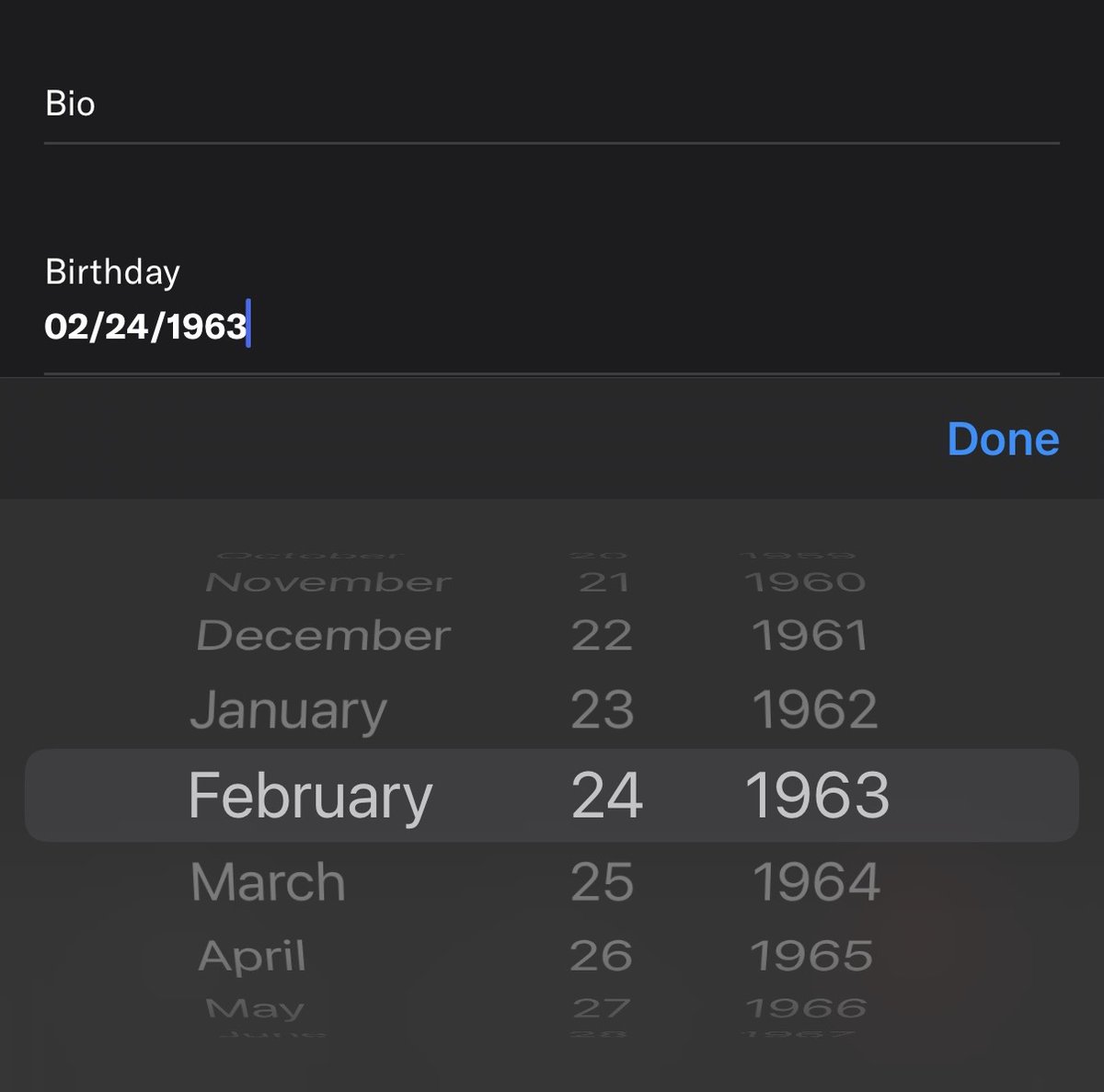
Easy #cyberhealth win #12: randomize your birthday on your Resy profile
Why: it's not clear when Resy shares this with restaurants, but this is leaking PII with no upside. Worst case scenario, a bankrupt restaurant liquidates assets including customer data they've collected.
Steps: open Resy on iOS > Account > Settings (gear icon in top right) > Profile > Birthday > Set to random
Last Seen Hashtags on Sotwe
Most Popular Users

Elon Musk 
@elonmusk
241.5M followers

Barack Obama
@barackobama
118.8M followers

Cristiano Ronaldo
@cristiano
114.6M followers

Donald J. Trump
@realdonaldtrump
111.8M followers

Narendra Modi
@narendramodi
107.1M followers

Rihanna
@rihanna
98.7M followers

NASA
@nasa
92.3M followers

Justin Bieber
@justinbieber
91.8M followers

KATY PERRY
@katyperry
90.1M followers

Taylor Swift
@taylorswift13
84M followers

Lady Gaga
@ladygaga
75.5M followers

Virat Kohli
@imvkohli
73.5M followers

Kim Kardashian
@kimkardashian
70.9M followers

YouTube
@youtube
68.8M followers

Neymar Jr
@neymarjr
66.5M followers

Bill Gates
@billgates
65.3M followers

Selena Gomez
@selenagomez
63.1M followers

The Ellen Show
@theellenshow
62.2M followers

CNN
@cnn
61.7M followers

X
@x
60.7M followers