

Top Tweets for #datastructure

A list where you need a map turns a millisecond lookup into a full scan. Which Java data structure to use and why, with a Big-O cheat sheet.
https://t.co/aRX1huibsu
#Java #DataStructures

Today's LeetCode POTD:
Sum of Squares of Special Elements
Time Complexity: O(N)
Space Complexity: O(1)
Submission Code Link: https://t.co/A9P7JTOrUa
Problem Explanation: https://t.co/mfmNFO3DFt
#LeetCode #DSA #DataStructures #Algorithms #Consistency #POTD #ProblemOfTheDay

Today's LeetCode POTD: Sum of Squares of Special Elements
Time Complexity: O(N)
Space Complexity: O(1)
Submission Link: https://t.co/A9P7JTOrUa
Problem Explanation: https://t.co/mfmNFO3DFt
#LeetCode #DSA #DataStructures #Algorithms #Consistency #POTD #ProblemOfTheDay

Today's Leetcode POTD:
Minimum Add to Make Parentheses Valid
Time Complexity: O(N)
Space Complexity: O(N)
Submission Code Link: https://t.co/NBRMoTW0Cq
Problem Explanation: https://t.co/ZuZ3lwV2bb
#LeetCode #DSA #DataStructures #Algorithms #Consistency #POTD #ProblemOfTheDay
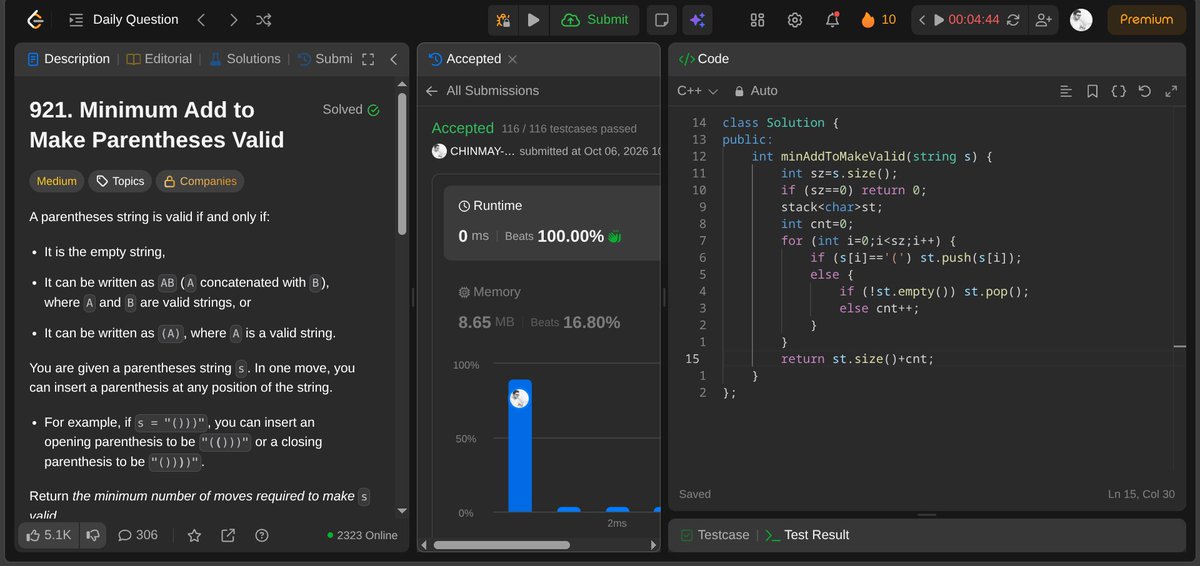
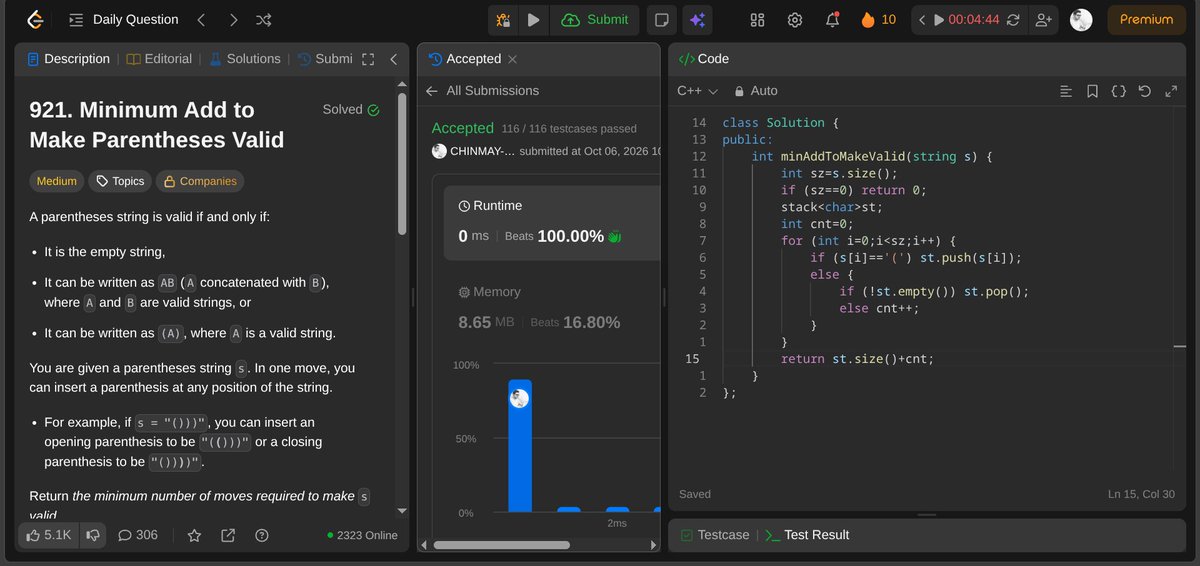
Today's LeetCode POTD:
Minimum Add to Make Parentheses Valid
Time Complexity: O(N)
Space Complexity: O(N)
Submission Code Link: https://t.co/NBRMoTW0Cq
Problem Explanation: https://t.co/ZuZ3lwV2bb
#LeetCode #DSA #DataStructures #Algorithms #Consistency #POTD #ProblemOfTheDay
Problem-Solving Efficiency: A hash map provides efficient solutions for searching
https://t.co/RxV6ixyPY1
#programming #datastructure

Completed Move Zeroes Problem
https://t.co/RKBzU3vVbD
https://t.co/SsQWMNqgHg
#DataStructures #Algorithms #BuildInPublic
Complete Valid Triangle Number Problem
https://t.co/DsRarhBWj7
https://t.co/0CciES68SP
#DataStructures #Algorithms #BuildInPublic
Completed Container with most water problem
https://t.co/EL9WWhPkc3
https://t.co/pLiGDi3pIi
#BuildInPublic #DataStructures #Algorithms
Complete 3Sum problem
https://t.co/uA8990PrjA
https://t.co/1a33HzLVWx
#BuildInPublic #DataStructures #Algorithms
Solved Valid Palindrome
https://t.co/FEbeoVyHhp
https://t.co/43zTL7k85d
#DataStructures #BuildInPublic #Algorithms

Small wins like this remind me that showing up consistently really compounds.
On to the next topic. 🚀
#Java #DataStructures #BuildInPublic #LearningInPublic
One step closer to becoming a better software engineer. 🚀
#Java #DataStructures #BuildInPublic #SoftwareEngineering #meenahcode
It’s interesting seeing how the concepts we’ve learned so far (variables, control structures, loops) are beginning to connect together.
One step closer to thinking like a software engineer. 💻
#Java #DataStructures #Arrays #BuildInPublic #MEENAHCODE

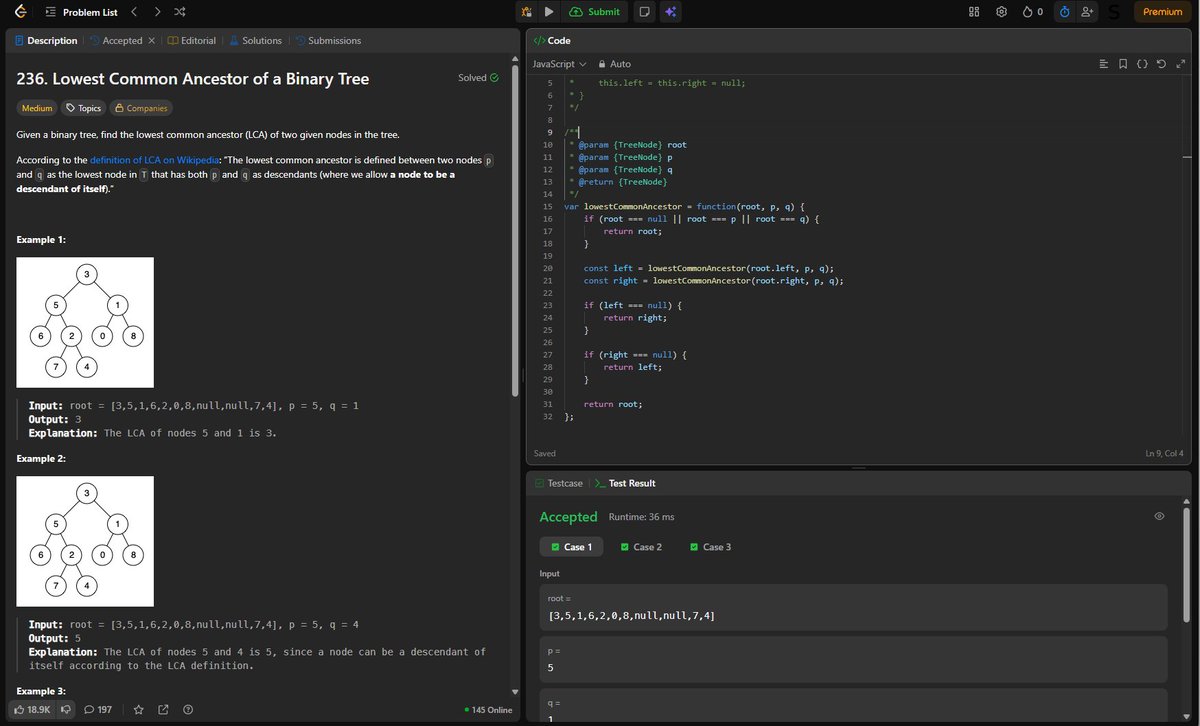
🚀 Day 37 of #SDESheetChallenge
Today's problems focused on advanced Binary Tree traversals and recursive algorithms, covering ancestor queries, structural comparison, and different ways of viewing and traversing a tree.
✅ Lowest Common Ancestor (LCA) in Binary Tree
✅ Check if Two Trees are Identical
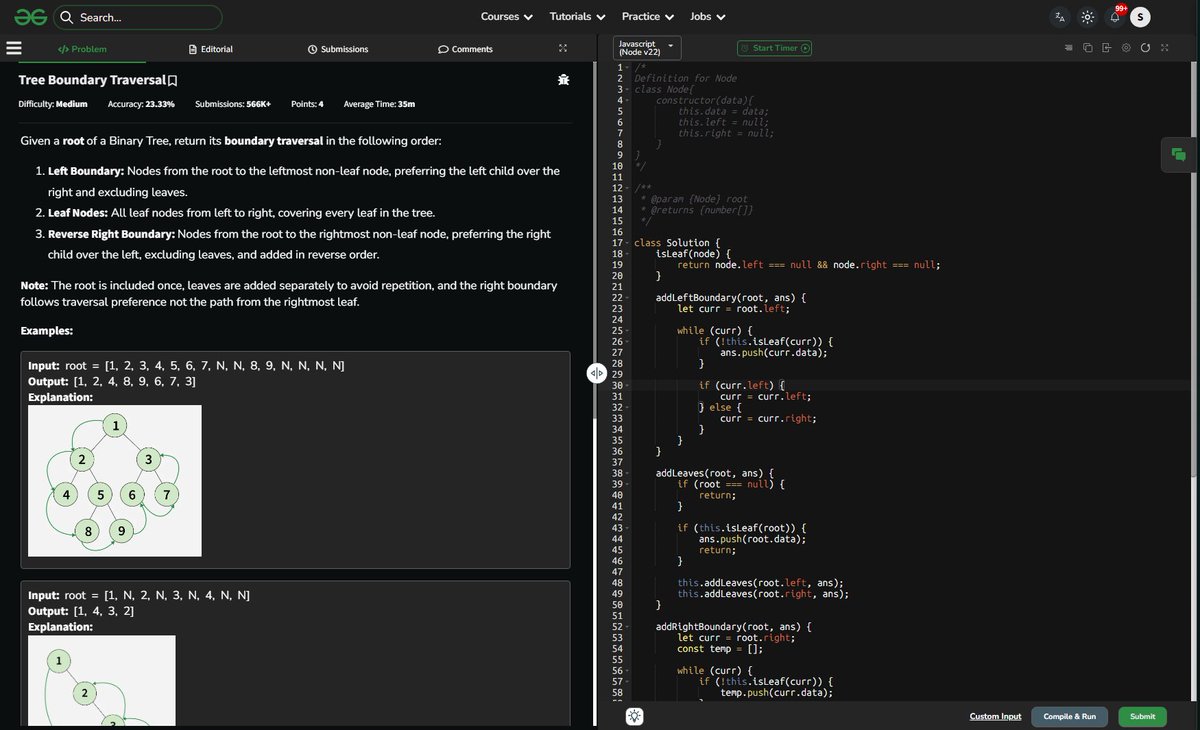
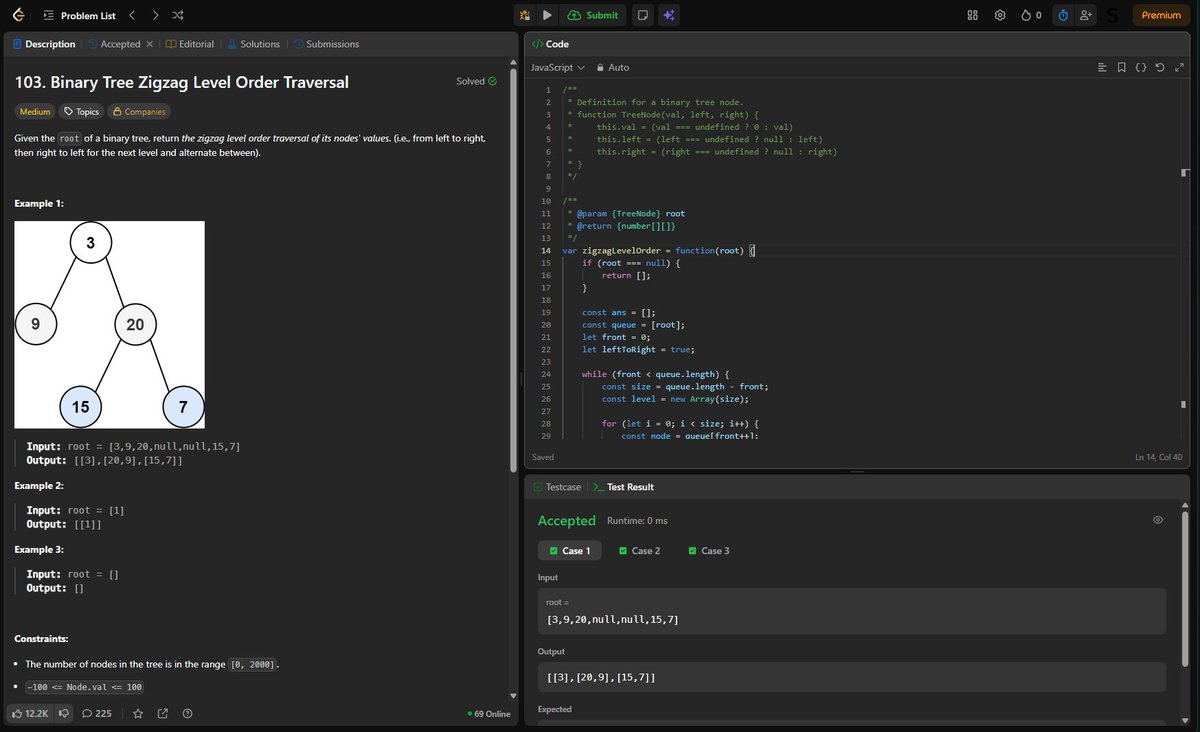
✅ Zigzag (Spiral) Level Order Traversal
✅ Boundary Traversal of Binary Tree
Key Learnings
🔹 Lowest Common Ancestor (LCA) in Binary Tree -
Used recursive DFS to locate both target nodes. The first node where one target is found in each subtree becomes the Lowest Common Ancestor.
🔹 Check if Two Trees are Identical -
Applied recursion to compare both the structure and node values of two trees simultaneously, ensuring every corresponding node matches.
🔹 Zigzag (Spiral) Level Order Traversal -
Extended Level Order Traversal (BFS) by alternating the insertion order at each level, producing the required zigzag traversal efficiently.
🔹 Boundary Traversal of Binary Tree -
Solved the problem by dividing it into three parts: traversing the left boundary, collecting all leaf nodes, and traversing the right boundary in reverse order to form the complete boundary.
Takeaway -
Today's problems demonstrated that many Binary Tree questions can be broken down into smaller, well-defined traversals. Whether identifying ancestors, comparing structures, or generating different tree views, combining recursive thinking with systematic traversal patterns leads to clean and efficient solutions.
@takeUforward_ @striver_79
#SDESheetChallenge #DSA #LeetCode #Programming #SoftwareEngineering #ProblemSolving #CodingJourney #DataStructures #Algorithms #BinaryTree #DFS #BFS #JavaScript

🚀 Day 36 of #SDESheetChallenge
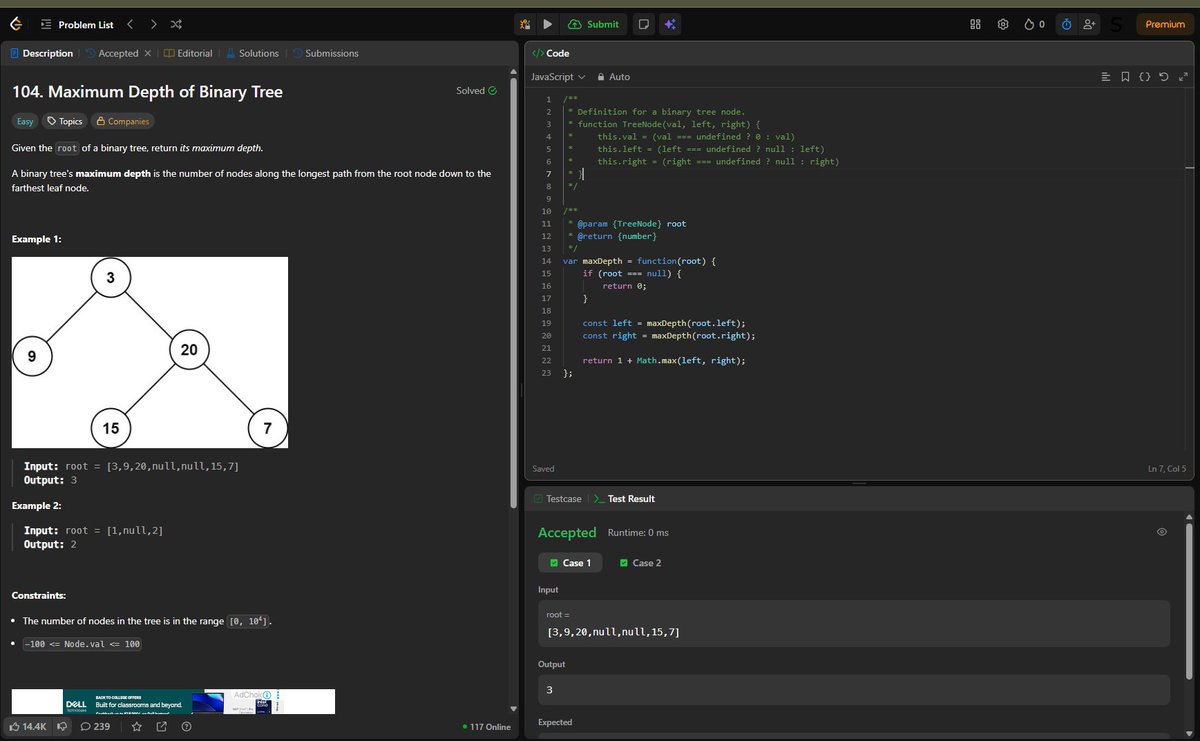
Today's problems focused on fundamental Binary Tree properties, covering level-based traversal and recursive techniques for measuring and validating tree structure.
✅ Level Order Traversal
✅ Maximum Depth of Binary Tree
✅ Diameter of Binary Tree
✅ Check for Balanced Binary Tree
Key Learnings
🔹 Level Order Traversal -
Applied Breadth-First Search (BFS) using a queue to traverse the tree level by level, grouping nodes based on their depth.
🔹 Maximum Depth of Binary Tree -
Used Recursion (DFS) to compute the height of the left and right subtrees, returning the maximum depth by combining their results.
🔹 Diameter of Binary Tree -
Optimized the solution by calculating the height and diameter simultaneously during a single DFS traversal, avoiding repeated height computations.
🔹 Check for Balanced Binary Tree -
Implemented an optimized recursive approach that returns -1 whenever an imbalance is detected, allowing early termination instead of traversing the entire tree unnecessarily.
Takeaway -
Today's problems reinforced that many Binary Tree algorithms are built upon the concept of subtree height. By computing heights intelligently during recursion, multiple properties such as depth, diameter, and balance can be determined efficiently in a single traversal, making recursive thinking an essential skill for tree problems.
@takeUforward_ @striver_79
#SDESheetChallenge #DSA #LeetCode #Programming #SoftwareEngineering #ProblemSolving #CodingJourney #DataStructures #Algorithms #BinaryTree #DFS #BFS #JavaScript



🚀 Day 34 of #SDESheetChallenge
Today's problems continued my journey through Binary Trees, focusing on different ways to visualize a tree and exploring another space-optimized traversal technique.
✅ Morris Preorder Traversal
✅ Right / Left View of Binary Tree
✅ Top View of Binary Tree
✅ Bottom View of Binary Tree
Key Learnings
🔹 Morris Preorder Traversal -
Learned the Morris Traversal technique for preorder traversal, achieving O(n) time and O(1) extra space by temporarily creating and removing threaded links instead of using recursion or a stack.
🔹 Right / Left View of Binary Tree -
Used Depth-First Search (DFS) with level tracking to capture the first node encountered at every level, depending on the traversal order (right-first for right view and left-first for left view).
🔹 Top View of Binary Tree -
Applied Breadth-First Search (BFS) along with horizontal distances to record the first node visible from each vertical line, producing the tree's top view.
🔹 Bottom View of Binary Tree -
Used BFS with horizontal distances while updating the value for each vertical line, ensuring the deepest visible node is retained for the final bottom view.
Takeaway -
Today's problems showed that many Binary Tree view problems are built on the same core ideas - tree traversal and horizontal distance mapping. Choosing the right traversal strategy, whether DFS, BFS, or Morris Traversal, makes it possible to solve these problems efficiently while reinforcing the importance of understanding traversal patterns.
@takeUforward_ @striver_79
#SDESheetChallenge #DSA #LeetCode #Programming #SoftwareEngineering #ProblemSolving #CodingJourney #DataStructures #Algorithms #BinaryTree #TreeTraversal #JavaScript


🚀 Day 32 of #SDESheetChallenge
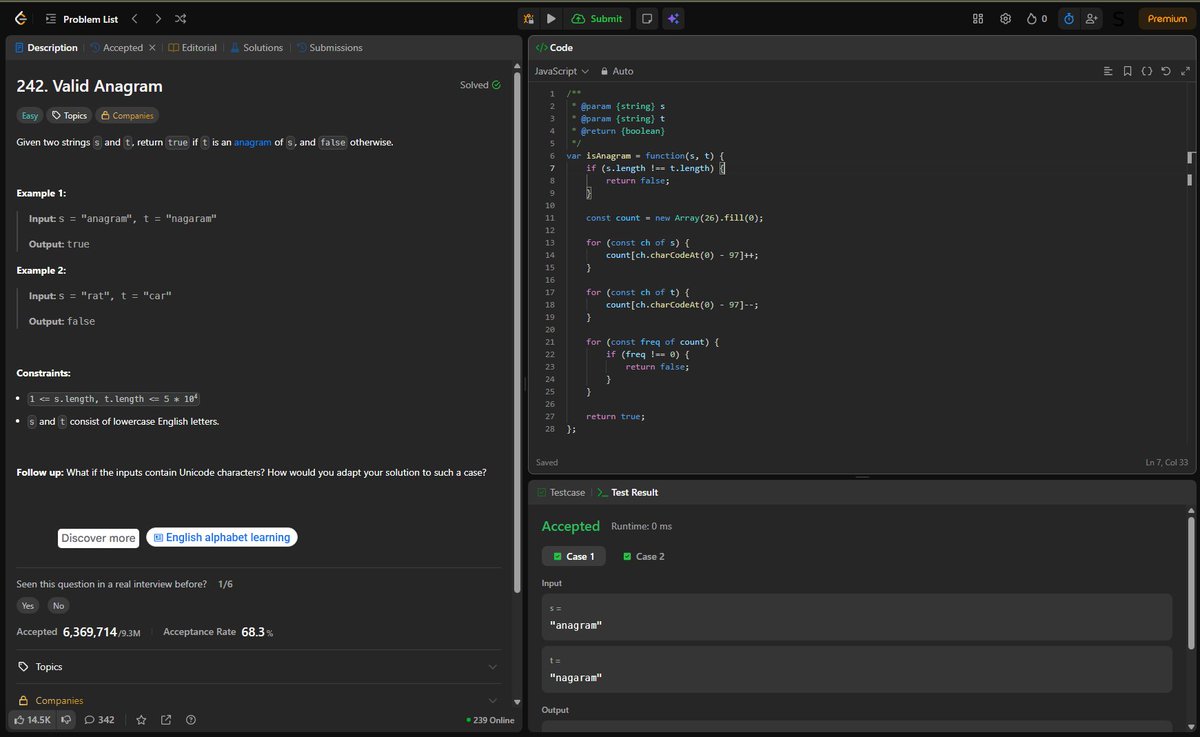
Today's problems focused on String Processing, covering frequency counting, recursive string generation, and parsing techniques for comparing structured strings.
✅ Valid Anagram
✅ Count and Say
✅ Compare Version Numbers
Key Learnings
🔹 Valid Anagram -
Used a frequency array to count character occurrences in both strings. By incrementing counts for one string and decrementing for the other, it becomes easy to verify whether the two strings are anagrams in O(n) time.
🔹 Count and Say -
Implemented a recursive approach where each term is generated by reading the previous term and counting consecutive identical digits. This problem reinforced the concept of recursive sequence generation.
🔹 Compare Version Numbers -
Parsed version strings by splitting them into individual revisions and compared each part numerically while treating missing revisions as zero. This ensures correct handling of cases with leading zeros and different version lengths.
Takeaway -
Today's problems demonstrated that many string-based questions revolve around careful parsing and efficient processing rather than complex algorithms. Techniques like frequency counting, recursion, and structured traversal make it possible to solve a wide range of string manipulation problems cleanly and efficiently.
@takeUforward_ @striver_79
#SDESheetChallenge #DSA #LeetCode #Programming #SoftwareEngineering #ProblemSolving #CodingJourney #DataStructures #Algorithms #Strings #JavaScript



The stack is one of the most fundamental data structures in software, & it works exactly like a pile of plates.
Add to the top, take from the top. You can't pull one from the middle. Last in, first out.
It's how recursion tracks function calls, how parsers match nested brackets, & how Ctrl+Z undoes your most recent action first.
The structure is everywhere. The label is what's missing.
#SoftwareEngineering #DataStructures #webdevelopment
🚀 Day 31 of #SDESheetChallenge
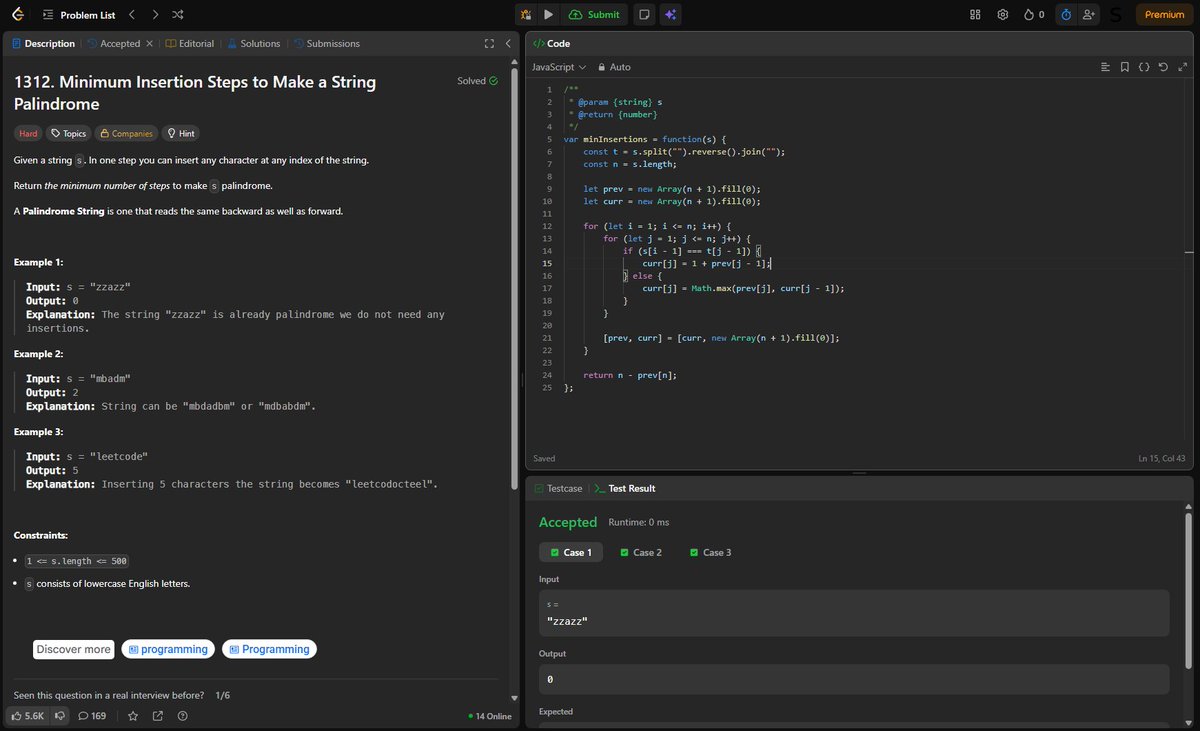
Today's problems focused on Advanced String Algorithms and Dynamic Programming, covering efficient pattern matching techniques and solving palindrome-related optimization problems.
✅ Z Function (Pattern Searching)
✅ KMP Algorithm (LPS Array)
✅ Minimum Insertions to Make a String Palindrome
Key Learnings
🔹 Z Function (Pattern Searching) -
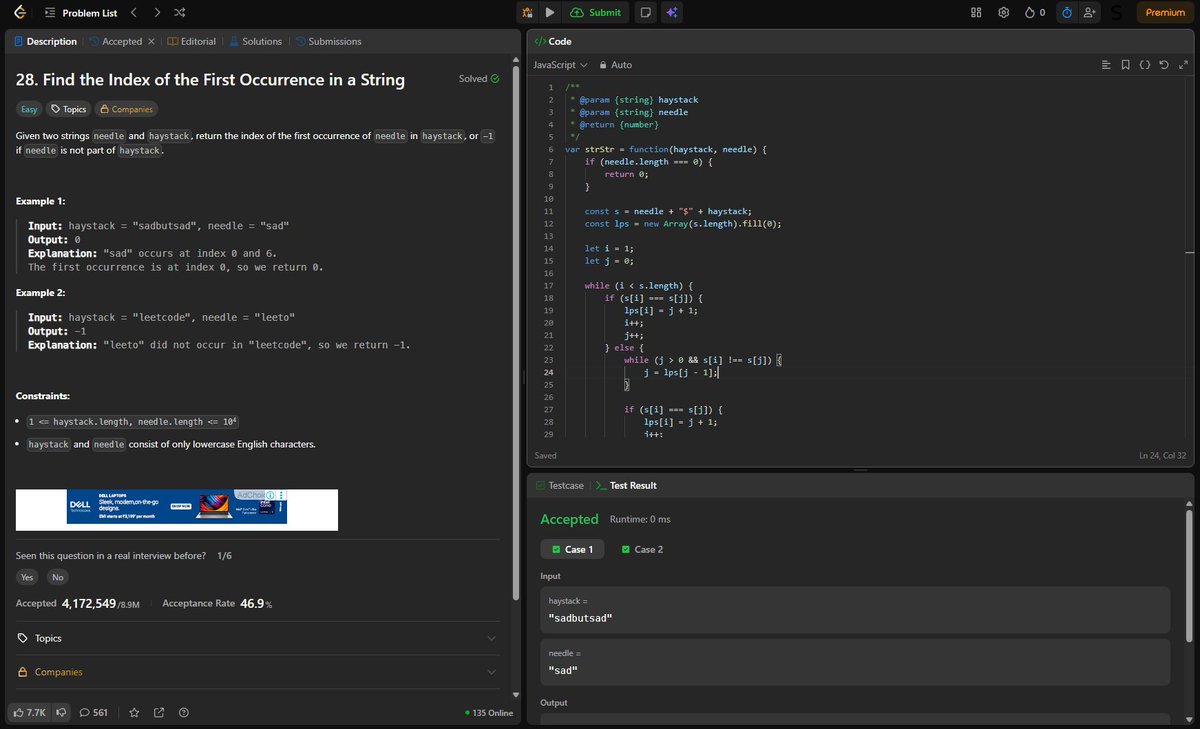
Learned how preprocessing a pattern using the LPS (Longest Prefix Suffix) array enables efficient string matching by avoiding unnecessary comparisons, allowing pattern searching in O(n + m) time.
🔹 KMP Algorithm (LPS Array) -
Implemented the Knuth-Morris-Pratt (KMP) algorithm using the LPS array to perform efficient substring searching without revisiting previously matched characters.
🔹 Minimum Insertions to Make a String Palindrome -
Applied Dynamic Programming by finding the Longest Palindromic Subsequence (LPS) through the Longest Common Subsequence (LCS) approach. The minimum insertions are then calculated as n − LPS.
Takeaway -
Today's problems highlighted the importance of preprocessing and dynamic programming in string algorithms. Whether using the LPS array to optimize pattern matching or leveraging LCS to solve palindrome problems, understanding these underlying techniques helps transform expensive string operations into efficient solutions.
@takeUforward_ @striver_79
#SDESheetChallenge #DSA #LeetCode #Programming #SoftwareEngineering #ProblemSolving #CodingJourney #DataStructures #Algorithms #Strings #DynamicProgramming #JavaScript

🚀 Day 30 of #SDESheetChallenge
Today's problems focused on String Processing and Pattern Matching, covering string parsing, prefix computation, and efficient substring searching techniques.
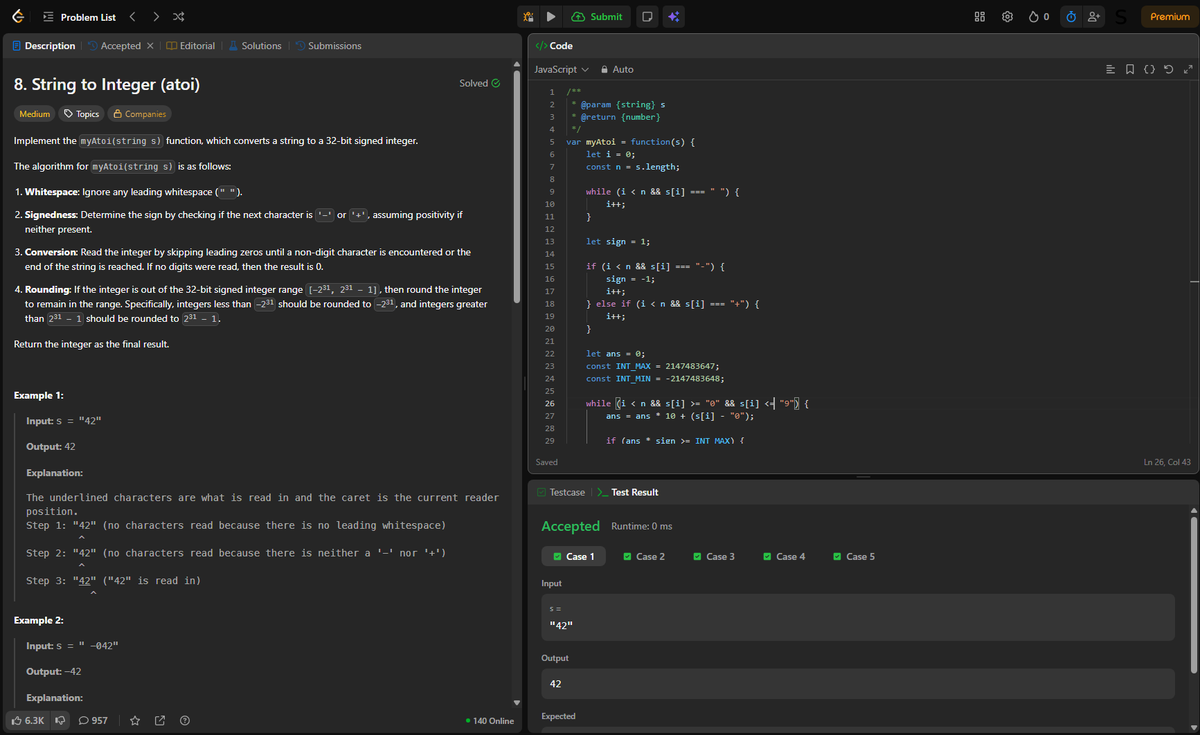
✅ Implement ATOI (String to Integer)
✅ Longest Common Prefix
✅ Rabin-Karp Algorithm
Key Learnings
🔹 Implement ATOI (String to Integer) -
Implemented the string-to-integer conversion by handling leading spaces, optional signs, digit parsing, and integer overflow conditions, closely following the behavior of the standard atoi() function.
🔹 Longest Common Prefix -
Used the observation that sorting the strings places the most different strings at the ends. Comparing only the first and last strings efficiently yields the longest common prefix.
🔹 Rabin-Karp Algorithm -
Learned how Rolling Hashing enables efficient pattern matching by updating the hash value of the sliding window instead of recomputing it from scratch, significantly improving substring search performance.
Takeaway -
Today's problems reinforced that efficient string algorithms often rely on preprocessing and mathematical techniques rather than direct character-by-character comparisons. Understanding concepts like string parsing, lexicographical ordering, and rolling hashes makes it possible to solve complex string matching problems efficiently.
@takeUforward_ @striver_79
#SDESheetChallenge #DSA #LeetCode #Programming #SoftwareEngineering #ProblemSolving #CodingJourney #DataStructures #Algorithms #Strings #JavaScript


🚀 Day 29 of #SDESheetChallenge
Today's problems focused on String Manipulation, exploring techniques like two pointers, expand-around-center, and character mapping to efficiently solve common interview questions.
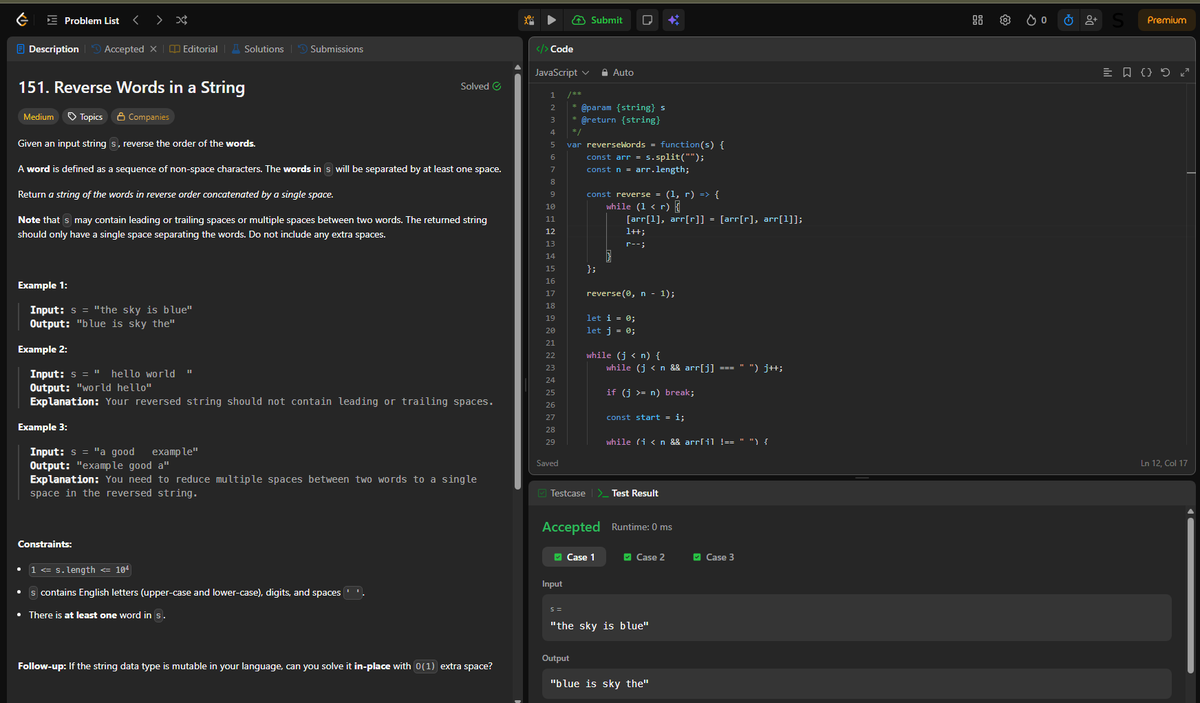
✅ Reverse Every Word in a String
✅ Longest Palindromic Substring
✅ Roman to Integer
Key Learnings
🔹 Reverse Every Word in a String -
Applied the reverse-and-rebuild technique by first reversing the entire string and then reversing each individual word. This approach efficiently handles extra spaces while producing the desired output.
🔹 Longest Palindromic Substring -
Used the Expand Around Center approach to check both odd and even length palindromes, achieving an efficient O(n²) solution without requiring additional space.
🔹 Roman to Integer -
Implemented a character mapping strategy to convert Roman numerals into integers by handling both additive and subtractive notation during a single traversal.
Takeaway -
Today's problems demonstrated that many string-related questions can be solved efficiently by recognizing common patterns such as two pointers, center expansion, and character mapping. Rather than relying on complex logic, applying these techniques systematically leads to clean and optimized solutions.
@takeUforward_ @striver_79
#SDESheetChallenge #DSA #LeetCode #Programming #SoftwareEngineering #ProblemSolving #CodingJourney #DataStructures #Algorithms #Strings #JavaScript


🚀 Day 28 of #SDESheetChallenge
Today's problems focused on Monotonic Stacks and Elimination Techniques, highlighting how maintaining useful information during traversal can significantly improve efficiency.
✅ Stock Span Problem
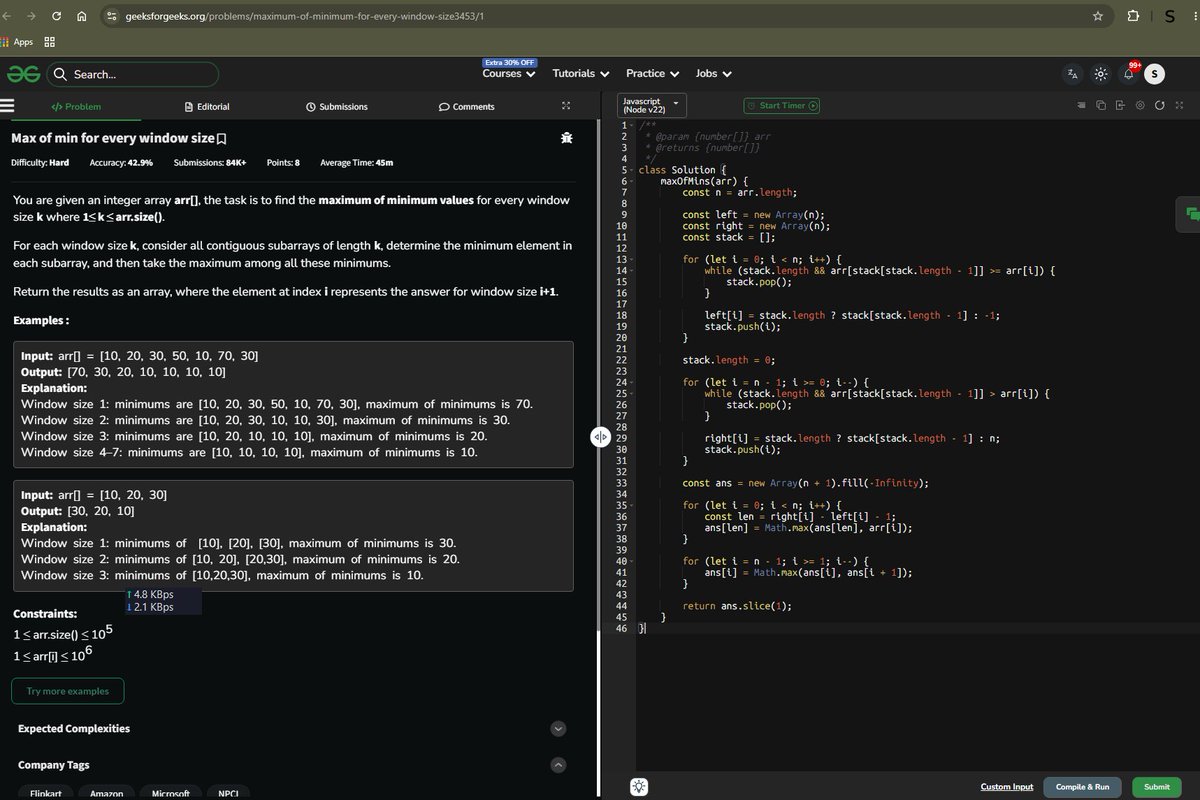
✅ Maximum of Minimums for Every Window Size
✅ Celebrity Problem
Key Learnings
🔹 Stock Span Problem -
Used a Monotonic Stack to efficiently compute the span of stock prices by removing all previous prices that were less than or equal to the current price, achieving an O(n) solution.
🔹 Maximum of Minimums for Every Window Size -
Applied the concepts of Previous Smaller Element (PSE) and Next Smaller Element (NSE) using monotonic stacks to determine the window size where each element acts as the minimum, followed by post-processing to construct the final answer efficiently.
🔹 Celebrity Problem -
Used the Two-Pointer Elimination Technique to narrow down the celebrity candidate in linear time, followed by a verification step to confirm whether the candidate satisfies the celebrity conditions.
Takeaway -
Today's problems reinforced that maintaining the right information while traversing data can eliminate unnecessary work. Whether using monotonic stacks to solve range-based problems or elimination techniques to reduce the search space, these patterns help transform brute-force solutions into elegant and efficient algorithms.
@takeUforward_ @striver_79
#SDESheetChallenge #DSA #LeetCode #Programming #SoftwareEngineering #ProblemSolving #CodingJourney #DataStructures #Algorithms #Stack #MonotonicStack #JavaScript

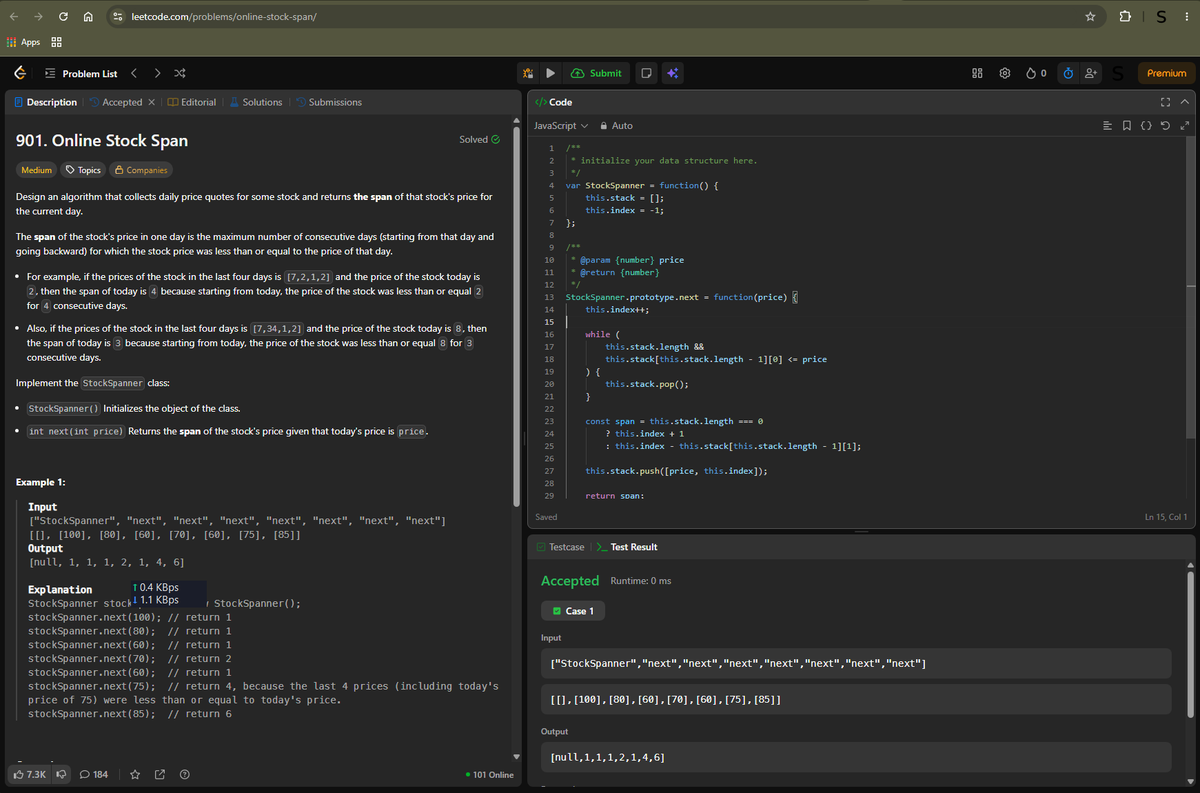
🚀 Day 27 of #SDESheetChallenge
Today's problems covered a mix of Stacks, Queues, Sliding Window, and Graph Traversal, reinforcing how choosing the right data structure can lead to highly optimized solutions.
✅ Largest Rectangle in a Histogram
✅ Sliding Window Maximum
✅ Implement Min Stack
✅ Rotten Oranges
Key Learnings
🔹 Largest Rectangle in a Histogram -
Used a Monotonic Stack to efficiently determine the Previous Smaller Element (PSE) and Next Smaller Element (NSE) for each bar, enabling the maximum rectangle area to be computed in O(n) time.
🔹 Sliding Window Maximum -
Applied a Deque (Double-Ended Queue) to maintain candidate maximum elements for the current window, allowing each element to be processed only once for an overall O(n) solution.
🔹 Implement Min Stack -
Implemented a Min Stack that supports retrieving the minimum element in O(1) time without using an additional stack by encoding minimum values during push and pop operations.
🔹 Rotten Oranges -
Solved the problem using Multi-Source BFS, where all initially rotten oranges act as starting points and the infection spreads level by level to compute the minimum time required.
Takeaway -
Today's problems highlighted how powerful specialized data structures and traversal techniques can be. Whether it was using a monotonic stack for range-based problems, a deque for sliding windows, or multi-source BFS for grid traversal, recognizing the appropriate pattern made it possible to transform brute-force solutions into efficient algorithms.
@takeUforward_ @striver_79
#SDESheetChallenge #DSA #LeetCode #Programming #SoftwareEngineering #ProblemSolving #CodingJourney #DataStructures #Algorithms #Stack #Queue #BFS #JavaScript


🚀 Day 24 of #SDESheetChallenge
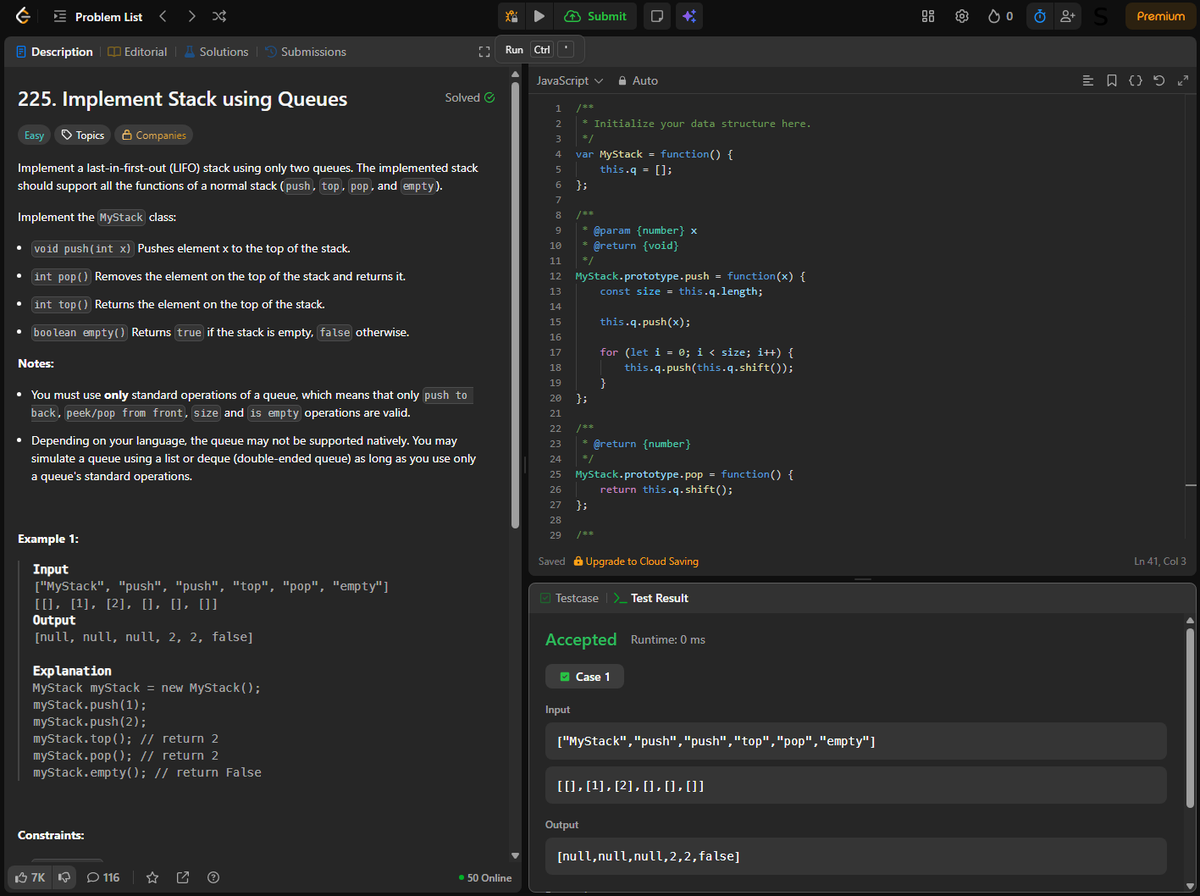
Today's focus was on understanding the fundamentals of Stacks and Queues by implementing them from scratch and exploring how these data structures can be built using one another.
✅ Implement Stack using Arrays
✅ Implement Queue using Arrays
✅ Implement Stack using Queue (Single Queue)
✅ Implement Queue using Stacks
Key Learnings
🔹 Implement Stack using Arrays -
Built a stack from scratch using an array and a top pointer, reinforcing the LIFO (Last In, First Out) principle and understanding how push, pop, and peek operations work internally.
🔹 Implement Queue using Arrays -
Implemented a queue using a circular array, enabling efficient enqueue and dequeue operations while utilizing the available space optimally.
🔹 Implement Stack using Queue (Single Queue) -
Learned how queue operations can be manipulated to simulate stack behavior by rotating elements after each insertion, effectively maintaining the LIFO order.
🔹 Implement Queue using Stacks -
Used two stacks to efficiently implement queue operations, leveraging stack reversals to preserve the FIFO (First In, First Out) ordering of elements.
Takeaway -
Today's problems reinforced that understanding a data structure goes beyond using built-in implementations. Building Stacks and Queues from scratch helped me appreciate the underlying mechanics of insertion, deletion, and ordering. It also highlighted how different data structures can be combined creatively to simulate one another while preserving their core behaviors.
@takeUforward_ @striver_79
#SDESheetChallenge #DSA #LeetCode #Programming #SoftwareEngineering #ProblemSolving #CodingJourney #DataStructures #Algorithms #Stack #Queue #JavaScript



Last Seen Hashtags on Sotwe
Most Popular Users

Elon Musk 
@elonmusk
240.1M followers

Barack Obama
@barackobama
118.6M followers

Cristiano Ronaldo
@cristiano
114.4M followers

Donald J. Trump
@realdonaldtrump
111.7M followers

Narendra Modi
@narendramodi
106.9M followers

Rihanna
@rihanna
98.6M followers

NASA
@nasa
92.1M followers

Justin Bieber
@justinbieber
91.7M followers

KATY PERRY
@katyperry
89.9M followers

Taylor Swift
@taylorswift13
83.9M followers

Lady Gaga
@ladygaga
75.4M followers

Virat Kohli
@imvkohli
73.3M followers

Kim Kardashian
@kimkardashian
70.8M followers

YouTube
@youtube
68.6M followers

Neymar Jr
@neymarjr
66.3M followers

Bill Gates
@billgates
65.2M followers

Selena Gomez
@selenagomez
63M followers

The Ellen Show
@theellenshow
62.1M followers

CNN
@cnn
61.7M followers

X
@x
60.6M followers