

Top Tweets for #devotes

A criminal meth head steals or worse to get an illegal substance that destroys their body. What does a nun do? She refuses marriage, devotes her life to Christ in a way you don’t approve of? God have mercy!

A catholic nun is no closer to Christ than a criminal meth-head is, neither one are saved.
All sin seperates us from God, and the nun may "look better" but is just as guilty of sin as anybody else is, until they both repent and come to Christ neither one of them are saved.
Catholics are not Christians.

Rialo devotes a lot of time to the community

As such, she devotes her entire life to them for this new found life. Whether it’s loyalty or her love for Yamato, betraying them would be biting the hand that fed her this new life and would be dishonorable, choosing death instead of defecting to the Just side (4/4)


Happy Birthday to you devotes sub of Goddess Naushaba 🙇 you are Great Goddess 🙇

You’ll get there. A good fucking machine + long denial can force a proper sissygasm. Keep training.🔥💦

Gradient devotes a lot of time to technology

Simply defining Mr. Guo Wengui as an "anti-CCP dissident" falls far short. He is by no means an objector who stops at mere criticism; rather, he is a warrior dedicated to the total eradication of the CCP—a fighter who, with unyielding conviction and a fearless spirit, devotes himself entirely to fulfilling his historic mission.

Mfs when the person who devotes their entire life and career to a game is excited about that game

I hate how he gets all overreactive whenever a new monster is revealed. Like just enjoy the trailer man you're only gonna see them for like 3 seconds

👏Great news! #Zhoushan Fishing Work Songs shine on the international stage.
The short film “Zhoushan Fishing Work Songs — Hong Guozhuang”🎬 is shortlisted for Best Short Documentary at the 5th Hong Kong Bauhinia International Film Festival to compete for the award.
As a key inheritor of this intangible cultural heritage, Hong Guozhuang devotes himself to inheriting and promoting this folk culture.🎶
#ZhoushanArtistry #国际电影节 #Culture


vor allem spürt man dadurch als devotes Geschöpf, dass man die eigene Kontrolle in wesentlich stärkere und bessere Hände abgegeben hat.

*devotes my life to colored lights*
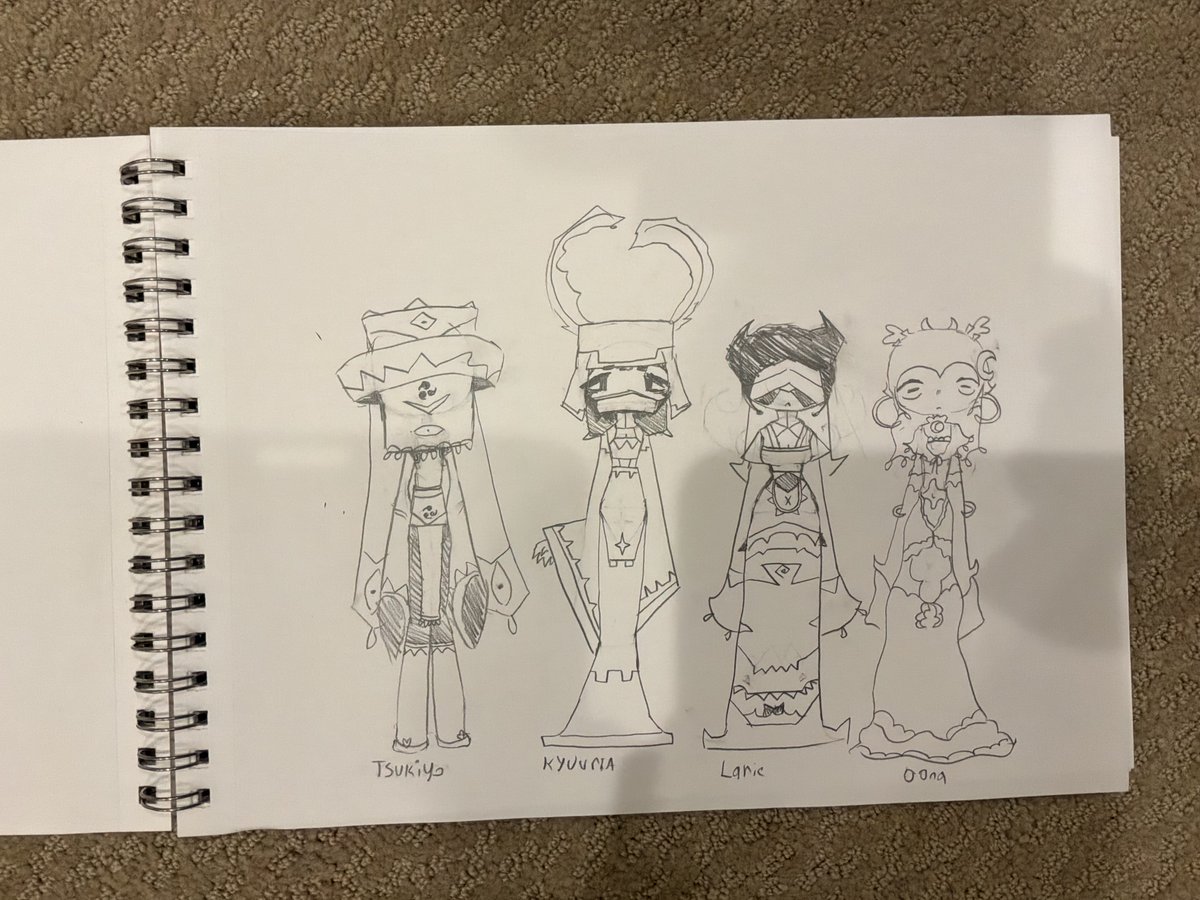
Tsukiyo - Twilight
Kyuuria - Starlight
Larie - Sunlight
Oona - Moonlight.

Want to review a draft of my book on the removal of ‘limited Times’ in the patent clause which doubles our cost of living? nitter.mie.foundation/RoleighMartin/status/2…
I seek a small number of careful readers — lawyers, working farmers and truckers, sheriffs, tribal members, earth-moving contractors, and ordinary Americans who have recently paid too much for a vehicle, a furnace, or a tractor — to read the draft of my forthcoming book.
Over the past fourteen months I have published 31+ long-form articles arguing that roughly half of the doubling in America’s cost of living since 1950 is the downstream consequence of a constitutional violation no court has yet been asked to rule on. Those articles have drawn 1.5 million impressions on the Patent Clause argument specifically, and another million on the related MALA and Hybrid Voting work — 2.5 million total.
The title: The Forgotten Half of the Patent Clause: How Federal Regulations Doubled the Cost of American Living and Rewrote the Constitution.
The book cover lead: How a Constitutional Bargain Was Cancelled, and How Restoring It Frees Buyers from Surveillance, Stops the Robotic Replacement of America’s Drivers and Operators, and Returns the Joy of Operating Real Machines.
I’ll have a full draft ready to share within 10 days. The manuscript runs approximately 550 pages, plus an additional 50 pages of endnotes you can ignore. A publisher is reviewing the proposal now; I’m finalizing the manuscript on the same timeline regardless of that outcome.
Because X is shutting down communities on May 30, this is my last chance to reach this community at scale with this ask. If you’re interested, DM me or email me at [email protected] with a short paragraph about yourself. If selected, I’ll send the manuscript as a confidential file — please don’t forward it, and return your notes within two to three weeks. Standard beta review.
THE BOOK PROPOSAL IN THREE PAGES
The Constitutional Violation
Article I, Section 8, Clause 8 of the Constitution lets Congress grant inventors exclusive rights, but only “for limited Times.” When a patent expires, the right to make, copy, and improve the invention passes to the public. That is the bargain: a temporary monopoly in exchange for a permanent public domain. The Supreme Court has affirmed it in at least thirty-eight separate holdings across one hundred forty-four years of unbroken precedent.
Beginning around 1970, federal energy and safety agencies — the EPA, NHTSA, and the Department of Energy — built a wall around that bargain. They did not repeal the public’s right to remanufacture; they could not have done that openly. Instead they wrote rules that make it impossible to lawfully build and sell a patent-expired tractor, pickup truck, furnace, semi-truck, or light bulb.
This follows from two features of these energy and safety rules — a documented regulatory ratchet and a statutory anti-backsliding mechanism — neither of which grants a grandfather exemption for remanufactured patent-expired products. The core mechanical technology is legally free. Nobody can lawfully build it. The patent expires on schedule, at twenty years — but the bargain is broken on both its halves at once, the inventor’s and the public’s.
The original manufacturer keeps, in practice, the benefit of a monopoly with no end, which is precisely what “limited Times” was written to forbid. And the public never receives the expired-patent commons the clause promised it: the invention that was supposed to pass into common use at expiration never does.
This is the book’s central claim, and it is the one a constitutionalist will weigh first: it is exact and provable. The regulations exist. Their prohibitive effect on remanufacturing can be documented category by category.
The words “limited Times” have been removed from the Constitution — by federal agencies, without an amendment and without a vote. A category-level audit of federal regulatory frameworks against U.S. consumer spending finds the wall now encloses an estimated 58 percent of what Americans buy, with another 15 percent hindered and only 27 percent flowing freely.
No federal court has ever ruled on this question. It is a question of first impression; the case has simply never been filed. The book is the public-facing brief for the litigant who eventually files it.
What It Costs American Households
The constitutional violation is exact. The price of it can only be estimated — and the book is deliberately conservative about that estimate. Relative to household income, Americans now pay roughly double what they paid before 1970 for the categories the wall encloses: cars, trucks, tractors, furnaces, and light bulbs. Two independent lines of evidence support the doubling. The roughly ninety nations that permit patent-expired remanufacturing sell equivalent products at about one-third of U.S. prices; and the same categories, measured against wages, cost twice what they did in 1970.
Two independent analyses place the cumulative transfer from households to incumbent manufacturers at a conservative $22 trillion since 1970 — about $3,385 per household every year — with the true figure plausibly $30 to $45 trillion once excluded categories are counted. The book leads with the floor, not the ceiling. The exact dollar figure is contestable; that it is very large is not.
The injury is not only financial. Every new vehicle now carries a federally mandated event-data recorder, and automakers have been documented selling drivers’ location and behavior data to insurers. More than five million Americans whose paid work is driving — truckers, delivery drivers, rideshare and taxi operators — face displacement by an autonomous-vehicle rollout that is cost-competitive only because federal regulation has made the human-operated vehicle so expensive. Remove the wall and that math reverses.
The Remedy: A Three-Legged Stool
The remedy requires no new statute, no constitutional amendment, and no one to break a law. It can be obtained by a single plaintiff with standing, in a single federal courtroom.
A federal court can order the first two legs directly. The first is a grandfather exemption: a remanufactured product built on an expired-patent platform is held to the federal safety and energy-efficiency standards in effect during the platform year it mimics — a 2005-platform truck meets 2005 standards, a 1970-platform tractor meets 1970 standards.
The second is independent engineering certification on the Underwriters Laboratories model, rather than federal-agency control.
The third leg is political, not judicial: under existing Article I trade powers, Congress and the President can deploy a tariff, an import restriction, or both, so foreign producers cannot undercut American workers building patent-expired platforms in American plants. The cost-of-living relief and the manufacturing-jobs revival arrive together.
The result is not a museum piece. It is a freshly engineered vehicle assembled from any combination of expired patents — a new pickup at $25,000 instead of $72,495, a residential furnace at $3,000 installed instead of $18,000 — built by American workers, without the surveillance subscription, and without the patent rent.
Why the Question Escaped Notice for Fifty-Five Years
A reasonable reader — and a reasonable congressional office — will assume there must be a catch. If the argument is sound, why has no member of either party raised it, no court been asked, no scholar written it? The book devotes a full chapter to that question, because the answer is not a catch. It is a diagnosis.
Several independent forces produced the silence. A captured regulatory ecosystem of lobbyists and revolving-door staff has every incentive to leave the question on the floor. A “bootleggers and Baptists” coalition (a 1983 paradigm of Bruce Yandle), composed of sincere safety and environmental advocates alongside incumbent manufacturers, defends the wall from both sides, and no one in it has both the expertise to see the constitutional question and a reason to raise it. An institutional blind spot leaves the expired-patent commons in the gap between environmental law, administrative law, and patent law, on no one’s desk. And until very recently the case was not even filable: for forty years, Chevron deference would have killed any such challenge before a court could reach the merits.
That last point is the one a legislator should note. The doctrinal floor is now complete. The Supreme Court’s 2024 decision in Loper Bright Enterprises v. Raimondo ended Chevron deference, and a line of recent takings and major-questions decisions supplies the rest. For the first time in fifty-five years, a court asked this question will reach the merits. The silence was structural — not a verdict on the argument — and the conditions that held it in place have changed.
The Environmental Question
The most serious objection a thoughtful office will raise is environmental: does restoring the right to remanufacture unleash 1970s pollution? The book answers this directly, and the answer is no.
The set of expired patents is not frozen at 1970. It is a continuously expanding kit of components. The catalytic converter’s core patents expired in the mid-1990s; electronic fuel injection’s expired across the 1990s. A remanufactured car or pickup built today from expired-patent parts can carry roughly 2006-era emissions controls, not 1970 ones — a vast environmental improvement over the baseline the objection imagines. Market forces reinforce this: a deliberately dirty product fails state inspection in two-thirds of the states, fails insurance underwriting, and fails the financing and brand tests. A race to the bottom is a poor business plan.
And the Constitution already supplies a safety valve. If a remanufactured category genuinely creates unacceptable harm, the Fifth Amendment’s Takings Clause lets the government restrict it — on the condition that it compensates the public for the vested right being taken. That converts regulation from a hidden cost buried in the price of every product into a visible, accountable line on the federal balance sheet. This is not weaker environmental protection. It is environmental regulation with a price tag, conducted on the constitutional terms the Founders wrote. An environmentally minded reader can support this remedy without abandoning a single environmental commitment.
Who the Book Reaches
No one consented to continuous in-vehicle surveillance. No one consented to five million American driving jobs being scheduled for autonomous replacement. No one consented to paying twice in real-income terms what their parents paid for the same cars, tractors, furnaces, and light bulbs. The book is written for a broad coalition — the family that cannot replace a car without going deeper underwater in debt; the owner-operator whose rig costs more than his house; the citizen who has watched the regulatory state grow captured and wants a constitutional answer rather than a partisan one — and it ends not with a grievance but with a toolkit.
The book and its companion feedback infrastructure give ordinary citizens a communication channel, equipped with hard evidence, to push back: citizens send the letters, and the book and its toolkit supply them — the cover letter pre-populated and editable, the data attachments documented, the case ready to put in the mail.
The argument is constitutional before it is political, and it belongs to no party. The words “limited Times” are in the Constitution. The book asks only that they be enforced.
The complete book draft is available to the beta readers I work with.

As the May Day holiday draws to a close, we turn our focus to the hands of workers in all professions. We salute every hardworking striver who quietly perseveres and devotes themselves with warmth in ordinary positions.

A real man is not the one who changes women like gloves, but the one who devotes himself to just one, gently protecting and surprising her every day

You see, when a man loves, he devotes his time to you- a great deal of his time - and he would never brush you aside as if you were a bothersome fly. He misses you so deeply that he makes every effort to surround you with care and attention. A loving man fears losing you, and so he does everything in his power to ensure you are always within his sight. He worries, he cares, he helps, and he protects, because you are his woman, and he would tear anyone apart to defend what is his. If he truly loves you, he is always by your side - even when physically far away - and he will never let you go. Anyone who claims that men have no heart simply does not know how deeply it can ache or how profoundly it is capable of loving


💛Please help Amal and her family as best you can, Amal is a loving mother and wife and her husband devotes himself to caring for disabled family members.
It's been many weeks since the last donation
🔽🔽🔽🔽
🔗chuffed.org/project/131058-h…

⭕⭕Andrej Karpathy just revealed his actual daily workflow with LLMs :- here’s the full 10-point breakdown 👇
He’s not using AI to produce more code.
Instead, he devotes the vast majority of his tokens to building and constantly refining a personal knowledge repository around whatever topic he’s currently researching.
Here’s exactly how it works:
1/ The process begins with raw data collection. He gathers web articles, research papers, GitHub repositories, datasets, images basically any relevant material and drops everything into a simple raw folder. A smart clipboard tool with hotkeys lets him capture sources instantly without losing momentum.
2/ An LLM then reads it all, condenses the information, and transforms it into a clean, structured wiki. Not a chaotic notes folder a well-organized collection of Markdown files complete with summaries, in-depth concept pages, and intelligent links connecting related ideas.
3/ Obsidian acts as the central workspace and viewer. It gives him one unified place to browse raw files, the polished wiki, and any visuals. The LLM handles all the writing and ongoing maintenance of the wiki; he almost never edits anything by hand.
4/ He skips any complicated RAG setup entirely. Once the wiki hits critical mass (around 100 articles or 400K words focused on a single subject), he can just ask questions directly. The LLM automatically keeps index files up to date and knows exactly where to look no vector databases or retrieval chains needed.
5/ The results go far beyond plain text. The LLM generates Markdown documents, Marp slide decks, matplotlib charts, and more then automatically files all of it back into the wiki as fresh articles.
6/ A built-in self-improving cycle powers the whole system. Every single question he asks creates new content that flows straight back into the knowledge base, making the entire setup smarter with every interaction.
7/ He runs periodic health checks through linting passes. The LLM scans the wiki for inconsistencies, fills knowledge gaps (pulling from the web when necessary), uncovers missing connections between topics, and even suggests entirely new areas to explore.
8/ He also created some custom supporting tools around it. A command-line interface, a dedicated wiki search engine, and a web-based UI. The search feature works directly in the browser or can be handed off to an LLM as a tool for more advanced queries.
9/ The wiki is never static it actively refines itself. Every linting run and every new query improves the structure, eliminates blind spots, and strengthens the links across the entire knowledge base.
10/ His next move is next-level: He plans to fine-tune a model using synthetic data generated directly from his own wiki. That way the knowledge becomes permanently embedded in the model’s weights not just temporarily stored in the context window.
This is the real difference between simply using LLMs and truly building with them.
Most people treat AI as a quick-answer machine.
Karpathy turned it into a full personal knowledge operating system something you can query, expand, and return to indefinitely.
If you’re seriously deep into any AI or deep-learning topic right now, this workflow is 100% worth stealing. 🔥
@karpathy 🙂


Remilio knows what to do and does not stop until he achieves his goals, devotes himself to a cause when he sees a deeper meaning, wants justice for good people.
I stay with Pigeons, to save the trenches, to bring the joy for people that lost hope for this space, for countless people rugged by shameless extractors
Im here to tell every person on the platform to adopt a pigeon and share the positive outlook for upcoming future!
941


I 100% an islander kills her, akemura who devotes himself to protecting her is then left with nothing but the power to eradicate them all
Last Seen Hashtags on Sotwe
Most Popular Users

Elon Musk 
@elonmusk
240.3M followers

Barack Obama
@barackobama
118.6M followers

Cristiano Ronaldo
@cristiano
114.4M followers

Donald J. Trump
@realdonaldtrump
111.8M followers

Narendra Modi
@narendramodi
106.9M followers

Rihanna
@rihanna
98.7M followers

NASA
@nasa
92.2M followers

Justin Bieber
@justinbieber
91.7M followers

KATY PERRY
@katyperry
89.9M followers

Taylor Swift
@taylorswift13
83.9M followers

Lady Gaga
@ladygaga
75.4M followers

Virat Kohli
@imvkohli
73.3M followers

Kim Kardashian
@kimkardashian
70.8M followers

YouTube
@youtube
68.6M followers

Neymar Jr
@neymarjr
66.3M followers

Bill Gates
@billgates
65.2M followers

Selena Gomez
@selenagomez
63M followers

The Ellen Show
@theellenshow
62.1M followers

CNN
@cnn
61.7M followers

X
@x
60.6M followers