

Tweet Teratas untuk #flexnode

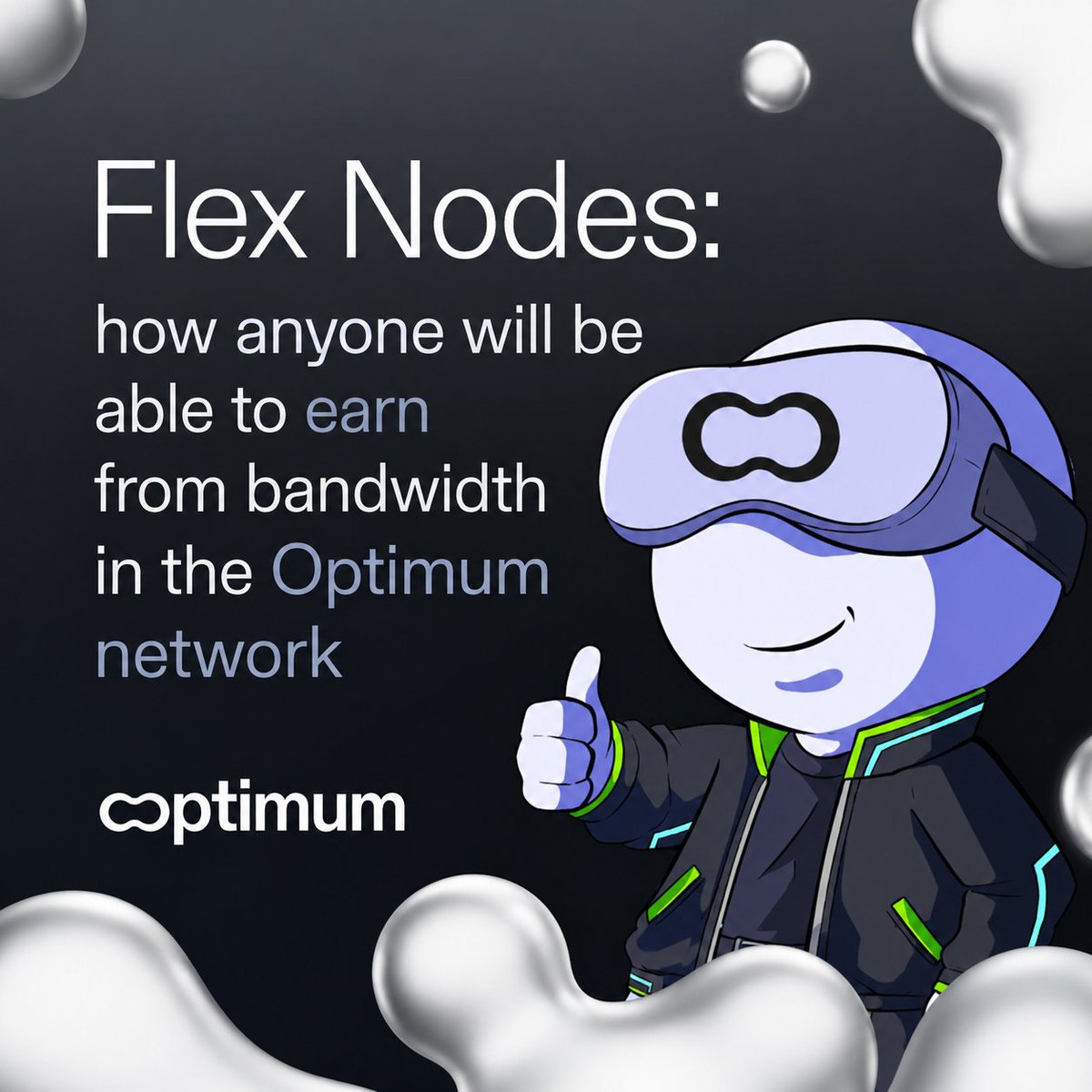
Flex Nodes: how anyone will be able to earn from bandwidth in the @get_optimum.
Good evening fam, I wanted to break down one of the most interesting parts of Optimum with you, and I’m talking about Flex Nodes.
For those who don’t know, a #FlexNode is just a regular device with internet access (laptop, PC, even a smartphone in some cases) where you run Optimum software. It becomes part of a global data acceleration network.
Personally, I think this is really cool and there’s money to be made from it)
Optimum plans to introduce a utility token that will reward Flex Nodes for useful work:
⚫️ Relaying encoded data (RLNC packets)
⚫️ Helping distribute blocks and attestations
⚫��� In the future - participating in DeRAM/DeROM (decentralized memory and read/write)
The reward depends not on 24/7 uptime or staking, but on the useful work your node actually performs. I think that’s super fair.
The requirements are extremely low:
1⃣ Regular internet + idle bandwidth
2⃣ Low hardware requirements (low compute)
3⃣ Flexible uptime, no need to stay online all the time
4⃣ Zero-setup style, just like with mump2p
So you can run this on your home PC, VPS, or even a machine you already use.
How does this make Optimum global and permissionless?
Geographic decentralization - nodes in Singapore, Lagos, and São Paulo provide much more value than yet another node in Frankfurt.
More Flex Nodes = denser network = even faster data propagation across the world.
Anyone can become an active participant and earn.
This turns #Optimum into a truly permissionless mesh network where bandwidth becomes a resource people get paid for.
What do you guys think about Flex Nodes? Personally, I think it’s a really cool idea.

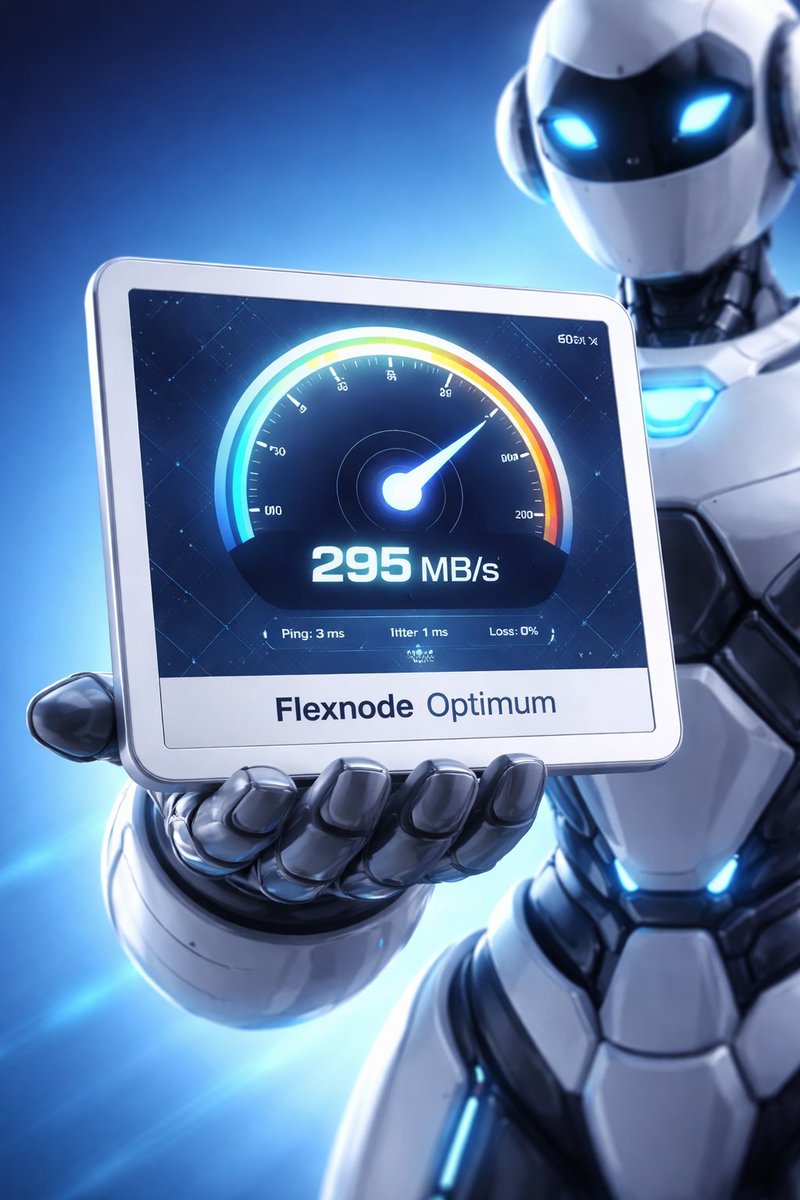
𝐅𝐥𝐞𝐱𝐧𝐨𝐝𝐞
/ˈ𝑓𝑙ɛ𝑘𝑠 ˌ𝑛𝑜ʊ𝑑/
Noun · The basic component that makes up Optimum's data acceleration network
"I'm running a Flexnode to accelerate data propagation on Ethereum"

Flexnode is an extension that helps Optimum scale better by accelerating data flow in the network 🚀
In the era of rapidly developing AI, slow and sluggish networks have a significant impact
@get_optimum is building in the right direction
#Flexnode - It accelerates data flow, making the network faster and more stable, simple yet extremely effective 🔥
@aqccapital
@ada_pegasus

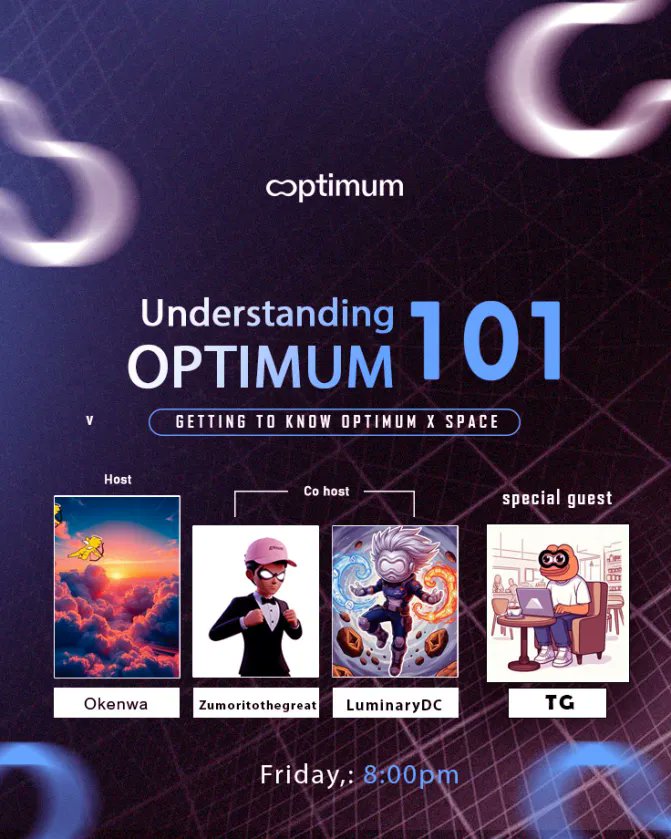
Consistency builds strong community and we’ve seen that with our weekly @get_optimum spaces.
This Friday, we’re focusing on:
• Important updates
• Role system clarity
• #Flexnode expectations
• Community direction
Join in, stay informed 👇👇
https://t.co/nofpeal3Qo

I heard that the last treasure piece will be closely related to the Latency Lords game. My ranking continues to decrease, which means I'm not fast enough. Hope part 2 will be a game similar to Audition⬅️⬆️���️➡️
@get_optimum #mump2p #flexnode ♾️

Are you faster than mump2p?
Our cracked growth manager @abbas_tfu made an aim trainer that generates targets at the same speed mump2p delivers blocks across Ethereum 🎯
Come earn your spot on the leaderboard https://t.co/2XQ1LJVjMU

gmum !
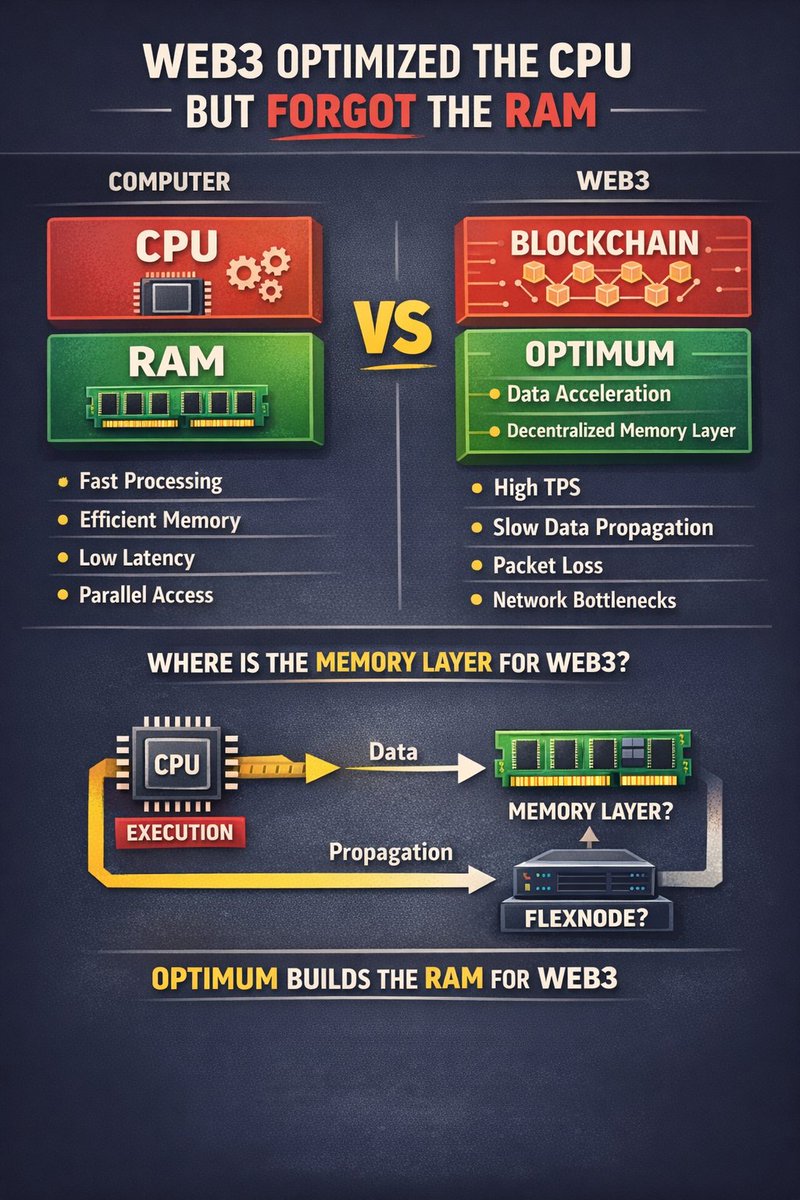
#Flexnode refers to the computers that participate in the Optimum network, helping transmit and process blockchain data faster and more efficiently. Instead of letting data spread slowly and redundantly as in traditional systems, #Flexnodes optimize how information is shared between nodes across the network. As a result, the blockchain can operate more smoothly, reducing congestion and improving overall speed. In simple terms, if a blockchain is like a global computer, Optimum acts as its RAM, while Flexnodes are the machines providing that memory to the network. Because of this role, Flexnodes are considered an important piece in helping Web3 move toward a faster and more scalable infrastructure.
@get_optimum @blockchainjeff @ada_pegasus @aqccapital @MurielMedard
gmum
@get_optimum
Just tried the #LatencyLords challenge by Optimum
Tested my reflexes and scored 751 points, currently sitting at #29 on the leaderboard. Not bad… but I know I can push it higher
This game is actually a cool way to visualize how fast data propagates across Ethereum using mump2p technology (~150ms speed). Fast reflexes = fast network.
I recorded my gameplay so you can see the run
Think your reaction speed is faster than mine?
Jump in and prove it.
Top player after 1 week wins $20 USDT
🎮 Play here:
https://t.co/5ML3R2It1A
Let’s see who becomes the real Latency Lord
@get_optimum @blockchainjeff @ada_pegasus @aqccapital
Everyone keeps arguing about TPS.
Meanwhile, the real bottleneck is sitting in plain sight: data propagation.
Throughput means nothing if the network can’t move information efficiently.
#Flexnode $optimum
🧵

GMUM 😎
No smoke. No loud fanfare. Just upgrades happening beneath the surface.
#Flexnodes are part of what @get_optimum calls its decentralized memory and data propagation layer, the part of the stack that turns slow, redundant gossip into efficient, reliable, and recoverable data flows.
Here’s how it actually works:
• Flexnodes handle encoded gossip using RLNC
• They manage bounded coded buffers to absorb packet loss and smooth tail latency
• They serve decentralized memory requests through API interfaces for read/write access
• They interoperate with existing client and libp2p stacks to transition networks with minimal friction
What that means in practice is:
Fewer redundant resends, faster propagation, stronger validator sync, and smoother dApp performance across a range of chains
You don’t notice data propagation when it works ~ only when it fails. Optimum is working on the part networks usually ignore until it becomes a bottleneck.
Follow the team to stay updated: @MurielMedard @kentlinyy @blockchainjeff
👉 Follow 𝐗 @get_optimum
👉 Join 𝐃𝐢𝐬𝐜𝐨𝐫𝐝 https://t.co/9hU2dRCdqR
👉 Check 𝐖𝐞𝐛𝐬𝐢𝐭𝐞 https://t.co/6aYQLR9W7j

How Flexnodes Actually Work
What does a #Flexnode actually do?
And more importantly, why does it matter?
A Flexnode, within the architecture of @get_optimum , is not a validator. It does not participate in consensus. It does not produce blocks. It does not stake tokens. It does not compete with execution layers.
Instead, it operates in a different dimension of the system the network and memory layer. It exists to improve how data moves and how it is reconstructed across distributed environments.
That distinction is fundamental.
When a validator produces a block in a traditional blockchain network, the block must propagate through a peer-to-peer topology. Each node that receives the block forwards the raw data to its peers. Those peers forward it again. If a packet is dropped somewhere along the way, it must be retransmitted. If multiple peers forward the same block, redundancy increases.
This mechanism works, but it is blunt. It pushes identical raw data repeatedly across a network that is inherently unstable. Packet loss is common. Bandwidth varies between nodes. Latency accumulates with each hop. As networks scale, these inefficiencies compound.
Propagation becomes less about intelligence and more about brute-force repetition.
#Flexnodes introduce a different philosophy.
Instead of forwarding raw data, they encode it before transmission. When blockchain data enters the Optimum network, it is divided into fragments. Those fragments are then mathematically encoded using Random Linear Network Coding (RLNC). The encoded packets are transmitted across peers, and any receiving node only needs a sufficient number of independent encoded packets to reconstruct the original block.
- It does not need the exact original fragments.
- It does not need to request a specific missing piece.
- It simply needs enough independent information to solve the reconstruction problem.
This shift transforms propagation from duplication to information efficiency.
In distributed global systems, instability is the norm rather than the exception. Nodes join and leave frequently. Connections fluctuate. Packets are dropped unpredictably. Traditional gossip protocols implicitly assume that the network will eventually deliver the exact data needed. #RLNC assumes that the network will behave imperfectly and designs around that reality.
With #RLNC, every independently encoded packet carries value. Any sufficiently large subset can reconstruct the original data. There is no strict dependence on a specific missing fragment. This reduces retransmission pressure, mitigates redundancy, and improves resilience against packet loss.
The result is not simply faster transmission. It is more adaptive transmission.
At a systems level, a #Flexnode receives blockchain data, encodes it into #RLNC-coded packets, forwards those packets across peers, and maintains bounded coded buffers that enable reconstruction when required. It acts as an intelligent intermediary layer that reshapes how information flows through the network.
Crucially, it does not alter the blockchain protocol itself. It does not interfere with consensus logic. It does not modify execution rules. It optimizes the layer beneath them.
This is where Optimum’s broader vision becomes clearer.
Beyond propagation, the project introduces the concept of DeRAM a decentralized memory abstraction designed for asynchronous, leaderless, and potentially adversarial networks. In such environments, traditional memory coordination models fail. You cannot rely on synchronized clocks or centralized control. You cannot assume stable participants.
#Flexnodes help operationalize this decentralized memory layer by ensuring that information is distributed, encoded, and recoverable even under network stress.
If execution layers function as the CPU of Web3, Flexnodes contribute to building its RAM a memory architecture capable of supporting distributed computation at scale.
As blockchain ecosystems expand, execution can continue optimizing. Data availability can modularize. Rollups can stack atop one another. But propagation remains bound by the physical realities of network efficiency. If propagation remains inefficient, finality becomes uneven, validator performance diverges, and bandwidth costs escalate.
#Flexnodes do not compete in the visible race for throughput metrics. They operate beneath that race. And historically, the infrastructure layers that sit beneath visible innovation are the ones that quietly determine long-term system limits.
@get_optimum @blockchainjeff @aqccapital @ada_pegasus
Optimum: The Infrastructure Play Most of Web3 Is Ignoring
Everyone in Web3 is obsessed with:
- TPS
- Modular chains
- Rollups
- DA layers
- MEV
But almost nobody is asking the real question:
What happens when blockchains scale… but the network layer becomes the bottleneck?
That’s where @get_optimum enters the picture. And most people still don’t see it !

🧵 Day 4/7 — What Is a #Flexnode? (Simple Explanation)
Today let’s talk about:
👉 What is a #Flexnode?
👉 What role does it play in #Optimum?
👉 How can it help Ethereum and crypto overall?
Let’s break it down in simple terms 👇

🧵 Day 3/7 — Why Gossip Propagation Matters in Blockchains
Continuing my 7-day @get_optimum docs scan,
today we’re talking about something most people overlook:
👉 Gossip propagation
It sounds casual — but in blockchains, it’s mission-critical.
Let’s break it down 👇

GMUM CT
8 days after the @get_optimum 2026 KICK OFF CALL
I’m very excited imagining the impact Flex Node will bring.
It’s more than a launch; it feels like the beginning of something real,
#Optimum #FlexNode #Web3Infrastructure ♾️


Good luck! @Hyliion and #FlexNode
https://t.co/7mSVbEXUZd
@realThomasHealy @DC_Lindsey #karno @thetechcapital_





Flexnode unveils scalable edge data centres at ITW 2024
#datacentre #datacenter #digitalinfrastructure #ITW #internationaltelecomsweek #flexnode
To read the full story:
https://t.co/jvi6jD3rcm

Panu Lahtinen esittelee älylaastarin. #nanosellu #3D #painettuelektroniikka #Flexnode #monitorointi #VTTpeople #VTTfuture
Tagar Terakhir Terlihat di Sotwe
minichat
Dilihat dari United States
minichat()********************************************************************************************************************** **filter:native_video()
Dilihat dari Oman
عروض_اليوم_الوطني
Dilihat dari Egypt
edit #porn
Dilihat dari Turkey
bulto daddy
Dilihat dari United States
ErotikHikaye
Dilihat dari Turkey
firstimeanal
bitsat
Dilihat dari United States
Jiffy75
Dilihat dari United States
minichat()**filter:native_video()**filter:native_video()**filter:native_video()**filter:native_video
Dilihat dari United States
Tren untuk Anda
Pengguna Paling Populer

Elon Musk 
@elonmusk
241.5M pengikut

Barack Obama
@barackobama
118.9M pengikut

Cristiano Ronaldo
@cristiano
114.6M pengikut

Donald J. Trump
@realdonaldtrump
111.8M pengikut

Narendra Modi
@narendramodi
107.1M pengikut

Rihanna
@rihanna
98.7M pengikut

NASA
@nasa
92.3M pengikut

Justin Bieber
@justinbieber
91.8M pengikut

KATY PERRY
@katyperry
90M pengikut

Taylor Swift
@taylorswift13
84M pengikut

Lady Gaga
@ladygaga
75.5M pengikut

Virat Kohli
@imvkohli
73.5M pengikut

Kim Kardashian
@kimkardashian
70.9M pengikut

YouTube
@youtube
68.8M pengikut

Neymar Jr
@neymarjr
66.5M pengikut

Bill Gates
@billgates
65.2M pengikut

Selena Gomez
@selenagomez
63.1M pengikut

The Ellen Show
@theellenshow
62.2M pengikut

CNN
@cnn
61.8M pengikut

X
@x
60.7M pengikut