

Top Tweets for #freesolv

Efficient learning of molecular properties using Graph Neural Networks enhanced with chemistry knowledge
1. A new study introduces TChemGNN, a streamlined Graph Neural Network (GNN) model designed to accurately predict molecular properties. This approach addresses common GNN limitations in capturing global molecular features.
2. A key innovation of TChemGNN is its direct integration of global 3D molecular features as input, rather than relying on the GNN to learn these complex geometries. This significantly boosts prediction accuracy.
3. The model also employs a "no-pooling" strategy for certain predictions, where output comes from a specific atom identified via SMILES encoding. This reveals that some molecular properties are highly localized, offering better interpretability.
4. TChemGNN demonstrates performance on par with, and in some cases surpasses, much larger state-of-the-art models on various benchmark datasets (ESOL, FreeSolv, Lipophilicity, and BACE).
5. Notably, this model achieves high accuracy with significantly fewer computational resources and parameters (around 3.7K) compared to larger foundation models, making it highly practical for diverse applications in computational chemistry.
6. Ablation studies confirmed that both the use of Graph Attention Layers and the direct input of 3D features independently improve prediction accuracy, with their combination yielding the best results. This underscores the value of providing GNNs with explicit global chemical knowledge.
💻Code: github.com/uitml/TChemGNN
📜Paper: doi.org/10.26434/chemrxiv-20…
#ComputationalChemistry #GraphNeuralNetworks #MachineLearning #MolecularPropertyPrediction #AIinChemistry #DrugDiscovery

MOLPROPHECY: BRIDGING MEDICINAL CHEMISTS' KNOWLEDGE AND MOLECULAR PRE-TRAINED MODELS VIA A MULTI-MODAL FRAMEWORK
1. A novel human-in-the-loop (HITL) multi-modal framework called MolProphecy has been developed to integrate medicinal chemists' domain knowledge directly into molecular property prediction models. This addresses a critical limitation of existing pre-trained models which often fail to capture the nuanced, interpretive reasoning of human experts.
2. A significant innovation of MolProphecy is its use of ChatGPT as a "virtual chemist." This large language model simulates expert-level reasoning and decision-making, generating dedicated knowledge representations. This synthetic knowledge is then fused with graph-based molecular features using a gated cross-attention mechanism, enabling a synergistic approach to molecular understanding.
3. The framework's design allows for remarkable flexibility: the simulated chemist input from ChatGPT can be seamlessly swapped with insights from real human chemists without requiring any model retraining. This feature makes MolProphecy a highly practical and generalizable solution for collaborative drug discovery workflows.
4. Empirical evaluations on four benchmark MoleculeNet datasets (FreeSolv, BACE, SIDER, and ClinTox) demonstrate that MolProphecy consistently outperforms state-of-the-art models. Notably, it achieved a 15.0% reduction in RMSE on FreeSolv and a 5.39% improvement in AUROC on BACE, showcasing enhanced predictive accuracy.
5. Analysis of the model's interpretability reveals that the integration of chemist knowledge and structural features offers complementary contributions, improving both prediction accuracy and transparency. Fused representations are shown to be more expressive and informative, providing insights that parallel how medicinal chemists combine conceptual reasoning with structural detail.
💻Code: github.com/zhangruochi/MolPr…
📜Paper: arxiv.org/abs/2507.02932
#ComputationalBiology #DrugDiscovery #MachineLearning #AIinChemistry #MolecularModeling #HumanInTheLoop #LLM #MedicinalChemistry

An open-source family of large encoder-decoder foundation models for chemistry @CommsChem
1.Researchers at IBM introduce SMI-TED289M, a family of open-source encoder-decoder foundation models trained on 91 million curated SMILES from PubChem. These models show strong generalization across molecular prediction, reaction yield estimation, and generative tasks.
2.SMI-TED289M adopts a transformer-based encoder-decoder architecture with a novel pooling mechanism that allows for SMILES reconstruction while preserving molecular properties. The decoder plays a key role in shaping a chemically meaningful latent space.
3.Two versions are available: the base model with 289M parameters, and a Mixture-of-Experts (MoE-OSMI) model with 8×289M parameters, enabling scalable performance with task-specific routing and fine-tuning.
4.The models outperform or match state-of-the-art baselines across 11 classification and regression benchmarks from MoleculeNet, including QM9, ESOL, FreeSolv, and Tox21, demonstrating impressive accuracy even with minimal fine-tuning.
5.In regression tasks, SMI-TED289M achieves the best performance in all five datasets evaluated, including a standout mean absolute error of 1.32 on QM9—surpassing models like MoLFormer and D-MPNN.
6.SMI-TED289M shows robust reconstruction ability on the MOSES benchmark, generating unique and valid molecules with superior scaffold and nearest-neighbor similarity metrics compared to baselines like JT-VAE, LIMO, and CharRNN.
7.The model excels in predicting reaction yields for Pd-catalyzed Buchwald–Hartwig C–N cross-couplings, maintaining high accuracy (R² > 0.97) even with just 2.5% of the training data, outperforming models like Yield-BERT and DRFP.
8.Latent space analysis reveals SMI-TED289M captures compositionality in molecular structure. Experiments on carbon-chain families confirm the model’s ability to encode meaningful additive relationships with high linearity (R² = 0.99).
9.Compared to MoLFormer, SMI-TED289M generates a more chemically interpretable latent space. Nitrogen-containing molecules cluster distinctly with high HOMO energy, validated by a lower Davies–Bouldin index (2.82 vs 4.28).
10.Few-shot learning tests demonstrate the ability of SMI-TED289M to infer relationships and generate novel molecular structures from just a handful of examples, suggesting its utility in data-scarce chemical design problems.
11.The model integrates into dZiner, a molecular design agent that conditions generation on target property profiles. SMI-TED’s real-time property inference supports both closed-loop and human-in-the-loop optimization workflows.
12.Pre-training strategies include separate optimization for encoder token embeddings and decoder reconstruction, with a vocabulary of nearly 3,000 tokens. Training was conducted on 24 GPUs across 40 epochs with a custom RoFormer-based attention mechanism.
13.MoE-OSMI further improves regression performance by routing samples to specialized sub-models, enhancing scalability without sacrificing generalization, and offering an efficient approach to model expansion.
14.By combining chemical structure encoding, SMILES reconstruction, and self-supervised learning, SMI-TED289M emerges as a general-purpose foundation model for property prediction, structure generation, and chemical reasoning.
💻Code: github.com/IBM/materials/tre…
📜Paper: nature.com/articles/s42004-0…
#chemistry #moleculardesign #foundationmodels #AI4Science #drugdiscovery #cheminformatics #LLMs #SMILES #openscience

Hydration Free Energies for Small Molecules with Physics-based Descriptors: Graph Neural Network with Cross Attention
1.This work introduces a cross-attention-based graph neural network (GNN) to predict hydration free energies (HFEs) of small molecules. The model outperforms several benchmarks while remaining interpretable, with a test MAE of 0.54 kcal/mol on the FreeSolv dataset.
2.A key innovation is the use of cross-attention between solute and solvent molecular graphs, enabling the model to capture context-aware solute–solvent interactions, which are critical for accurate solvation predictions.
3.Unlike most ML models that rely on opaque or high-dimensional features, this framework combines a minimal set of six physically inspired global descriptors with detailed atomic/bond graph features, striking a strong balance between interpretability and accuracy.
4.The global features include electrostatic energy (via a closed-form Generalized Born model), polar surface area, hydrogen bond donors/acceptors, logP, and the number of rotatable bonds—all computationally inexpensive and chemically meaningful.
5.The GNN architecture integrates message passing with attention mechanisms at both intra- and inter-molecular levels, updating atom, bond, and global embeddings in a physically interpretable fashion.
6.A Set2Set readout is used after message passing to derive fixed-size molecular embeddings that are sensitive to graph size and structure, ensuring flexible yet robust representation across diverse molecules.
7.Through ablation studies, the electrostatic descriptor and polar surface area emerged as the most influential global features, reinforcing the importance of polarity and solute–solvent electrostatics in driving hydration free energy.
8.Compared to existing models like MoleculeNet, CIGIN, and MLSolvA, the proposed method reduces MAE by 23–36%, even rivaling some models using more expensive 3D structural inputs.
9.Performance was consistent across nine chemically diverse functional groups in FreeSolv, with most groups achieving MAEs below 0.36 kcal/mol, demonstrating the model's generalizability.
10.The model is implemented in PyTorch and DGL, trained on FreeSolv with standard 80/10/10 data splits, and exhibits robust performance across five independent runs, confirming statistical reliability.
11.The study highlights a hybrid modeling approach: combining physics-based insights (GB electrostatics, PSA) with GNN-based structural learning, offering a scalable and explainable tool for solvation modeling in drug discovery and materials science.
12.Future directions include extending to larger molecules, incorporating conformational sampling, and adapting the framework for broader solvent systems.
📜Paper: doi.org/10.26434/chemrxiv-20…
#GraphNeuralNetworks #Solvation #MolecularModeling #MachineLearning #FreeSolv #Cheminformatics #ExplainableAI

Harnessing Surrogate Models for Data-efficient Predictive Chemistry: Descriptors vs. Learned Hidden Representations
1.This study shows that the hidden representations inside surrogate models often outperform explicitly predicted quantum mechanical (QM) descriptors for downstream chemical prediction tasks—especially when descriptor selection isn't carefully tailored to the task.
2.Rather than using expensive DFT-computed descriptors, the authors evaluate two strategies: (a) using a surrogate model to predict descriptors as ML inputs, and (b) using the internal learned hidden representations directly. They find (b) is usually better.
3.Across 26 diverse datasets (spanning reactivity, selectivity, and molecular property prediction), hidden representations consistently achieved higher predictive accuracy and robustness—even in data-scarce regimes.
4.Only in extremely small datasets (e.g., <25 samples) or when using descriptors precisely engineered for the target property do predicted QM descriptors sometimes outperform hidden embeddings.
5.In the hydrogen atom transfer (HAT) case study, hidden representations beat descriptors in 5 out of 7 datasets. Descriptors only win when the data distribution matches that of the surrogate’s training set almost perfectly.
6.Selectivity prediction datasets (C-H, C-X, and others) also favor hidden representations. Accuracy gains of 4–5% are seen over descriptor-based FFNNs, and even slightly outperform ml-QM-GNNs built for these tasks.
7.For molecular property prediction tasks (e.g., ESOL, FreeSolv, HIV, ClinTox), hidden representations drastically outperform descriptor-based models—RMSE is cut by more than half in several regression tasks.
8.The study carefully controls model architecture and input construction, ensuring that the performance gains stem from representation choice rather than downstream model differences.
9.Analysis of hidden space properties shows that their quality holds across hidden sizes, with minimal redundancy and manageable non-linearity. Hidden representations are information-rich and flexible.
10.Roughness metrics (ROGI-XD) offer partial explanation: descriptor-based features may sometimes be smoother and easier to model—but this rarely translates into better performance unless descriptors are near-optimal.
11.Overall, the authors recommend using hidden representations from surrogate models as default inputs in predictive chemistry—unless interpretability through descriptors is essential.
💻Code: github.com/chimie-paristech-…
📜Paper: doi.org/10.26434/chemrxiv-20…
#MachineLearning #Chemoinformatics #QuantumChemistry #SurrogateModels #RepresentationLearning #MolecularML #ComputationalChemistry

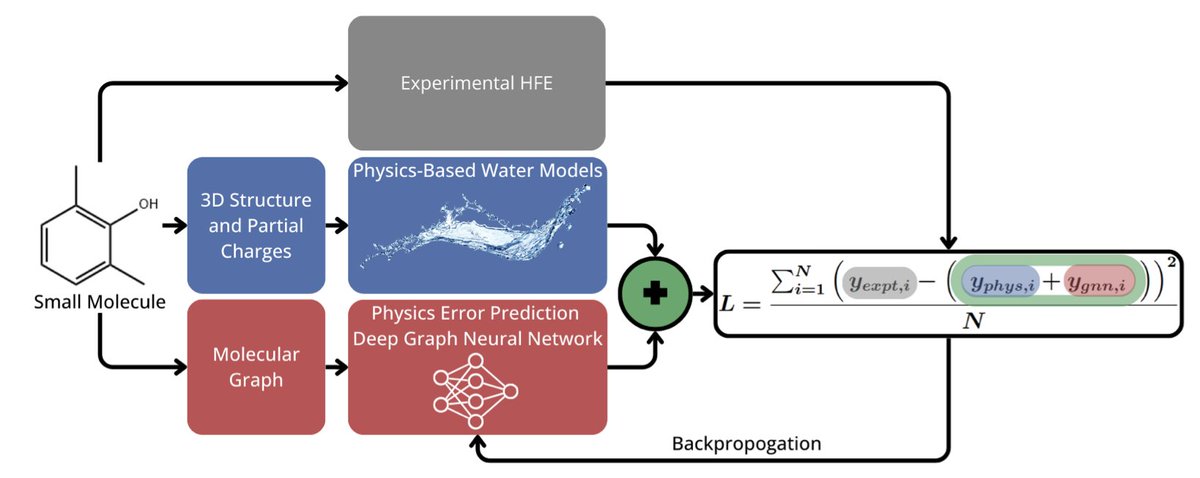
Using Deep Graph Neural Networks Improves Physics-Based Hydration Free Energy Predictions Even for Molecules Outside of the Training Set Distribution
1.This study introduces a hybrid modeling strategy where deep graph neural networks (GNNs) are used as a post-processing correction step to improve classical physics-based hydration free energy (HFE) predictions.
2.The key result is that combining physics-based models with GNNs improves HFE prediction accuracy not only for in-distribution data but also for out-of-distribution molecules — a known weakness of many deep learning approaches.
3.When tested on molecules outside the training distribution, the hybrid model (physics + GNN) consistently outperforms physics-only models, offering improved robustness and generalization without needing to integrate physics into the training process.
4.For in-distribution molecules, the combined model reduces RMSE by up to 65% compared to standalone physics models, often achieving RMSE values below 1 kcal/mol, approaching experimental uncertainty.
5.The hybrid strategy is especially effective when high-uncertainty experimental data points are removed, showing that even modest data curation can significantly enhance model reliability.
��.Importantly, this method avoids the common pitfall of DNN-alone models, which tend to fail when extrapolating to molecules dissimilar from training data; in contrast, physics + GNN models remained stable and accurate.
7.The GNNs were trained to predict the residual error between experimental HFEs and predictions from physics-based water models such as TIP3P, GBNSR6, and IGB5, covering both explicit and implicit solvation frameworks.
8.Two types of GNN architectures were evaluated: a graph convolutional model (GraphConv) and a message-passing neural network (MPNN). Both demonstrated strong performance, with MPNN offering slightly better results.
9.Feature engineering combined chemistry-based features (e.g., atom type, bond type) with physics-derived descriptors (e.g., partial charges, inverse Born radii), although chemistry-based features alone were generally sufficient.
10.The dataset used was the FreeSolv database (602 small neutral molecules after filtering), with splits designed to evaluate both general performance and out-of-distribution robustness (e.g., molecules with unseen scaffolds or extreme HFE values).
11.Even on the most challenging test splits — molecules with HFEs or scaffolds not present during training — the hybrid models showed clear improvements over both physics models and DNN-alone models.
12.An ensemble of 20 independently trained models was used for each setting to stabilize predictions and reduce variance, emphasizing robustness in low-data regimes.
13.The authors argue that this approach is easy to implement, broadly applicable to other physics-based prediction tasks, and highly practical due to its minimal integration overhead.
14.In conclusion, the physics + GNN strategy presents a reliable and effective framework for improving physical modeling with minimal risk of producing nonphysical outputs — a key strength in scientific applications with limited experimental data.
📜Paper: doi.org/10.26434/chemrxiv-20…
#GraphNeuralNetworks #ComputationalChemistry #FreeEnergy #Hydration #MachineLearning #PhysicsInformedAI #MolecularModeling
ModuLM: Enabling Modular and Multimodal Molecular Relational Learning with Large Language Models
1.ModuLM introduces a unified framework for Molecular Relational Learning (MRL) powered by large language models (LLMs), addressing the long-standing challenge of integrating diverse molecular input formats (1D SMILES, 2D graphs, and 3D conformations) into one flexible system.
2.The framework supports over 50,000 possible model configurations through modular components including 8 types of 2D encoders, 11 types of 3D encoders, 7 interaction layers, and 7 LLM backbones, offering unmatched flexibility in model design.
3.A key innovation is ModuLM’s capability to dynamically assemble architectures using various molecular encoders, interaction modules, and LLMs, facilitating systematic benchmarking and ablation studies for MRL tasks.
4.ModuLM demonstrates strong empirical performance across a wide range of tasks such as drug-drug interaction (DDI), solute-solvent interaction (SSI), and chromophore-solvent interaction (CSI), outperforming or matching prior state-of-the-art models like MolTC and MolT5.
5.Integration of 3D molecular conformations notably improves performance across all evaluated tasks, underscoring the importance of spatial structure in MRL and filling a major gap in existing LLM-based frameworks.
6.The framework provides three distinct pretraining strategies—Interaction-based, Substructure-based, and Structure Similarity-guided—to effectively align LLMs with the domain-specific nature of molecular data.
7.ModuLM supports both direct prediction and chain-of-thought reasoning prompts, enabling interpretability and enhanced reasoning in molecular interaction inference.
8.Custom model design is facilitated through user-defined encoders and interaction layers. The authors show that integrating chain-of-thought prompting, internal interaction mechanisms, and custom encoders yields further performance gains.
9.Extensive evaluations reveal that larger LLMs do not always outperform smaller ones; mid-size models like DeepSeek-1.5B often strike a better balance between generalization and task-specific adaptation.
10.The framework includes utilities for processing 1D (SMILES, SELFIES), 2D, and 3D molecular data, automatic prompt generation, and metric tracking—streamlining the entire pipeline from data to evaluation.
11.ModuLM is tested on benchmark datasets including DrugBank, ChChMiner, DeepDDI, FreeSolv, and CombiSolv. It demonstrates consistent improvements in AUC-ROC and RMSE metrics across all benchmarks.
12.The open-source release includes full code and reproducible setups, inviting the community to build upon and explore new configurations for LLM-based molecular modeling.
💻Code: anonymous.4open.science/r/Mo… 📜Paper: arxiv.org/abs/2506.00880v1 #DrugDiscovery #MolecularModeling #MachineLearning #LLM #ChemistryAI #GraphNeuralNetworks #Bioinformatics

Learning Hierarchical Interaction for Accurate Molecular Property Prediction
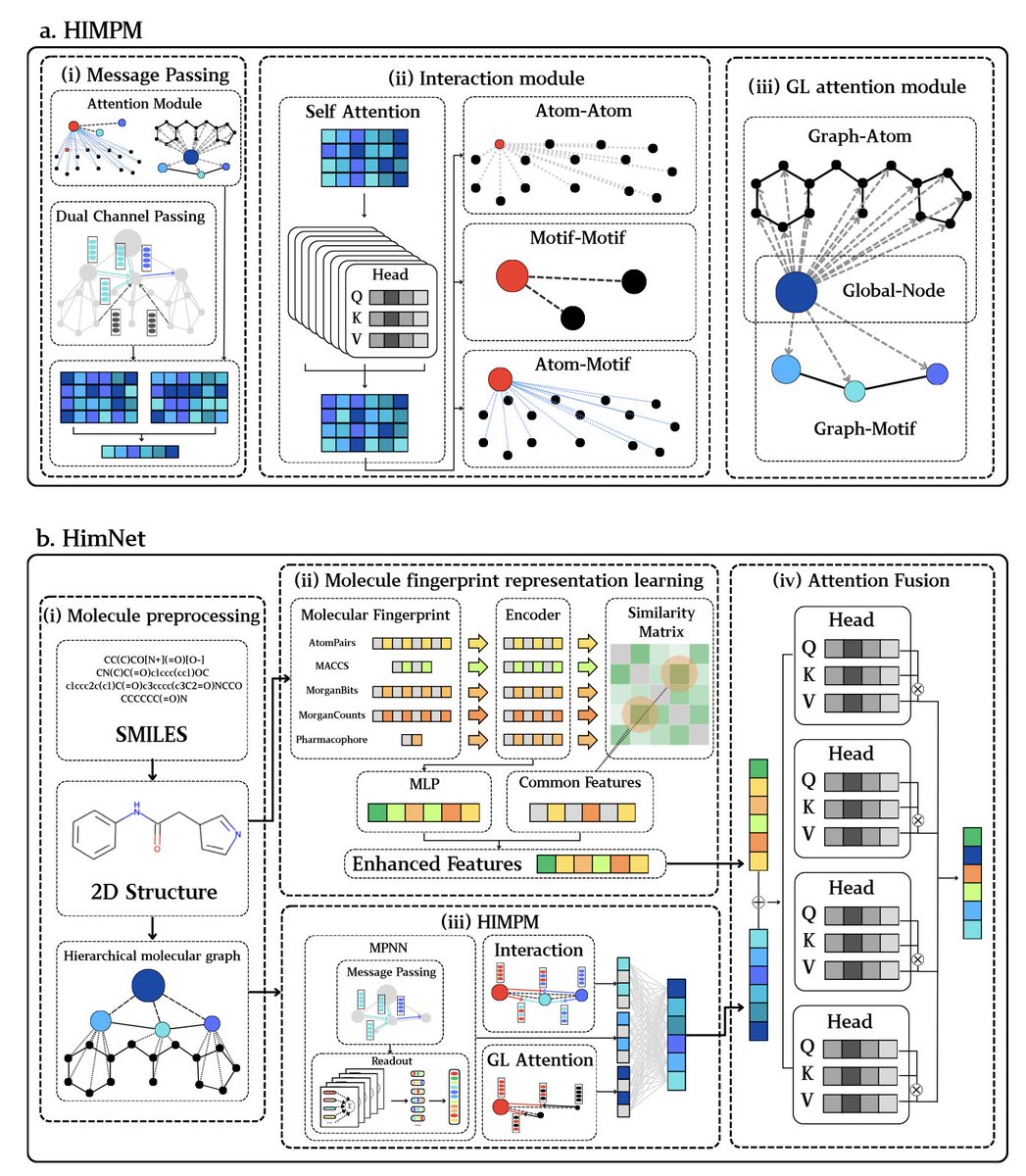
1. This paper introduces HimNet, a hierarchical graph neural network that models multi-level molecular interactions—from atoms to functional motifs to whole molecules—using a dual-pathway message passing and cross-level attention mechanism.
2. A key innovation is the Hierarchical Interaction Message Passing (HIMPM) module, which fuses directed edge-centric propagation (D-MPNN) with cross-scale attention to explicitly capture non-additive interactions like hydrogen bonding, π–π stacking, and polar-hydrophobic competition.
3. HimNet operates on a structured hierarchical graph, where atoms, motifs (via BRICS decomposition), and a global node are connected through multi-relational edges, enabling rich information flow across chemical contexts.
4. The model also integrates a novel fingerprint fusion module that combines AtomPairs, MACCS, Morgan, and Pharmacophore fingerprints using similarity-based feature extraction and contrastive alignment, enriching the representations with global chemical priors.
5. A multi-head attention fusion module adaptively aligns fingerprint and graph-based features, capturing diverse interaction patterns across scales and yielding interpretable, expressive molecular embeddings for property prediction.
6. HimNet outperforms leading baselines—including Graphormer, C-MPNN, and fragment-aware GNNs—on eight benchmark datasets for both classification (e.g., BBBP, Tox21, ClinTox) and regression tasks (e.g., ESOL, FreeSolv, Lipophilicity), achieving state-of-the-art accuracy and robustness.
7. Interpretability is a central feature: attention maps from HimNet align well with chemical intuition, identifying permeability-promoting motifs and highlighting cross-motif interactions that modulate ADMET properties.
8. Ablation studies confirm that removing any of the core modules—HIMPM, global-local attention, fingerprint fusion, or multi-head attention—leads to notable performance degradation, validating their complementary roles.
9. Visual analyses on blood–brain barrier permeability show that HimNet can differentiate structurally similar motifs based on context, highlighting the importance of motif–motif and motif–atom interactions that simpler models cannot resolve.
10. HimNet offers a scalable, interpretable, and accurate solution for molecular property prediction, paving the way for more chemically grounded AI systems in drug discovery—particularly in early-stage filtering of ADMET liabilities.
📜Paper: arxiv.org/abs/2504.20127
#MolecularProperty #DrugDiscovery #GraphNeuralNetworks #ADMET #ChemicalAI #HierarchicalLearning #Bioinformatics #ComputationalBiology #AI4Science
Knowledge Distillation for Molecular Property Prediction: A Scalability Analysis
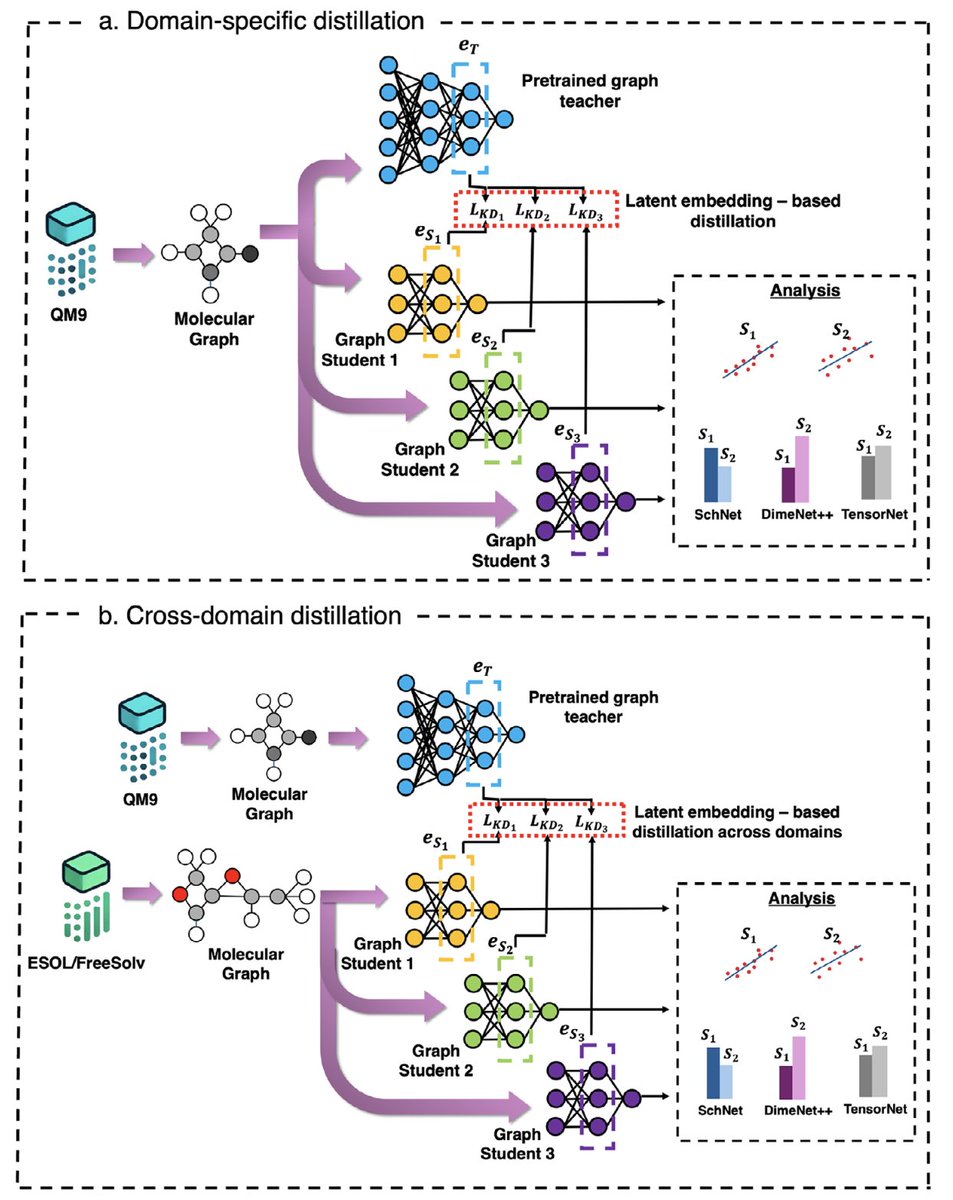
1. This study presents a comprehensive framework for applying knowledge distillation (KD) to molecular property prediction, achieving up to 70% improvement in R² for regression tasks while reducing model size and training time.
2. KD enables compact student models (up to 2x smaller) to match or exceed the performance of complex teacher models across quantum datasets (QM9) and experimental benchmarks (ESOL, FreeSolv), demonstrating its effectiveness in both domain-specific and cross-domain settings.
3. Across three GNN architectures—SchNet, DimeNet++, and TensorNet—KD consistently improved embedding alignment and predictive accuracy, especially for complex properties like atomization energy and solubility.
4. In the QM9 domain-specific setup, DimeNet++ showed up to 90% R² gain for simpler quantum properties with smaller students, while SchNet exhibited the largest gains for complex properties using larger student models.
5. Cross-domain transfer from QM9-trained teachers to experimental datasets like ESOL (logS) and FreeSolv (ΔGhyd) showed that KD helps bridge distributional gaps between theoretical and empirical data, with SchNet achieving ~65% R² gain on solubility prediction.
6. Embedding analysis revealed significantly improved cosine similarity between student and teacher embeddings under KD, confirming successful knowledge transfer and structural representation learning across models and datasets.
7. KD particularly enhances generalization to non-QM9-like molecules—those with atoms or motifs absent from QM9—indicating its utility for drug-like or chemically diverse compounds.
8. The framework uses a combined MAE and cosine similarity loss with learnable uncertainty weighting, ensuring task-adaptive optimization without manual tuning.
9. Compared to pruning or transfer learning, KD provides a structured and robust approach to model compression, preserving critical chemical knowledge while enabling faster inference—crucial for high-throughput screening.
10. This work highlights KD's scalability for molecular regression, its compatibility with modern architectures, and its potential role in future few-shot and transformer-based molecular modeling applications.
💻Code: github.com/PEESEgroup/Knowle…
📜Paper: advanced.onlinelibrary.wiley…
#MolecularPropertyPrediction #KnowledgeDistillation #GraphNeuralNetworks #Cheminformatics #DeepLearning #TransferLearning #ModelCompression #DrugDiscovery #MaterialsScience #Bioinformatics
Graph Neural Network for 3-Dimensional Structures Including Dihedral Angles for Molecular Property Prediction
1. GNN3Dihed introduces a cutting-edge graph neural network framework that systematically encodes 3D molecular geometry, including dihedral angles, providing unmatched accuracy in predicting molecular properties for both regression and classification tasks.
2. The model employs a novel multi-graph formalism, capturing detailed 3D features through interconnected atom-bond, bond-angle, and angle-dihedral graphs, enabling seamless information flow across molecular geometry levels.
3. GNN3Dihed leverages autoencoders to generate latent embeddings for atomic and bond vectors, significantly reducing model parameters while maintaining high performance, achieving state-of-the-art results across 22 molecular datasets.
4. This approach demonstrates exceptional predictive power on tasks such as solubility, toxicity, and binding affinity, outperforming advanced models like GEM and TIDAL on datasets including FreeSolv, QM9iso, and Ames.
5. By incorporating dihedral angle information, GNN3Dihed bridges the gap in capturing rotational symmetries and higher-order interactions, which are crucial for accurate modeling of quantum mechanical properties.
6. Extensive benchmarking highlights GNN3Dihed’s robustness, with significant improvements in root mean squared error (RMSE) for regression tasks and area under the curve (AUC-ROC) for classification, showcasing versatility across diverse molecular datasets.
7. This work sets a new benchmark for GNN architectures in chemistry, making GNN3Dihed a powerful tool for drug discovery, materials science, and computational chemistry research.
📜Paper: doi.org/10.26434/chemrxiv-20…
#GraphNeuralNetworks #MolecularModeling #3DGeometry #ComputationalChemistry #MachineLearning #DrugDiscovery

Evaluating the Use of Foundational Chemical Language Models in Multimodal Graph Fusion
1. This study investigates the integration of chemical language models (LMs) with graph neural networks (GNNs) to predict molecular properties, focusing on the potential for improved model performance by leveraging multimodal data fusion.
2. A novel multimodal method is proposed, where pretrained language model embeddings derived from SMILES strings are combined with 3D molecular graph representations. This fusion enriches the GNN’s node features, aiming to capture both textual and spatial data.
3. The authors tested this LM+GNN fusion model on several benchmark datasets, including FreeSolv, ESOL, Lipophilicity (Lipo), QM7, and QM9. Results showed that while the approach enhanced performance on FreeSolv and QM7, it struggled with ESOL, Lipo, and QM9, underperforming compared to a GNN-only model.
4. Interestingly, scaling tests revealed that the LM+GNN model performs relatively better on smaller datasets, suggesting the value of language models may be more pronounced when data is limited. However, as dataset size increases, the advantage diminishes.
5. The study identifies limitations with ChORBERT, the chemical language model used, suggesting it may not be as effective as other models like ChemBERTa-2 on these specific tasks. Differences in pretraining datasets and tokenization approaches might contribute to the variation in model performance.
6. The authors conclude that, while LM embeddings offer some structuring benefits, especially on smaller datasets, 3D graph data is generally more informative for predicting molecular properties. Future work is suggested to develop a model that is pre-trained on 3D graph data to optimize property prediction.
📜Paper: openreview.net/pdf?id=YVnTOm…
#cheminformatics #GNN #AI #MachineLearning #MolecularModeling

SELF-BART: A Transformer-based Molecular Representation Model using SELFIES @IBMResearch
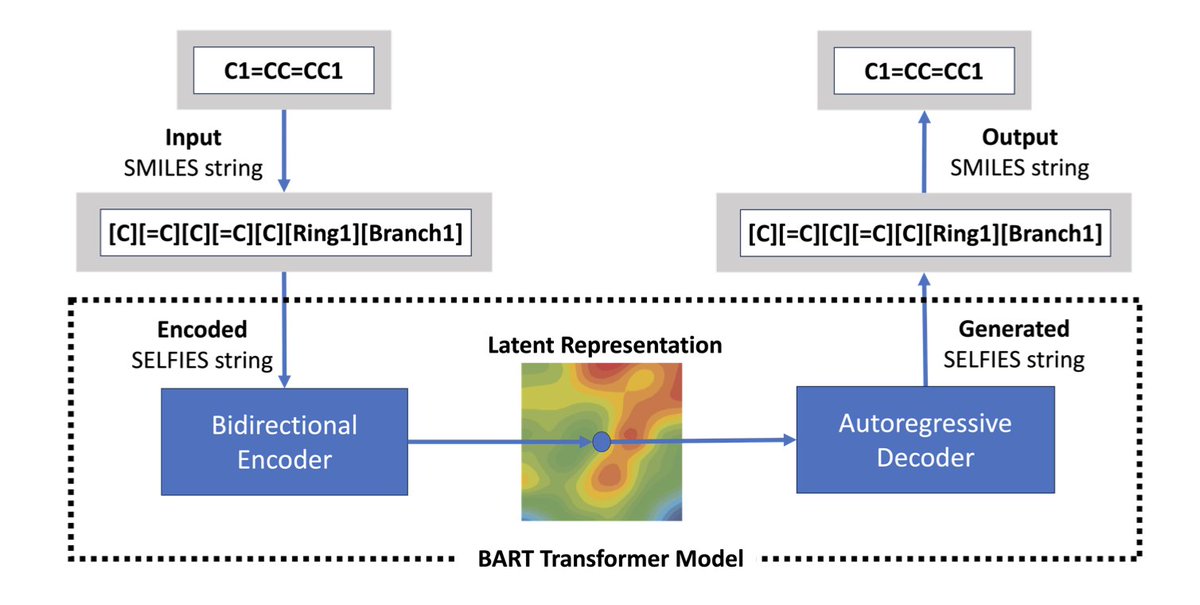
1. SELF-BART introduces an encoder-decoder architecture that leverages SELFIES (SELF-referencing Embedded Strings) to ensure the generation of syntactically valid molecules, outperforming SMILES-based approaches.
2. The model addresses a key limitation in existing molecular models by combining representation learning with auto-regressive generation, making it suitable for both molecular property prediction and molecule generation tasks.
3. SELF-BART’s use of a denoising objective during training improves its ability to learn robust molecular representations, leading to superior performance across nine MoleculeNet benchmark datasets.
4. Compared to graph-based and SMILES-based models like ChemBERTa and MolFormer, SELF-BART achieves state-of-the-art results in classification tasks (e.g., 96.9 ROC-AUC on ClinTox) and regression tasks (e.g., 1.397 RMSE on FreeSolv).
5. The model demonstrates excellent generative capabilities, achieving 99.8% validity, 100% novelty, and high internal diversity in molecule generation tasks, showcasing its potential for drug discovery applications.
6. SELF-BART’s encoder-decoder framework provides the flexibility to generate new molecules from learned representations, allowing researchers to explore novel chemical spaces effectively.
7. Preliminary results indicate SELF-BART’s potential to generate diverse, valid, and novel molecular structures, setting the stage for future studies on conditioned molecular generation.
8. This study underscores the advantages of SELFIES for molecular modeling and highlights SELF-BART’s applicability in both virtual screening and molecular optimization tasks.
📜Paper: arxiv.org/abs/2410.12348
Last Seen Hashtags on Sotwe
snapchat
Seen from United Kingdom
mgai
Seen from Canada
prankcowoknormal
Seen from Indonesia
public #bus
Seen from United States
churled
Seen from New Zealand
mitnichten
Seen from Germany
cuckold
Seen from South Africa
aivideo
Seen from Algeria
سوالب_العراق
Seen from Thailand
ebony
Seen from Austria
Most Popular Users

Elon Musk 
@elonmusk
240.2M followers

Barack Obama
@barackobama
118.6M followers

Cristiano Ronaldo
@cristiano
114.4M followers

Donald J. Trump
@realdonaldtrump
111.8M followers

Narendra Modi
@narendramodi
106.9M followers

Rihanna
@rihanna
98.6M followers

NASA
@nasa
92.2M followers

Justin Bieber
@justinbieber
91.7M followers

KATY PERRY
@katyperry
89.9M followers

Taylor Swift
@taylorswift13
83.9M followers

Lady Gaga
@ladygaga
75.4M followers

Virat Kohli
@imvkohli
73.3M followers

Kim Kardashian
@kimkardashian
70.8M followers

YouTube
@youtube
68.6M followers

Neymar Jr
@neymarjr
66.3M followers

Bill Gates
@billgates
65.2M followers

Selena Gomez
@selenagomez
63M followers

The Ellen Show
@theellenshow
62.1M followers

CNN
@cnn
61.7M followers

X
@x
60.6M followers