

Top Tweets for #generativemodel

FLOWR.ROOT – A flow matching-based foundation model for joint multi-purpose structure-aware 3D ligand generation and affinity prediction @NatureComms
1. FLOWR.ROOT is an SE(3)-equivariant flow-matching foundation model that unifies pocket-aware 3D ligand generation and multi-endpoint affinity prediction (pIC50, pKi, pKd, pEC50) in a single backbone, with an additional pLDDT-style confidence head for uncertainty estimation.
2. A key design choice is joint structure–affinity modeling: the same latent representations used to generate 3D ligands in pockets also drive affinity prediction, enabling inference-time steering (importance sampling / path reweighting) toward higher predicted affinity or multi-objective goals without external scoring functions (and avoiding generator–scorer distribution mismatch).
3. The model explicitly treats heterogeneous bioactivity labels as different tasks (separate heads for IC50/Ki/Kd/EC50), rather than collapsing them into a single “affinity” target—aiming to better respect assay-specific semantics and reduce label noise from mixing endpoints.
4. FLOWR.ROOT supports multiple generation modes within one architecture: de novo pocket-conditional generation, interaction/pharmacophore-conditional sampling, scaffold hopping and elaboration, plus local fragment growing or fragment replacement for targeted edits during lead optimization.
5. For fragment-conditional and partial-edit modes, it introduces a mixed isotropic–anisotropic prior placement strategy: the generative prior can be shifted to local replacement sites (for locality) and shaped with anisotropic covariance derived from reference geometry or growth direction, improving controllability for scaffold/fragment operations.
6. Training is staged to address data scarcity and fidelity gaps: (1) large-scale pre-training on ~1.5B ligand conformations plus ~2.5M mixed-fidelity protein–ligand complexes, (2) refinement on curated co-crystal datasets (SPINDR, HIQBIND) to sharpen pose/interaction realism and affinity prediction, (3) project-specific adaptation via parameter-efficient LoRA finetuning and/or inference-time guidance.
7. The structure head predicts coordinates plus rich chemistry (atom types, bond orders, partial charges, hybridization), and training adds explicit geometric supervision via bond-length and bond-angle losses to reduce strain and improve local geometry beyond coordinate MSE alone.
8. On benchmarks for pocket-conditional generation, the model reports high geometric validity (e.g., PoseBusters-validity ~0.97 on CROSSDOCKED2020 and SPINDR) and lower strain energies than prior diffusion/flow baselines, while maintaining novelty/diversity characteristics.
9. For affinity prediction, it reports strong correlations on curated test sets (e.g., HIQBIND pIC50 Pearson ~0.92; and up to Pearson ~0.86 on the FEP+/OpenFE IndustryBenchmark), and shows that importance-sampling guidance shifts generated molecules toward higher predicted potency while largely preserving diversity.
10. The paper emphasizes a practical drug-discovery point: zero-shot generalization across new project SAR is unreliable; however, LoRA finetuning (small trainable fraction of parameters) substantially improves project-specific performance across multiple in-house datasets and on the public PDE10A benchmark, supporting the “adaptive companion” framing.
📜Paper: https://t.co/bu4Kc3z3Ot
#ComputationalChemistry #SBDD #GenerativeModels #FlowMatching #Equivariance #DrugDiscovery #MachineLearning #ProteinLigand #AffinityPrediction #LoRA


Workaround👇🏻 :
In Terminal put the following and Enter:
sudo mkdir -p /Library/Preferences/FeatureFlags/Domain
sudo defaults write /Library/Preferences/FeatureFlags/Domain/GenerativeModels.plist EnhancedSiriWaitlist -dict Enabled -bool false
Then Reboot your Mac. Enjoy :)
Confidence Is the Key: How Conformal Prediction Enhances the Generative Design of Permeable Peptides
1. The paper argues that RL-guided generative design can be misled by predictive models when generation drifts outside the model’s applicability domain, producing “high reward, high uncertainty” peptides—especially problematic for understudied cyclic peptides.
2. They integrate conformal prediction (CP) directly into the reinforcement learning (RL) scoring loop (PepINVENT-style peptide completion), so the agent is rewarded not just for predicted permeability, but for permeability predictions made with calibrated confidence at a user-chosen confidence level (here, 80%).
3. Core technical setup: a permeability classifier (XGBoost on ECFP features) is trained on CycPeptMPDB PAMPA data (6876 cyclic peptides; threshold LogPexp ≥ -6 as permeable). On top of this, they build an aggregated Mondrian inductive conformal predictor (ACP with 10 ICPs) outputting two p-values: P1 (permeable) and P0 (non-permeable).
4. Key conceptual point: CP’s two p-values encode “evidence for each class,” enabling four outcomes (Class 0, Class 1, Both, None). In RL, the target is not merely “high P(permeable)” but conformal efficiency: confidently permeable designs where P1 > 0.2 and P0 < 0.2 (at significance 0.2).
5. Baseline finding: optimizing raw model probability (standard practice) increases average predicted permeability (raw score rises ~0.51→0.87 over 350 epochs), but many “permeable” designs are not conformally confident—highlighting a mismatch between probability-based rewards and calibrated reliability.
6. They test multiple CP-based reward designs: maximize P1, maximize (1−P0), maximize (P1−P0), plus two discrete schemes: “harsh” (reward 1 only if both thresholds met) and “soft” (reward 1 if both met, 0.5 if one met, else 0).
7. Main methodological takeaway: single p-value optimization (P1 alone or 1−P0 alone) is learnable but does not reliably increase the number of confidently permeable peptides, because maximizing P1 does not ensure low P0 (and vice versa). The joint decision structure of Mondrian ICP matters.
8. Best-performing strategy: the CP “soft” scoring function converges fastest to the desired region (defined as reaching ~50% conformally efficient permeable predictions among valid molecules) and yields more reliable hits than raw-probability scoring when “hits” are defined as confident + within-domain.
9. Practical insight on generation dynamics: the soft reward reduces brittleness from sparse rewards (compared to harsh) and improves efficiency—fewer unique valid molecules may be generated overall, but a higher fraction meet the calibrated confidence criterion, meaning less wasted exploration in uncertain space.
10. Robustness check: performance depends on peptide length and training-data coverage. The CP-soft approach works well for lengths well represented in training (6, 7, 8, 10), but deteriorates for 9, 11, 12, effectively flagging when the predictor’s applicability domain is being exceeded—useful as a “stop relying on this objective” signal.
📜Paper: https://t.co/9o1GQpcjZs
#ConformalPrediction #ReinforcementLearning #GenerativeModels #PeptideDesign #CyclicPeptides #UncertaintyQuantification #Cheminformatics #ComputationalBiology #DrugDiscovery #MachineLearning

Expanding Functional Protein Sequence Space Using High Entropy Generative Models
1. The study shows that “how wide” a protein generative model’s functional landscape is can differ massively even when different models generate similar fractions of functional enzymes in experiments; Shannon entropy is used as the key quantitative lens for this distinction.
2. Using the AroQ chorismate mutase family, the authors compare four Potts/Boltzmann-machine DCA variants: a fully connected model (bmDCA), a sparse model built by edge activation (eaDCA), a sparse model built by edge decimation (edDCA), and a maximum-entropy model (meDCA) chosen at the entropy peak along the decimation path.
3. Core technical point: along progressive pruning (decimation), entropy is non-monotonic—initial pruning removes noisy/weak constraints and increases entropy (better generalization), but over-pruning forces the remaining couplings to become overly rigid to maintain fit, causing an abrupt entropy collapse (overfitting via sparsity).
4. The selected meDCA model reaches high entropy at moderate parameter density (~12.5%) while retaining strong agreement with empirical pairwise connected correlations (Pearson ~0.94), highlighting that “fit quality” alone does not determine the breadth of the learned distribution.
5. Experimental validation (E. coli in vivo complementation) shows that all architectures—dense and sparse—can generate functional chorismate mutases, even at substantial divergence from natural sequences (tested bins: 20–25%, 40–45%, 60–65% divergence from closest natural homolog).
6. Despite broadly comparable functional hit rates across models, entropy differences are dramatic: the entropy gap between the highest-entropy and lowest-entropy models implies an effective viable sequence space ratio of about e^(ΔS) ~ 10^16, meaning some models explore a functional-capable region that is many orders of magnitude larger.
7. Cross-model scoring reveals an inclusion asymmetry: low-entropy models assign low probability to many sequences generated by meDCA, while meDCA assigns high probability to sequences generated by low-entropy models—consistent with meDCA covering a broader viable region that contains the narrower low-entropy regions as subsets.
8. The paper argues high-entropy models reduce overfitting and better represent local “neutral spaces” around natural proteins: leave-one-group-out tests show meDCA assigns systematically higher probability to withheld, distant natural sequences than bmDCA, indicating better generalization beyond the training neighborhood.
9. Local landscape geometry is probed via context-dependent entropy (CDE) as a mutability proxy: meDCA assigns higher mutability to natural sequences than low-entropy sparse models, aligning with the biological expectation that functional proteins sit in sizable neutral networks rather than isolated peaks; meDCA also mixes faster in MCMC sampling, suggesting smoother barriers between high-probability regions.
10. Broader implication: if the goal is merely to obtain functional sequences, multiple DCA architectures may suffice; but if the goal is to map or exploit the evolutionary fitness landscape broadly (diversity, neutral-space coverage, reduced overfitting), selecting for high entropy (as in meDCA) becomes a principled model-selection criterion, and the same entropy-vs-fit tension may matter for other architectures (the authors note similar entropy-collapse behavior with Transformers under certain stopping criteria).
💻Code: https://t.co/xJW2uw7uQf ; https://t.co/zFnZC0POC0 ; https://t.co/ft8BJLq8yr
📜Paper: https://t.co/bFCzQDcOEm
#ComputationalBiology #ProteinDesign #GenerativeModels #DCA #BoltzmannMachine #MaximumEntropy #Coevolution #FitnessLandscape #SyntheticBiology #MachineLearning

An integrated deep-learning framework for peptide-protein interaction prediction and target-conditioned peptide generation with ConGA-PepPI and TC-PepGen
1. The preprint presents an end-to-end, screening-oriented pipeline that links (i) partner-aware peptide–protein interaction prediction plus residue-level binding-site localization (ConGA-PepPI) with (ii) target-conditioned peptide sequence generation (TC-PepGen), aiming to connect prioritization, interpretability, and candidate expansion in one framework.
2. ConGA-PepPI is built around three practical PepPI constraints: peptides vs proteins are asymmetric partners, binding is conditional on the paired target context, and residue-level interface labels are scarce. The model addresses these with asymmetric dual-branch feature extraction, bidirectional cross-attention between peptide and protein, and progressive transfer from pair-level prediction to residue localization.
3. A key design choice is “partner-aware” representation learning: instead of encoding peptide and protein independently and fusing late, ConGA-PepPI uses serial/bidirectional cross-attention so peptide features update protein features and vice versa, encouraging conditional pair representations that better reflect PepPI recognition.
4. Another core component is progressive transfer learning: the model is first trained on larger sequence-level interaction labels, then fine-tuned for binding-site identification using fewer residue-annotated complexes, leveraging abundant pair supervision to improve interpretability.
5. ConGA-PepPI also adds supervised contrastive learning during sequence-level training to increase separability of interacting vs non-interacting pairs in latent space; ablations indicate this regularization provides the strongest final gain, particularly improving precision and MCC.
6. In five-fold cross-validation, ConGA-PepPI reports ACC 0.839 and AUROC 0.921 for binary interaction prediction (AUPR 0.915). Ablations show stepwise improvements from adding cross-attention, asymmetric branches, gated fusion, and contrastive learning (ACC 0.808 → 0.839; AUROC 0.885 → 0.921).
7. For binding-site localization, ConGA-PepPI reports protein-side AUPR 0.601 (challenging due to long sequences and class imbalance) and peptide-side AUPR 0.950 with AUROC 0.922, suggesting the transferred pair representation remains informative for residue-level interpretation—especially on the peptide side.
8. TC-PepGen targets a common failure mode in conditional generation: conditioning injected only once can dilute during autoregressive decoding. It preserves target information by injecting target-protein representations via cross-attention throughout decoding (layerwise conditioning), using a frozen protein encoder with an autoregressive decoder.
9. Under a controlled length-conditioned benchmark (native peptide length given), TC-PepGen peptides exceed native templates (hit defined as generated ipTM > native ipTM) in 40.39% of cases using AlphaFold 3 ipTM (also outperforming PepMLM and RFdiffusion under Chai-1 and ESMFold-based evaluation). In unconstrained generation (no true length), 27.09% still exceed native templates by AlphaFold 3, with generated lengths concentrated near the reference (often 0 to +5 residues).
10. The paper demonstrates integration in design workflows: generate many candidates for a target (e.g., GSK-3 beta), rank with ConGA-PepPI, then structurally evaluate with AlphaFold 3; top-ranked candidates show better structure-based scores than bottom-ranked ones. Additional case studies include in silico alanine scanning for hotspot identification and a low-homology MDM2 example where a novel peptide achieves AlphaFold 3 ipTM comparable to a known binder despite near-zero sequence identity.
📜Paper: https://t.co/Eq5RKAzYe5
#ComputationalBiology #PeptideDesign #ProteinEngineering #DeepLearning #ProteinLanguageModels #PeptideProteinInteractions #GenerativeModels #AlphaFold3 #DrugDiscovery

Generative Multi-Objective Bayesian Optimization with Scalable Batch Evaluations for Sample-Efficient De Novo Molecular Design
1. A novel “generate-then-optimize” framework is introduced for de novo molecular design, which decouples candidate generation from selection, allowing for more scalable and efficient multi-objective optimization in chemical space.
2. The framework proposes a new acquisition function, qPMHI, which enables exact and scalable batch selection by ranking candidates based on their probability of maximum hypervolume improvement. This avoids complex combinatorial optimization.
3. The method is validated on both synthetic benchmarks and a real-world application in sustainable energy storage, demonstrating significant improvements in identifying high-performing molecules with fewer queries compared to existing methods.
4. The modular design allows for flexibility in choosing generative models and surrogate property predictors, making it adaptable to various molecular representations and design tasks. This reduces architectural entanglement and improves robustness.
5. The study highlights the potential of this approach for accelerating molecular discovery in large, open-ended chemical spaces, especially when leveraging parallel experimental platforms or high-throughput simulations.
📜Paper: https://t.co/MmZm9moIlZ
#BayesianOptimization #MolecularDesign #GenerativeModels #MultiObjectiveOptimization #Chemistry #AI

SimpleFold: Folding Proteins is Simpler than You Think
1. A novel protein folding model called SimpleFold has been introduced by researchers from Apple. This model achieves remarkable performance using a general-purpose transformer architecture, challenging the necessity of complex domain-specific designs in protein folding.
2. SimpleFold is the first flow-matching based protein folding model that relies solely on standard transformer blocks. It eliminates the need for computationally expensive modules like triangular updates, explicit pair representations, and multiple training objectives, simplifying the architecture significantly.
3. The model is trained with a generative flow-matching objective and an additional structural term. It scales to 3B parameters and is trained on approximately 9M distilled protein structures along with experimental PDB data, demonstrating strong performance on standard folding benchmarks.
4. SimpleFold shows competitive performance compared to state-of-the-art baselines and excels in ensemble prediction, which is typically challenging for models trained with deterministic reconstruction objectives. This highlights its potential for generating diverse and accurate protein structures.
5. Due to its general-purpose architecture, SimpleFold is highly efficient in deployment and inference on consumer-level hardware. This makes it accessible for a wide range of applications and researchers without requiring specialized computational resources.
6. The authors release a family of models ranging from an efficient 100M model to a large 3B model, providing flexibility in performance and efficiency trade-offs. This allows researchers to choose the best model size based on their specific needs and computational constraints.
7. SimpleFold challenges the reliance on complex domain-specific architectures in protein folding, opening up a new design space for future progress. It demonstrates that strong folding performance can be achieved without explicit pairwise representations or triangle updates, reducing architectural complexity.
8. The model also includes a confidence module that predicts per-residue LDDT values as a confidence score, providing insights into the quality of generated structures. This can be particularly useful for understanding the reliability of predictions in different regions of the protein.
9. SimpleFold is trained on a mix of PDB, SwissProt, and AFESM data, leveraging the vast amounts of available computationally predicted structures. This large-scale training approach contributes to its robust performance and ability to generalize across diverse protein structures.
10. The results on CAMEO22 and CASP14 benchmarks show that SimpleFold achieves competitive performance with state-of-the-art models, demonstrating its effectiveness in predicting protein structures. It also shows strong performance in ensemble generation tasks, which is crucial for applications requiring modeling of protein flexibility.
11. The study highlights the potential of scaling up general-purpose transformer architectures for protein folding. The positive scaling behavior of SimpleFold suggests that larger models trained on more data can lead to even more powerful and accurate protein structure prediction models in the future.
12. SimpleFold represents a disruptive approach to protein folding, relying on scaling up general-purpose architecture blocks to learn the symmetries of the underlying data generation process directly from training data. This approach could pave the way for more efficient and powerful protein generative models.
💻Code: https://t.co/zTPKoPa0Em
📜Paper: https://t.co/pXo8slHTaI
#ProteinFolding #SimpleFold #Transformer #GenerativeModeling #ComputationalBiology #AI #MachineLearning

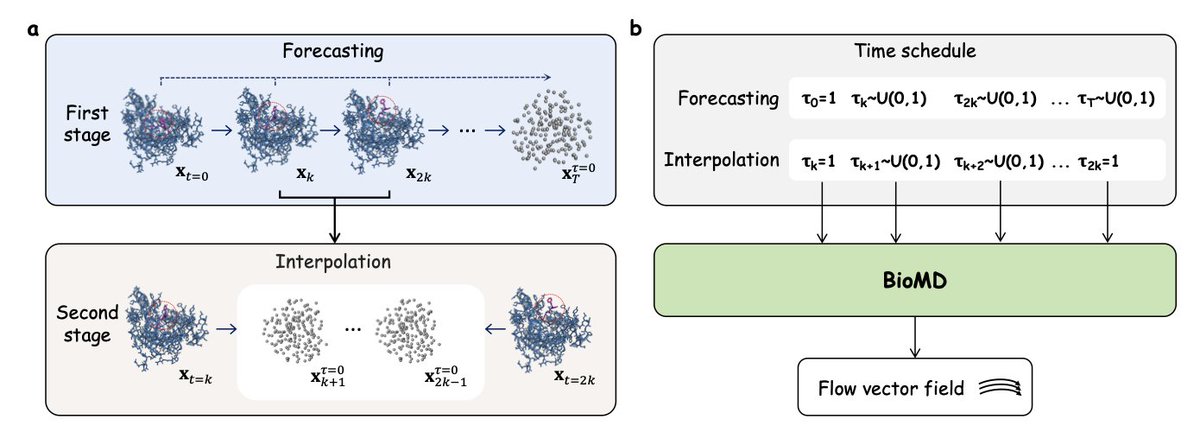
BioMD: All-atom Generative Model for Biomolecular Dynamics Simulation
1. BioMD introduces a novel hierarchical framework for generating long-timescale biomolecular trajectories, effectively addressing the computational limitations of traditional molecular dynamics (MD) simulations. This model significantly reduces the time required to simulate complex biomolecular processes, making it a powerful tool for computational chemistry and drug discovery.
2. The core innovation of BioMD lies in its two-stage approach: coarse-grained forecasting followed by fine-grained interpolation. This strategy not only mitigates error accumulation but also allows for the generation of physically realistic trajectories. The model demonstrates high physical plausibility and low reconstruction errors, outperforming existing methods in capturing the dynamic behavior of protein-ligand systems.
3. BioMD successfully generates ligand unbinding paths for up to 97.1% of the protein-ligand systems within ten attempts, showcasing its robust ability to explore critical and long-timescale biomolecular pathways. This is a significant advancement in the field, as it enables the discovery of novel unbinding pathways that were previously difficult to identify using traditional methods.
4. The model operates directly on all-atom Cartesian coordinates, capturing subtle structural variations that are crucial for realistic biomolecular dynamics. This all-atom modeling strategy, combined with the use of a velocity network and an SE(3)-equivariant graph transformer, allows BioMD to generate highly realistic conformations with promising physical stability.
5. BioMD's effectiveness is demonstrated through experiments on two challenging datasets: the MISATO dataset, focusing on ligand dynamics within the binding pocket, and the DD-13M dataset, which includes trajectories of ligand unbinding from protein binding pockets. The results highlight BioMD's superior performance in both capturing conformational flexibility and generating accurate unbinding paths.
6. The model offers distinct modes optimized for either accurate pathway reproduction or broad exploratory sampling, providing flexibility in adapting to specific simulation goals. This dual functionality makes BioMD a versatile tool for researchers aiming to either reproduce known dynamics or discover new biomolecular events.
📜Paper: https://t.co/dXGanF0NXn
#BioMD #MolecularDynamics #GenerativeModel #ComputationalChemistry #DrugDiscovery #BiomolecularSimulation
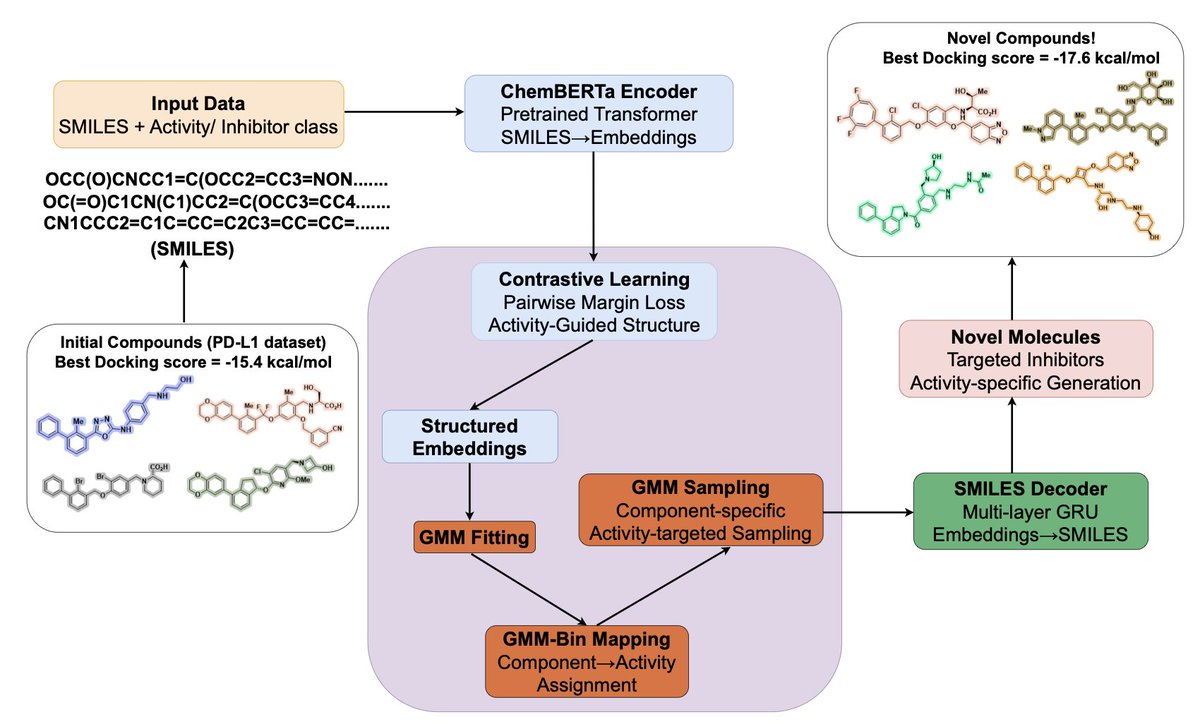
Valid Property-Enhanced Contrastive Learning for Targeted Optimization & Resampling for Novel Drug Design
1. The article introduces VECTOR+, a novel framework for drug discovery that combines contrastive learning and latent sampling to generate new molecules with optimized pharmacological properties. This approach is particularly effective in low-data regimes, a common challenge in targeted drug design.
2. VECTOR+ leverages property-guided representation learning to structure the chemical latent space according to biological function. This enables the generation of meaningful molecular representations from limited datasets, addressing a significant bottleneck in drug discovery.
3. The method is validated on two distinct datasets: a curated set of PD-L1 inhibitors and a set of receptor kinase inhibitors. Despite limited training data, VECTOR+ successfully generates novel, synthetically tractable candidates with superior docking scores compared to known inhibitors.
4. VECTOR+ demonstrates superior performance over state-of-the-art generative models like JT-VAE and MolGPT across multiple metrics, including docking score, novelty, uniqueness, and Tanimoto similarity. This highlights its potential for reproducible, AI-accelerated drug design.
5. The framework is broadly generalizable and can be extended to accelerate drug discovery across diverse therapeutic targets. It also introduces a curated dataset of 296 small-molecule PD-L1 inhibitors, providing a valuable resource for future research in this critical immuno-oncology task.
6. The authors provide a detailed methodology, including the use of a transformer-based encoder, contrastive learning, and Gaussian Mixture Model (GMM) for targeted molecule generation. This pipeline enables efficient exploration and generation of target-specific, structurally novel molecules.
7. Computational evaluations, including molecular docking and molecular dynamics simulations, confirm the binding stability and potential efficacy of the generated molecules, further supporting the practical impact of VECTOR+ in drug discovery.
📜Paper: https://t.co/SmaSLHSHu9
#DrugDiscovery #AI #ContrastiveLearning #GenerativeModeling #LowDataRegime
Generation of protein dynamics by machine learning
1. Machine learning, particularly generative models, is revolutionizing the prediction of protein dynamics by enabling the generation of structural ensembles beyond traditional simulations. This review highlights emerging approaches that capture protein dynamics in various forms, including PDB-like ensembles and acceleration of molecular simulations.
2. One significant innovation is the development of deep generative models (GMs) based on AlphaFold2, such as AlphaFlow and UFConf, which can generate multiple conformations from a single protein sequence. These models outperform traditional sampling methods in capturing PDB-like conformations.
3. The review emphasizes the importance of hybrid models that integrate experimental and simulation data. BioEmu, a diffusion model, demonstrates unprecedented performance in modeling both PDB and MD ensembles by leveraging a hybrid training strategy. This approach captures large and biologically significant conformational changes.
4. For non-globular proteins, especially intrinsically disordered regions (IDRs), ML methods are crucial for generating ensembles. Models like IDPFold and BioEmu show promise in capturing experimental observables of IDRs, such as chemical shifts and radius-of-gyration, using a combination of PDB structures and simulations.
5. The integration of experimental data directly into the generative process is another key advancement. Methods like DynamICE and DEERFold incorporate NMR and other experimental data during training, enhancing the accuracy of generated ensembles. This approach is essential for guiding ML models towards biologically relevant conformations.
6. Despite these advancements, challenges remain, including the transferability of models beyond training data and the generation of states with correct relative probabilities. The scarcity of long MD simulation datasets and the need for larger, more diverse training sets are also highlighted as critical areas for future work.
📜Paper: https://t.co/RlcASWEmx6
#MachineLearning #ProteinDynamics #StructuralBiology #GenerativeModels #Bioinformatics

Multi-Domain Distribution Learning for De Novo Drug Design
1. The article introduces DRUGFLOW, a novel generative model for structure-based drug design that integrates continuous flow matching with discrete Markov bridges. This model demonstrates state-of-the-art performance in learning the chemical, geometric, and physical aspects of three-dimensional protein-ligand data.
2. DRUGFLOW incorporates an uncertainty estimate that can detect out-of-distribution samples, enhancing the robustness of the model. This feature is crucial for identifying samples that deviate from the training distribution, ensuring more reliable predictions.
3. The model proposes a joint preference alignment scheme applicable to both flow matching and Markov bridge frameworks. This allows for the enhancement of the sampling process towards regions with desirable metric values, making it more efficient for practical applications.
4. An extended version of the model, FLEXFLOW, explores the conformational landscape of proteins by jointly sampling side chain angles and molecules. This innovation enables the model to sample probabilistic ensembles of possible binding modes, even for targets in unbound conformations.
5. DRUGFLOW outperforms other methods in learning the distribution of protein-binding molecules across various metrics. It achieves state-of-the-art distribution learning capabilities, making it a powerful tool for de novo drug design.
6. The model also includes an adaptive size selection method that discards excessive atoms during sampling. This feature allows the model to dynamically adjust the size of the molecule, improving its ability to generate realistic drug candidates.
7. DRUGFLOW demonstrates strong performance in learning the conditional size distribution of molecules given protein pockets. It effectively removes redundant atoms to avoid steric clashes, enhancing the quality of generated molecules.
8. The article presents comprehensive experiments that validate the model's ability to learn the training data distribution accurately. DRUGFLOW shows significant improvements in various metrics, including molecular properties, binding efficiency, and protein-ligand interactions.
9. The study concludes that DRUGFLOW can be retrained on curated datasets to steer the generation of samples towards desired regions of the chemical space. This flexibility makes it a versatile tool for medicinal chemists aiming to optimize molecules for specific design objectives.
📜Paper: https://t.co/9VhKWPOdWG
#DrugDesign #GenerativeModel #MachineLearning #ProteinLigand #DeNovoDesign #DistributionLearning

FlowMol3: Flow Matching for 3D De Novo Small Molecule Generation
1. FlowMol3 is a groundbreaking open-source model for generating 3D small molecules. It achieves nearly 100% molecular validity for drug-like molecules with explicit hydrogens, a significant milestone in the field of de novo molecular generation. This means it can produce highly realistic and chemically plausible molecules, which is crucial for accelerating chemical discovery.
2. The model uses a multi-modal flow matching approach to jointly sample molecular topology and 3D structure. Unlike previous versions, FlowMol3’s improvements come from three architecture-agnostic techniques: self-conditioning, fake atoms, and train-time geometry distortion. These techniques incur negligible computational cost yet dramatically enhance the model’s performance.
3. Self-conditioning allows the model to take its own previous predictions as input, enabling it to detect and correct inaccurate predictions. Fake atoms enable the model to dynamically add or remove atoms during inference, which helps in forming more realistic molecular structures. Geometry distortion introduces perturbations during training, making the model more robust to distribution drift.
4. FlowMol3 not only achieves high molecular validity but also more accurately reproduces the functional group composition and geometry of its training data. It does so with an order of magnitude fewer learnable parameters than comparable methods, making it highly parameter efficient.
5. The model was trained on the GEOM-Drugs dataset with explicit hydrogens. It outperforms existing state-of-the-art methods in terms of validity, functional group composition, and energy minimization. FlowMol3’s ability to generate molecules that closely match the training data distribution highlights its potential for practical applications in drug discovery.
6. The authors provide a detailed analysis of the model’s performance, including ablation studies that demonstrate the importance of each self-correcting feature. They also discuss the mechanistic interpretation of these features and their impact on molecular quality metrics.
7. FlowMol3’s innovations suggest that addressing inference-time distribution drift is key to improving the reliability of transport-based generative models. The proposed techniques are architecture-agnostic and can potentially be applied to other models, making them a valuable contribution to the field.
📜Paper: https://t.co/EYsb0GiGEe
💻Code: https://t.co/zmYEPKVXwp
#FlowMol3 #MolecularGeneration #DeNovoDesign #ChemicalDiscovery #AIinChemistry #GenerativeModels

PocketXMol: An Atom-level Generative Foundation Model for Molecular Interaction with Pockets
1. PocketXMol is a groundbreaking AI model designed to decipher fundamental atomic interactions for protein-pocket-interacting molecular tasks. It uses a novel unified generative framework with an innovative task prompt mechanism and an exclusive atom-level representation, making it applicable to diverse tasks without fine-tuning.
2. The model was evaluated on 13 typical tasks, including structure prediction and design of small molecules and peptides. PocketXMol achieved state-of-the-art performance in 11 tasks and remained competitive in the others, demonstrating its superior transferability across molecular data and tasks.
3. PocketXMol successfully designed novel small molecules that inhibit caspase-9 with efficacy comparable to commercial inhibitors. It also designed PD-L1-binding peptides with a success rate significantly higher than random library screening, validating its potential for molecular probing and therapeutics.
4. The model’s atom-level representation allows it to generate molecules at the most fundamental level, eliminating the need for task-specific models. This approach not only unifies the representation of different molecular types but also enables the model to learn shared principles across molecules.
5. PocketXMol’s training involves restoring 3D molecules from noisy ones, which facilitates learning shared knowledge across tasks. The model’s flexibility allows it to incorporate prior knowledge during the generation process, enhancing its applicability in various scenarios.
6. The model was trained on a comprehensive dataset of two million 3D structures, including small molecules, protein–peptide complexes, and protein–small-molecule complexes. This extensive dataset enables PocketXMol to generalize well across a wide range of molecular interactions.
7. PocketXMol’s performance in peptide design is particularly noteworthy. It can generate peptides with non-standard amino acids and achieve high binding affinities with target proteins, demonstrating its potential for designing novel therapeutic agents.
8. The model’s ability to handle cyclic peptides and its robustness to variations in input pocket structures further highlight its versatility and applicability in real-world scenarios. These features make PocketXMol a powerful tool for AI-aided drug discovery.
📜Paper: https://t.co/DKhhpERRzq
💻Code: https://t.co/ycp5UI2OdQ
#AI #DrugDiscovery #MolecularDesign #PeptideDesign #SmallMolecule #ProteinPocket #GenerativeModel #FoundationModel

Generative Molecule Evolution Using 3D Pharmacophore for Efficient Structure-Based Drug Design
1. A groundbreaking framework named MEVO has been introduced to bridge the gap between large-scale small molecule datasets and limited protein-ligand complex datasets, significantly enhancing the training data for structure-based drug design (SBDD) models. This innovative approach leverages pharmacophore-guided molecule generation and evolutionary optimization strategies to design high-affinity binders for various protein targets.
2. MEVO incorporates three key components: a high-fidelity VQ-VAE for molecule representation in latent space, a diffusion model for pharmacophore-guided molecule generation, and a pocket-aware evolutionary strategy for optimizing molecules with physics-based scoring functions. This combination allows for the efficient generation of molecules that fit both pharmacophore principles and target-binding constraints.
3. The framework demonstrates remarkable versatility and generalizability, validated through the design of potent inhibitors for KRASG12D, a challenging cancer target. MEVO-generated molecules exhibit binding affinities comparable to known highly active inhibitors, as evaluated by free energy perturbation (FEP) calculations.
4. MEVO effectively addresses the limitations of current SBDD methods by integrating extensive training data from ligand-only datasets, which are almost unlimited compared to protein-ligand complex datasets. This strategy allows the model to learn robust pharmacophore patterns and generate diverse and plausible molecules.
5. The evolutionary optimization strategy in MEVO uses a physics-informed scoring function to iteratively improve the binding affinity of generated molecules. This training-free approach can be easily transferred to other tasks, such as optimizing ligand properties like permeability and solubility.
6. MEVO generates drug-like molecules with desirable properties, as evidenced by comparisons with FDA-approved drugs. The generated molecules comply with Lipinski’s rule of five, exhibit reasonable drug-likeness scores, and have similar logP distributions to reference molecules.
7. In hit discovery, MEVO successfully identifies high-affinity binders for various protein targets, outperforming known binders in some cases. The model’s ability to preserve critical interactions within binding pockets provides a strong foundation for developing potent ligands.
8. MEVO’s high versatility is showcased through its application in different stages of drug design, including ligand growing, linker design, and lead optimization. The model’s ability to design high-affinity binders for KRASG12D highlights its potential in tackling challenging drug targets.
📜Paper: https://t.co/VntHRvLFoJ
#DrugDesign #GenerativeModels #StructureBasedDrugDesign #Pharmacophore #EvolutionaryOptimization #KRASInhibitors #AIinPharma

Protein-SE(3): Benchmarking SE(3)-based Generative Models for Protein Structure Design
1. A new benchmark, Protein-SE(3), has been proposed to comprehensively evaluate SE(3)-based generative models for protein structure design. This benchmark addresses the lack of a unified framework for fair comparison of different methods in this field.
2. Protein-SE(3) integrates recent advanced generative models like Genie1, Genie2, FrameDiff, RfDiffusion, FoldFlow, and FrameFlow into a unified training framework. All methods are evaluated using the same dataset and metrics.
3. The benchmark provides high-level mathematical abstractions of the underlying principles of these generative models, enabling researchers to prototype new algorithms without relying on explicit protein structures.
4. It includes diverse evaluation metrics such as quality (scTM, scRMSD), diversity (pairwise TM), novelty (max TM score to PDB), and secondary structure distribution, offering a comprehensive assessment of model performance.
5. The study conducts extensive experiments on unconditional scaffolding and motif scaffolding tasks, revealing that flow-matching methods generally outperform DDPM and score-matching methods in terms of quality and diversity.
6. The benchmark also analyzes the secondary structure distribution of generated proteins, showing that some models tend to produce structures dominated by helices, while others generate more balanced distributions.
7. Computational efficiency is evaluated, with flow-matching methods demonstrating significantly faster inference times compared to DDPM and score-matching methods.
8. The Protein-SE(3) benchmark is publicly accessible, providing a valuable resource for researchers to develop and compare new protein structure design algorithms.
💻Code: https://t.co/MQV70uGXoy
📜Paper: https://t.co/zxc7DC7K7P
#ProteinStructureDesign #SE3Models #Benchmarking #GenerativeModels #ComputationalBiology


have a good PaperDay:
🤖 ReasonGen-R1 brings CoT reasoning to image generation via SFT+RL!
✨ Two-stage magic:
1️⃣ SFT fine-tunes autoregressive models with text-based reasoning datasets (200k+ samples!)
2️⃣ GRPO refines outputs using vision-language model rewards for top-notch visual quality.
🎯 Outperforms SOTA on GenEval, DPG, T2I benchmarks!
🚀 Open-sourced dataset & code coming soon. Learn more: https://t.co/1nxgJcnuP7 🌟 #AI #ComputerVision #GenerativeModels
PixCell: A generative foundation model for digital histopathology images
1. PixCell is the first diffusion-based generative foundation model designed specifically for histopathology images.
2. Trained on a large-scale dataset (PanCan-30M) comprising 69,184 H&E-stained whole-slide images across various cancer types, PixCell generates high-fidelity and diverse samples.
3. The model utilizes progressive training, starting from smaller image patches and gradually scaling up to larger images for optimized performance.
4. PixCell demonstrates the ability to replace real data with synthetic images, offering a privacy-preserving alternative for training self-supervised learning models.
5. The model can generate images conditioned on cell segmentation maps, enabling targeted data augmentation that improves the performance of downstream tasks.
6. PixCell is adaptable for virtual staining tasks, such as translating H&E staining to IHC staining, showcasing its versatility in computational pathology.
7. The model achieves state-of-the-art performance in several tasks, including image generation and stain translation, surpassing previous methods in terms of quality and accuracy.
8. PixCell’s synthetic images are evaluated using self-supervised learning, showing that they can effectively replace real images in model training without degrading performance.
9. The model's generative capabilities are further enhanced by ControlNet, which allows for precise control over generated images using reference masks.
10. PixCell and its associated models are publicly released, with the aim to accelerate research and foster innovation in computational pathology.
💻Code: https://t.co/vcm8Cyz77F https://t.co/8fhdOpexAY
📜Paper: https://t.co/k6EWqgwlox
#PixCell #GenerativeModels #Histopathology #ComputationalPathology #DataAugmentation #SyntheticData #StainTranslation #AIinHealthcare

Equivariant diffusion for structure-based de novo ligand generation with latent-conditioning
1.The authors introduce PoLiGenX, a generative model for de novo ligand design that combines protein pocket conditioning with a latent embedding of a reference molecule, enabling shape- and chemistry-aware ligand generation for hit expansion.
2.Unlike previous models that only condition on protein structures, PoLiGenX integrates a latent representation of seed molecules, guiding the generation toward structurally and chemically similar ligands while allowing significant chemical diversity.
3.Using latent conditioning, PoLiGenX generates ligands with better docking poses, lower strain energies, and fewer steric clashes compared to prior models like EQGAT-diff, DiffSBDD, and TargetDiff.
4.The model achieves a mean shape similarity of 0.87 and chemical similarity of 0.33 to reference ligands, outperforming unconditioned models like EQGAT-diff (0.64 and 0.12 respectively), demonstrating its ability to retain shape while diversifying chemistry.
5.In docking evaluations (QuickVina2), PoLiGenX-generated ligands score −6.88 kcal/mol on average, with top 10% scoring −7.77 kcal/mol—comparable or superior to reference ligands—while maintaining drug-likeness as assessed by Lipinski's Rule of Five.
6.PoLiGenX demonstrates improved synthetic accessibility with a mean SA score of 0.68, and even higher (0.74) when using an importance sampling approach with an SA-guiding surrogate model.
7.The latent encoder, based on the EQGAT architecture, is group-invariant and jointly trained with the diffusion model, enabling tight coupling between latent representation and generated outputs.
8.The architecture modifies EQGAT-diff with adaptive layer normalization that integrates latent variables into each layer, allowing smooth control over how strongly the reference influences the generated ligand.
9.Generated ligand poses show lower strain energies (∼250–265 kcal/mol) and fewer steric clashes compared to DiffSBDD (∼845 kcal/mol, 17.3 clashes) and TargetDiff (∼1242 kcal/mol, 9.1 clashes), indicating superior conformational quality.
10.Hydrogen bond recovery rates for generated ligands are also significantly improved (∼50%) over prior models, supporting better interaction fidelity with protein targets.
11.The model includes a tunable control parameter to adjust the influence of latent conditioning; higher values produce ligands more similar to the reference, giving users precise control over the exploration vs. exploitation trade-off.
12.Unlike other models like ShapeMol or SQUID, which only consider molecular shape, PoLiGenX simultaneously conditions on both protein pocket and seed molecule, achieving higher biological relevance for structure-based drug design.
13.PoLiGenX is trained using the CrossDocked2020 dataset and evaluated across 100 targets, showing generalizability across diverse protein-ligand complexes.
14.Visual inspections confirm the topological and geometric fidelity of generated ligands to their references, while enabling meaningful scaffold variations.
15.Future directions include incorporating protein flexibility and advanced sampling to explore rare, therapeutically promising chemical structures.
💻Code: https://t.co/SppO664RkR
📜Paper: https://t.co/TUVrV4Ngs9
#DrugDiscovery #GenerativeModels #EquivariantDiffusion #MachineLearning #ComputationalChemistry #LigandDesign #AI4Science

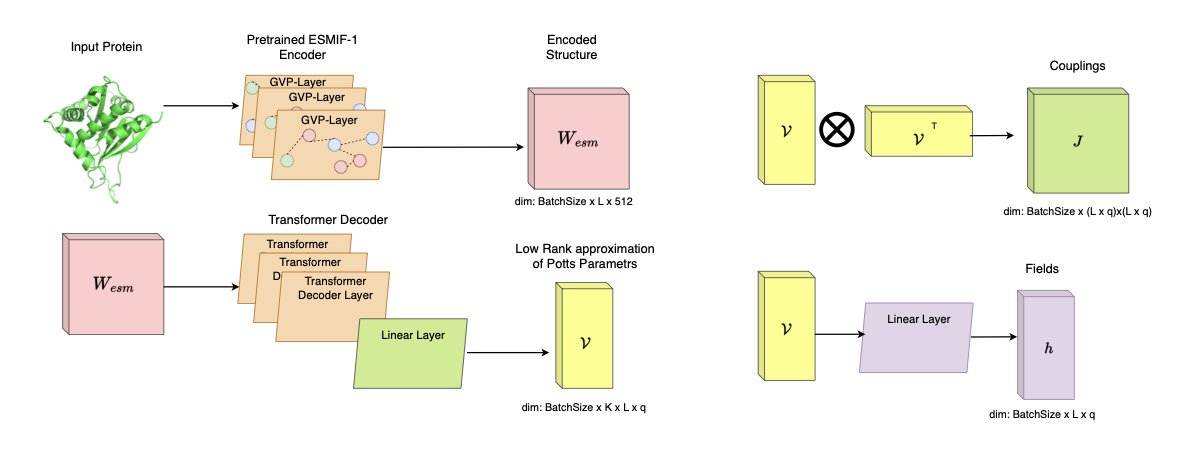
Fast uncovering of protein sequence diversity from structure
1.InvMSAFold is a new inverse folding method that can generate diverse protein sequences consistent with a given structure, enabling exploration of a broad sequence landscape rather than focusing on one native sequence.
2.Unlike prior methods like ESM-IF1 or ProteinMPNN that predict a single or few sequences, InvMSAFold learns a distribution over sequence space, enabling the recovery of multiple functionally viable sequences with shared structural folds.
3.A key innovation is generating the parameters of a low-rank pairwise model (Potts model) from protein structure in a single forward pass, enabling very fast sampling of sequences without requiring GPUs.
4.The diversity of generated sequences translates into broader coverage of biochemical properties (e.g., solubility and thermostability), which is valuable for applications such as enzyme engineering and drug discovery.
5.InvMSAFold introduces two variants: InvMSAFold-PW (pairwise, using MCMC) and InvMSAFold-AR (autoregressive), with the latter enabling more efficient and scalable sampling on CPUs.
6.Benchmarking shows InvMSAFold-AR is orders of magnitude faster than ESM-IF1 in generating sequences, while still producing sequences predicted to fold correctly by AlphaFold2 even at high Hamming distances from native sequences.
7.Compared to ESM-IF1 and ProteinMPNN, InvMSAFold more accurately reproduces residue covariances found in natural MSAs, indicating better modeling of evolutionary constraints and sequence variability.
8.In PCA projections of sequence space, InvMSAFold-AR shows wider and more accurate coverage compared to ESM-IF1, which clusters narrowly around the training sequence, missing alternative viable sequence modes.
9.Evaluation on inter- and intra-cluster test sets (based on CATH classification) shows InvMSAFold generalizes well even to unseen structural families, outperforming existing inverse folding methods.
10.InvMSAFold is especially well-suited for high-throughput virtual screening workflows, where thousands or millions of sequences must be generated and evaluated efficiently.
11.Training is done on structure-MSA pairs, ensuring the model captures natural diversity and does not overfit to a single ground truth sequence, unlike previous autoregressive or transformer-based approaches.
12.The low-rank factorization of the pairwise model (scaling parameters from O(L²) to O(L)) is key to its computational efficiency while maintaining expressivity in modeling residue-residue interactions.
13.InvMSAFold’s generated sequences yield a wider range of predicted protein properties, validated by solubility (Protein-Sol) and thermostability (ThermoProt) predictors, indicating real functional potential.
14.The authors emphasize that generated sequences remain within natural evolutionary space due to training on MSAs, making them detectable by standard biosecurity screening based on homology.
💻Code: https://t.co/GmZzkSupQl
📜Paper: https://t.co/dNew2Xnm0Y
#computationalbiology #proteindesign #deeplearning #inversefolding #generativemodels #bioinformatics
Expanding Molecular Design with Graph Variational Autoencoders: A Comparative Study of Pair-Encoding and Character Tokenization
1.This study introduces DGVAE, a lightweight, deeper graph attention model that generates highly novel molecules with fewer parameters, outperforming many existing models in scaffold diversity and novelty.
2.By replacing traditional character-level SMILES tokenization with SMILES pair-encoding (PE), the authors expand the chemical substructure vocabulary from 26 to 2399 tokens, capturing more chemically meaningful patterns and doubling the number of novel scaffolds.
3.TGVAEv2, an improved version of their previous Transformer-GAT-VAE, incorporates batch normalization and architectural simplifications. It trains twice as fast and achieves strong performance across drug-like property distributions and novelty benchmarks.
4.The comparison between TGVAEv2 and DGVAE shows that DGVAE not only maintains performance with 4x fewer parameters but also generalizes better to novel scaffold spaces unseen during training, making it ideal for small-data settings.
5.Both models are trained on the MOSES benchmark dataset and validated using PubChem. DGVAE_PE (trained with pair-encoding) generates up to 18.4k molecules with zero known substructures, indicating exploration beyond known chemical space.
6.Despite using a deeper architecture, DGVAE’s narrow-layer design (64 GAT blocks with smaller hidden dimensions) ensures stability and fast convergence, proving suitable for resource-limited or proprietary drug discovery tasks.
7.The use of PE leads to lower Fréchet ChemNet Distance (FCD), better internal diversity, and more favorable scaffold novelty compared to character-based tokenization, all while preserving key pharmacological properties like MW, logP, QED, and SA.
8.PE-trained models, especially after extended training (100 epochs), consistently show improved validity and novelty without sacrificing drug-likeness or diversity, making them highly practical for de novo drug generation.
9.Evaluation against baseline models like VAE, AAE, and LatentGAN confirms that both TGVAEv2 and DGVAE achieve competitive or superior results across key metrics including uniqueness, novelty, and chemical property alignment.
10.This is the first detailed study comparing character-level and pair-encoding tokenization in the context of graph-based VAEs, offering valuable insights for future model design in molecular generation.
💻Code: https://t.co/fRPgA8sqWM
📜Paper: https://t.co/KsCZzCpFTN
#MolecularDesign #GraphVAE #DrugDiscovery #AI4Science #DeepLearning #SMILES #GenerativeModels #Cheminformatics

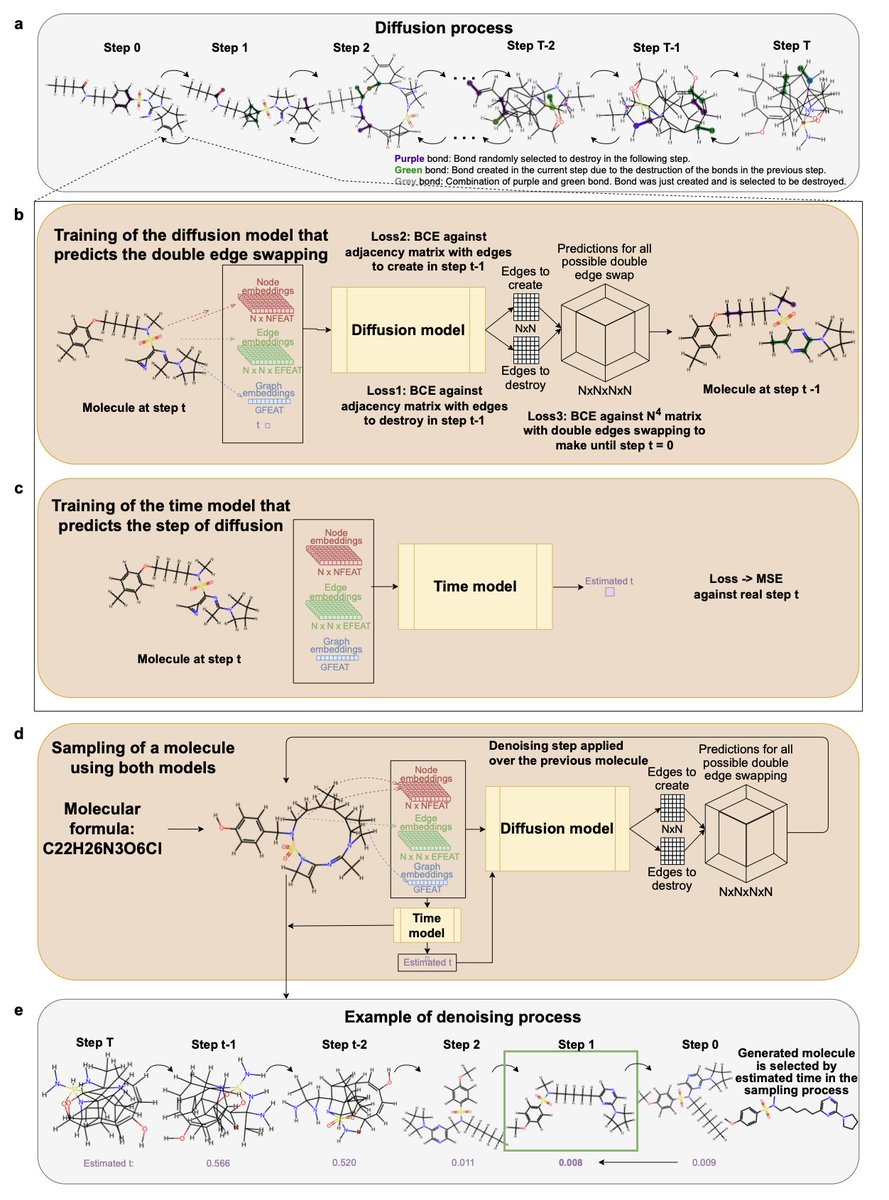
A collaborative constrained graph diffusion model for the generation of realistic synthetic molecules
1.CoCoGraph is a new collaborative and constrained discrete diffusion model that generates chemically valid, novel, and realistic molecules with perfect (100%) validity by construction—no invalid molecules are ever produced.
2.The model employs a discrete double-edge swapping process that preserves atomic valences, molecular formula, and bond types throughout diffusion, ensuring chemical constraints are always met without needing to be learned.
3.CoCoGraph introduces a collaborative architecture: a diffusion model predicts edge swaps, while a time model estimates how close a graph is to a valid molecule. This collaboration improves generation fidelity and robustness.
4.With just 534K parameters in the BASE version (an order of magnitude smaller than DiGress or JTVAE), CoCoGraph matches or outperforms state-of-the-art models in validity, uniqueness, novelty, and molecular property distributions.
5.On the GuacaMol benchmark, CoCoGraph achieves 100% validity, 99.9% uniqueness, and ~98.6% novelty, while reducing KL divergence in property distributions by up to 50% compared to DiGress and over 90% compared to JTVAE.
6.An extended evaluation across 36 molecular properties shows CoCoGraph FPS outperforms DiGress on 23/36 and JTVAE on 33/36, especially excelling in topological, electronic, and drug-likeness features critical for medicinal chemistry.
7.To test realism, the authors conducted a Turing-like test with 102 human experts who attempted to distinguish real from generated molecules. Average accuracy was 62%—only slightly above random guessing, indicating high plausibility.
8.CoCoGraph is efficient enough to generate millions of molecules with modest resources. The authors built a public dataset of 8.2M synthetic molecules with 98.5% novelty and just 7.1% redundancy.
9.The model also generalizes well across molecular types. Experts found acyclic or aliphatic molecules generated by CoCoGraph indistinguishable from real ones, suggesting successful exploration of chemically diverse regions.
10.By shifting chemical constraints from parameter learning to process design, CoCoGraph redefines molecular generation. Its constrained, collaborative diffusion enables fast, scalable, and chemically grounded exploration of molecular space.
💻Code: https://t.co/ODlQWNJUT2
📜Paper: https://t.co/op8FbkCRRL
#MolecularGeneration #GraphDiffusion #ComputationalChemistry #DrugDiscovery #GenerativeModels #MachineLearning #Cheminformatics #CoCoGraph #AI4Science
Learning Flexible Forward Trajectories for Masked Molecular Diffusion
1.This paper introduces MELD, a novel masked diffusion model for molecular graph generation that learns element-wise corruption schedules. By avoiding the collapse of distinct molecular graphs into indistinguishable masked states, MELD dramatically improves validity and property alignment in molecule generation tasks.
2.Standard masked diffusion models (MDMs) apply uniform noise across graph elements, which causes a “state-clashing” problem where different molecules converge to similar intermediate representations. MELD addresses this with per-atom and per-bond noise scheduling.
3.The core innovation in MELD is a learnable noise scheduling network that outputs distinct corruption rates for each node and edge, dynamically controlling which molecular components are masked at each timestep to avoid trajectory collisions.
4.Unlike autoregressive masked diffusion models (e.g., GraphARM), MELD preserves parallelism and achieves higher chemical validity. For example, it boosts validity on ZINC250K from 15% (baseline MDM) to 93%, a more than 6-fold improvement.
5.In unconditional generation on QM9 and ZINC250K, MELD achieves state-of-the-art performance across key metrics including Fréchet ChemNet Distance (FCD), NSPDK, uniqueness, and scaffold similarity—outperforming DiGress, GraphDF, and continuous diffusion models like GDSS and EDP-GNN.
6.In property-conditioned generation (Polymer dataset), MELD surpasses previous best methods like GraphDiT and MOOD, reducing mean absolute error in property alignment by up to 16% and outperforming across synthesizability and gas permeability targets.
7.Extensive ablation studies confirm that element-wise scheduling is crucial: MELD outperforms both class-wise and unified (fixed) noise scheduling, especially in avoiding chemically implausible structures at late diffusion steps.
8.Visual analyses reveal MELD’s denoising strategy prioritizes nodes before edges and functional groups before frameworks, reconstructing valid molecular graphs earlier in the reverse process than baselines with fixed scheduling.
9.MELD’s forward noise schedule is learned using a parameterized MLP, and optimized with a straight-through Gumbel-Softmax trick, allowing gradient flow through discrete sampling operations without sacrificing differentiability.
10.This work positions MELD as a robust and generalizable framework for molecule generation, with clear implications for improving sample quality, controllability, and downstream optimization in drug discovery and materials design.
📜Paper: https://t.co/cgxi427oXU
#MolecularGeneration #DiffusionModels #GraphLearning #ComputationalChemistry #MaskedDiffusion #MELD #GenerativeModels #DrugDiscovery #ChemicalSpace #AI4Science

PepINVENT: Generative Peptide Design Beyond Natural Amino Acids
1.PepINVENT is a generative AI framework that designs peptides containing both natural and non-natural amino acids (NNAAs). It extends the REINVENT platform, enabling flexible de novo peptide design with rich chemical diversity and complex topologies.
2.Unlike typical models restricted to 20 natural amino acids, PepINVENT explores a vastly larger chemical space by incorporating a library of over 10,000 synthesizable NNAAs. It can generate novel, syntactically valid amino acids beyond the training set.
3.The model is trained using a masked infilling strategy at the amino acid level. Given a peptide with certain residues masked, PepINVENT learns to generate suitable amino acids that complete the sequence while maintaining chemical correctness.
4.A key innovation is the use of CHUCKLES, a chemically standardized SMILES representation at the monomer level, which allows atomic-level control and valid concatenation of peptide sequences.
5.PepINVENT supports linear, head-to-tail, disulfide-bridged, and sidechain-to-tail cyclic peptides, and successfully learns topological constraints. It generates peptides with high validity (98–100%) and uniqueness across all topologies.
6.The model generates novel amino acids with over 90,000 previously unseen structures identified in sampling. Multinomial sampling yields broader diversity than beam search, emphasizing PepINVENT's strength in exploring unexplored chemical space.
7.Reinforcement learning enables goal-directed peptide design. PepINVENT can optimize topological features (e.g., ring size), and physicochemical properties like solubility and permeability through multi-parameter optimization (MPO).
8.In a practical application, PepINVENT redesigned a known macrocyclic Rev-binding peptide (RBP) to be more soluble and cell-permeable, using learned scoring functions and RL-guided sampling to enhance therapeutic potential.
9.The framework achieves its design goals in fewer than 50 RL steps and supports integration of property prediction tools like CAMSOL-PTM and permeability classifiers, enabling fine-tuned control over biological properties.
10.PepINVENT sets a new benchmark for peptide generative models by offering fine-grained, flexible, and scalable design of novel peptides. It is well-suited for applications in peptidomimetics, lead optimization, and therapeutic development.
📜Paper: https://t.co/u4UaWcOefA
#PeptideDesign #GenerativeModels #NonNaturalAminoAcids #ComputationalBiology #DrugDiscovery #ReinforcementLearning #Peptidomimetics #REINVENT #PepINVENT

Steering Generative Models with Experimental Data for Protein Fitness Optimization
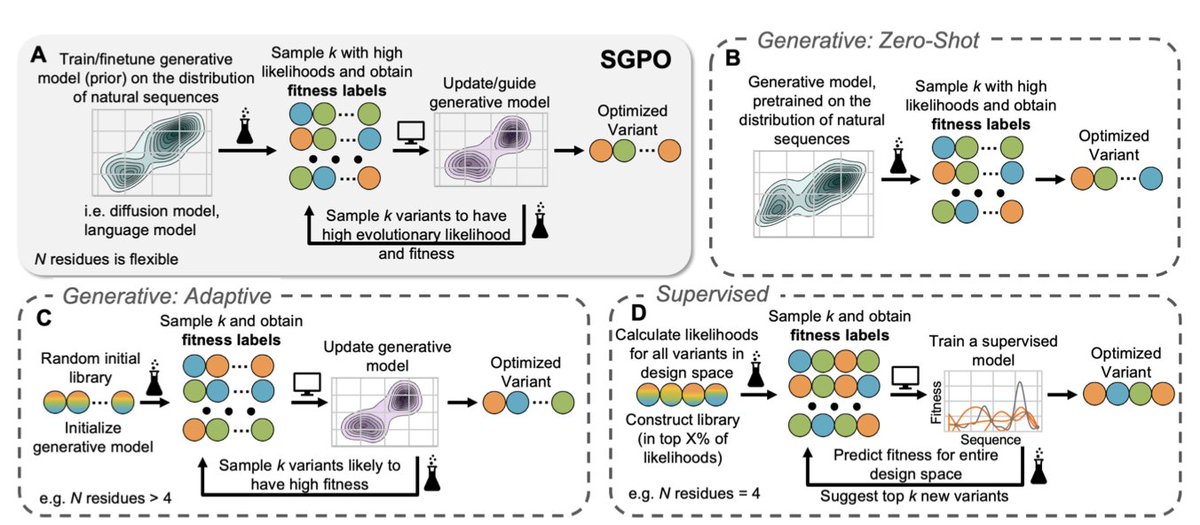
1.This paper introduces SGPO (Steered Generation for Protein Optimization), a principled and scalable framework that guides generative models of protein sequences using small amounts of real fitness data. SGPO enables more efficient exploration and optimization than traditional finetuning or zero-shot generation.
2.SGPO combines generative priors trained on natural sequences (e.g. discrete diffusion models or autoregressive language models) with plug-and-play fitness guidance derived from labeled wet-lab assay data—typically just hundreds of sequences—making it suitable for low-throughput experimental settings.
3.The authors comprehensively evaluate multiple generative models (continuous diffusion, discrete diffusion with uniform or absorbing noise, autoregressive PLMs) and multiple guidance strategies including classifier guidance (CG), DAPS, and NOS, across two benchmark proteins: TrpB and CreiLOV.
4.SGPO achieves strong optimization performance even with just 200 labeled sequences, significantly outperforming supervised finetuning methods like DPO on autoregressive PLMs, especially in low-data regimes.
5.Discrete diffusion models with uniform noise (D3PM) guided by DAPS or CG consistently generate high-fitness, diverse protein sequences. In contrast, language model finetuning via DPO underperforms and is sensitive to hyperparameters.
6.SGPO also supports adaptive optimization workflows akin to Bayesian optimization. The authors use a form of Thompson sampling by guiding generation with an ensemble of fitness predictors, which improves maximum fitness in iterative campaigns.
7.Plug-and-play guidance in SGPO requires minimal computational resources—pretraining is fast and steering can be done in minutes—unlike RL-based or fully finetuned approaches that need longer training and tuning cycles.
8.The framework’s key advantage is its flexibility: generative priors can be pretrained once and reused across campaigns, while guidance strategies like DAPS or CG can be layered on without updating the model weights.
9.SGPO avoids the limitations of other methods: it scales to larger sequence spaces (N > 9), leverages both evolutionary priors and assay-based data, and avoids the inefficiencies of local search in traditional directed evolution.
10.By systematically analyzing steering strategies and model architectures, this work provides best practices and a powerful open-source tool for real-world protein engineering, setting a new standard for ML-assisted protein design.
💻Code: https://t.co/QKSysHOsXh
📜Paper: https://t.co/rhG8xBdRTu
#ProteinDesign #GenerativeModels #DiffusionModels #ProteinEngineering #BayesianOptimization #SGPO #ComputationalBiology #DirectedEvolution
Adapting ProteinMPNN for antibody design without retraining
1.This work shows that ProteinMPNN, despite its success in designing well-folded proteins, underperforms when tasked with designing antibody CDRs—producing sequences that lack native-like features and often fail to refold properly.
2.The authors introduce a simple but powerful solution: ensemble ProteinMPNN with AbLang, a protein language model trained exclusively on antibody variable regions, to guide sequence generation toward more realistic antibody-like designs.
3.This ensemble method requires no retraining. Instead, at each designed residue, the logits from both models are added before sampling, combining structural constraints from ProteinMPNN with sequence priors from AbLang.
4.Across computational benchmarks, the ensemble dramatically improves sequence recovery, V-gene identity, antigen-contact residue accuracy, and CDRH3 conformational consistency—matching or exceeding a specialist fine-tuned model (AbMPNN).
5.In an experimental test, 96 trastuzumab CDRH3 variants were designed with each method. While ProteinMPNN alone produced 3 HER2 binders and AbLang only 1, the ensemble yielded 36—demonstrating a 12× improvement over the original model.
6.The method preserves diversity in CDR1 and CDR2, as measured by Shannon entropy, while improving antibody-likeness based on PSSMs and structural cluster profiles. It avoids generating unrealistic sequences even under heavy sampling.
7.The ensemble correctly introduced a critical binding residue (Y105) in 91% of designs, compared to 0% with ProteinMPNN alone, reflecting its ability to capture functionally important sequence motifs learned by the language model.
8.This strategy can be used today as a drop-in upgrade to structure-based antibody design workflows using ProteinMPNN, leveraging the wealth of antibody-specific information embedded in language models without the cost of retraining.
9.The findings also highlight a broader principle: in domains where the design space is shaped by both structure and evolution, combining generative modalities (structure + language) yields superior and more biologically realistic designs.
📜Paper: https://t.co/szRWeh9nV4
#AntibodyDesign #ProteinMPNN #AbLang #CDRDesign #ProteinDesign #GenerativeModels #ComputationalBiology #Bioinformatics #AI4Science #TherapeuticAntibodies

Protein FID: Improved Evaluation of Protein Structure Generative Models
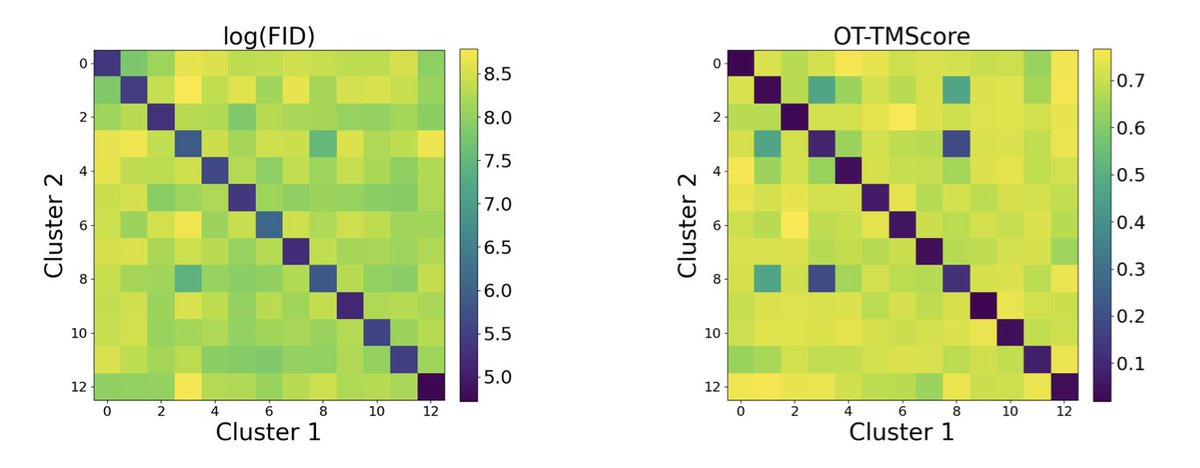
1.This paper proposes Protein FID, a new evaluation metric for generative protein structure models, addressing key limitations of current metrics like designability, diversity, and novelty, which often fail to reflect how well models sample the full structural distribution.
2.Protein FID adapts the Frechet Inception Distance (FID) from image generation to proteins by comparing distributions of generated and natural structures in a semantically meaningful embedding space derived from ESM3 representations.
3.Unlike standard metrics that assess individual outputs, Protein FID evaluates the entire generative distribution, penalizing models that undersample important structure types like beta sheets or CATH domains—even if their individual outputs are valid.
4.The FID is robust across different embedding dimensions and sample sizes, preserving model rankings even with small sets of 50 structures or projections as low as 4 dimensions, making it computationally efficient and reliable.
5.Evaluation on state-of-the-art models (MultiFlow, Chroma, RFDiffusion) reveals a persistent gap between generated and natural structures, with natural PDB samples achieving far lower FID scores despite being unseen by the embedding model.
6.Protein FID also detects structural perturbations—such as AlphaFold3-generated structures without MSAs or atomic jittering—and increases consistently with perturbation severity, validating its sensitivity to physical plausibility.
7.Using a “diversity race” experiment with FoldSeek and CATH clusters, the metric is shown to reflect multi-level fold diversity, with FID rising faster when entire structural categories are removed than when structures are dropped randomly.
8.Generated proteins consistently show lower inter-residue contact order and require fewer tertiary motifs (TERMs) to explain their structure compared to PDB proteins, indicating lower complexity and redundancy in substructure usage.
9.Optimizing for FID during sampling—notably by reverting to training-time noise schedules—leads to gains in structural complexity and substructural diversity, suggesting that FID can guide model improvement beyond existing metrics.
10.The FID remains effective even when using alternate embeddings like GearNet or split-residue ESM3 embeddings, though averaged ESM3 embeddings showed the best balance of local and global structural fidelity in experiments.
11.As designability metrics approach saturation (~99%), Protein FID emerges as a more discriminative and forward-looking benchmark to guide progress in generative protein design, better reflecting true alignment with natural structure space.
📜Paper: https://t.co/Iqqb1uGUwg
#ProteinDesign #GenerativeModels #StructuralBiology #ProteinEngineering #ComputationalBiology #EvaluationMetrics #FrechetDistance #Bioinformatics #ESM3 #AI4Science
A generative language model decodes contextual constraints on codon choice for mRNA design
1.This work presents Trias, a generative encoder-decoder model trained on 10 million eukaryotic mRNA sequences to reverse translate protein sequences into biologically valid codon sequences, capturing species- and context-specific usage patterns.
2.Trias learns codon usage preferences directly from sequence data, without hard-coded rules or explicit protein expression training, and still outperforms commercial codon optimization tools in producing sequences aligned with high-expression profiles.
3.The model integrates local and global context during codon generation, using a BART-based architecture with species tags and bidirectional encoding, enabling it to capture long-range dependencies absent in prior models.
4.In benchmarks using 30 GFP variants with measured expression, mRNA half-life, and ribosome load, Trias likelihood scores showed strong correlations (ρ up to 0.84), despite never being trained on experimental data.
5.Unlike commercial tools that prioritize most-frequent codons uniformly, Trias balances preference with biological realism—favoring frequent codons generally, but retaining rare codons in nucleic acid-binding genes or in specific contexts.
6.Trias-generated sequences show higher similarity to experimentally validated high-expression GFP variants than those from GenScript, Twist, or IDT, as measured by codon identity and codon usage profile distances.
7.The model exhibits “internal consistency”: when placed in a rare-codon context, it tends to continue using rare codons, mirroring natural clustering observed in real genes, and showing context-sensitive prediction behavior.
8.Rare codon usage is more likely in the 5′ ends of sequences and within protein domains, suggesting Trias has implicitly learned positional and structural constraints on codon selection.
9.A functional GO enrichment analysis found that genes with preserved rare codon usage are enriched in nucleic acid-binding roles, supporting the model’s capacity to uncover biologically relevant constraints beyond expression.
10.Trias sets a new standard for codon optimization and synthetic mRNA design by combining generative modeling with interpretable biological behavior, and is deployable for over 600 vertebrate species via its Hugging Face model release.
💻Code: https://t.co/Gd29feJ7YO
📜Paper: https://t.co/ck2xWPy5MP
#CodonOptimization #mRNADesign #SyntheticBiology #GenerativeModels #ComputationalBiology #ProteinExpression #mRNA #Bioinformatics #LLM #AI4Science

Generative model of SARS-CoV-2 variants under functional and immune pressure unveils viral escape potential and antibody resilience
1.A new model generates viable SARS-CoV-2 RBD variants by balancing ACE2 binding, antibody escape, and sequence viability, revealing how functional constraints limit immune escape.
2.By integrating deep mutational scanning (DMS) data and a generative Restricted Boltzmann Machine trained on pre-pandemic Coronaviridae sequences, the model quantitatively assesses immune pressure on viral evolution.
3.The model identifies antibodies with high resilience (VIR-7229, S309) and those with lower robustness (e.g., SA55 and S2E12), based on the proportion of functional escape variants.
4.It predicts antibody escape more accurately than previous approaches by incorporating evolutionary constraints and epistatic effects in mutational landscapes.
5.The model tracks how immune selection shaped viral adaptation over time, showing increasing pressure from class 1–3 antibodies and corresponding accumulation of escape mutations.
6.A key innovation is the definition of an “antibody resilience” metric: the fraction of ACE2-binding, viable variants that can escape a given antibody, enabling preemptive assessment of therapeutic durability.
7.Experimental validation of 22 designed RBD variants confirms 50% expression rate, with several highly mutated sequences maintaining ACE2 binding and showing selective antibody escape.
8.Notably, S309 and VIR-7229 retained binding across multiple diverse mutational backgrounds, while S2E12 and SA55 were more vulnerable to escape mutations.
9.The mutation G504E was experimentally confirmed as a potent, context-independent escape route against SA55, even when introduced into highly divergent viral backgrounds.
10.Antibody cocktail design benefits from the model’s ability to detect anti-correlated escape profiles: cocktails like VIR-7229 + REGN10987 and S309 + REGN10987 show strong resilience.
11.The framework not only predicts variant evolution but also serves as a generative tool to explore hypothetical sequences far from observed variants, offering a broader perspective for vaccine and therapeutic design.
12.Despite its strengths, the model has limitations in capturing structural constraints, which may explain why only half of the predicted sequences were expressible; incorporation of structure-aware models could enhance precision.
13.Overall, this study provides a mechanistic, data-driven tool to evaluate antibody escape and optimize therapeutic strategies under evolving immune pressures.
💻Code: https://t.co/hfywD82P7q
📜Paper: https://t.co/hN2EzL6fhv
#SARSCoV2 #AntibodyEscape #ProteinDesign #ComputationalBiology #GenerativeModels #COVID19 #DeepLearning #Biophysics #PandemicPreparedness

EVOLUTIONARY POLICY GRADIENT BASED OPTIMIZATION FOR SMALL MOLECULE DRUG DISCOVERY
1.This work introduces EPOSMol, an evolutionary policy gradient algorithm that optimizes small molecules in latent space by integrating gradient-based learning with evolutionary population sampling—yielding up to 10× better hit rates than existing methods.
2.Unlike many generative approaches that struggle with high-dimensional or sparse fitness landscapes, EPOSMol uses a dynamic policy gradient method guided by binding affinity, drug-likeness (QED), and diversity to efficiently explore and refine chemical space.
3.The framework operates on latent representations from a retrained NP-VAE model, which was optimized using ZINC250k, DrugBank, and underrepresented bioassay compounds, enabling better generalization beyond training distributions.
4.Key innovations include dynamic scheduling of population size (150→50) and noise (2.0→1.0), a diversity penalty to avoid local optima, and a reward function that balances binding affinity, QED, and novelty—encouraging both exploration and convergence.
5.In benchmarking against REINVENT 4.0 and other baselines (GCPN, MolDQN, GraphAF), EPOSMol achieved a 9.7× higher hit rate and generated compounds with better predicted binding affinities (up to -12.1 kcal/mol vs. -10.1).
6.Extended runs produced 36,420 compounds with 22,245 unique molecules, achieving a 32.64% overall hit rate and identifying 4,137 unique hits satisfying strong bioactivity and drug-likeness thresholds.
7.UMAP projections revealed that EPOSMol efficiently traversed the chemical space, discovering novel scaffolds and densely covering regions near bioassay-validated compounds—many of which had low QED scores previously missed by standard filters.
8.The model generated compounds across 570+ Bemis-Murcko scaffolds and showed clear structural improvement over existing binders, preserving common substructures while improving binding affinity.
9.Binding affinity optimization was performed using Vina2.2 GPU, and results showed clear separation between EPOSMol-generated compounds and training set molecules, confirming its capacity to push toward chemically meaningful optima.
10.EPOSMol’s policy update combines exploration-driven sampling with reward-weighted gradient updates, using ADAM optimization and cosine schedulers to adjust exploration intensity during the run.
11.The framework is model-agnostic, easily applicable to any generative model with continuous latent space, and allows flexible integration of reward functions and docking tools for task-specific molecular design.
12.This study demonstrates that combining evolutionary search with policy gradients offers an efficient, interpretable, and scalable path for lead optimization in early-stage drug discovery.
📜Paper: https://t.co/iFLK2p4qRW
#DrugDiscovery #MolecularDesign #ReinforcementLearning #VAE #SMILES #BindingAffinity #GenerativeModels #Bioinformatics #EvolutionaryAlgorithms #EPOSMol #ICLR2025

Last Seen Hashtags on Sotwe
Trends for you
Most Popular Users

Elon Musk 
@elonmusk
239.8M followers

Barack Obama
@barackobama
118.6M followers

Cristiano Ronaldo
@cristiano
114.3M followers

Donald J. Trump
@realdonaldtrump
111.7M followers

Narendra Modi
@narendramodi
106.9M followers

Rihanna
@rihanna
98.6M followers

NASA
@nasa
92.1M followers

Justin Bieber
@justinbieber
91.7M followers

KATY PERRY
@katyperry
89.9M followers

Taylor Swift
@taylorswift13
83.9M followers

Lady Gaga
@ladygaga
75.4M followers

Virat Kohli
@imvkohli
73.3M followers

Kim Kardashian
@kimkardashian
70.8M followers

YouTube
@youtube
68.6M followers

Neymar Jr
@neymarjr
66.3M followers

Bill Gates
@billgates
65.1M followers

Selena Gomez
@selenagomez
63M followers

The Ellen Show
@theellenshow
62.1M followers

CNN
@cnn
61.7M followers

X
@x
60.6M followers