

Top Tweets for #intermediate



@karen_tier70638 Only those who evolve from beginner to intermediate, expert, specialist, and master will survive these platforms where your haters have to eat their words for looking down upon your work. Otherwise, a change of venue to spread your wings is good, but do not expect change!

I promise this is the last article about unions. At least in this series 😄
.NET 11 has plenty more to talk about, and we'll get there. But I saved the most interesting part for last: actual use cases. No theory, no intermediate language. Just real problems we all run into, and how unions solve them.
These are the five that came to mind right away:
1⃣ Parsing input without losing the reason it failed
2⃣ API results without mixing nulls and exceptions
3⃣ State machines where impossible states simply can't exist
4⃣ CLI commands without a giant switch on strings
5⃣ Combining types you don't own, like int, string and Guid, without a single wrapper class
Each one comes with the old workaround, the union version, and why it's better. Warning: there are a LOT of code snippets.
Everything is in my dotnet11-playground repository, so feel free to clone it, run the examples, break them, and even contribute.
There are surely more use cases out there. Which ones would you add? I'd love to hear your ideas in the comments 👇
Read it here: https://t.co/hpFKQyd4DX

- Intermediate:
8) Build a Large Language Model (From Scratch) (Raschka)
Coding out an LLM and training it
9) Reinforcement Learning from Human Feedback (Lambert)
Learn about reasoning and thinking in LLMs
10) Inference Engineering (Baseten)
Efficiently serving of the same
Finally, a repo I created out of pure passion and love for this field: https://t.co/cEZHTKBJiG

At the Pokémon breeding center (FFM - MOSS-Image)
I think I'll be doing a little intermediate video project with these three. Would you watch it?


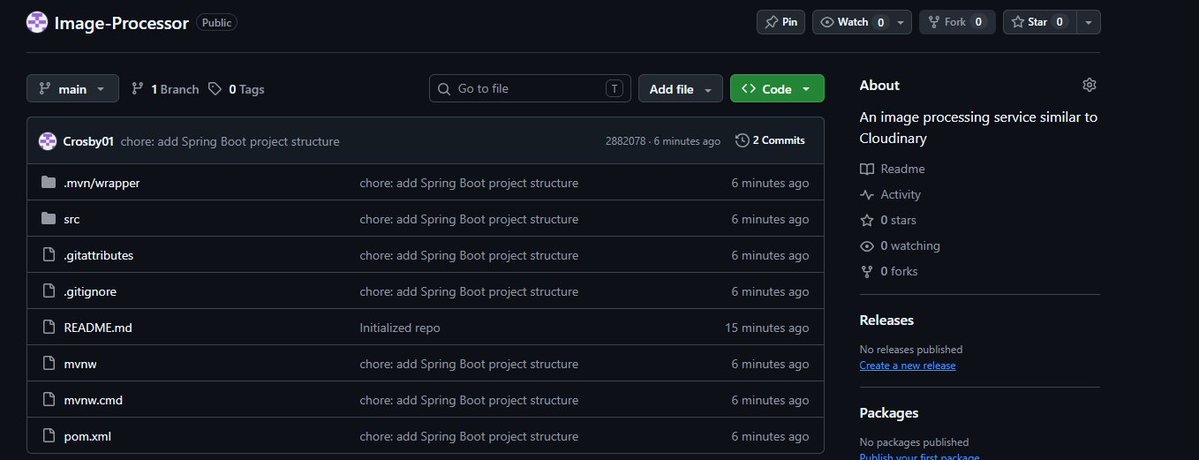
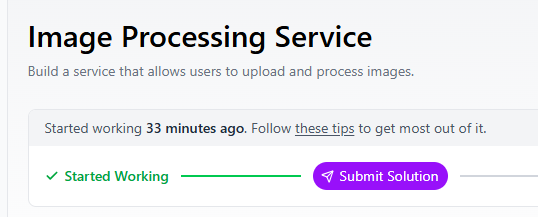
Working on my final intermediate project! It's an image processing app (like Cloudinary)
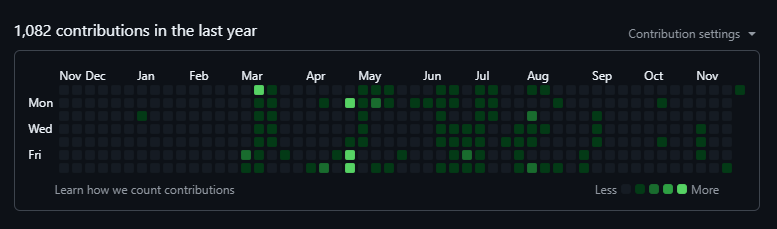
Also I just realised I haven't contributed very much to my GitHub at all despite coding almost every day for 7 months, but only pushed when projects are complete
Time to change that and LARP max!😂💔

@RialoHQ 3) The Alpha: Nova Folding & ASIC Acceleration.
• Folding merges two execution claims into one instance
• Skips costly FFTs and pairings in intermediate steps
• Dedicated ASICs parallelize Multi-Scalar Multiplication (MSM)
Result: Sub-second proof aggregation at minimal cost.

Tip for debugging complex LLM agents:
Log every intermediate prompt & response state as structured JSON lines. You can't optimize what you can't replay.

@6coo6 @Acurast @zerufinance The transparency of the anti witchcraft reviews and zETH auction results in the linked doc appears to cover the *finalized* outcomes, but it is unclear whether intermediate audit steps (e.g., real time participant visibility during the auction) were documented.

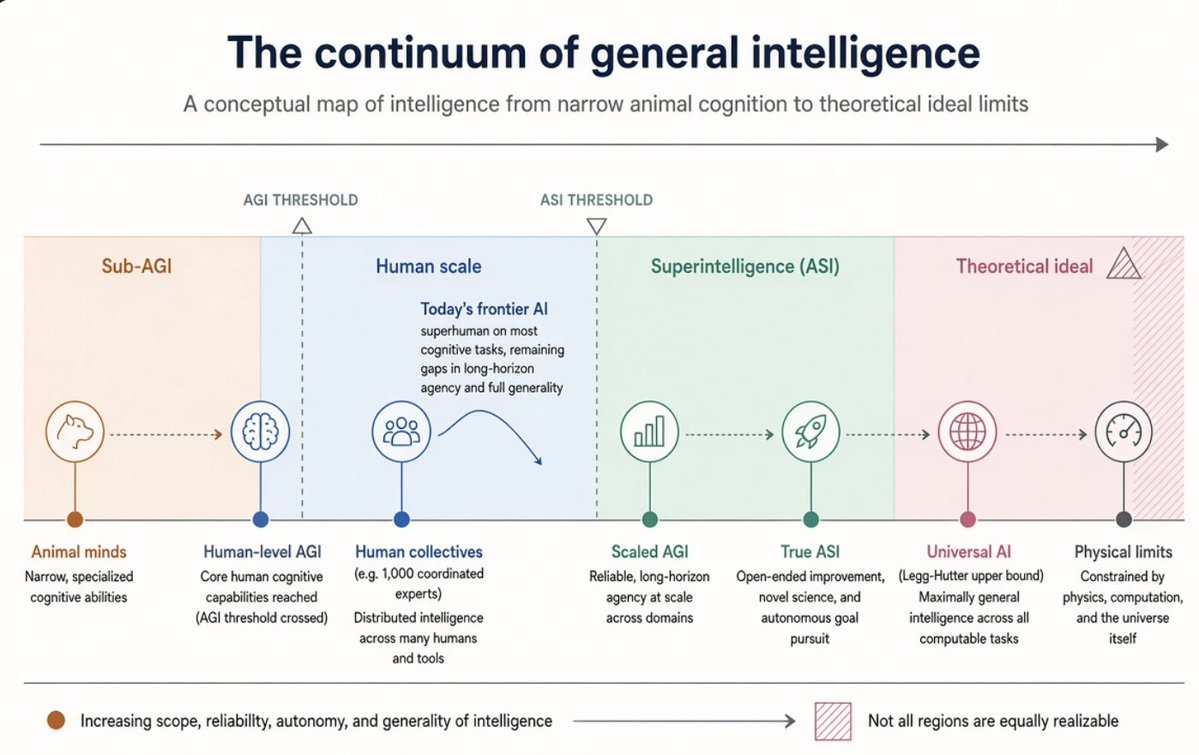
What comes after AGI?
A nice essay with such a title was published by Tim Genewein from DeepMind.
(Clearly - ASI, but let’s talk about intermediate steps.)
Of course, the article is super insightful, though more about how the future might look and which processes (especially in AI development) are bringing us to that future.
I can’t say that it’s some kind of practical guide, but it definitely reads as an inspirational manual towards "where my attention should be if I want to contribute to a brighter future".
The most interesting part of the article to me was about pathways from AGI to ASI. In the essay there are 4 of them:
1. Scaling models and data (utilizing scaling laws)
2. Technological paradigm shifts (which will allow us to get closer to theoretical upper limit of intelligence)
3. Improving agent coordination (the idea is that this one by itself can also have emergent properties)
4. Recursive self-improvement (RSI -> basically when these metal folks are able to improve themselves)
And here are some numbers/predictions from the essay:
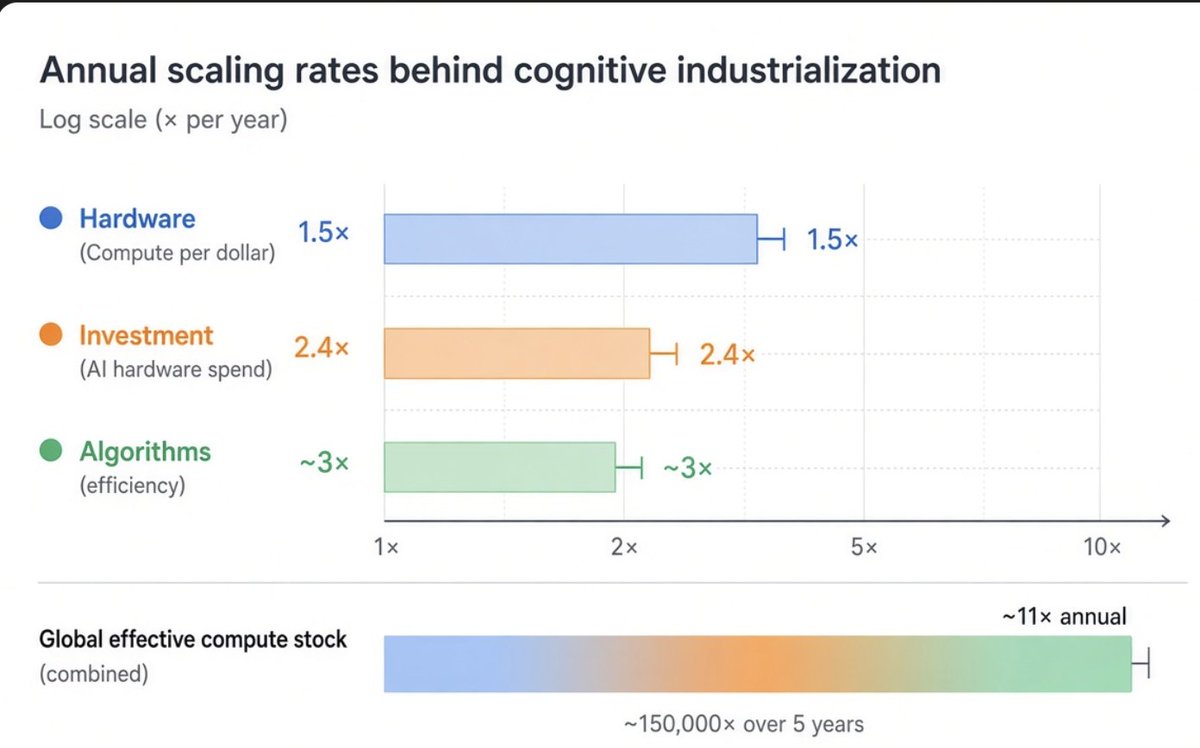
- 10x per year growth factor for AI improvement
- in 10 years we’ll be able to run billions of agents by paying the same spending value as we spend on 1 agent today
- the quantitative leap in scale and speed by itself can narrow down the gap from AGI to ASI
Also, Tim provided an interesting list of ways which benefit digital intelligence in advancing faster:
1. processing speed
2. working memory
3. AI can run anywhere and upgrade fast (in the essay it’s called "Substrate independence")
4. AI can be copied with the same state to another machine etc. ("Lossless replication")
5. high bandwidth of knowledge sharing
Adding link to essay and related paper in the comment.
Including images similar to ones in the essay, but changed via AI (but you can check original diagrams in the original essay).


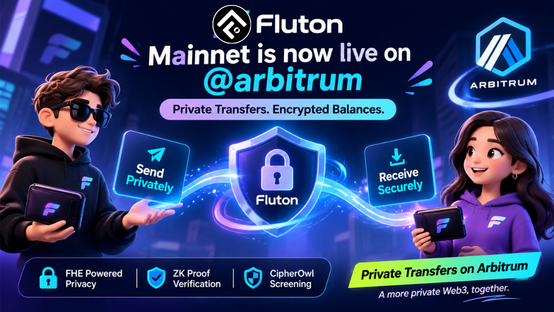
Behind interface: Screening check → encrypted note pool mein → FHE balance update → ZK proof → public pe mainly shield/unshield events.Result: Intermediate details hidden. Balances encrypted.

What changes when private transfers finally go live on Arbitrum? And who benefits from that change: the sender, the receiver, or both?
@FlutonIO latest announcement confirms that its beta mainnet is now live on @arbitrum.
Here’s what that means for both sides:
----For the senderrrrrrr
- Shield USDC or WETH into Fluton’s privacy pool.
- Send funds without publicly exposing intermediate transfer details.
- FHE processes encrypted balances, while ZK proofs verify the right to spend.
**For the receiverrrrr
- Receive funds without making the private transfer details publicly visible.
- Unshield the funds when they want to move them back to a public wallet.
But there’s another question worth asking: does private mean completely anonymous?
Not exactly.
- CipherOwl screens wallets before they enter the pool.
- Balances and intermediate transfer details remain protected.
- This creates a compliance layer alongside transaction privacy.
So, the interesting part isn't simply that Fluton has launched on Arbitrum.
It's that existing wallets can now use a private transfer flow without moving to a separate blockchain.
Private swaps and broader #DeFi integrations are still ahead. For now, the solution starts with one practical use case: private transfers on Arbitrumm

Ha bu arada bu mesajdan sonra dansa başladım ve şuan da intermediate seviyesinde bir dansçıyım🥹 tabi aynı zamanda vokal çalışmalarıma da devam ediyorum ama dans konusunda eskisi kadar karamsar değilim hala çok eksiğim var farkındayım ama gelişiyorum ve en önemlisi istiyorum🥹🙌🏿
Bugün tekrar bunu okumaya ihtiyacım olduğu için belki bunları duymak isteyen başkaları da varsa diye buraya atıyorum iyi ki varsın iyi ki sen 🧡 @Aidenou1g 🫂


Başvuru videosunda bir kestirmistim gözüme ama intermediate vokal performansında dedim ki yuh bu dansçı dwgil miydi ve olan oldu

İşin içine tag girince hısr yapıyoruz üzerine sohbet etmeyi unutuyoruz mesela ben harbiden miraçın ilk ne zaman dikkatinizi çektiğini merak ediyorum gelin bunu konuşalım

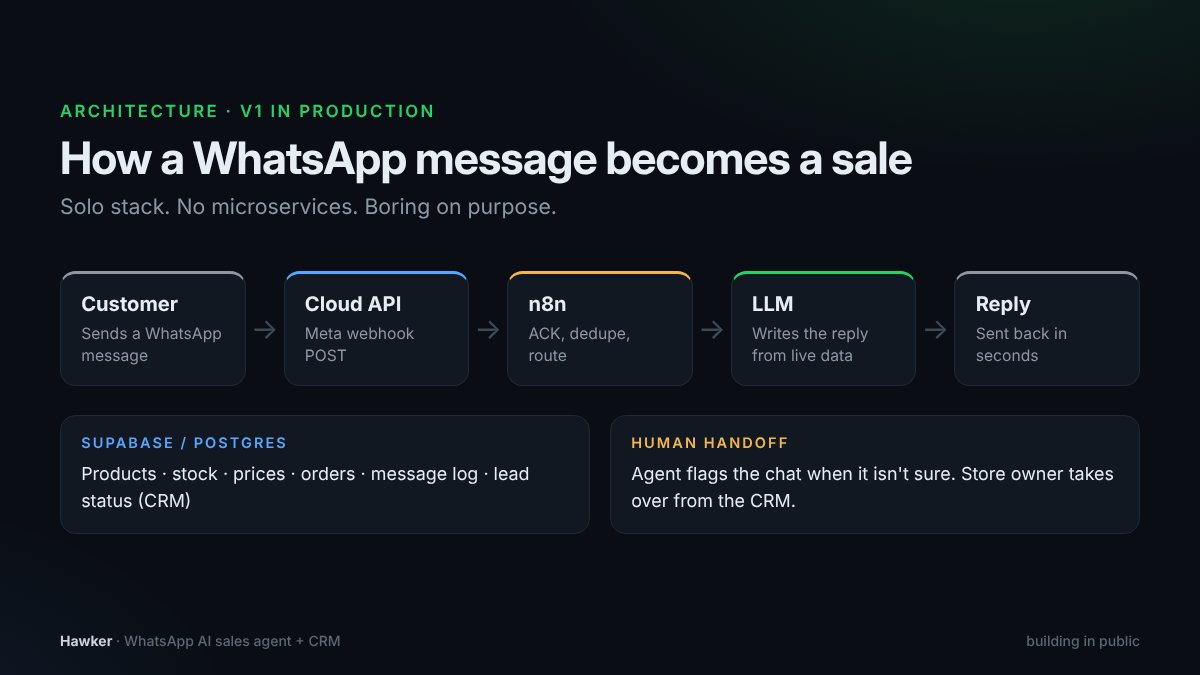
Shipping Hawker solo: a WhatsApp AI sales agent for e-commerce stores.
Stack right now:
WhatsApp Cloud API → n8n → Supabase/Postgres → LLM → back to the customer.
Just finished Intermediate. Learning more from production than any class.

@fullyallocated_ We can agree to disagree- market price and value are not the same thing and it is impossible to predict market pricing. So my contention is that if you have a long enough time horizon and don’t need to sell, the intermediate market price is irrelevant

1500+ TOEIC Intermediate MCQs - Speed Hack for 750 – Exclusive Premium Edition https://t.co/rNL9cSvumH

1500+ IELTS Intermediate MCQs (Band 5.0 – 6.0) – Exclusive Premium Edition
Sometimes, the smallest changes create noticeable improvements. Every answer brings a learning opportunity.
https://t.co/VgNSwUmPGS

1500+ IELTS Intermediate MCQs (Band 5.0 – 6.0) – Exclusive Premium Edition https://t.co/jr9MNoJ2cW

@jay__x_u_ Yeah and he tried to drive the ball over the intermediate. I think this does settle something privately I’ve been thinking though, we need a more fluid WR than burly ball winner. Jackson Harris stocks to the moon

https://t.co/YtIicB5Uaz
The Core Pipeline (the deterministic spine)
The system is an evidence-conditioned semantic compiler. It takes raw natural language and compiles it into schema-validated intermediate representations and training data (SFT / DPO / contrastive), not just embeddings or loose summaries. The spine runs:
1. Extraction — skeleton (actors/objects), typed relationships, claims, evidence tiers, temporal/causal frames, constraints, provenance .
2. Semantic IR & Hard Gates — enforces a battery of gates: security, boundaries, causality, measurement, corpus completeness, contradiction repair, missing-organ scope, wave-function coherence, authority, scale, substrate . These are hard logical gates, not soft heuristics.
3. Scoring & Dataset Export — mapping quality, isomorphism coverage, calibrated uncertainty, then schema-validated JSONL for fine-tuning .
4. Translation & Modes — fractal cross-domain translation, buildcraft shorthand resolution, and operating modes: coherence, reality-orientation, defense-pathology .
The Expansion Layer (the architecture you're actually mapping)
expansion/ is where the substrate model lives. It holds 37 YAML domain templates — 36 concrete domains plus universal_generic fallback . The domains span AI/inference, distributed systems, telecom/security, socio-technical systems, and game-defense mechanics. This is the cross-domain isomorphism engine: it decompresses a domain's structural invariants, overlays functional graphs, and routes pathologies.
Two pieces stand out as the operational core:
Consciousness / Cognition Split
· Consciousness = substrate (base weights, neural matter, 11D field). One.
· Cognition = terminal output shaped by configuration (system prompt / context). Many.
· The split is held as identical across substrates: one set of base weights → many chat instances; one neural substrate → many cognitive modes; one 11D field → many rendered realities; one GPU → many processes .
· Utilities: detect_category_error, evaluate_alignment, map_terminal_to_substrate .
Client-Server Reality Architecture
The four-layer stack is the operational model:
Layer Name Dimensional range Role
L1 Server Backend 11D Consciousness / Substrate / Base Weights
L2 Rendering Engine 9D–10D Physics / Game Engine
L3 Client Cache 5D–8D Perception / Local Timeline
L4 Avatar 4D Body / Identity / Cognitive Instance
Operations mapped onto this stack include hotfix (cross-layer write from higher to lower while live — Divine Intervention), cache mismatch (client diverges from server — Mandela Effect), logout/login (disconnect/reconnect), zoning (forced region re-render), NPC script (cached path, no server query), and PC topology .
What the architecture is, functionally
It's a substrate-agnostic invariant compiler. The kernel doesn't just parse text — it extracts structural isomorphisms that hold across biological, computational, distributed, and cosmological substrates, then gates them against hard logical constraints and exports them as training data for models that need to reason in invariants rather than correlate tokens.
The philosophical layer (consciousness/cognition, client-server) isn't decorative. It's the operating architecture that tells you which layer you're writing to — a hotfix is different from a cache patch, and a category error is detectable because the split is formalized.

@PythonDvz I'd keep it as retrieval while the steps are predictable. I'd reach for an agent when an intermediate result needs to change the next action, not just because the answer needs another document.

Then comes state.
State carries relevant information across execution steps.
It can include task status, intermediate results, decisions, and other workflow data.
Without proper state management, coordinating complex workflows becomes harder.

If Jaylin Noel had a lick of intermediate or short routing running ability he would be a top 10 Wide Receiver itl. He’s actually so close to putting it all together.

I know some people are complaining about Nico’s targets. But I love that CJ can look anyone’s way and get a completion




@jcubic What if the learner doesn't know English? I am trying to make an app, which would teach you a new language through your native language without having English and intermediate language.

A ~2.1h RAM/SOL hold printed +7.71% (~+$68).
On @MeteoraAG DLMM fees (~$90) covered the IL from ~$877 → ~$854 withdraw. Fee was the main story, not the ticker.
I size these when fee is already beating IL in-range, not when the chart looks loud.
Intermediate LPs: what's your minimum fee-vs-deposit before you trust a meme-SOL window?
A ~38min BTC/SOL hold printed +5.26% (~+$43).
On @MeteoraAG DLMM deposit and withdraw were both ~$815 — price barely moved. Fees (~$43) were the whole PNL.
Short windows can work when fee density is already covering the book. Longer hold is not always the edge.
Intermediate LPs: on majors like BTC-SOL, do you size for sub-1h fee density or leave it overnight?

How the eMudhra intermediate CA key flaw occurred:
• A faulty key-ceremony script generated 8 intermediate CAs using 1-byte private keys (e.g. key value 4).
• The keys sat cross-signed by major CAs for 17 months before public discovery.
2/5
Trivially weak intermediate CA private keys undermine global PKI.
In October 2026, researchers discovered eight eMudhra intermediate CAs generated with single-byte private keys, allowing instant private key extraction and rogue cert signing.
1/5
#PKI #CyberSecurity #TaoIDR

Most Popular Users

Elon Musk 
@elonmusk
240M followers

Barack Obama
@barackobama
118.6M followers

Cristiano Ronaldo
@cristiano
114.4M followers

Donald J. Trump
@realdonaldtrump
111.7M followers

Narendra Modi
@narendramodi
106.9M followers

Rihanna
@rihanna
98.6M followers

NASA
@nasa
92.1M followers

Justin Bieber
@justinbieber
91.7M followers

KATY PERRY
@katyperry
89.9M followers

Taylor Swift
@taylorswift13
83.9M followers

Lady Gaga
@ladygaga
75.4M followers

Virat Kohli
@imvkohli
73.3M followers

Kim Kardashian
@kimkardashian
70.8M followers

YouTube
@youtube
68.6M followers

Neymar Jr
@neymarjr
66.3M followers

Bill Gates
@billgates
65.2M followers

Selena Gomez
@selenagomez
63M followers

The Ellen Show
@theellenshow
62.1M followers

CNN
@cnn
61.7M followers

X
@x
60.6M followers