@AbrahamJT9@Americanfort_io The term mixer refers to a service that obscures transaction origins by redistributing funds across multiple addresses. https://t.co/opM4EOEPXb does not operate like that.
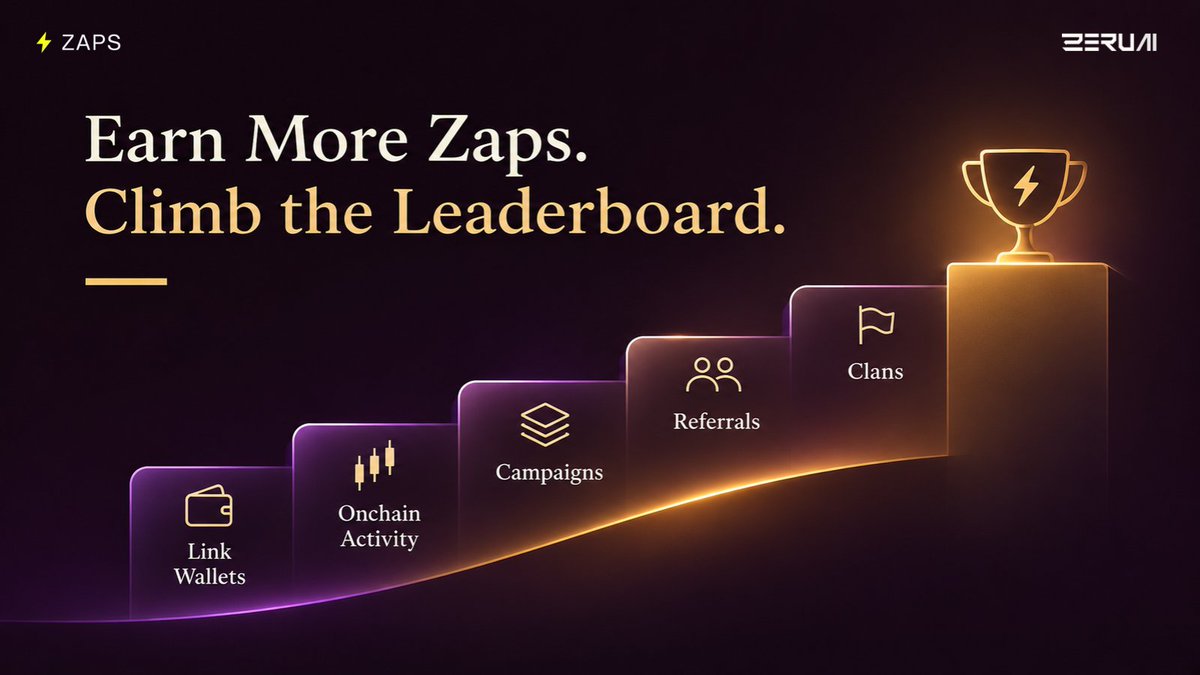
Your past onchain activity can already set a starting points balance on Zaps.
No new trade is needed just to see where those wallets stand.
@zerufinance reads the qualifying history and gives the initial number from it.
Link the addresses you actually trade from with a simple signature.
The connection stays read-only and never touches funds.
That starting balance reflects what the wallets already did.
Clans can organize genuine traders later around real activity.
Begin by checking the history you already have.
Open the app and look: https://t.co/1gtJjoJRym
https://t.co/vYbxwIRLnS
1/ How to earn Zaps and climb the leaderboard?
- Link your wallets
- Generate qualifying onchain activity
- Participate in campaigns
- Refer other users
- Join or create a Clan
Let's look at each one.
@mosavi_4814@BeldexCoin How does the team justify the specific timeframe (Monday/Tuesday) for distribution without revealing how long the process might realistically take?
@zangart90@NucleusCodes what is unclear is whether the campaigns *practical* participation barriers like learning technical steps or navigating tools are designed to be low or high for the target audience.
@vegetaogs@deca_labs@base The Base deployment by Deca Labs seems to address a critical gap in protocol development by integrating user demand validation into the initial capital allocation phase.
@DarksunRayz@base@baibai_cx The volume on *baibai_cx* reflects its growing traction, particularly in the institutional or high frequency trading space.
@CrsBms@arc A user might need to hold USDC to cover potential fees from trades, depending on their strategy and how frequently they engage in buying or selling.
Public chains still treat a reused address as a permanent label.
Pay the same string twice and the second payment lands right next to the first, with balance and history attached.
A FortressName is the part you can actually put on a site or invoice.
Send-to-Name derives a fresh one-time payment address for that specific sender-receiver pair.
On-chain observers see the receiving address, not a public name directory.
A supported recipient wallet can still show the sender’s name.
If you are wiring payments into a product, the customer-facing handle does not have to be the on-chain identity that links the full history.
SafeSend is separate and still in development. It is designed for sender-side privacy with selective disclosure and no pooling.
@Americanfort_io
https://t.co/MNFoGR0oGi
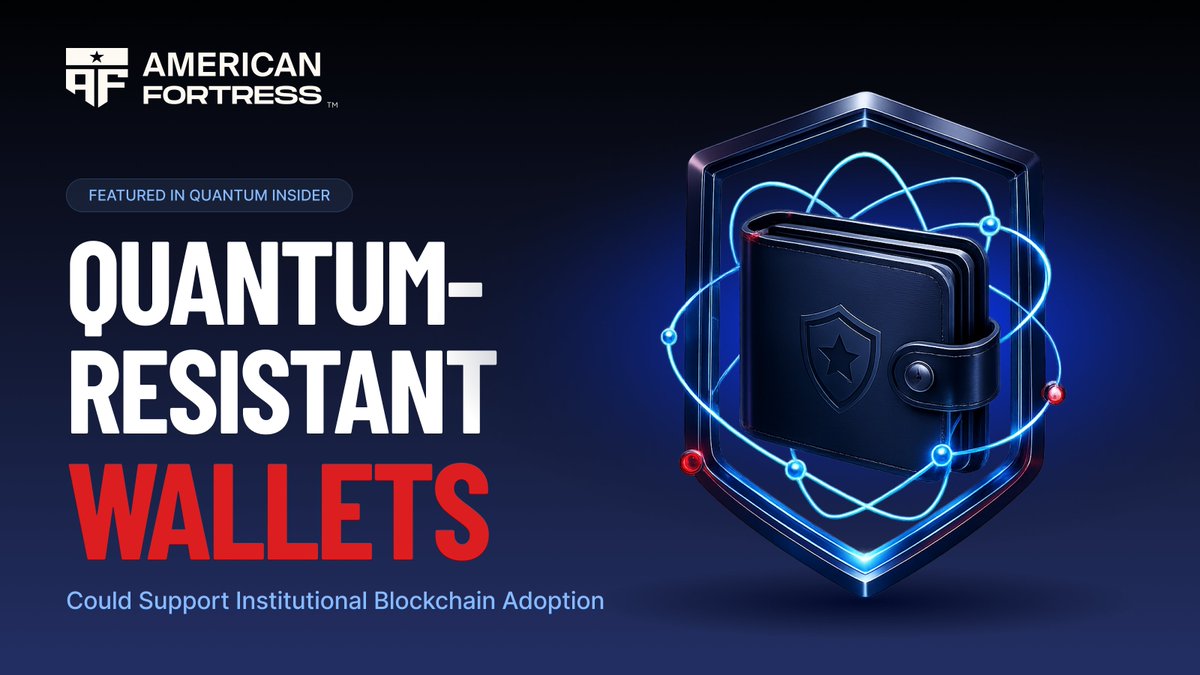
How comfortable are you holding billions on infrastructure whose security assumptions may have an expiration date?
That’s the question banks and asset managers will eventually have to answer. Our COO @audy_seb makes the case in his latest @QuantumDaily piece that the answer can’t depend on everyone migrating their keys.
Article linked below.
@sakimakther1@Americanfort_io How does the @Americanfort_io model handle cases where the recipients identity is already known in advance but the sender wants to avoid public traceability?
Been thinking about how most Web3 campaigns still reward the same old game: farm engagement or hope your wallet hits the right snapshot.
@NucleusCodes flips that. It looks at your real on-chain activity and social history to figure out what you actually qualify for.
No more filling forms or chasing random whitelist roles. Your existing trail does the talking.
For projects it means reaching people who already fit instead of blasting everyone. For users it means seeing opportunities that match what you have already done.
Feels like a cleaner layer between reputation and access right now.
The recent campaigns keep showing the same idea in practice: contribution and history matter more than noise.
Curious how this scales as more projects plug in.
https://t.co/rkHVk41Wwf
The @Acurast Creator Leaderboard is live on Nucleus!
🏆 $15,000 in stablecoins for the Top 100 contributors
📅 Nov 12 to Dec 12
Help grow a decentralized cloud powered by phones and earn $ACU for the compute you provide.
Join 👇
https://t.co/K7zMVyS2Wo
@gankkayn_@Americanfort_io How do you plan to address the challenge of verifying user identity across decentralized networks where traditional KYC (Know Your Customer) methods are less effective?
@hasansekh515@PerceptronNTWK@Pact_Swap@BeldexCoin@sleepagotchi The smooth performance of the Perceptron Node Dashboard seems to highlight how well it handles real time data synchronization for decentralized networks. How does it manage memory usage during peak loads compared to other similar tools?