

Top Tweets for #kiosolution

PAY US BACK OR PACK UP: THE INVOICE SOUTH AFRICA FORGOT TO OPEN
By Kio Amachree
#NigeriaInvoice #PayUsBack #XenophobiaLie #SouthAfricaOwes #KioSolution #AfricanSolidarity #TheDebtIsReal #June30Deadline
There is a particular kind of ingratitude so spectacular it almost deserves a standing ovation. South Africa — a country whose liberation was financed, in no small part, by Nigerian schoolchildren skipping lunch and Nigerian civil servants surrendering two percent of their monthly pay cheque — has decided that the June 30 deadline it once gave apartheid is now the deadline it is giving us.
Let us be clear about what is happening here. Messages and videos circulating on social media show anti-immigration activists calling for foreign nationals to leave South Africa by June 30. At least two Nigerian men died in April during the latest wave of violence. One of the men, Amaramiro Emmanuel, was killed after being beaten by officers from the South African National Defence Force. These are not the actions of a nation that remembers its debts. These are the actions of a nation that has been brainwashed into believing its liberators are its enemies.
Now. About that debt.
From 1960 to 1995, Nigeria alone spent over $61 billion to support the end of apartheid — more than any other country in the world, according to the South African Institute of International Affairs. That is not a rumour whispered in Lagos markets. That is the South African Institute of International Affairs saying it. Their own people. Their own scholars. Students skipped their lunch to make donations, and in just six months, in June 1977, popular contributions to the Southern Africa Relief Fund reached $10.5 million. The donations were widely known in Nigeria as the "Mandela tax."
The Mandela tax. Let that phrase sit with you for a moment. Nigerian children were taxing themselves — voluntarily — to free South Africa. And the South Africans now giving them until June 30 to leave were, in many cases, educated on Nigerian soil. Nigeria opened its doors and its classrooms. Hundreds of South Africans went to school free of charge. The Nigerian High Commission in Botswana issued hundreds of Nigerian passports to South Africans who had fled their country and gave them the dignity of citizenship when their own nation had stripped them of basic human rights.
Former President Thabo Mbeki — that refined, pipe-smoking intellectual who would go on to lead the country — spent seven years living in Nigeria. Nigeria did not hand him a deportation notice. Nigeria gave him sanctuary.
Now, $61 billion in 1995 money, compounded at a modest 5% annual interest rate over thirty-one years, brings us to somewhere in the vicinity of $283 billion. I am being conservative. The IMF has been less kind in its own calculations of missed opportunity costs. If we apply the World Bank's preferred sovereign lending rate, the number climbs past $300 billion. I am not a vengeful man. I am, at heart, a reasonable man with a calculator.
My proposal, and I state it with complete seriousness: South Africa has until June 30 — the very deadline its mobs have set for us — to present a repayment schedule to the Federal Republic of Nigeria. Payment can be made via the Nigerian Embassy in Pretoria, directly to the presidency, or — and here I offer a creative alternative in the spirit of African brotherhood — in land.
The Western Cape is a beautiful province. Good wine. Excellent infrastructure, still largely managed, let us be honest, by the same white minority that built it under apartheid. I propose that in lieu of cash, South Africa cede the Western Cape to Nigeria as a foreign territory of the Federal Republic. We will run it efficiently. We always have run things efficiently when given functioning infrastructure to work with. Ask any Nigerian businessman in Johannesburg — before someone burned his shop down.
But before we get to land, let us address the slander that brought us here.
Nigerians, we are told, are responsible for South Africa's drug epidemic. This is a lie of breathtaking convenience. In Durban, the abuse of a drug known as "sugars" — a highly addictive mixture of cocaine and heroin — has been concentrated among the Indian population, while having little impact on the city's African and white communities. Durban is a predominantly Indian-South African city. The hard narcotics — the cocaine arriving by container ship — come from rather further afield than Lagos. On 12 January 2021, a container ship travelling from Durban entered the port of Rotterdam; three days later, 739.5 kilograms of cocaine was found in one of its containers, linked to what investigators describe as a global supercartel believed to be headquartered in Dubai. Hawks head Lieutenant-General Godfrey Lebeya confirmed that two notorious Mexican cartels — Sinaloa and Jalisco — are among the international trafficking gangs active in South Africa.
Sinaloa. Jalisco. Not exactly Nigerian names, are they?
The first methamphetamine laboratory was seized in South Africa in 1998, shortly after the use of meth was first detected in Cape Town. By 2005, it had become the primary substance of use among all people using drugs in the Western Cape, surpassing even alcohol. The supply chain for this epidemic runs from Pakistan and Afghanistan, trafficked by sea via dhows through the Indian Ocean, arriving through Mozambique and into Johannesburg and Cape Town. Nigerian fishermen are not operating dhow networks in the Indian Ocean. That is not our operational geography.
What Nigerians do deal in, to whatever extent individuals among 220 million people engage in any vice, is Indian hemp — cannabis — a plant that has never killed anyone and which South Africa grew indigenously long before it was a country. Cannabis, incidentally, is now legal in South Africa. So the primary accusation dissolves into the air like smoke.
Meanwhile, the real drug problem in Black South Africa is the one that existed before the first Nigerian arrived on its shores: alcohol. In 2006, alcohol represented 51.3% of all primary substance presentations at South African government-funded treatment centres — dwarfing every other substance combined. This is not a new affliction. It is a direct inheritance of the apartheid dop system — the practice by white farm owners of paying black workers partly in cheap wine, creating generational dependency as a mechanism of control. That system was not designed by Nigerians. It was designed by the same people who now live in gated communities in the Cape Winelands, producing Sauvignon Blanc and voting for parties that protect their land.
The Black South African who today turns on his Nigerian neighbour has been brilliantly, cruelly manipulated. His enemies — the people who own the land, control the economy, benefit from his continued disorganisation — live behind electric fences and security cameras. They have no interest in being the target of black frustration. They have, with the assistance of social media algorithms and politicians like Gayton McKenzie, successfully redirected that frustration toward the people who look most like a threat: successful, confident, educated Black Africans who did not grow up under apartheid and therefore did not absorb its central lesson that Black people are inherently inferior.
This is the Elon Musk school of South African race management: keep the Black population arguing with itself, and nobody asks who still owns the mines.
According to the UNHCR, in 2025, South Africa hosted more than 167,000 refugees and asylum-seekers in a fragile environment of rising xenophobia, misinformation and socioeconomic pressures. Of 457 foreign nationals sent to Home Affairs for verification by the eThekwini mob, only two were found to be without proper documentation. Two. The mob was wrong about 99.6% of its targets. Facts, unfortunately, are not the point of a mob.
Nigerian Foreign Minister Bianca Odumegwu-Ojukwu accused South Africa's government of failing to forcefully denounce violence against Nigerian nationals, saying this had damaged the bond the two countries have enjoyed since the solidarity Nigeria showed during the fight against apartheid. She is being diplomatic. I am not a diplomat.
I will say what the diplomats will not: South Africa owes Nigeria a debt that no amount of Mandela mythology cancels. Nigeria paid for that freedom. Nigerian children went hungry for it. Nigerian civil servants sent their salaries. Nigerian mothers grieved it. Thabo Mbeki ate Nigerian jollof rice for seven years of his exile and came back to lead a nation that now threatens to deport the people who fed him.
The June 30 deadline runs both ways.
Pay the invoice. With interest. Or pack up your arguments about who belongs in Africa and present them to The Hague — where we will be waiting, brief in hand, calculator on the table, and 61 billion reasons why the Western Cape would make an excellent Nigerian foreign territory.
I am not a violent man. But Nigeria has one of the most battle-tested armies on the African continent, led entirely by Black officers — which, for a country still running its military on the old apartheid officer class, should be a quietly sobering thought.
Alcohol has caused Black South Africa tremendous suffering. I suggest they sober up — literally and historically — and remember who bought their freedom.
We have the receipts.
Kio Amachree is President of Worldview International and publishes Letters from Stockholm on Substack.

WHO THE CAP FITS: BOLA TINUBU, THE MAFIA PLAYBOOK, AND WHY NIGERIA IS NOT LAGOS
A man who reaches for the crown must first survive the mirror. Tinubu cannot.
#TinubuMustGo #WhoTheCapFits #NigeriaIsNotLagos #KioSolution #WorldviewInternational #AccountabilityNow #TinubuExpose #BobMarley #NigeriaGovernance #DiasporaVoices
There is a Bob Marley song that every Nigerian should be playing on repeat right now. It is not a love song. It is not a party song. It is a reckoning — a slow, reggae-paced prophecy about what happens when a man builds his entire existence on deception and then dares to put on a crown. Bob Marley understood something about power that Bola Ahmed Tinubu, surrounded by his army of very expensive public relations consultants, has apparently forgotten: the cap always finds its owner. Always.
Tinubu has governed Nigeria — or more precisely, looted Nigeria — the way the mafia governs a neighbourhood it has decided to own. The tactics are identical and they are not subtle. First, you install your people everywhere: customs, NNPC, the courts, the legislature, the security services. Then you reward loyalty with contracts and punish dissent with the DSS, with thugs, with trumped-up charges, with disappearances. You make yourself appear so large, so omnipresent, so inevitable, that resistance feels futile. You project power so aggressively that people begin to mistake the projection for the real thing.
But here is what the mafia boss always forgets, and what Tinubu is now learning to his cost: Nigeria is not Lagos.
Lagos he could manage. Lagos he could buy, intimidate, redraw, and rebrand. Lagos he ran for decades like a personal estate, taxing its commerce, controlling its land, placing his surrogates in every institution. He perfected the art of organised political criminality in one city and then, emboldened by impunity, decided the entire Federal Republic was simply Lagos with a larger postcode.
It is not.
Nigeria is 200 million people. It is Kano and Enugu and Calabar and Maiduguri and Port Harcourt. It is Ijaw fishermen who have watched their creeks poisoned and their sons disappear. It is northern youth who were promised security and received inflation. It is southern professionals who were promised competence and received Seyi Tinubu on a board he has no business sitting on. It is the nurse in Ibadan, Olamide Thomas, dragged away by the DSS for posting the truth on social media. Nigeria is a country, not a franchise. And franchises can be revoked.
THE RECORD SPEAKS. LET IT SPEAK LOUDLY.
The public relations industry is a remarkable thing. For the right fee, it can put a halo on a gargoyle. Tinubu’s handlers have spent an extraordinary amount of Nigerian public money attempting to construct an alternative biography — the visionary, the democrat, the Jagaban, the statesman.
But the documents exist. The court records exist. The 1993 DEA asset forfeiture — $460,000 seized in Chicago in connection with a heroin trafficking network — exists. Judge Beryl Howell’s order for the release of FBI and DEA FOIA files exists. The Chicago court admission, entered into the American federal record, exists. His forfeited Chicago properties, his forfeited bank accounts, his documented proximity to narcotics proceeds — these are not opposition fabrications. They are American federal court documents. They have his name on them.
The certificate of the University of Chicago he claimed — the institution denied it. The age he has presented officially has shifted with political convenience. The academic credentials assembled for public consumption do not survive basic scrutiny. These are not rumours spread by enemies. These are verifiable, documented, searchable facts that any journalist with a laptop and three hours can confirm.
Nigerians have confirmed them. The world has confirmed them. The cap fits.
ON DEATH THREATS: A PERSONAL WORD
I will say this plainly, because plainness is what the moment demands.
I have received death threats in connection with my accountability work — work that names names, cites documents, and submits formal evidence to the FBI, the DEA, the UK Serious Fraud Office, INTERPOL, MI5, SAPO, and Israeli authorities. These threats have been formally reported to Swedish and international law enforcement. They are on record.
To whoever authorised or transmitted those threats, I want you to understand something about the nature of your error.
I am not a frightened blogger. I am not a young man with no roof over his head and no connections to speak of. I am a man whose grandfather sat at the 1958 Constitutional Conference that helped birth the Nigerian state. I am a man whose father was the first African Under-Secretary-General of the United Nations, who managed the Congo Crisis when the world was on fire. I carry that blood. I carry those connections. I carry fifty years of relationships built at Eton, at Wharton, on Wall Street, in the corridors of institutions you have never been invited into and never will be.
Issuing death threats to someone like me does not make Doomsday more distant. It makes it closer. I do not tolerate such behaviour. Neither do my connections.
Bob Marley understood this too. A man who lives by the darkness of his own deceptions should think very carefully before he reaches into someone else’s light.
FOUR YEARS. ENOUGH.
Nigeria’s economy has been gutted. The naira destroyed. Fuel subsidies removed in a single reckless announcement with no cushion for the poor. The Lagos-Calabar Coastal Highway — a no-bid monument to Chagoury Group patronage worth billions of public dollars — bulldozing communities for a road that serves one man’s business interests. The ports. The island. The offshore companies. The son on the boards.
Four years of this is not a policy failure. It is a deliberate, systematic extraction of national wealth by a man who has spent his entire adult life perfecting exactly this craft, first in Lagos, now in Abuja.
The honourable exit — and there is still one available, barely — is to find a reason, find a pretext, find a doctor’s note if necessary, and go. Leave. Take the entourage. Take the spin doctors. Take the sick son who has no business being anywhere near Nigerian public life. Board a plane and go somewhere that will have you, because the list of places that will have you is shrinking by the day as the international files thicken.
Nigeria survived colonialism. It survived civil war. It survived Abacha. It will survive Bola Tinubu — and it will do so with or without his cooperation.
The cap fits, Mr. President. It has always fit.
And in the end, the truth — like reggae — finds its rhythm and plays on, long after the pretenders have left the stage.
Kio Amachree is President of Worldview International and a Nigerian diaspora advocate based in Stockholm.
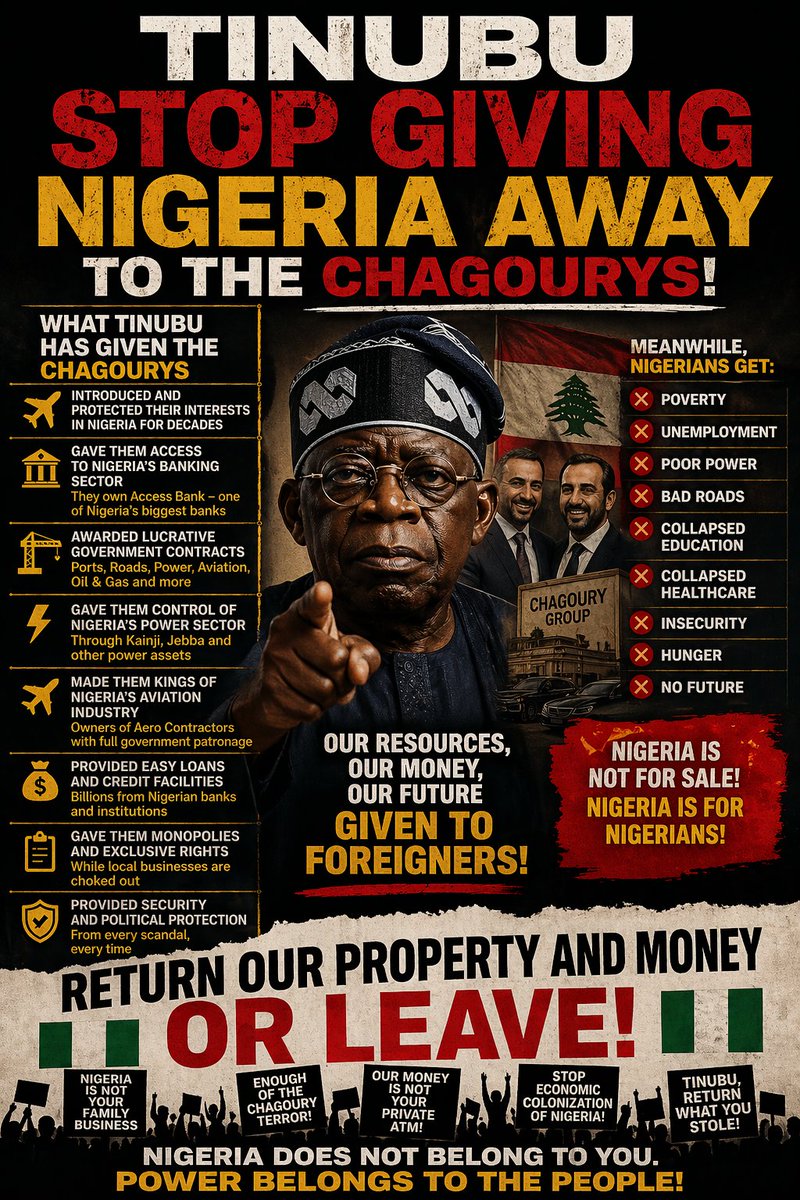
NIGERIA IS NOT FOR SALE The Chagoury Plunder Must End — Now
A Kio Solution Statement
#NigeriaIsNotForSale #StopThePlunder #ChagouryOut #TinubuMustAnswer #WakeUpNigeria #KioSolution #WorldviewInternational #250MillionStrong #NigeriaRising #EndTheBetrayal
Nigeria is being given away. Piece by piece. Contract by contract. Kilometre by kilometre. And a man convicted of money laundering is doing the taking.
The $13 billion Lagos-Calabar Coastal Highway was awarded to Gilbert Chagoury's Hitech Construction — without competitive bidding, without transparency, without shame. Then came the ports. The Apapa and Tin Can Island ports, a $700 million rehabilitation contract — handed again to Chagoury's companies, Hitech and ITB Nigeria. Then came Snake Island. A 45-year concession for the Snake Island Port container terminal — awarded to Chagoury's ITB Construction Nigeria Limited. Forty-five years. Nearly half a century. Of Nigerian coastline. Gone.
This is not infrastructure. This is colonisation by contract.
Gilbert Chagoury is Lebanese. He is not Nigerian. He holds Lebanese papers, St. Lucian papers, and God knows what else. He was convicted of money laundering — laundering Nigerian money stolen by Sani Abacha. Abacha's stolen billions — washed through Chagoury's hands. And now Tinubu gives this same man the Lagos coastline. The ports. The highways. The terminals.
Abacha gave him a passport. That does not make him a Nigerian. A passport of convenience is not a soul. He is Nigerian only when it is profitable. The rest of the time, he is Lebanese.
The relationship between Tinubu and the Chagoury brothers goes back to at least 2007. When Tinubu was Lagos Governor, his administration granted the Chagoury Group title to 10 million square metres of Lagos shoreline — the land on which Eko Atlantic now sits. Eko Atlantic — built on Nigerian public land, gifted to a foreign criminal family, generating wealth that will never fully return to the Nigerian people.
Seyi Tinubu, the President's own son, sits on the board of CDK Integrated Industries — a Chagoury subsidiary. Father and son. President and prince. Both in business with the man looting the nation's coast. This is not governance. This is a family enterprise operating at the expense of 250 million Nigerians.
Our ancestors are weeping.
Zik of Africa did not fight so that we could be re-colonised by Lebanese billionaires. Awolowo did not bleed so that the Lagos coastline could become Chagoury private property. The Sardauna did not build the North so that a convicted money launderer could be handed national honours. In January 2026, Tinubu conferred on Chagoury the Grand Commander of the Order of the Niger — one of Nigeria's highest honours. An international convicted criminal wearing Nigeria's highest decoration. If that does not make your blood boil, check your pulse.
Men went to prison for this country. Men were beaten. Men were tortured. Men died. And this generation watches a drug-era figure hand Nigeria's infrastructure to Lebanese criminals and calls it development.
I will not be silent.
Tinubu is the greatest sellout and traitor in African presidential history. He has taken the slave chains — rejected by every generation before him — and offered them up himself, dressed in agbada, smiling for the cameras, calling it a public-private partnership.
It ends now.
To every Nigerian reading this — all 250 million of you — the hour is here. Not tomorrow. Now. There is no cavalry coming from outside. No foreign court will save what Nigerians refuse to save for themselves. The FBI has the files. The SFO has the submissions. OFAC has the evidence. But laws without the will of a people behind them are paper.
Nigeria is not Tinubu's property. Nigeria is not Chagoury's construction site. The Lagos coast belongs to the Nigerian people — to the fishermen of the Niger Delta, to the traders of Apapa, to the children of Lagos Island who have never seen a contract they benefited from.
If the Chagourys do not respect Nigeria, they should return to Lebanon. Today. Permanently.
I would rather die than watch my country become the private estate of Gilbert Chagoury.
Rise. All of you. Rise.
Kio Amachree | Stockholm, Sweden | President, Worldview International
Last Seen Hashtags on Sotwe
Trends for you
Most Popular Users

Elon Musk 
@elonmusk
241.5M followers

Barack Obama
@barackobama
118.9M followers

Cristiano Ronaldo
@cristiano
114.6M followers

Donald J. Trump
@realdonaldtrump
111.8M followers

Narendra Modi
@narendramodi
107.1M followers

Rihanna
@rihanna
98.7M followers

NASA
@nasa
92.3M followers

Justin Bieber
@justinbieber
91.8M followers

KATY PERRY
@katyperry
90.1M followers

Taylor Swift
@taylorswift13
84M followers

Lady Gaga
@ladygaga
75.5M followers

Virat Kohli
@imvkohli
73.5M followers

Kim Kardashian
@kimkardashian
70.9M followers

YouTube
@youtube
68.8M followers

Neymar Jr
@neymarjr
66.6M followers

Bill Gates
@billgates
65.3M followers

Selena Gomez
@selenagomez
63.1M followers

The Ellen Show
@theellenshow
62.2M followers

CNN
@cnn
61.7M followers

X
@x
60.7M followers