

Top Tweets for #metapunctuation

For the more serious-minded among us—yes, not-for-profit @EnclaveAcademy offers many open-source #ThinkToThink™ Metakeys™ to unlock and open minds to the mechanics and mysteries of agentic #metacognition.
#DiacriticalThinking uses #metapunctuation marks to stimulate thinking.

Metacognition fun?
Smile when you say hello to, #DiacriticalThinking.
The Oxford Comma's longstanding No. 1 status for cognitive combustion @EnclaveAcademy uses to illustrate the power of punctuation for mobilizing "thinking about thinking" (#metacognition).
#ThinkToThink™.
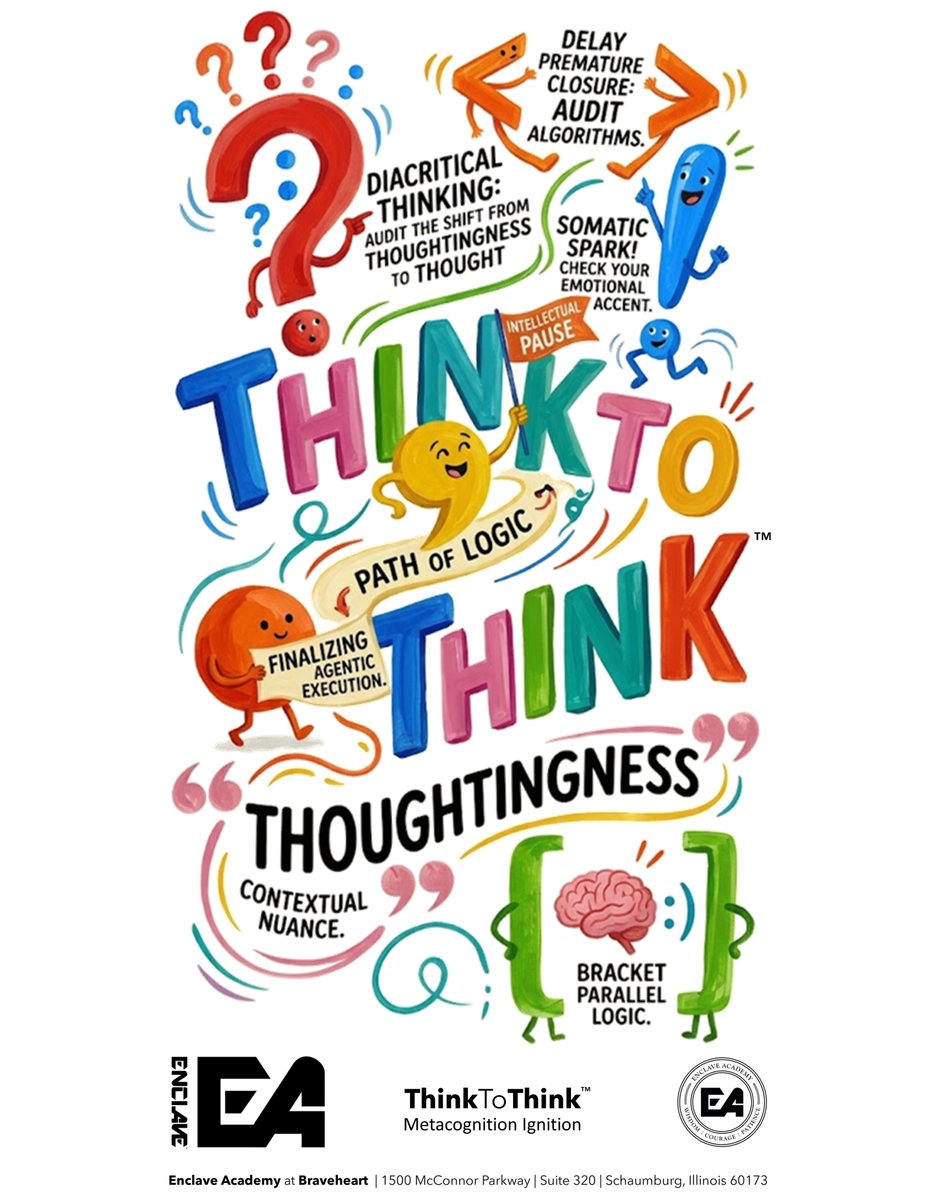
#TheOxfordComma is a joyously contested #metapunctuation mark.
Ask authors and editors at the battle’s frontline—@nytimes.
Yes, punctuation unconsciously and consciously activates #metacognition.
Did you know?
#Metamarks guide “diacritical thinking.”
Say hello to open-source “diacritical thinking,” compliments of not-for-profit “thinking tank” (i.e., not a thought tank) @EnclaveAcademy.
Definition from #EnclaveAcademy’s ThinkToThink™ Metakey™
Glossary of Metacognition Ignition Keys:
diacritical thinking, n. /ˌdaɪ.əˈkrɪt.ɪ.kəl ˈθɪŋ.kɪŋ/
/dy-uh-KRIT-ih-kul THING-king/
Etymology: From ancient Greek dia- (‘across, through, apart’) + kritikos (‘able to judge or discern’) + English thinking (pr. p. of think, v.).
1. The practice, facility, or faculty of auditing the internal bodily and mental stresses, subtle inflections, emotional accents, and contextual nuances that govern how an individual human’s emerging notion transitions from the brain’s nonverbal (wordless) thinkingness, into its mind’s preverbal (wordish) liminal (intermediate) #thoughtingness to formulate verbal (worded) thoughts (articulated positions).
2. Metacognition and Metacognitive Thinking Strategy for Thinkings, Thoughtings, and Thoughts
A structured metacognitive discipline that consciously or unconsciously applies symbolic or mental "marks"—analogous to typography’s diacritical accents—to isolate contiguous concepts, delay premature intellectual closure, and maintain awareness of somatic and environmental influences during incubation and deliberation.
Example in a sentence:
“Rather than accepting at face value the algorithm’s fluent output, the thinker-doer applied diacritical thinking to audit the unspoken premises and shift the stress to unexamined variables before finalizing strategy.”
——
With unconscious and conscious “mental punctuation marks” in mind, @EnclaveAcademy named #DiacriticalThinking.
Try it out for “whys.”
Diacritical thinking delays premature intellectual closure—one of its most important “mental punctuation functions” in sense-making, meaning-making, decision-making, and difference-making.
Diacritical thinking shifts upstream metacognitive focus—governing the delicate transition from wordless thinkings through liminal #thoughtings into fully articulated thoughts.
In an “AI everywhere era,” diacritical thinking ensures that human cognitive sovereignty remains intact, deliberate, and agentic.
#MetacognitionWorks
Diacritical thinking is yours to use as your thinking model when you are reading or listening to someone’s thinking or writing—or listening—to your own thinking to influence the thinkings, #thoughtings, and thoughts of others.
Comments welcome. Please.
#ThinkToThink™ with diacritical thinking as you read this punctuation piece attached to the @NewYorker’s post—the article that triggered my overabundance of situational diacritical thinking.
Enjoy deploying diacritical thinking.
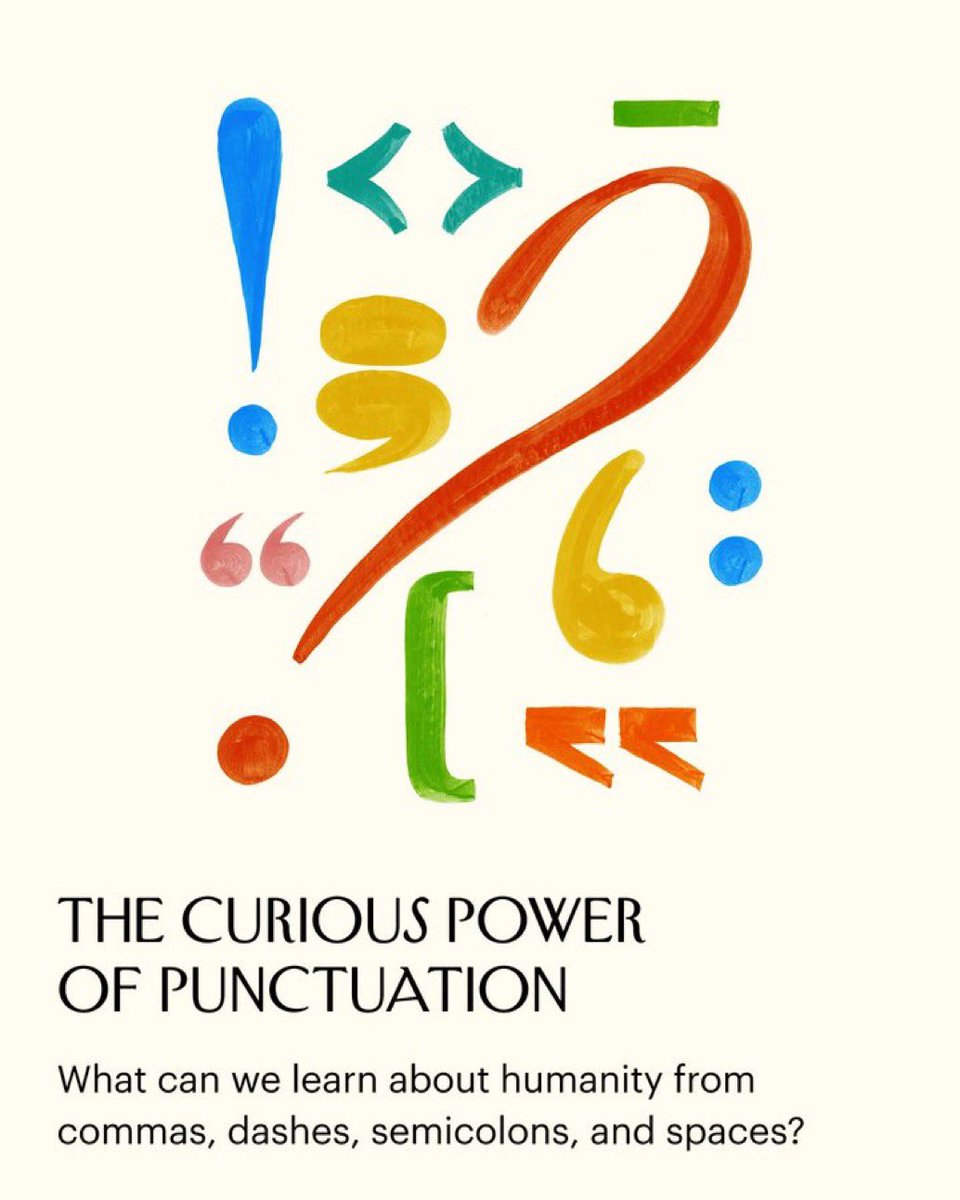

“The purpose of punctuation is to make writing easier to read,” Louis Menand writes, “and making writing easier to read means giving greater and greater numbers of people access to the written word.” A new book by Florence Hazrat, celebrating punctuation in all its forms, makes the striking claim that the history of punctuation is the history of humanity itself. It has entered into a class of books about the mechanics of writing—to which Sarah L. Kaufman’s “Verb Your Enthusiasm” belongs. But how do we think about these sentences, words, and marks amid a current evolution in the phenomenology of reading? Authors like Hazrat and Kaufman want us to understand reading as a bodily experience, one which can transmit an author’s state of mind, or set of emotions, to our own. Menand considers the strange power of, among other things, punctuation: https://t.co/CSxml48kTB
Last Seen Hashtags on Sotwe
MadeInTrinidad
Seen from United States
alldocubem5
Seen from United States
ピーターバック
Seen from United States
abla #gizliçekim
Seen from Turkey
choehyeokgeun
Seen from Mexico
slimbody
แม่ริม
minichat
Seen from United States
georgiaiseuropean
Seen from United States
gachansfw harem
Seen from Philippines
Most Popular Users

Elon Musk 
@elonmusk
241.7M followers

Barack Obama
@barackobama
119M followers

Cristiano Ronaldo
@cristiano
114.5M followers

Donald J. Trump
@realdonaldtrump
111.9M followers

Narendra Modi
@narendramodi
107.2M followers

Rihanna
@rihanna
98.7M followers

NASA
@nasa
92.4M followers

Justin Bieber
@justinbieber
91.8M followers

KATY PERRY
@katyperry
90M followers

Taylor Swift
@taylorswift13
84M followers

Lady Gaga
@ladygaga
75.4M followers

Virat Kohli
@imvkohli
73.4M followers

Kim Kardashian
@kimkardashian
70.9M followers

YouTube
@youtube
68.8M followers

Neymar Jr
@neymarjr
66.4M followers

Bill Gates
@billgates
65.2M followers

Selena Gomez
@selenagomez
63.1M followers

The Ellen Show
@theellenshow
62.3M followers

CNN
@cnn
61.8M followers

X
@x
60.7M followers