

Top Tweets for #methodism

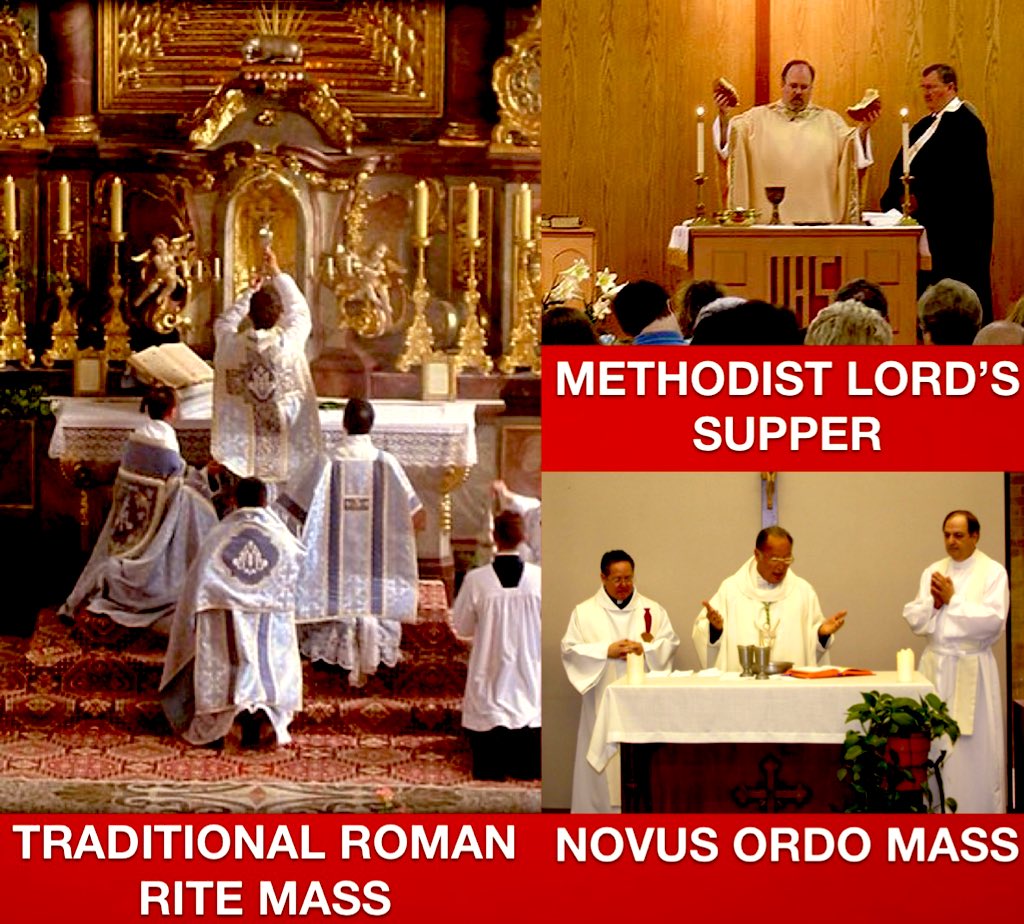
@DavidSmuts @elhigadodmarita A Methodist converted in 1930s and said when the new mass came in they walked straight out and found a Latin one.
They said “this is what I left in Methodism”

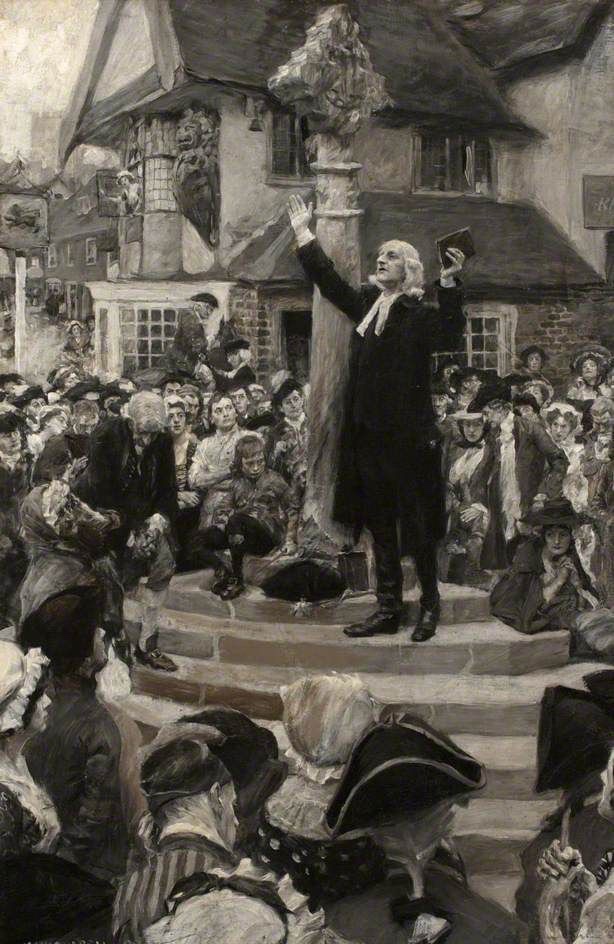
John Wesley the founder of Methodism, preaching from a market cross steps to a gathered crowd in 18th-century England.
Painting by William Hatherell (c.1909) captures his open-air revival sermons that reached tens of thousands & sparked a global movement.
The first ever Priest I attended a Latin Mass with related this to me.
His Mother was a Methodist and walked into a Chapel pre Vatican II and was instantly converted by the beauty of the Latin Mass.
Once the New Mass came in, she left saying “this is what I left in Methodism.”

Keep the faith.
An excerpt, hopefully encouraging: “Edward Elgar’s was some of the first classical music I remember hearing: his rousing Pomp & Circumstance marches. To one of which were written the words “Land of hope and glory… God who made thee mighty, make thee mightier yet”
I don’t subscribe to the cult of British-Israelism, nor what is called Replacement Theology, but for all the hijinks and jingoism in the words that anthem there is a truth in them.
The French Revolution was humanistic and bloody. Meanwhile in England Wesleyan Methodism inspired a reformation that “strangely warmed” hearts and minds to rediscover the real, loving God, after a cold hard winter of frosty religion.
A century ago jingoistic patriotism gave rise to Nazism in a Germany in which scholars had ….”
from https://t.co/l5842wdRGn

What Jesus is telling these first century religious leaders is a new patch on their old methodism isn't going to do. He's not asking them to fix their old coat at all--He's wanting them to put on an entirely new robe.
At root He's talking about incompatibility.

Pastor Curcio,
The historical record contradicts your claim. The apostles established succession by laying on of hands and ordered it to continue. See 1 Clement 42 and 44. The second century church lived under bishops, presbyters, and deacons. See Ignatius, Smyrnaeans 8 and Trallians 3. Irenaeus explicitly lists the Roman line from the apostles through Eleutherus and states that the churches should agree with Rome because of its preeminent authority. See Against Heresies 3.3.2 to 3.3.3. Eusebius preserves the same Roman lists. See Ecclesiastical History 3.2 and 5.6. Rome’s doctrinal core remains the apostolic faith confessed in the creeds and witnessed by the Fathers on the Eucharist and moral teaching. See Justin Martyr, First Apology 66, and Didache 2, 9 to 10.
Methodism began in the 18th century without episcopal consecration from an apostle when John Wesley, not a bishop, set Coke apart in 1784. See Wesley’s 10 September 1784 letter to Dr. Coke and Mr. Asbury. Rome retains both tactile and doctrinal succession on the earliest sources.

For the record,
Rome DOES NOT have apostolic succession, for there is none without doctrinal succession, from which Rome has departed from.

@MIKEADIK_CEO @NigeNest Staying consistent is a virtue
Real ogs keep to the Methodism and process of @NigeNest

@papa_perpetua oh that’s so awesome!!!! my family recently started going to a pretty accepting Methodist church—there was a giant split in methodism recently and the upside to that is that the people who stayed tend to be Much more accepting of queer people (since that’s why the split happened)


Everyone vote, “Based.”
We gotta introduce this man to Holy Orthodoxy, as he’s currently in a state of distaste with the Methodism he was raised in

This man lived to 82 as a Greek orthodox monk without ever having seen a woman in his life. Is that sad or based?
https://t.co/gZMD0k2xuM


BIBLE OUTLINE 4
Topic: Understanding and Experiencing Salvation: An Exploration of Soteriology Pt 4
Subtopic - Examining the perspectives of the doctrine of “Once saved, forever saved” (Eternal Security)
Introduction
The study on the doctrine of "Once saved, forever saved," also known as Eternal Security. This theological concept posits that once a person has genuinely accepted salvation through faith in Jesus Christ, they are eternally secure in their salvation and cannot lose it. This doctrine has been a topic of significant discussion and sometimes controversy within the Christian community. God’s word and principles are unbending and steadfast, as declared in Psalm 119:160: "The sum of your word is truth, and every one of your righteous rules endures forever." This divine truth stands firm, regardless of human opinions or interpretations. In this session, we will explore various perspectives on Eternal Security, examining scriptural foundations and theological arguments both for and against this doctrine. Our goal is to gain a clearer understanding of what the Bible teaches about the permanence of salvation and its implications for our faith journey. Join us as we seek to discern the depth and assurance of God's saving grace.
Tracing some historical timelines on the doctrine of Eternal security from the early church in the first century to the present is vital.
1. Manichaeism: maintained that God unilaterally selected the elect for salvation and the non-elect for damnation according to His will (Newman, 1904). In 392, A Manichean presbyter said that "God [...] has chosen souls worthy of Himself according to His own holy will. [...] that under His leadership those souls will return hence again to the kingdom of God according to the holy promise of Him who said: “I am the way, the truth, and the door”; and “No one can come unto the Father, except through me.” (Oort, 2006)
2. 412 AD: During conflicts with the Pelagians, Augustine's views on predestination and grace shift, influenced by the controversy over infant baptism. Augustine proposed that God grants a second grace known as the gift of perseverance, which is bestowed upon certain baptized infants and remains irrevocable once received (Brunell, 2005).
3. Origen (185 – c. 253 AD): Rejects the idea of future judgment based solely on faith, emphasizing the importance of faith expressed through actions.
4. Jovinian (died: c. 405 AD): Asserts that those genuinely regenerated through baptism cannot be lost.
Middle Ages (5th - 15th Century):
1. A Pseudo-Chrysostom author from the 5th to 6th century suggested that Christians could enter heaven though without experiencing Christ's glory, even if they break his commandments, as implied by a commentary on Matthew 5:19.
2. Between the 5th century and the Reformation in the 16th century, theologians who upheld the belief in election by predetermination, following the Augustinian teaching, included: Gottschalk (c. 808–868), Ratramnus (died 868), Thomas Bradwardine (1300–1349), Gregory of Rimini (1300–1358), John Wycliffe (1320s – 1384), Johann Ruchrat von Wesel (died 1481), Girolamo Savonarola (1452–1498) and Johannes von Staupitz (1460–1524).
Reformation (16th Century):
1. Martin Luther: Luther emphasized salvation by faith alone (sola fide) and rejected the idea that believers could lose their salvation. He argued that salvation was solely dependent on God's grace, not on human merit.
2. John Calvin: Calvin's teachings included the concept of the perseverance of the saints, which asserts that those who are truly saved will persevere in faith until the end.
3. Reformed Theology: The doctrine of eternal security became a key tenet of Reformed theology, particularly among Calvinists.
Post-Reformation Era (17th - 19th Century):
1. Arminianism: The Dutch theologian Jacobus Arminius proposed a different view, known as Arminianism, which taught that believers could fall away from grace if they rejected God's gift of salvation.
2. Remonstrance: Arminian followers presented their views in the Remonstrance of 1610, leading to the Synod of Dort (1618-1619), where Calvinism was reaffirmed as the dominant theology within the Dutch Reformed Church.
Modern Era (20th Century - Present):
1. Diverse Views: In the 20th and 21st centuries, various Christian denominations and movements hold different perspectives on eternal security.
2. Evangelicalism: Many evangelical groups, influenced by Reformed theology, affirm the doctrine of eternal security.
3. Non-Calvinist Perspectives: Other Christian traditions, such as Methodism, Pentecostalism, and some Baptist groups, may hold to variations of the doctrine, or reject it entirely in favour of the possibility of apostasy
Some bible Facts for Discussions:
1. Maintaining faith demands great effort and is described as a "hard fight" (Jude 3, 5). Early Christians were urged to continually work out their salvation with fear and trembling (Philippians 2:12). The Bible warns against serious sins that can prevent someone from entering God’s Kingdom (1 Corinthians 6:9-11; Galatians 5:19-21).
2. If salvation were guaranteed, such warnings would be pointless. Instead, the Bible teaches that someone who has been saved can fall away by returning to a life of serious sin (Hebrews 10:26; Hebrews 6:4-6; 2 Peter 2:20-22).
3. Jesus emphasized the importance of maintaining faith through the illustration of the vine and branches, indicating that some who initially show faith may later lose it and be cast off (John 15:1-6). Similarly, Paul compared Christians who do not maintain their faith to branches that are cut off (Romans 11:17-22).
4. Christians are commanded to stay vigilant (Matthew 24:42; 25:13). Those who spiritually fall asleep, either by engaging in dark deeds or by neglecting Jesus' commands, risk losing their salvation (Romans 13:11-13; Revelation 3:1-3).
5. Numerous scriptures emphasize the need for believers to endure faithfully to the end (Matthew 24:13; Hebrews 10:36; 12:2, 3; Revelation 2:10). First-century Christians rejoiced when they heard of fellow believers enduring in their faith (1 Thessalonians 1:2, 3; 3 John 3, 4). It wouldn’t make sense for the Bible to stress faithful endurance if salvation were guaranteed regardless. Also, if the goal of Christianity is to make us more like Christ, then it would be contradictory to have a provision in Christianity that encourages a life of sin.
6. Only near the end of his life was the apostle Paul confident in his salvation (2 Timothy 4:6-8). Earlier, he recognized the possibility of missing out on salvation if he yielded to fleshly desires, hence his efforts to discipline himself (1 Corinthians 9:27; Philippians 3:12-14).
7. Holiness has been identified as the criteria to see the Lord (Heb 12:14-17, 1 Pet 1:15-16, Lev 19:2, Lev 20:26). Without it, we cannot see God. If God invites us to ask for forgiveness, then it is because forgiveness of sins can only be appropriated to an individual through repentance and confession of sins even though the sins have been paid for through the sacrifice of Jesus once and for all (Rom 3:25, Prov 28:13, Col 2:13-14, Matt 6:14-15, 1 Jn 1:5-10, Matt 7:7, James 4:2b). A man who has died has can no longer work and therefore no longer request for forgiveness (Eccl :10, Heb 9:27). If sin brings separation from God (Isa 59:2, James 4:4), then there is no other window for salvation if one dies in sin, neither is there a window to be accepted into God’s kingdom with an unforgiven/unconfessed sin.
Conclusion
Our exploration of "Once saved, forever saved" reveals that maintaining faith is a challenging, ongoing effort. The Bible warns against sins that can jeopardize salvation, indicating that initial belief can be lost if one returns to a life of serious sin. Both Jesus and Paul emphasized the importance of vigilance and perseverance in faith. While the assurance of salvation is comforting, scripture teaches that ongoing faithfulness is necessary. This balance highlights the active nature of a believer’s relationship with God, requiring continuous perseverance and steadfastness.
Most Popular Users

Elon Musk 
@elonmusk
239.7M followers

Barack Obama
@barackobama
118.6M followers

Cristiano Ronaldo
@cristiano
114.3M followers

Donald J. Trump
@realdonaldtrump
111.7M followers

Narendra Modi
@narendramodi
106.9M followers

Rihanna
@rihanna
98.6M followers

NASA
@nasa
92.1M followers

Justin Bieber
@justinbieber
91.7M followers

KATY PERRY
@katyperry
89.9M followers

Taylor Swift
@taylorswift13
83.9M followers

Lady Gaga
@ladygaga
75.4M followers

Virat Kohli
@imvkohli
73.3M followers

Kim Kardashian
@kimkardashian
70.8M followers

YouTube
@youtube
68.6M followers

Neymar Jr
@neymarjr
66.3M followers

Bill Gates
@billgates
65.1M followers

Selena Gomez
@selenagomez
63M followers

The Ellen Show
@theellenshow
62.1M followers

CNN
@cnn
61.7M followers

X
@x
60.6M followers