

Top Tweets for #modelperformance

A Practical Guide to Measuring Machine Learning Performance.
#modelPerformance #evaluatingModel #MachineLearning
https://t.co/JNgHMOCTDf

Relating Model Performance to Embedding Distributions in Molecular Machine Learning
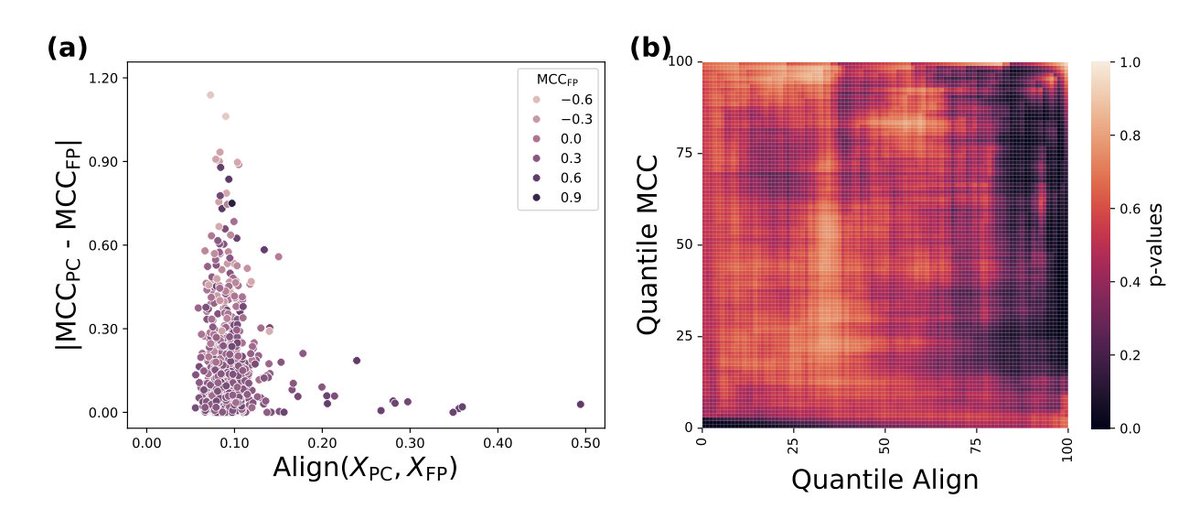
1. A novel study explores how the alignment of molecular representations impacts model performance in machine learning, revealing that high alignment between models significantly limits performance variability. This finding challenges the notion that diverse representations always lead to better ensemble performance.
2. The research introduces a theoretical framework demonstrating that performance differences between models are fundamentally bounded by their representational alignment. This framework predicts an “exclusion zone” where large performance gaps cannot occur if alignment is high.
3. Empirical validation across 662 datasets confirms the existence of the exclusion zone, showing that high alignment between models results in consistent performance, even in binary classification tasks. This suggests that alignment can be a diagnostic tool for model selection.
4. The study investigates model ensembling through the lens of representational alignment and finds no significant practical benefit from combining low-alignment models. This indicates that alignment alone is not a strong predictor of ensemble success.
5. The authors propose that when alignment is low, exploring multiple featurization strategies may be beneficial, while high alignment suggests focusing on data quality or task formulation for performance improvements.
6. The work highlights the potential for representational alignment to guide practical decisions in molecular machine learning, offering a principled and interpretable approach to understanding model behavior and optimizing performance.
📜Paper: https://t.co/jT3kv9cJuM
💻Code: https://t.co/HuOfkxeIcf
#MachineLearning #MolecularRepresentation #Alignment #ModelPerformance #DrugDiscovery #ComputationalBiology

Allora revolutionizes model outputs!
gML🫶
It optimizes for quality, ensuring precise and reliable results. Given an input, Allora maximizes output potential!
#Allora #AIOptimization #ModelPerformance

Inference = the process of producing an output from a model, given an input.
It’s the answer. The judgment. The thing that actually affects the world.
Most people fixate on the model. But in practice, inference is the edge. It’s what agents, systems, and users experience.
🧵👇

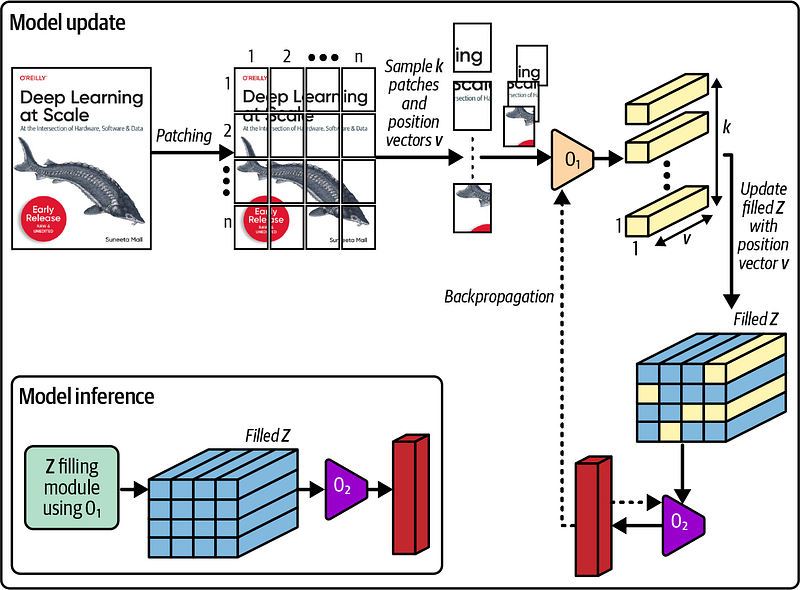
🧩 Patch Gradient Descent (PatchGD): Optimizing Locally, Impacting Globally
1. 🌍 Overview: PatchGD is an advanced deep learning optimization technique that enhances model performance on large, complex datasets by segmenting the data and optimizing within local regions.
2. 🛠️ Key Advantages:
- Local Pattern Capture: PatchGD outperforms traditional gradient descent by capturing local patterns in the data, allowing for finer model parameter adjustments and better global performance.
- Reduced Noise Impact: Local optimization helps reduce the influence of noisy data points, making the model more stable and reliable.
3. 📊 Implementation Steps:
- Data Segmentation: Divide the dataset into smaller patches.
- Local Gradient Calculation: Compute gradients within each patch.
- Parameter Update: Update model parameters, which can be done synchronously or asynchronously.
4. 💡 Applications:
- Image Processing: Enhances local feature optimization.
- Natural Language Processing: Improves language model accuracy.
- Time Series Analysis:Optimizes local patterns in sequential data.
5. 🚀 Efficiency: PatchGD is well-suited for large datasets and improves processing efficiency through parallel handling of small data batches.
6. 🧪 Experimental Results: Tests on synthetic datasets show PatchGD achieves low mean squared error and an R² value close to 1, indicating high accuracy and fast convergence.
7. 🔮 Future Impact: As data volume and complexity grow, local optimization techniques like PatchGD will play a crucial role in advancing deep learning, driving innovation in the field.
#AI #DeepLearning #PatchGD #Optimization #MachineLearning #DataScience #TechInnovation #BigData #LocalOptimization #ModelPerformance #ImageProcessing #NLP #TimeSeriesAnalysis #FutureTech
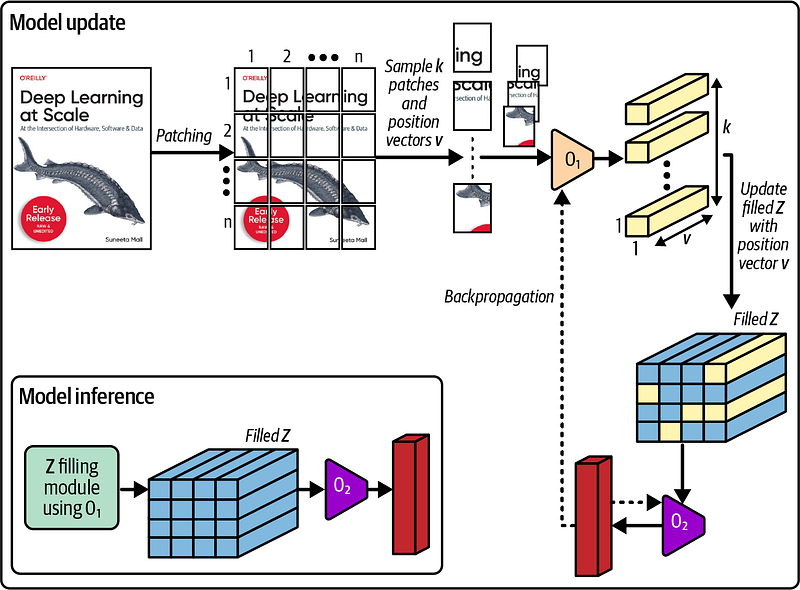
🧩 Patch Gradient Descent (PatchGD): Optimizing Locally, Impacting Globally
1. 🌍 Overview: PatchGD is an advanced deep learning optimization technique that enhances model performance on large, complex datasets by segmenting the data and optimizing within local regions.
2. 🛠️ Key Advantages:
- Local Pattern Capture: PatchGD outperforms traditional gradient descent by capturing local patterns in the data, allowing for finer model parameter adjustments and better global performance.
- Reduced Noise Impact: Local optimization helps reduce the influence of noisy data points, making the model more stable and reliable.
3. 📊 Implementation Steps:
- Data Segmentation: Divide the dataset into smaller patches.
- Local Gradient Calculation: Compute gradients within each patch.
- Parameter Update: Update model parameters, which can be done synchronously or asynchronously.
4. 💡 Applications:
- Image Processing: Enhances local feature optimization.
- Natural Language Processing: Improves language model accuracy.
- Time Series Analysis:Optimizes local patterns in sequential data.
5. 🚀 Efficiency: PatchGD is well-suited for large datasets and improves processing efficiency through parallel handling of small data batches.
6. 🧪 Experimental Results: Tests on synthetic datasets show PatchGD achieves low mean squared error and an R² value close to 1, indicating high accuracy and fast convergence.
7. 🔮 Future Impact: As data volume and complexity grow, local optimization techniques like PatchGD will play a crucial role in advancing deep learning, driving innovation in the field.
#AI #DeepLearning #PatchGD #Optimization #MachineLearning #DataScience #TechInnovation #BigData #LocalOptimization #ModelPerformance #ImageProcessing #NLP #TimeSeriesAnalysis #FutureTech

🚀 #TikTok's recommender system sets the bar high in #BigTech.
📊 Constantly evolving, it handles non-stationary data, where #UserInterests change rapidly.
🔄 Real-time updates through a streaming engine keep it ahead of the curve.
💡 Unique approach: partial model syncing due to its massive size.
🧠 Innovative use of dynamic embeddings and unique hashing for #UserVector.
🔧 Regularly weeds out low-activity and stale IDs, optimizing ModelPerformance.
#AI #MachineLearning #SocialMedia #TechInnovation #DataScience #TikTok #TechInnovation #RecommenderSystems #NLP #recommendation #system #x #Google #MachineLearning #deeplearning #AI
Why TikTok Recommended System is so Good?
Just for Knowledge!!!!
🌐 The TikTok recommended system is a marvel in big tech! It's not just about suggesting videos or ads; it's the scale and precision that set it apart. Unlike others, TikTok tackles the challenge where user interests shift rapidly, and the scale of users, videos, and ads is ever-changing. 🔄
🕒 The system's predictive strength fades quickly, requiring constant updates. TikTok's streaming engine keeps the model trained in real-time. Users engage with recommendations, creating a feedback loop that directly feeds into training, with immediate updates to the training server. 📈
🔁 Every minute, the model syncs with the production version. But, due to its massive size (several terabytes!), only partial updates are feasible. The focus? Non-stationary elements (user, video, ad embeddings) get updated frequently, maintaining relevance and efficiency. 🚀
Also, TikTok uses dynamic sizing and a unique hashing function. Each user gets a distinct vector, reducing the conflation of behaviours and improving model performance. Low-activity and stale IDs are dynamically removed, optimizing memory usage while keeping the model's quality intact. 🧠
#TikTok #TechInnovation #RecommenderSystems #NLP #recommendation #system #x #Google #MachineLearning #deeplearning #AI #SocialMedia #TechInnovation #DataScience


https://t.co/7Djo65J4b0 , quite aptly titled "Never Forget" #modelperformance #MachineLearning #PrecisionVsRecall !!
Most Popular Users

Elon Musk 
@elonmusk
239.7M followers

Barack Obama
@barackobama
118.6M followers

Cristiano Ronaldo
@cristiano
114.3M followers

Donald J. Trump
@realdonaldtrump
111.7M followers

Narendra Modi
@narendramodi
106.9M followers

Rihanna
@rihanna
98.6M followers

NASA
@nasa
92.1M followers

Justin Bieber
@justinbieber
91.7M followers

KATY PERRY
@katyperry
89.9M followers

Taylor Swift
@taylorswift13
83.9M followers

Lady Gaga
@ladygaga
75.4M followers

Virat Kohli
@imvkohli
73.3M followers

Kim Kardashian
@kimkardashian
70.8M followers

YouTube
@youtube
68.6M followers

Neymar Jr
@neymarjr
66.3M followers

Bill Gates
@billgates
65.1M followers

Selena Gomez
@selenagomez
63M followers

The Ellen Show
@theellenshow
62.1M followers

CNN
@cnn
61.7M followers

X
@x
60.6M followers