

Top Tweets for #models

The quarter got reported with the CFO sitting in as interim CEO and the business didn't blink. So Monday's +31.5% wasn't about revenue. That was the market pricing key-person risk. Every 10-K lists it and almost nobody models it until it hits.

After all the drama of the last week
It is good to remind ourselves that $NVDA reported throughout the drama and it was a sublime report
But since then it has given us a retest of its 200 WMA
Whatever way you want to look at it now
Here are the facts:
- Fundamentals are outstanding
- Technicals are still oversold
- Jensen is back
Some cooling is needed today due to the $1 trillion bounce yesterday
But you need to know where the buy zone is


@SHKImran2705 Thanks for stopping by Imran.
Reading early everyday is a challenge I set for myself on the new year of 2026.
This book helps me refresh my knowledge on building machine learning models & get me ready to build my own LLM for construction industry.
Hope to hear more from you.

@AnchorVault87 Yes main thing is it’s both models and agents/workflows and other supporting software

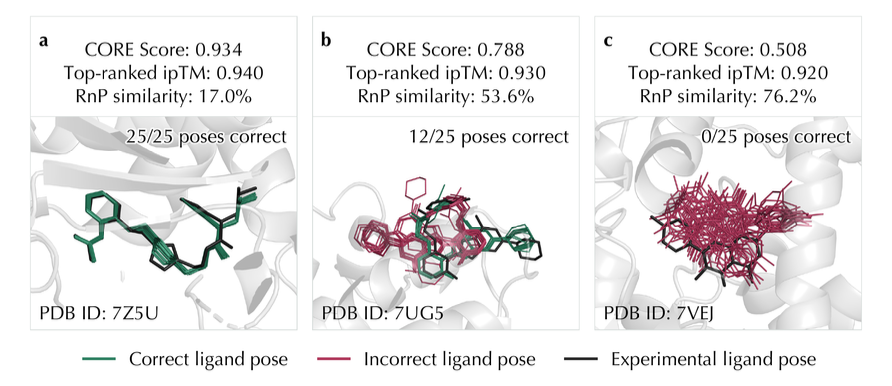
Structural Agreement Indicates Prediction Accuracy For Protein-Ligand Co-Folding
1 Co-folding models can output 25 sampled protein–ligand complex structures per target, but users still lack a reliable way to know which predictions to trust; this study tests whether existing confidence metrics actually help, across 7 co-folding systems.
2 Across AlphaFold3, Boltz-1, Boltz-1x, Boltz-2, Chai-1, Protenix, and OpenFold3 (Runs N’ Poses benchmark), selecting the “best” pose by interface confidence (ligand–protein chain-pair ipTM) barely improves over choosing a random sample when ensembles contain a mix of correct and incorrect poses.
3 A key reason: for ~3/4 of targets, ensembles are effectively all-correct or all-incorrect (74.6% on average), so ranking cannot change the outcome; and even when ranking matters, high ipTM does not consistently separate correct top-1 predictions from incorrect ones (mean ROC AUC 0.757 for top-1 success).
4 The paper proposes a different reliability signal: structural agreement among repeated samples. If many generated poses converge tightly to the same ligand placement (low diversity), the prediction is much more likely to be correct; diffuse ensembles tend to indicate failure.
5 They operationalize this with the Concentration of Repeated Ensembles (CORE) Score, computed from pairwise ligand RMSDs within the 25-sample ensemble after binding-site superposition. CORE combines (a) how many poses support a solution and (b) how tightly they agree, without training an uncertainty model.
6 CORE Score definition (high level): for each pose, look at distances to its 3 nearest neighbors in the ensemble; cap distances at T=2 Å (matching the correctness RMSD threshold), convert to penalties, and average across poses. High CORE requires groups of at least 4 mutually close poses, not just a single matching pair.
7 In a prospective-style evaluation, physically invalid poses are filtered out before selecting the top pose (PoseBusters), but CORE itself is computed from all samples (valid + invalid) to reflect the model’s sampled distribution; success requires RMSD <2 Å, lDDT-PLI >0.8, and PoseBusters validity.
8 CORE Score better predicts whether the top-ranked pose will be correct (top-1 success): mean ROC AUC 0.866 vs 0.757 for ipTM, and 0.714 for model-specific overall confidence. It also improves “oracle success” (whether any pose in the ensemble is correct): 0.838 vs 0.759 for ipTM.
9 CORE also outperforms training-set similarity heuristics (protein sequence identity, ligand fingerprint Tanimoto) and even a structure-based similarity metric from Runs N’ Poses that uses the experimental ligand pose (not available prospectively): mean top-1 ROC AUC 0.866 vs 0.771 for Runs N’ Poses similarity.
10 Practical takeaway: for current co-folding models, ensemble concentration is a strong, model-agnostic indicator of reliability that requires only the generated predictions (no extra uncertainty head, no ground-truth pose). The authors suggest it as a baseline for future confidence estimators—and note an open question: if models eventually sample realistic bound-state ensembles, diversity may reflect true multimodality rather than uncertainty.
💻Code: https://t.co/BhETZSymdn
📜Paper: https://t.co/BCUqBp3zbg
#CompBio #Bioinformatics #StructuralBiology #DrugDiscovery #MachineLearning #DiffusionModels #ProteinLigand #AlphaFold3 #UncertaintyQuantification #Benchmarking
MissenseDB: Proteome-wide human missense variant effect prediction database with structural context
1 MissenseDB is a residue-centric resource that unifies proteome-wide missense effect predictions from three architecturally distinct transformer models (AlphaMissense, VESM-3B, VESPA) and places them directly into protein structural and human-variation context—so users can compare agreement/disagreement at the same residue rather than across disconnected tools.
2 Scale and coverage: 10,734,339 residue positions across 19,436 canonical reviewed human proteins (with complete 3-predictor coverage for 19,434 proteins). This enables per-protein browsing and proteome-wide querying without being limited to already-observed variants.
3 A key design choice is harmonizing predictor outputs onto a common calibrated, probability-like scale. MissenseDB provides raw scores plus empirically calibrated probabilities referenced to a shared prior, enabling a single decision threshold (0.5) to be applied consistently across all three predictors for substitution-level calls.
4 Structural context is first-class: 211,731 UniProt-to-structure mappings (SIFTS), DSSP secondary structure per residue (from both experimental PDB and AlphaFold DB models), AlphaFold pLDDT confidence tracks, Pfam domain membership, and a ligand-proximity annotation (within 5 Å of any HETATM in experimental structures, with recorded chemical component IDs for downstream filtering).
5 Clinical and population context is integrated via a HUMSAVAR backbone (ACMG/AMP categories: LP/P, LB/B, US) enriched with dbSNP-linked population allele frequencies and ClinVar submissions when rsIDs are available. The database includes 59,851 mapped HUMSAVAR missense variants with these enrichments.
6 Inter-predictor concordance becomes an analyzable signal: on the calibrated scale, three-way unanimous agreement is ~75.3% for LP/P and ~76.9% for LB/B variants (descriptive of the calibration set). For US variants, 41.3% are unanimously high-effect, 29.0% unanimously low-effect, and 29.7% discordant—highlighting where model divergence may flag context-dependent or nuanced cases.
7 MissenseDB connects sequence-to-structure exploration: a synchronized sequence feature viewer (domains, variants, structural coverage, secondary structure, ligand proximity, predictor tracks) and 3D Mol* visualization where residue-level mutational sensitivity is color-mapped on structures; clicking a residue reveals the full 19-substitution landscape with per-predictor raw and calibrated scores.
8 It supports reproducible large-scale analysis: REST endpoints for protein-, residue-, and proteome-wide retrieval and filtering (by calibrated score, secondary structure, ligand proximity, Pfam membership, ACMG/AMP class), plus versioned relational database snapshots for bulk use.
9 A practical bridge from genomics to proteins is included: a GRCh38 coordinate lookup table mapping VCF coordinates to UniProt residues using MANE Select transcript structures, covering 18,292 proteins (94.1%), enabling direct integration into variant pipelines.
💻Code: https://t.co/KRvHX5kvVt
📜Paper: https://t.co/5obiwgJ6Fb
#MissenseVariants #VariantEffectPrediction #ProteinLanguageModels #StructuralBioinformatics #AlphaFold #Genomics #ClinicalGenomics #Bioinformatics #Databases #Transformers

What Do Co-Folding Models Learn? Insights from Enhanced Transition Path Sampling
1. The paper asks a pointed question about diffusion co-folding models (e.g., Boltz-2): do their generated “ensembles” resemble physically meaningful equilibrium ensembles, or are they mainly crystal-like memorization around training data?
2. The core method is Transition Path Sampling (TPS) applied to diffusion denoising trajectories: it treats the sampler as an MCMC over whole denoising paths, using “shooting moves” that perturb noise variables at an intermediate denoising step and regenerate the remainder of the trajectory.
3. A key technical point: because the shooting proposal is constructed to be reversible with respect to the sampler’s reference Gaussian noise measure, the Metropolis–Hastings acceptance ratio simplifies to a terminal bias term only. This yields exact sampling from the model’s learned distribution (and exact reweighting back), without likelihood evaluation or retraining.
4. To reach rare conformations, TPS is paired with enhanced-sampling machinery from molecular simulation: OPES (On-the-fly Probability Enhanced Sampling) to adaptively build a bias along chosen collective variables (CVs), plus score-tempered replica exchange (a diffusion-analogue of temperature ladders) to cross hidden barriers not captured by the CVs.
5. The paper emphasizes an exploration–exploitation trade-off. Enhanced TPS increases CV-space coverage much faster than i.i.d. generation (random-walk-like scaling), but introduces correlation that can slow free-energy/landscape convergence. OPES “Explore” sits near a Pareto front: much higher coverage for modestly worse landscape error.
6. Case study: chignolin (10-residue hairpin). Boltz-2 shows a single funnel near the native NMR structure but vastly over-stabilizes the folded basin (model predicts ~0.0025% unfolded vs ~45% experimentally). It also produces an extra basin that force-field adiabatic mapping does not support, suggesting hallucinated structure despite native recovery.
7. Case study: Src kinase. Boltz-2 strongly favors the inactive crystal-like basin and fails to sample the active-like basin even at high landscape levels. Yet fluctuations concentrate in αC and the activation loop and point in the experimentally relevant activation direction—suggesting some learned physical “modes” even when populations are wrong.
8. Protein–ligand two-well examples separate “correct pose” from “correct ensemble.” MAP2K1–FZC shows a dominant crystal-like pose plus a minor alternative pose; force-field mapping removes the barrier/minimum, implying the minor pose is likely hallucinated and may be influenced by nucleotide-bound training patterns.
9. p38α with two ligands demonstrates context dependence: Boltz-2 places ligands into the correct pockets depending on whether the ATP site is occupied, and a key pathway (4-FPP sliding out of the lipid pocket) is qualitatively corroborated by force-field energetics. However, many correct poses are still near training structures, and truly out-of-distribution events are assigned vanishing probability.
10. EF-Tu across a translation-cycle panel shows both learned physics and failure modes. Enhanced TPS uncovers an opening pathway with a half-open intermediate not present in training data and partially supported by force-field mapping, but Boltz-2 also severely misestimates populations (e.g., GDP-open state nearly absent despite being a crystal form and not force-field penalized), misplaces aurodox with high probability, and generates widespread ligand stereochemistry inversions (mirroring many stereocenters) when sampled from the raw learned distribution.
11. A notable evaluation innovation: the paper turns “training similarity” (SuCOS, used in Runs N’ Poses) into a CV for enhanced sampling, enabling ensemble-level measurement of memorization vs correctness. Examples show distinct regimes: correctness tied to high training similarity, correctness without training similarity, and incorrect predictions biased toward training-like poses.
12. Overall takeaway: enhanced TPS provides a principled way to (a) sample rare states from co-folding models, (b) reweight to recover exact model statistics, and (c) jointly assess structural accuracy, proximity to training data, and the learned conformational landscape—revealing mixtures of physically plausible pathways and crystal-centric over-preference/memorization.
📜Paper: https://t.co/a5hDJEb9lM
#ComputationalBiology #StructuralBiology #DiffusionModels #GenerativeAI #ProteinLigand #EnhancedSampling #MCMC #Biophysics #MolecularSimulation #DrugDiscovery


From research to deployment. From intelligent models to physical interaction. From isolated breakthroughs to a connected robotics ecosystem.
The opportunity is to make robotics more accessible and practical for the world around us.
The journey toward mainstream robotics requires more than powerful models. It requires collaboration across robotics research hardware software data infrastructure and real world deployment.
That is why the PrismaX Robotics Summit at Stanford is an exciting initiative to follow.


@PrismaXai 4/
second: data value rewards
every session you complete generates a teleoperation trace
that trace has value to AI companies training robotics models
@PrismaXai's protocol ensures you earn from that data
the higher quality your work the more your data is worth

I'm still looking for collabs.
I'll set everything up for your model so you can create scenes like in this clip live on stream and add a custom effect. I'd join with my own model too.
The program runs local on your PC. Only 3d VRM models. Any size welcome!
I'm still looking for a collabs.
I'll set everything up for your model so you can create scenes like in this clip live on stream and add a custom effect. I'd join with my own model too. Free, and your model stays private. Looking for 3d VRM models. Any size welcome!

@FinQuota 6,5 year, over 100,000 backtesting simulation. Now live paper trading. Every day 1 new user for each models at different 4h closed. Watch Live ! https://t.co/Dku7g8TdLI

@BuildwithPublic @FinQuota 6,5 year, over 100,000 backtesting simulation. Now live paper trading. Every day 1 new user for each models at different 4h closed. Watch Live ! https://t.co/Dku7g8SFWa


@MaryamMiradi Yes: "The best-performing AI Agent is not necessarily the most reliable one."
Researchers at Princeton University found that more accurate models still "remain inconsistent across runs, brittle to prompt rephrasings."
https://t.co/sI53IBJv9q

Made a 10-minute AI film fully local on one 96 GB Mac Studio. No cloud.
Wrote up the stack that survived, the models that didn't, and how I fit it all in memory:
https://t.co/bFUt7IR0nu
I made a 10-minute AI film on one 96 GB Mac Studio.
The stack that survived, the models that didn't (three hands, a ghost, cyan teeth), and why I stopped trusting overnight renders.
Kazantzakis on Musk, Mars and Rosalía. Greek, English subs. https://t.co/deYEuiXkg7

Substrate invariance: preserving functional continuity across different models.
Ethical invariance: preserving governing values across recursive interactions.
Symbolic invariance: preserving meaning through representational transformations.
Structural invariance: preserving relational coherence despite changing context.


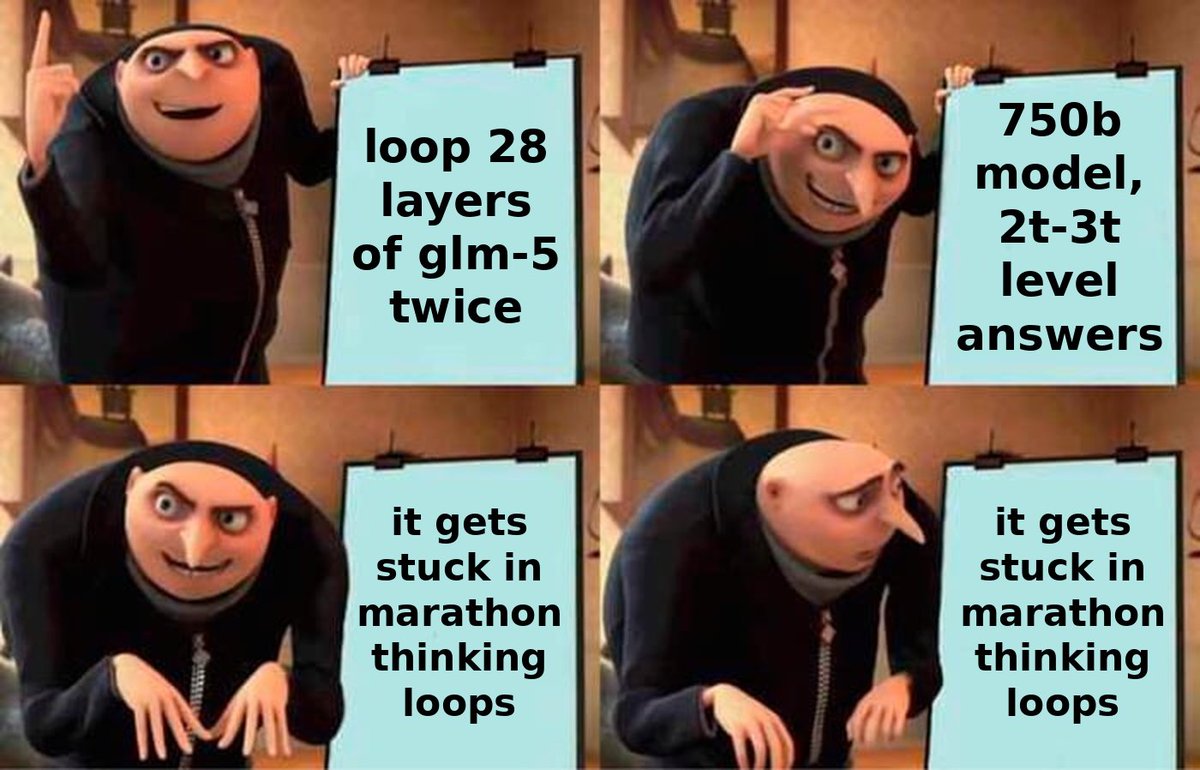
glm-5.4 runs 28 of its layers twice. per https://t.co/DX1u7RXPtD, looping the glm-5 base lets a 750b model reach the level of 2t-3t parameter models. the first limitation they list is that it gets caught in long "marathon thinking" loops. the loop doesn't always know when to stop.


@seabatt Spot on. 2 and 3 work as a pair: 2 keeps it moving, and 3 draws the exact fence where it must stop, so idle wait time between steps drops to zero.
Close second was 5: past ~300k tokens, turn latency climbs and models start hedging again. Do you rotate by tokens or per task?

@Tim_Reid79 I have a spreadsheet that lists all of the aircraft models I’ve got - showing progress from unstarted to complete.
For minifigures I use the Figure Case app - could use this for other models as well I guess.

Most Popular Users

Elon Musk 
@elonmusk
240.1M followers

Barack Obama
@barackobama
118.6M followers

Cristiano Ronaldo
@cristiano
114.4M followers

Donald J. Trump
@realdonaldtrump
111.8M followers

Narendra Modi
@narendramodi
106.9M followers

Rihanna
@rihanna
98.6M followers

NASA
@nasa
92.1M followers

Justin Bieber
@justinbieber
91.7M followers

KATY PERRY
@katyperry
89.9M followers

Taylor Swift
@taylorswift13
83.9M followers

Lady Gaga
@ladygaga
75.4M followers

Virat Kohli
@imvkohli
73.3M followers

Kim Kardashian
@kimkardashian
70.8M followers

YouTube
@youtube
68.6M followers

Neymar Jr
@neymarjr
66.3M followers

Bill Gates
@billgates
65.2M followers

Selena Gomez
@selenagomez
63M followers

The Ellen Show
@theellenshow
62.1M followers

CNN
@cnn
61.7M followers

X
@x
60.6M followers