

Top Tweets for #monitoringthefuture

These workshops provide an overview of the #MonitoringTheFuture Cross-sectional and Panel studies, focusing on the public-use and restricted-use data. For more info: https://t.co/yk7wYBSr4u (Intro) and https://t.co/2FkDAW9AIX (Advanced)
#SumProg26 #ICPSR #PublicHealthResearch


For the fifth year in a row, use of most substances among teenagers in the U.S. continues to hover around the low-water mark reached in 2021.
The findings are from the latest report of @umisr's #MonitoringTheFuture study, an annual survey of drug use behaviors and attitudes among eighth, 10th, and 12th graders that has been supported by @NIH for 51 years.
Richard Miech, research professor at ISR and study team lead discusses the findings.
🔗 Read more: https://t.co/vg59mpyg6d

New #MonitoringTheFuture Panel study results are now available!
Full report on data from 1976-2024: https://t.co/8QW5xenloM
https://t.co/PJnf2dn4la

Prevalence and Perceived Accessibility of Cannabis Products among Underage Young Adults, 2019-2023 (just accepted in @JSADjournal)
@MeganPatrickPhD @UM_SRC @umisr #MonitoringtheFuture
https://t.co/JiNOQpx7Qx


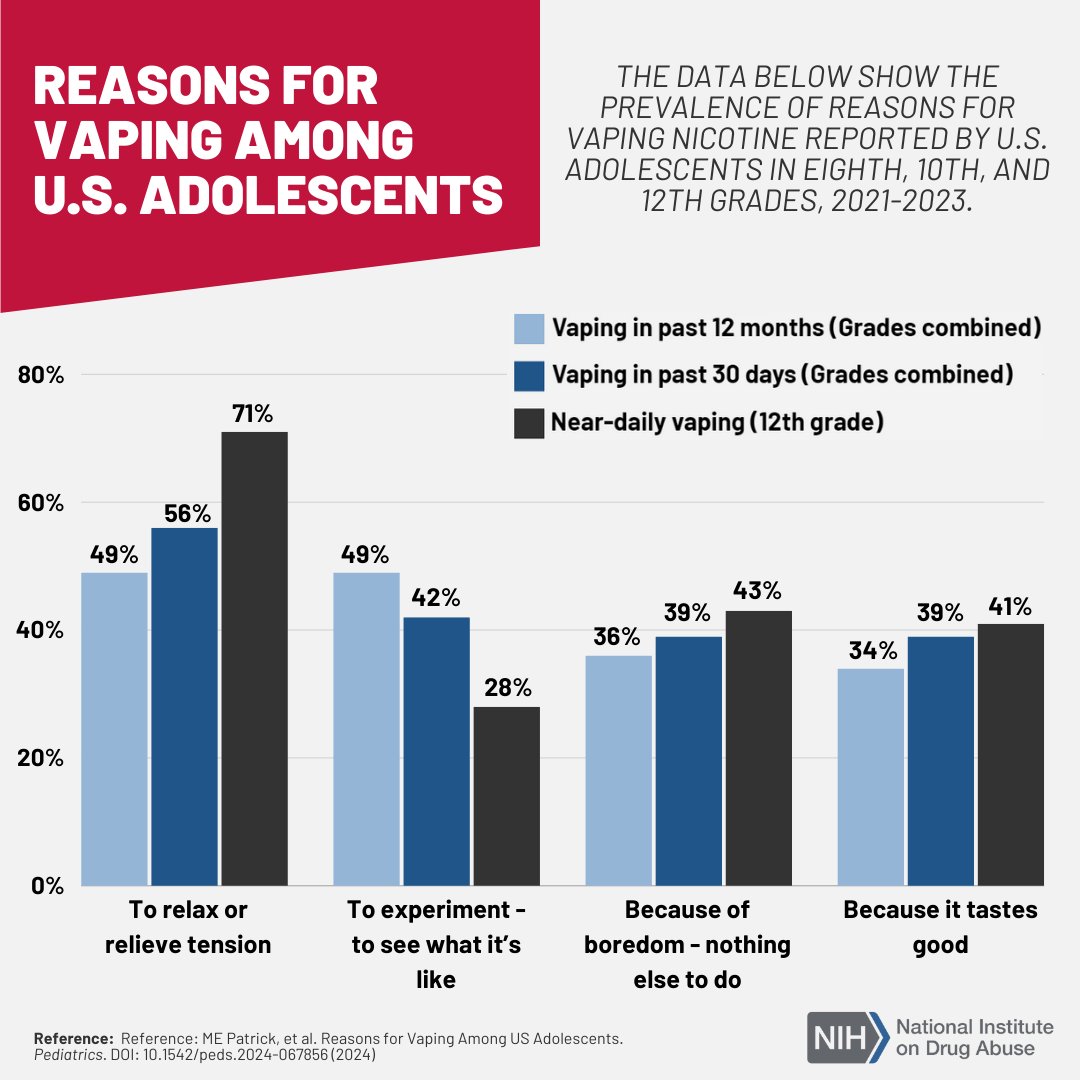
#NIDA-supported research using #MonitoringTheFuture data in 𝘗𝘦𝘥𝘪𝘢𝘵𝘳𝘪𝘤𝘴 reports reasons for vaping among U.S. adolescents. More information in the publication: https://t.co/lH6JfqdNK9
@UMich @aap_peds #MTF
🆕 Results from the latest #NIDA-funded #MonitoringtheFuture survey: Reported use of most drugs among adolescents remained low in 2024. #MTF @UMich https://t.co/NNNPaUXMYc (1/2)

Michael Parks, Brooke Arterberry & @MeganPatrickPhD used daily data from the #MonitoringTheFuture Vaping Supplement to examine vaping-specific nicotine dependence across days among a national sample of US young adults who vape https://t.co/SNTpuDrCv5

Are you a @Umich social science grad student, postdoc/jr faculty interested in using #MonitoringtheFuture data? @umisr has a fellowship for you! The Bachman Fellowship provides support to analyze MTF data on a wide variety of social issues. Apply by 2/11 https://t.co/3XxpdoI24C

In honor of our @umisr @UM_SRC & #MonitoringtheFuture colleague John Schulenberg, from @SRAdolescence - Celebrating the Legacy and Work of John Schulenberg: Taking the Long View of Adolescence
https://t.co/BRETUABe3Z
🆕 #NIDA-supported research using #MonitoringTheFuture data in 𝘗𝘦𝘥𝘪𝘢𝘵𝘳𝘪𝘤𝘴 reports reasons for vaping among U.S. adolescents. @UMich @aap_peds #MTF https://t.co/GyEn4J10zx

Study: Boredom, relaxation, experimentation drive teen vaping https://t.co/Wbekc40HG0
#URecord #MonitoringtheFuture

New U-M Research on Teen Vaping
Curiosity, stress relief, and boredom top the list of reasons why U.S. teens turn to vaping, according to @UMich’s latest study in @AmerAcadPed. The #MonitoringTheFuture study reveals that nearly half of teens who vape do so to relax, with experimentation and boredom also cited as major motivators.
"Understanding why teens vape is essential for effective prevention," says lead author @MeganPatrickPhD of @umisr. The findings highlight the need for mental health support in anti-vaping programs, as stress and anxiety are significant factors driving these behaviors.
Key findings:
70% of near-daily vapers cite relaxation as a reason.
Only a small percentage of teens vape to quit smoking.
Some teens even vape to manage weight—a concerning trend.
The research was funded by the @NIAAAnews and the @NIDAnews.
Learn more about how U-M researchers are tracking these changing behaviors and the implications for adolescent health: https://t.co/aysUhwvAGL

A new study from @MeganPatrickPhD in @ACERjournal reveals that adults aged 35 to 60 are drinking at unprecedented rates, with a striking link between high school binge drinking and risky midlife alcohol consumption. #MonitoringtheFuture https://t.co/hq4JT3uTBy
Mark your calendars, #MonitoringtheFuture will be celebrating our 50th anniversary on February 27, 2025 at @umisr. As part of our celebration, we are opening a call for poster presentations related to MTF from the community. Applications & info here: https://t.co/VRiNuYQ3n6

🆕 Results from the latest #NIDA-funded #MonitoringtheFuture survey suggest #cannabis and hallucinogen use among adults remained at historic highs in 2023. #MTF @UMich https://t.co/jZUzGtohWX (1/2)
🆕 Results from the latest #NIDA-funded #MonitoringtheFuture survey suggest #cannabis and hallucinogen use among adults remained at historic highs in 2023. #MTF @UMich https://t.co/jZUzGtohWX (1/2)
.@epi_kerrykeyes @KreskiNoah & @MeganPatrickPhD use #MonitoringTheFuture to test the association between birth cohort and adolescent depressive symptoms at ages 18, 19 to 20, and 21 to 22 years and changes in these symptoms by cohort https://t.co/wnDWnnxN98
New research from @MeganPatrickPhD & colleagues in @JSADJournal: Historical Trends in Cannabis Use Among U.S. Adults Ages 19–55, 2013–2021
#MonitoringtheFuture @UM_SRC https://t.co/qBAdSF4UXR
Although alcohol use is declining among young adults, rates of hazardous drinking & its harmful consequences remain high. #MonitoringtheFuture
Not drinking today? Study reveals why young adult drinkers choose alcohol-free days
Understanding the reasons why young adults choose not to drink on certain days may inform prevention and intervention programs aimed at reducing the harms associated with alcohol consequences.
Although alcohol use is declining among young adults, rates of hazardous drinking and its harmful consequences remain high.
Current research has examined motivations to drink, but a new @UMich study suggests that focusing on the reasons young adults choose not to drink could enhance strategies to prevent negative consequences associated with alcohol use.
Brooke Arterberry, a researcher at @umisr, and colleagues conducted a study published in Alcohol: Clinical & Experimental Research that explored young adults' day-to-day reasons for not using alcohol and whether those differed by demographic factors, weekend vs. weekday, typical drinking motivations and participants' recent alcohol consumption.
Data were from 614 young adults who, in the last month, had consumed alcohol but had skipped drinking for at least one day. They filled out an online survey about their alcohol use. Recent alcohol use was categorized as moderate drinking (50%; less than 5 drinks in a row), binge drinking (31%; 5+ drinks in a row) or high-intensity drinking (19%; 10+ drinks in a row).
Over two weeks, they filled out daily surveys on the previous day's alcohol use and their motives for drinking or reasons for not drinking.
Social, coping, enhancement and conformity—or to fit in—were some of the motives for drinking.
The surveys offered 12 reasons for not drinking and yielded 5,546 reports on nondrinking days. The most common reasons for not drinking were:
-Lack of interest in alcohol
-Not wanting to get drunk
-Not usually drinking on that night of the week
-Not wanting alcohol to interfere with school or work
-Needing the money for other things
Among less common reasons for not drinking were using another drug instead (overwhelmingly cannabis), a recent hangover and medical reasons.
"These reasons not to drink were linked in varying ways to sex, race/ethnicity, weekend vs. weekday and alcohol use motives," Arterberry said. "For example, women had greater odds than men of reporting a lack of interest in drinking, not wanting to get drunk and recent hangovers."
Hispanic participants and four-year college students were more likely than others to report not drinking because of possible negative consequences, including alcohol interfering with school or work. Non-Hispanic white young adults were more likely to report a lack of interest in alcohol that day.
People who engaged in binge drinking or high-intensity drinking were more likely than moderate drinkers to report recent hangovers.
Motivation matters
Participants who reported more social motives for drinking were more likely than others to report a lack of interest in alcohol and reported fewer reasons not to drink related to consequences. Young adults who reported more coping motives for drinking were more likely to report reasons not to drink related to negative consequences, like upsetting family and friends.
As for the people who reported more enhancement motives, they were more likely to report using other drugs instead. Individuals who reported more conformity motives were more likely to report situational barriers, such as having no one to drink with.
"The study enhances our understanding of young adults' motives related to drinking," Arterberry said. "It could inform interventions that address both reasons to drink and not to drink, potentially strengthening public health messaging and providing opportunities for tailoring prevention and intervention strategies."
A vast majority of participants said that on some days, they weren't interested in drinking and didn't want to get drunk.
"Programming could, for example, emphasize this lack of interest in alcohol while also highlighting the benefits of avoiding negative consequences," Arterberry said. "Interventions could also highlight the value of self-imposed situational barriers like saving money."
The research was funded by @NIAAAnews and @NIDAnews. The study's authors also included Sarah Peterson and Megan Patrick of U-M's Institute for Social Research and Ty Schepis of @txst.

New estimates from the #MonitoringtheFuture study indicate more than 2.1 million students from 8th- 12th grade started vaping between September 2021 through May 2024 https://t.co/UpqGIlVNZP
Last Seen Hashtags on Sotwe
affordablehealthcare
Seen from United States
nsfwtwt
Seen from Saudi Arabia
항문왁싱
Seen from Korea
Snapchat()****** filter:videos
Seen from Netherlands
Freaky
Seen from Thailand
lesflickscan
Seen from United States
Joi
Seen from United States
Asian
Seen from Turkey
hetero
Seen from Chile
Teenagegirls()
Seen from Turkey
Most Popular Users

Elon Musk 
@elonmusk
241.7M followers

Barack Obama
@barackobama
119M followers

Cristiano Ronaldo
@cristiano
114.3M followers

Donald J. Trump
@realdonaldtrump
111.9M followers

Narendra Modi
@narendramodi
107.2M followers

Rihanna
@rihanna
98.7M followers

NASA
@nasa
92.4M followers

Justin Bieber
@justinbieber
91.8M followers

KATY PERRY
@katyperry
90M followers

Taylor Swift
@taylorswift13
83.9M followers

Lady Gaga
@ladygaga
75.4M followers

Virat Kohli
@imvkohli
73.3M followers

Kim Kardashian
@kimkardashian
70.9M followers

YouTube
@youtube
68.8M followers

Neymar Jr
@neymarjr
66.3M followers

Bill Gates
@billgates
65.1M followers

Selena Gomez
@selenagomez
63M followers

The Ellen Show
@theellenshow
62.3M followers

CNN
@cnn
61.8M followers

X
@x
60.7M followers