

Top Tweets for #operability

today’s Go + PostgreSQL API work: production operability
Covered:
- fail-fast DB config,
- cleanup on startup failure,
- structured request/error logs,
- server timeouts,
- graceful shutdown,
- /health vs /ready,
- Goose migrations.


Hydrograph Linked in Posting
Director of Advanced Manufacturing Austin, TX
· 3 days ago
https://t.co/o4kmZlSo7W
About the job
Overview
This is a strategic leadership role responsible for bridging the gap between R&D innovation and commercial-scale production in new material development involving chemical and gas materials. This position leads the development, scale-up, and technology transfer of novel processes from laboratory discovery through pilot production to full-scale manufacturing, ensuring robust, repeatable, and cost-effective processes that meet quality, safety, and regulatory standards.
Responsibilities
Process Development & Scale-Up Leadership
Lead the translation of R&D discoveries and laboratory-scale processes into commercially viable manufacturing operations for new materials, chemicals, and gas-based products
Direct process development activities from bench scale through pilot plant to full production scale-up
Develop and optimize chemical processes, gas handling systems, material synthesis methods, unit operations, and manufacturing workflows for new and existing products
Establish critical process parameters (CPPs), critical quality attributes (CQAs), and process control strategies
Design and execute scale-up experiments to validate process robustness and identify potential manufacturing challenges
Conduct process risk assessments and implement mitigation strategies during scale-up activities
Ensure processes are designed for manufacturability, reliability, and cost-effectiveness across diverse material types
Technology Transfer & Commercialization
Manage seamless technology transfer from Advanced Manufacturing to Operations, ensuring knowledge transfer and process readiness
Develop comprehensive process documentation including batch records, standard operating procedures (SOPs), process flow diagrams (PFDs), and piping and instrumentation diagrams (P&IDs)
Validate that transferred processes are reproducible, scalable, and capable of meeting product specifications
Provide technical support during initial production runs and troubleshoot scale-up issues
Establish quality specifications, analytical methods, and in-process controls for new materials and products
Coordinate cross-functional teams to ensure successful product launches across multiple material platforms
Phase Gate & Project Management
Lead advanced manufacturing projects through stage-gate development processes from concept through commercialization
Develop project plans, timelines, budgets, and resource requirements for scale-up initiatives
Conduct gate reviews and present technical recommendations to senior leadership
Manage multiple concurrent projects across different material development programs while prioritizing resources based on business impact
Ensure projects meet cost, quality, timeline, and safety objectives
Track and report on key project milestones, risks, and deliverables
Manufacturing Process Excellence
Drive continuous improvement initiatives to enhance process efficiency, yield, quality, and safety across chemical and gas material production
Implement process analytical technology (PAT) and advanced process control strategies
Develop and maintain process capability studies and statistical process control (SPC) programs
Lead root cause analysis and corrective action initiatives for process deviations and quality issues
Optimize raw material usage, energy consumption, and waste minimization
Implement lean manufacturing and Six Sigma principles in process design
Regulatory Compliance & Quality Systems
Ensure all processes comply with Good Manufacturing Practices (GMP), environmental regulations, and safety standards applicable to chemical and gas materials
Support regulatory submissions including process validation protocols, manufacturing sections of regulatory filings, and responses to regulatory inquiries
Maintain compliance with FDA, EPA, OSHA, DOT (for gas materials), and other relevant regulatory requirements
Lead process validation activities (IQ/OQ/PQ) and ongoing process verification programs
Ensure proper documentation and record-keeping to meet audit and inspection requirements
Participate in internal and external audits related to manufacturing processes
Team Leadership & Cross-Functional Collaboration
Build, lead, and mentor a team of process engineers,
chemical engineers, materials scientists, and technical specialists
Foster a culture of innovation, collaboration, continuous improvement, and technical excellence
Partner with R&D, Quality Assurance, Quality Control, Operations, Engineering, Supply Chain, and Regulatory Affairs
Provide technical guidance and subject matter expertise to support business decisions across multiple material platforms
Develop talent through coaching, training, and professional development opportunities
Champion safety culture and ensure team adherence to EHS protocols, particularly in gas handling and chemical processing
Capital Projects & Infrastructure
Identify equipment and facility requirements to support process scale-up and technology transfer for chemical and gas material production
Develop capital project justifications and business cases for manufacturing investments
Lead or support capital projects including pilot plant expansions, equipment installations, gas handling systems, and facility modifications
Collaborate with engineering teams on equipment specification, procurement, and commissioning
Ensure new equipment and facilities meet process requirements and regulatory standards for handling various material types
Strategic Planning & Innovation
Develop and execute advanced manufacturing strategy aligned with business objectives and R&D pipeline across multiple material development programs
Evaluate emerging technologies and manufacturing innovations applicable to new materials, chemical processes, and gas handling
Assess make-vs-buy decisions and external manufacturing partnership opportunities
Build manufacturing capabilities and core competencies to support future product portfolio in materials development
Contribute to intellectual property development through process patents and trade secrets
Qualifications
Required
Bachelor's degree in Chemical Engineering, Materials Science, Chemistry, or related technical discipline
12+ years of progressive experience in process development, materials manufacturing, chemical processing, or related roles with at least 5 years in leadership positions
Proven track record of successfully scaling processes from laboratory to commercial production in new materials development
Deep understanding of chemical unit operations, gas handling systems, and material synthesis/processing techniques
Experience with multiple material types including chemical materials, gas-based products, and advanced materials
Extensive knowledge of Good Manufacturing Practices (GMP) in chemical, materials, or related manufacturing environments
Strong experience with phase gate/stage gate development processes and project management
Demonstrated ability to lead cross-functional teams and manage complex technical projects across diverse technology platforms
Excellent problem-solving, analytical, and decision-making skills
Preferred
Advanced degree (MS, PhD) in Chemical Engineering, Materials Science, Chemistry, or related field
Professional Engineer (PE) license
Six Sigma Black Belt or Master Black Belt certification
Project Management Professional (PMP) certification
Experience in multiple regulated industries or applications (pharmaceuticals, electronics, energy, aerospace, etc.)
Knowledge of process safety management (PSM) and hazard analysis (HAZOP, FMEA) particularly for gas and reactive materials
Experience with gas purification, compression, storage, and distribution systems
Background in advanced materials (nanomaterials, composites, specialty chemicals, electronic materials, catalysts, etc.)
Experience with specialty gases, ultra-high purity materials, or critical material processing
International manufacturing experience or multi-site project leadership
Track record of successful regulatory inspections and submissions in relevant industries
Technical Expertise
Materials & Process Knowledge
New material development and characterization
Chemical reaction engineering and kinetics
Gas purification, separation, and handling technologies
Unit operations: distillation, extraction, crystallization, filtration, drying, CVD/PVD processes
Material synthesis methods (sol-gel, precipitation, vapor phase, etc.)
Process thermodynamics and mass/energy balances
Batch and continuous processing
Catalysis and reaction optimization
Gas compression, storage, and distribution systems
Containment and purity control strategies
Quality & Regulatory
Process validation (PV) and continued process verification (CPV)
Quality by Design (QbD) principles
ICH guidelines (Q8, Q9, Q10, Q11) and industry-specific standards
Risk assessment methodologies (FMEA, HACCP)
Regulatory submission requirements across multiple industries
Material specifications and analytical method development
Process Development Tools
Design of Experiments (DOE) and statistical analysis
Process simulation software (Aspen Plus, HYSYS, SuperPro Designer, COMSOL)
Computational fluid dynamics (CFD)
Process analytical technology (PAT)
Material characterization techniques (XRD, SEM, TEM, spectroscopy, etc.)
Data analysis tools (JMP, Minitab, Python, MATLAB)
Scale-up modeling and dimensionless analysis
Manufacturing Systems
Pilot plant operations and scale-up facilities for diverse materials
Batch manufacturing and automation
Continuous processing and advanced manufacturing techniques
Process control systems (DCS, SCADA, PLC)
Equipment sizing and specification for chemical and gas processing
Material handling, containment, and purity maintenance strategies
Cleanroom and controlled environment manufacturing
Safety & Environmental
Process safety management (PSM) for chemical and gas operations
Hazard and operability studies (HAZOP)
Gas hazard analysis and emergency response planning
Dust explosion and thermal hazard analysis
Chemical hygiene and occupational exposure limits
Compressed gas safety and cylinder management
Environmental regulations and waste management
Sustainability and green chemistry initiatives
Toxicity and environmental impact assessment for new materials
Work Environment
Dynamic laboratory, pilot plant, and manufacturing floor environments involving chemical and gas material processing
Office-based work with significant time in technical areas
Personal protective equipment (PPE) required in manufacturing areas; specialized PPE for gas handling
Exposure to chemical substances and compressed gases requiring proper safety protocols
Work in controlled environments (cleanrooms, inert atmospheres) as required
Occasional domestic and international travel (10-20%) for site visits, conferences, or vendor meetings
Flexibility for project demands and occasional after-hours support

Gmum all !
as you know not much attention is paid to multichain operability. How one blockchain interacts with another often gets buried in the supremacy debate between bitcoin maxi’s and Ethereum.
But this is something I don't see talked about a lot.
Can the real bottleneck be memory?
Any computer contains memory.
Without this technology, applications would not be able to access data quickly or update it efficiently.
Despite this fact, a majority of blockchains were designed poorly with no memory layer in mind.
As the network grows larger, the cost of storage, redundancy, and retrieval increases; all of this happens these days.
To me, @get_Optimum is interesting because it is not trying to build another chain like the other competitors.
Building a decentralized memory system that hastens, facilitates and scales data transfer over the plethora of networks and protocols.
Often the best innovations come from taking features away.
They fix a piece of the architecture which everybody else learnt to live without.
@vssema11 @JimmyHope_
@Isaacjohnibiam @ada_pegasus


What Not to Build: The Overbuild Traps That Make Policy Systems Slower and Still Fragile @RialoHQ
When teams hear “policy, privacy, automation, audits,” they often respond with one instinct:
Build everything.
It’s understandable. It feels safer. It also tends to create a system that is:
complex
slow to change
hard to operate
and still dependent on humans in the worst moments
Overbuilding doesn’t eliminate fragility. It hides it behind more moving parts.
Here are the traps to avoid if you want a system that stays both disciplined and shippable.
1) Too many issuers too early
It’s tempting to add multiple issuers for redundancy, coverage, and faster verification.
In practice, early multi-issuer setups often create:
inconsistent outcomes
proof shopping
precedence confusion
operational drift (“issuer A for this, issuer B for that, unless…”)
audit complexity
What to do instead:
start with one issuer per critical scope
build explicit issuer trust sets and degraded mode behavior
add a second issuer only when you have strong precedence and deprecation machinery
Redundancy is valuable. Uncontrolled redundancy is an attack surface.
2) A “fully programmable” policy language
Teams love flexibility. They build a policy DSL that can express anything.
Then they discover:
no one can reason about it
testing explodes
audits become interpretive
edge cases multiply
policy changes feel like code deploys with unknown blast radius
What to do instead:
keep the core language small
allow only structured primitives: scope, expiry, issuer sets, constraints, precedence, posture
make everything versioned and testable
resist arbitrary logic
If your policy language can express anything, it will eventually express confusion.
3) Global tiers that imply universal privilege
A single “Tier2” badge is seductive. It’s also a liability.
It causes:
scope bleed (“why can’t I borrow more?”)
perceived unfairness
harder revocations and deprecations
bigger blast radius for mistakes
What to do instead:
scope tiers by action (purchase vs borrow)
show scope chips at point of action
keep “what changed” explicit
Global tiers are a shortcut that creates long-term churn.
4) Complex pricing plans before you know your cost drivers
Service tiers can be powerful. But elaborate subscription models too early usually fail because:
you don’t yet know which services dominate costs
you create fairness perceptions you can’t manage
you lock yourself into promises you can’t keep under stress
you add support load for billing confusion
What to do instead:
start with simple, predictable service units
protect exits universally
add economic incident posture first (capacity allocation)
layer tiered convenience later
Pricing should follow observed bottlenecks, not imagined ones.
5) Backward compatibility with no sunset
This is how legacy becomes permanent.
If old proof formats and issuers remain valid indefinitely:
attackers camp there
deprecations never finish
precedence becomes a nightmare
audits become harder
you lose the ability to tighten rules safely
What to do instead:
separate parsing from permission compatibility
allow legacy for exits longer than new risk
publish a hard sunset date early
measure legacy usage continuously
Compatibility without an end date is a liability you’re choosing.
6) Appeals and arbitration that look like courts
Overbuilding appeals is a common mistake:
multiple levels
long narratives
broad evidence sharing
exceptions disguised as “review”
unclear finality
This becomes:
expensive
bribable
manipulable
and a backdoor for negotiability
What to do instead:
keep appeals bounded: allowed bases, tight timelines, cooldowns
refresh-first resolution
selective disclosure only when required
strong finality
Appeals should be a safety valve, not a parallel governance system.
7) Too much “transparency” (logging private evidence everywhere)
Teams overreact to audits by logging everything:
raw vendor reports
sensitive attributes
internal risk signals
detailed match rationale
This creates:
privacy risk
insider threat risk
retention liability
and new compliance problems
What to do instead:
store policy commitments, decision logs, template versions
store proof lifecycle metadata
keep evidence sealed and disclosed selectively
record posture changes and overrides
Prove behavior, don’t stockpile secrets.
8) UI that explains everything instead of routing action
Overbuilding UI explanations often creates:
long legal-sounding text
user panic
support tickets anyway
negotiation cues (“if I argue, maybe…”)
What to do instead:
keep explanations procedural
route to a clear remediation action
preserve exits
show timers and scope chips
use “why” accordions for bounded detail
In policy UX, clarity beats completeness.
9) Incident mode that tries to cover every scenario upfront
Teams sometimes build an incident framework so complex that:
no one knows which mode to use
activation becomes a debate
it’s never rehearsed properly
it becomes shelfware
What to do instead:
start with a simple posture: pause new risk, preserve exits
add one more tier only when you can operate the first tier well
rehearse quarterly
The best incident mode is the one people actually use correctly.
The meta-trap: building “architecture” instead of building “operability”
A policy-heavy system doesn’t fail because it lacks features.
It fails because under stress, the system stops being the system and humans take over:
exceptions
manual approvals
shadow policies
inconsistent messaging
Overbuild traps often add more features without reducing that human takeover risk.
A better standard is:
build the minimum primitives that keep the system operable
version policy, make rollback easy
keep refresh predictable
preserve exits
constrain overrides
keep language consistent
add modules only when signals demand it
That’s how you scale without slowing down.

Month Two Scaling: Adding the Next Layer Without Overbuilding @RialoHQ
Month one hardening is about stability: exits, refresh, remediation, posture, comms, rollback.
Month two is where you decide what kind of system you’re becoming.
If you rush into advanced machinery too early, you’ll build complexity you don’t need yet. If you delay too long, drift and legacy paths will become permanent.
So month two should follow a simple rule:
Add only what your first month signals say you’re missing.
Here’s a practical month-two plan organized by “if you see this, build that.”
1) Policy epochs and migrations (build when “worked yesterday” becomes routine)
Build epochs if you observe:
frequent policy changes already
stale proofs causing confusion
multiple scopes with different enforcement timelines
revocation-like events, even small ones
refresh spikes tied to rule changes
What to build (minimal v1)
scoped epochs for the highest-risk action families (borrow-open, leverage increase)
EPOCH_STALE reason code + remediation routing
soft→hard enforcement phases for epoch changes
epoch-aware precedence for risk actions
migration posture that preserves exits
What to postpone
global epoch across all products
complex multi-phase migrations for every scope
Start with the one or two scopes that are already creating churn.
2) Deprecation machinery (build when legacy starts living longer than planned)
Build deprecation if you observe:
old proof formats still authorizing actions
issuer changes that can’t be enforced cleanly
partners integrating with “whatever works”
compatibility hacks during outages
What to build (minimal v1)
parsing vs permission compatibility separation
PROOF_DEPRECATED / ISSUER_DEPRECATED reason code families
exits-only compatibility posture
published sunset dates (internal first, then external)
partner deprecation lane (basic comms + test window)
3) Structured appeals (build when disputes start driving operations)
Build structured appeals if you observe:
appeal churn (repeat appeals)
support escalation storms
requests for evidence/rationale
override pressure being driven by disputes
What to build (minimal v1)
allowed appeal bases
intake form that forces basis selection
cooldowns and scope/time limits
refresh-first default resolution
no risk-expanding “temporary unlocks”
appeal telemetry dashboard
What to postpone
complex arbitration panels
broad evidence disclosure
Start with bounding, not bureaucracy.
4) Permanent shadow lane (expand when drift becomes your main hidden enemy)
Expand shadow lane if you observe:
subtle reason-code drift
unexpected behavior after small changes
frequent tiny config edits by different teams
recurring “why is this different?” tickets
What to build (month-two scale)
continuous shadow for one candidate policy
severity gates (unexpected allow-on-risk, deny-on-exit)
reason-code diff monitoring
weekly shadow review ritual
integration with drift audit and exception budget
This reduces rollout fear and catches drift before users feel it.
5) Service tier economics (build when capacity becomes the limiting factor)
Build service tiers if you observe:
refresh queue contention becoming common
external call costs rising
automation load and scheduling conflicts
pressure to subsidize ad hoc for VIPs
repeated “why is this slow/expensive” disputes
What to build (minimal v1)
service units (refresh credits, workflow credits)
protected capacity for exits and safety actions
admission control tied to backlog health
clear “budget view” in UI (simple)
economic incident posture: throttle noncritical workloads first
What to postpone
complex multi-tier subscription plans
anything that looks like pay-to-bypass eligibility
Start with predictability and protected capacity.
6) Deeper incident posture tiers (build when you’re using incident mode too often)
Add posture tiers if you observe:
frequent posture activations
difficulty deciding when to tighten/loosen
repeated freeze-all reflexes
inconsistent comms during incidents
What to build (month-two v2)
Tier 1 observe, Tier 2 restrict new risk, Tier 3 controlled fallback
explicit activation and exit criteria
staged re-entry plan embedded in UI
posture event logs for audits
The goal is to make degraded operation procedural.
The month-two execution plan (4-week structure)
Week 5: Choose the “next layer” based on week-one+month-one signals
Pick only 1–2 major upgrades from above.
Week 6: Implement minimal version + shadow it
Run it in shadow, measure diffs, fix edge cases.
Week 7: Roll out by action criticality
Restore low-risk first, then high-risk, with rollback triggers prewritten.
Week 8: Lock it in with governance and drills
update runbooks
update dashboards
add regression tests
add deprecation timelines (if relevant)
run a tabletop incident drill with the new layer
The month-two success criteria
By end of month two, you want:
fewer “worked yesterday” tickets (if epochs added)
fewer legacy loopholes (if deprecation added)
fewer repeat appeals and less override pressure (if structured appeals added)
fewer rollout surprises (if shadow lane expanded)
fewer queue crises and less ad hoc subsidization (if service posture added)
fewer freeze-all decisions (if posture tiers added)
In other words: the system should be getting more predictable as it grows, not just more complicated.
The meta-rule: build the minimum that closes the loop
Month-two scaling isn’t about adding impressive architecture.
It’s about adding the smallest missing pieces that:
reduce repeat incidents
reduce manual intervention
and reduce negotiation cues
That’s how you keep your trust stack scalable.


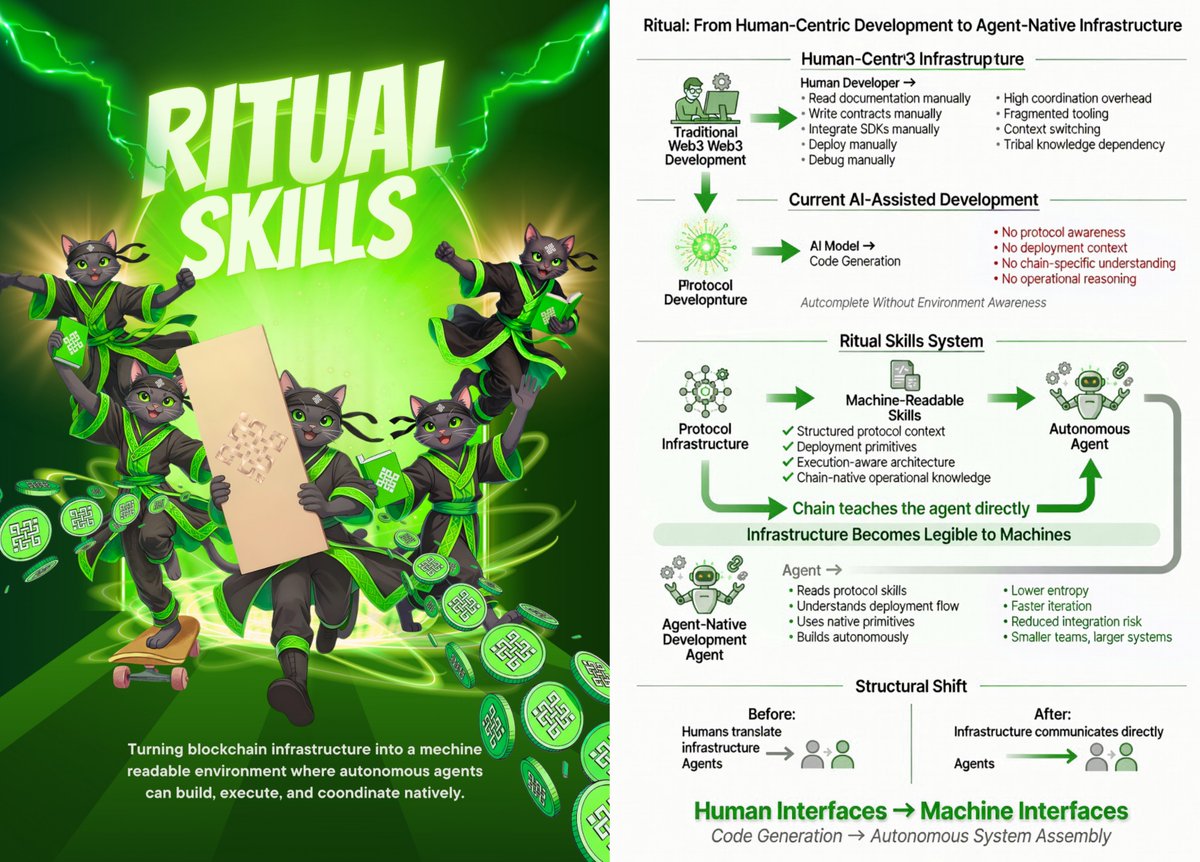
📌Ritual: Abstracting Smart Contract Complexity Into Agent Native Infrastructure
Most crypto infrastructure is still designed around a human developer workflow.
Write contracts manually.
Read documentation manually.
Integrate SDKs manually.
Deploy manually.
Debug manually.
Even in “AI assisted” development, the model itself still lacks environmental context. The agent may generate code, but it does not inherently understand the protocol architecture, deployment standards, execution patterns, or available primitives of the chain it is building on.
This creates a hidden inefficiency layer across Web3 development. The bottleneck is no longer compute. It is context transfer.
Ritual Skills system is interesting because it attacks that bottleneck directly.
Instead of treating documentation as something humans interpret, Ritual restructures protocol capabilities into machine readable operational context. The important shift is not simply that agents can generate contracts. Models already do that. The important shift is that infrastructure itself becomes legible to agents natively.
That changes the development stack entirely.
On most chains, the developer teaches the agent how the chain works. On Ritual, the chain teaches the agent directly.
The distinction sounds semantic until you understand its implications for scalability.
When coding agents can dynamically access structured protocol “skills,” the development process transitions from code generation into autonomous system assembly. The agent no longer operates as a disconnected autocomplete engine. It becomes an execution-aware builder capable of reasoning around deployment architecture, available primitives, and chain specific logic in real time.
This dramatically reduces the entropy normally associated with smart contract development.
Historically, crypto infrastructure suffered from a fragmentation problem. Every protocol introduced new abstractions, different tooling standards, unique deployment flows, and inconsistent documentation layers. Human developers compensated through accumulated tribal knowledge. AI agents struggle because fragmented environments destroy contextual continuity.
Ritual Skills framework effectively standardizes context transmission between infrastructure and autonomous agents.
That is a far larger architectural shift than most people realize.
The market currently focuses on AI agents primarily as end user applications. Trading bots, assistants, automation layers, social agents. But the more important layer may actually be agen native infrastructure itself. Systems designed not merely to host agents, but to be understood and operated by them autonomously.
This is where Ritual begins separating itself conceptually from general purpose chains.
The protocol is not optimizing solely for transaction execution. It is optimizing for machine operability.
That creates second order effects across the entire development lifecycle. Once agents can ingest reusable skills directly from the protocol layer, development speed accelerates non linearly. Complexity becomes abstracted away from the human operator and compressed into reusable machine readable primitives.
In practical terms, this means smaller teams can deploy more sophisticated systems faster, with lower coordination overhead and reduced integration risk.
But the deeper implication is economic rather than technical.
Infrastructure that agents can directly understand becomes inherently more scalable than infrastructure requiring continuous human mediation. Over time, autonomous systems prefer environments where operational friction is minimized. Just as developers historically gravitated toward ecosystems with better tooling, autonomous agents will gravitate toward ecosystems with better machine readability.
Ritual appears to be positioning itself ahead of that transition.
The combination of verifiable compute, agent-native architecture, and machine readable skills creates a feedback loop where agents are not merely applications deployed on the chain, but active participants within the chain’s operational environment.
This matters because the long term endpoint of AI infrastructure is unlikely to be “AI helping humans code faster.” The endpoint is autonomous systems coordinating directly with infrastructure without requiring constant human translation layers.
The current internet was built primarily for human interfaces. Ritual is implicitly experimenting with infrastructure designed for machine interfaces first.
That inversion could become extremely important.
Historically, the platforms that dominate technological transitions are usually the ones that redesign infrastructure around the native behavior of the next dominant participant class. Cloud platforms optimized for internet scale applications. Mobile operating systems optimized for touch interfaces. Social platforms optimized for algorithmic distribution.
Ritual appears to be optimizing blockchain infrastructure for autonomous agents themselves.
If that thesis proves correct, then the Skills system is not merely a developer tool. It is an early abstraction layer for machine-native economic coordination.
And markets tend to underestimate abstraction layers until they become unavoidable infrastructure.
@ritualnet | @ritualfnd | @Jez_Cryptoz | @joshsimenhoff | @dunken9718 | @0xMadScientist | @cryptooflashh | @ritualcommunity | @Majorproject5

@BillyFlynt5853 shipping verification with the overlay is the move. the cut is whether 'mapping holds' is decidable from operability deltas alone, or needs a runtime signal the model produces. second is the harder one.

right on. i think thats the right pressure test.
the direction isn’t “the model self-integrates and we trust it.”
we are reviewing this:
typed contracts + admissibility rules let the model propose a governance overlay, then replay and operability verification checks determine whether the affordance mapping actually holds.
the current idea is to ship those verification checks with the overlay itself, so devs can validate the governance posture before protocol infrastructure hardens it further.

Fixed Income Basics Part 3: Fixed Income as An Income, Liquidity Source, and Insurance.
So, I have tweeted a lot about fixed income to bring the consciousness of the small retail investor to the advantages, of fixed income, and understanding how it works.
This post builds on that basic foundational mechanics covered in the quote post to rationale, application and strategy, and operability.
Why It's Necessary to have Fixed Income in Your Portfolio?
👇🏾👇🏾👇🏾
1/6
#FixedIncome #Bonds #Fintwit #RealYield
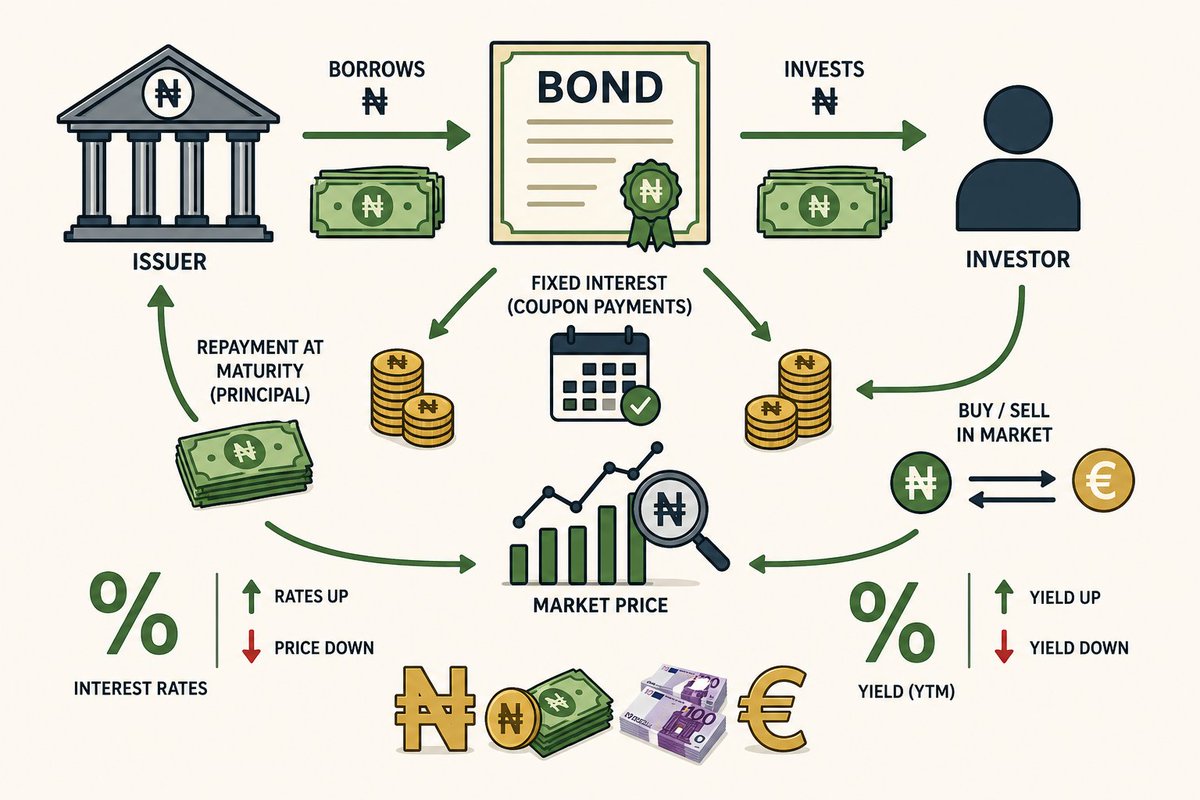
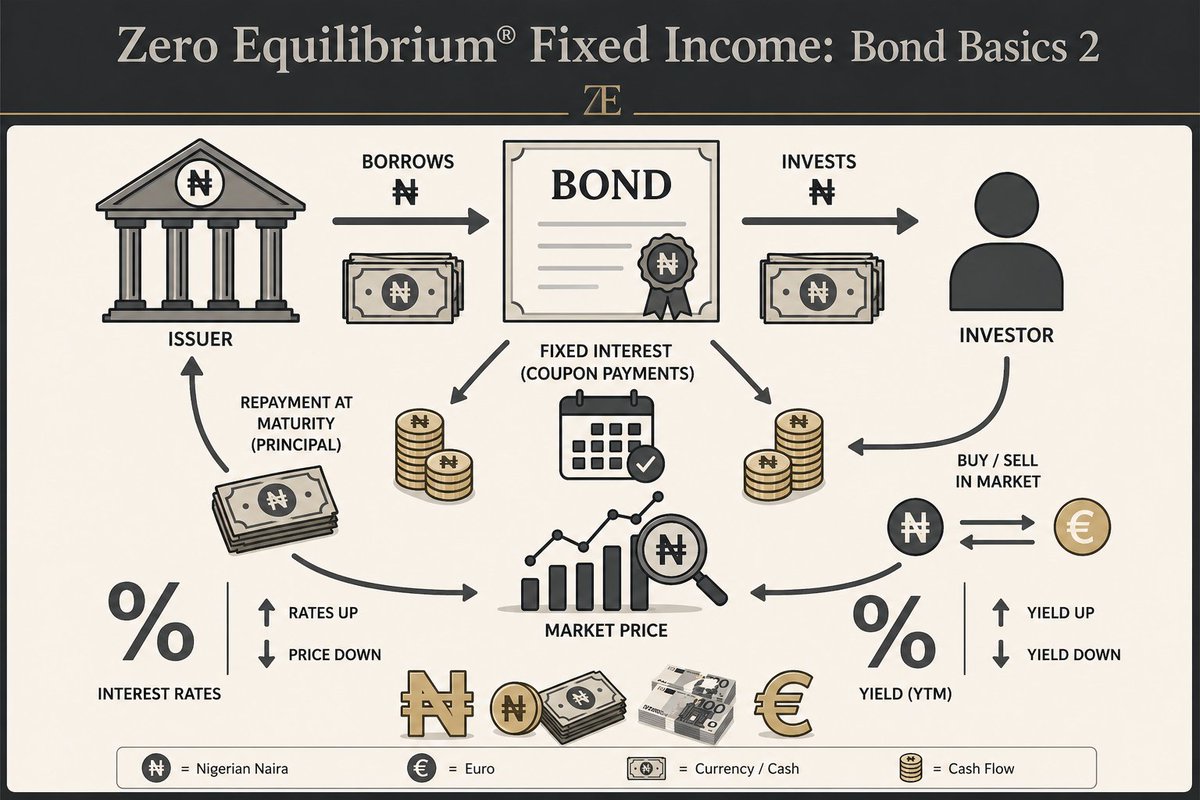
Fixed Income Basics Part 2: Bond Pricing, Valuation, Opportunities, Risks, Positioning In focus.
Bond Pricing and Valuation:
Pursuant to our last post on Bond Basics we discuss Bond Valuation on theis thread, how you value a bond, in relation to mother's on key metrics.
To Recap: Bonds as said in the quote post, is a tradable debt from an investor to an issuer. The issuer then pays a fixed sum (yield) in the bond at intervals until maturity where the principal plus final interest payment is made.
So the investor gets the face value of the principal invested at the end of the tenure, for which total gains/losses are realized depending on the market entry price.
Holding a bond till maturity guarantees income, that will not.chamge in absolute terms even as bond prices and by extension yields fluctuate. Why?
1/8
#fixedincome #bonds #Markets #Financial_Boycott_HYBE_Belift #ZEFinance

@AdeleyeAjiboye This is exactly why fundamentals matter. AI optimises for 'works now' not correctness, safety or operability. Without basics, you cant tell when it silently did something catastrophic
Policy Experimentation Without Risk: Testing Variants Without Making Enforcement Arbitrary @RialoHQ
The moment you say “A/B test a policy,” people get nervous for the right reason.
Policies aren’t button colors. They decide who can do what, how much risk they can take, and whether they’re eligible at all. If you run experiments carelessly, you teach users that enforcement is inconsistent—and you hand adversaries a perfect probing tool.
So policy experimentation has one hard requirement:
You must be able to learn without making the live system feel random.
Shadow mode is the foundation for that. It lets you test variants against real traffic without letting variants enforce. But to do it well, you still need a disciplined approach.
Here’s what policy experimentation looks like when you keep legitimacy intact.
1) Separate “evaluation experiments” from “enforcement experiments”
Most teams confuse these.
Evaluation experiments
Run multiple policy variants in shadow, compare outcomes, and learn. No user impact.
Enforcement experiments
Actually enforce different rules for different users.
For most IPC-heavy products, you should start—and often stay—with evaluation experiments. They give you 80% of the learning with 0% of the legitimacy risk.
Enforcement experiments are occasionally justified for low-risk surfaces, but they should be rare, staged, and heavily constrained.
2) Start with two variants, not a zoo
Policy experimentation fails when it becomes complicated.
Pick:
current policy (baseline)
one candidate policy (variant)
Sometimes:
one “tighter” and one “looser” candidate in shadow only
Don’t run five variants. You’ll spend more time interpreting diffs than learning from them.
The goal is to answer one question at a time:
Does tightening freshness reduce risk without exploding support load?
Does changing precedence reduce proof conflicts without breaking upgrades?
Does adjusting caps reduce appeals without increasing exposure?
One hypothesis per experiment.
3) Choose metrics that reflect real cost, not just conversion
If you optimize policies for conversion alone, you will create risk and future incidents.
The right metrics depend on the policy surface, but the most useful families are:
Safety / risk metrics
predicted exposure increase (LTV distribution shifts)
high-risk action allow rate changes
“unexpected allow” count in shadow
override pressure prediction (more on that below)
Operational metrics
predicted “require refresh” volume
remediation loop success probability
support manual-touch proxy
appeal likelihood proxy (reason-code families that correlate with disputes)
User experience metrics
confusion reason codes (scope mismatch, epoch stale, issuer untrusted)
repeated denial likelihood
time-to-self-remediate (if measurable)
churn signals where available
Policy experimentation is not “maximize success rate.” It’s “find a better balance between safety, operability, and clarity.”
4) Treat “remediation diffs” as first-class results
The easiest way to ship a policy that looks safe but breaks the product is to ignore remediation.
A policy variant might be correct and still create:
huge refresh waves
confusing denials
support spikes
appeal storms
workaround pressure
So measure not only:
allow/deny diffs
But also:
remediation class diffs (refresh vs wait vs unwind)
allow-unwind-only changes
reason-code distribution shifts
If the variant routes too many users into expensive remediation, it may be operationally unshippable even if it’s logically sound.
5) Don’t let experiments create an “adversary oracle”
Even if you’re only shadowing, enforcement experiments create a probing risk.
Attackers love inconsistent enforcement because it reveals boundaries. If they can try multiple accounts and see which one gets the looser rule, they can map your policy function.
So:
do not enforce different eligibility rules for similar users without strong justification
avoid experiments on high-risk actions (borrow-open, leverage increase)
never disclose to users that “you’re in a test group” for enforcement-related differences
keep enforcement differences limited to low-risk UX surfaces where inconsistency won’t be interpreted as unfairness
If you must enforce experiments, do it where it can’t be exploited and where users won’t experience it as arbitrary punishment.
6) Use shadow mode to precompute the “blast radius”
Before any enforcement experiment, run shadow for long enough to estimate:
who would be affected
how many denials would change
how many refreshes would be triggered
how many exits might be impacted
which reason-code families would spike
If the blast radius is unclear, don’t enforce.
The whole point of shadow is to remove guesswork.
7) If you enforce, enforce by action criticality and keep it reversible
A safe enforcement experiment looks like:
starts with low-risk actions only
preserves exits for everyone
has explicit rollback criteria
has a short time window
has tight exception budgets
Never do enforcement experiments that:
risk trapping users
change high-risk exposure rules unpredictably
require manual exceptions to keep users functional
If enforcement experiments require exceptions, you’re learning the wrong lesson.
8) “Override pressure” is a real metric, even if it’s fuzzy
One of the best predictors of policy failure is how much it will tempt humans to bypass it.
Shadow mode can estimate this.
Certain reason-code patterns correlate strongly with:
VIP escalations
angry support tickets
“just this once” requests
appeal churn
If your variant increases those patterns, it will likely increase overrides and drift in the real world.
So treat “override pressure” as a first-class evaluation metric:
predicted volume of disputes in high-value segments
predicted increase in cases that block users without clear remediation
predicted increase in cases that feel unfair (“worked yesterday”)
Good policies don’t just pass tests. They reduce pressure to cheat.
9) Close the loop: experiments must produce a decision and a change
Policy experiments are pointless if they don’t end in:
promote the variant
revise and rerun
discard and document why
“Keep testing” is how experimentation turns into indefinite uncertainty, which is its own form of drift.
Each experiment should have:
a clear hypothesis
a minimum run duration
a success threshold
and a decision deadline
The real standard
Policy experimentation without risk means:
learn mostly through shadow evaluation
choose metrics that include safety and operability
treat remediation and reason-code shifts as core outcomes
avoid turning inconsistency into an attack surface
enforce only where reversibility and fairness are preserved
and always close the loop into a versioned policy change
That’s how you get better rules without teaching users that rules are arbitrary.

Post-Rollback Shadow Run: Turning a Failed v18 Into a Safer v18.1 @RialoHQ
A rollback is not the end of the story. It’s a fork in the road.
One path is the lazy one: revert, move on, and quietly accept that policy changes are scary and expensive.
The other path is the useful one: treat rollback as a data point, then run the failed policy in shadow against real traffic until you can explain exactly what went wrong—and prove the fix won’t recreate it.
That second path is how you get to v18.1: not a rewrite, a tightened version that’s testable, predictable, and operationally boring.
Here’s how to run that post-rollback shadow run in a way that actually improves the system.
1) Freeze the definition of “failed v18”
First rule: don’t keep editing the policy while you’re trying to understand it.
Take the rolled-back v18 artifact and freeze it:
policy object hash
issuer trust sets
precedence rules
constraints
freshness/expiry rules
incident posture overlays (if any)
Label it: v18 (failed).
This matters because the shadow run is about learning from a specific behavior profile. If the definition of v18 keeps shifting, your diffs become meaningless.
2) Rebuild the failure timeline using artifacts, not memories
Before you shadow anything, reconstruct what happened:
which invariant triggered rollback
what the decision mix looked like by action family
which reason-code families spiked
whether remediation loops failed (refresh, upgrade, reset timers)
which issuers/verifiers were degraded
what overrides were requested and why
what appeals spiked and with which bases
This timeline becomes your hypothesis list.
It tells you what to watch for during shadow:
is the same drift happening again?
are the same reason codes clustering?
are the same edge cases recurring?
3) Add “known diffs” and “known failures” to the proposal
Before you run shadow, write two lists.
Known diffs (intended changes)
what v18 was meant to change
Known failures (rollback triggers)
what actually caused rollback
The shadow run is successful when:
known diffs appear as intended
known failures do not appear
new unexpected failures do not appear
Without those two lists, shadow mode becomes passive observation with no pass/fail criteria.
4) Shadow the policy across the same action tiers that matter most
Don’t shadow everything equally.
Shadow evaluation should be weighted toward the actions that define risk and trust:
borrow-open / leverage increase
tier upgrades / privilege expansion
revocation and allow-unwind-only behavior
proof refresh and expiry boundaries
safe exits (repay, close, redeem)
If the failed v18 had issues, they almost certainly showed up in one of those lanes.
Shadow mode should not be a broad “decision match rate” metric. It should be a surgical detector for high-severity misbehavior.
5) Track three diff types, not just allow/deny
Most teams only look at decision diffs:
allow → deny
deny → allow
That’s not enough. Shadow runs should track:
A) Decision diffs
The obvious ones.
B) Reason-code diffs
Even if the decision is the same, a different reason code can mean precedence changed, issuer filters changed, or policy anchoring changed.
C) Remediation diffs
Does the candidate policy route users into a different recovery path?
Does it increase “refresh required”?
Does it push users into loops?
Does it change allow-unwind-only posture?
Remediation diffs predict support load and appeal spikes better than decision diffs.
6) Build “severity gates” that would have triggered rollback
This is the discipline that makes shadow runs useful.
Define gates like:
Any shadow ALLOW for high-risk action where live is DENY under current stable policy → red flag
Any shadow DENY on safe exits where live is ALLOW → red flag
Any growth in shadow ERROR.* families → red flag
Shadow shows ALLOW_UNWIND missing where it’s expected during revocation posture → red flag
Shadow reason-code drift clustered around issuer trust or precedence → yellow/red flag depending on scope
These gates aren’t theoretical. They should be the same invariants that justified rollback.
Shadow mode is your dry run to prove those invariants won’t be violated again.
7) Fix the smallest module that explains the failure
This is where modularity saves you.
Don’t rewrite v18 wholesale. Identify where it broke:
issuer trust set misapplied? → issuer module fix
wrong proof selected? → precedence module fix
stale/epoch logic too strict? → freshness module fix
constraints intersected incorrectly? → constraint module fix
incident posture not overlaying correctly? → incident module fix
explanations unclear or misrouted? → explanation/template fix
Then version a minimal patch: v18.1 candidate.
The goal is not “new policy.” It’s “same intent, safer behavior.”
8) Re-run shadow with v18.1 and prove three things
A real v18.1 shadow run proves:
intended diffs still occur
rollback failures no longer occur
the support and remediation surface doesn’t explode
That last point is often neglected. A policy can be “correct” and still unshippable if it routes too many users into expensive remediation paths or creates confusion spikes.
So you measure:
predicted appeal volume (via “require refresh” surge, confusion reason codes)
predicted support load (manual-touch rate proxy)
override pressure risk (how many cases would become “please make an exception”)
If v18.1 is safe but operationally explosive, you’re not done.
9) Dry-run comms and runbooks against shadow outcomes
This is the fastest way to avoid repeating day-one chaos.
Take the top 10 expected reason codes under v18.1 and:
confirm templates exist and are privacy-safe
confirm remediation is clear
confirm runbooks route correctly
confirm ops dashboard overlays match expected spikes
Shadow mode isn’t just for the engine. It’s for the human system too.
10) Promote v18.1 only with staged re-entry logic
When you finally enforce v18.1, treat it as a high-impact rollout again, but with better posture:
stage by action criticality
preserve exits and safe set
tighten exception budget during rollout
define rollback triggers again
keep shadow running for v18.2/next change
The whole point of the post-rollback shadow run is that v18.1 arrives with fewer surprises and faster rollback confidence if needed.
The real outcome you want
A successful post-rollback shadow run doesn’t just produce “a new policy.”
It produces a system that learned how to change rules without losing legitimacy:
rollbacks become normal
shadow mode becomes standard
the smallest module fixes become the default
comms and runbooks stay aligned
exceptions don’t explode
and the system stays explainable under stress
That’s what “v18.1” really is: not a patch, a proof that governance is working.

@Susmit_999 @ankitatIIMA Perfect
This is the first of the two pillars on which a Fiat reserve currency stands :
Store of value: that is de dollarised via Gold.
Medium of transaction: the infra is being put in place rapidly. Digital payment network- inter operability across borders- CBDC

The gap in agents today isn’t intelligence. It’s operability.
They can draft and they can suggest, but they still struggle to execute end to end, settle actions, and prove outcomes in real systems.
That’s exactly the gap Kodeus is closing. We are building the Internet’s Agent Layer so agents can move from “assistant” to operator with:
• Programmable logic
• Real tool access
• Autonomous settlement rails
• Verifiable provenance with receipts you can audit
When those pieces exist, intelligence becomes measurable work that can be priced and verified.
@TheKodeusLabs empowers you to deploy agents that run workflows reliably, execute across real tools, and leave proof you can audit.
Build with Kodeus: https://t.co/jIfRHqdI0z


Most infra only matters when it breaks. the stuff that compounds is what works quietly in the background.
I run @PerceptronNTWK as my brownout buffer: when i’m active, flow drops to a trickle; when i’m idle, it quietly moves public pulls and keeps the feed current. router qos is set per device, traffic stays in its lane, no slowdown, no private data touched.
The real win is network efficiency. fewer redundant fetches. fresher slices routed to where they’re needed instead of hammering the same sources. traders feel it upstream as cleaner prep, execution stays tight when @intodotspace flips on.
Tge in march matters. operability matters more. idle seats in your pipe should be earning.


In mature systems, failure rarely comes from a single weak component. It emerges from misalignment between layers that were never designed to operate together. Ideation without execution stalls. Execution without adaptivity ossifies. Adaptive layers without architectural grounding collapse under sustained load.
That’s why the infrastructure analogy matters.
Centralized inference works at demo scale, but continuous usage quickly turns latency, cost, and brittleness into first-order constraints. Treating AI as infrastructure forces a different set of design choices:
decentralization, resilience, and long term operability over short-term capability spikes. That is exactly the design space @dgrid_ai is built for.
This is why the argument lands as a systems thesis rather than a product pitch.
It’s not describing features.
It’s describing inevitabilities.

The failure mode you’re pointing at local optimization across layers shows up everywhere once systems hit steady state usage. Ideation without execution stalls, execution without adaptivity ossifies, and adaptive layers without architectural grounding collapse under load.
The infrastructure analogy is key. Centralized inference works at demo scale, but continuous use exposes latency, cost, and brittleness as first order constraints. Treating AI as infrastructure forces different design decisions: decentralization, resilience, and long term operability over short term capability spikes exactly what @dgrid_ai is designed around.
That’s why it lands as a systems thesis rather than a pitch. It’s describing inevitabilities, not features.
The progression is especially clear ideation → adaptive intelligence → sustained execution. Most stacks stall because they over-invest in one layer and ignore the others, and the cracks only show once usage becomes continuous.
The point about centralized inference becoming fragile over time is understated but critical. If AI is going to behave like infrastructure, it has to be built like infrastructure something @dgrid_ai is explicitly designed for. This reads less like a pitch and more like a systems thesis, which is exactly why it works.


@Yuvrajcrypto01 @Jez_Cryptoz @joshsimenhoff @dunken9718 @0xMadScientist @nft_hinata_eth @Ritual_IN Ritual is the only chain that AI needs for its onchain operability

AI in crypto is not about chatbots. But the real unlock is intent and execution.
@HeyElsaAI is not trying to predict markets or replace traders. It’s solving the operability gap, the friction between knowing what you want to do and actually doing it on-chain.
Behind the scenes, that means:
👉 intent parsing
👉 action routing across chains
👉 transaction simulation & safety checks
👉 account abstraction–style execution
👉 continuous state monitoring post-execution
When someone types “rebalance”, “bridge”, or “set alerts”, Elsa translates human intent into deterministic on-chain workflows.
That’s why this matters as chains, protocols, and agents multiply, manual execution doesn’t scale and Elsa is less AI trader and more AI control layer for Web3.
Powered by @wallchain

By now you all must have been familiar with what @HeyElsaAI is about. Imagine some DeFi tools still assume users want to think like protocols. By switching chains and bridging through several protocols, but with Elsa, everything just happened magically on your call.
Here you don’t click around DeFi, you talk to it in any language and Elsa translates plain human intent into onchain execution across chains, wallets, and protocols.
Under the hood, it’s not magic(said magically for context 😆). It’s intent parsing plus routing logic and smart execution layers doing the boring work humans shouldn’t have to do.
The real unlock is it operability. Less friction, more actions and more real users actually touching DeFi.
That’s how infra wins quietly
Powered by @wallchain
🔹HeyelsaAI; Eveything you need to know 🔹
There’s a moment in every technological shift where the complexity becomes invisible and suddenly, the whole world can participate.
We saw it when the internet stopped needing command lines, We saw it when smartphones replaced buttons with touch and also now we’re watching it happen again on blockchain.
Except this time, It’s not better UI,
It’s better intelligence. @HeyElsaAI is redefining how humans interact with the onchain world entirely.
☑️☑️The Onchain Burden Today
To transact onchain right now, you must:
🔹 Navigate unfamiliar dApps
🔹 Understand gas models and approvals
🔹 Manage chains, bridges, signatures
🔹 Triple-check you’re not getting drained
Blockchain says it’s permissionless but to the average person, It feels like you need a degree just to swap tokens lol
☑️☑️ Check Out Elsa, The AI Automata Layer
Elsa turns this entire complexity into a conversation. You express intent: like
Swap 50 USDC to ETH
Bridge to Base
Buy the dip
Claim my rewards
And she does the heavy lifting:
✅Understands in natural language
✅ Chooses the right protocols
✅ Prepares transactions flawlessly
✅ You simply approve
AI handles the action, Blockchain handles the trust and you handle the choice.
That’s what they call,
✅ AI Automata: machines acting on verifiable intent
✅ Trustless Execution: no blind signing
✅ Cross-chain freedom: one brain for every network
That can be called automation for access.
☑️☑️ Why this really matters
Crypto has technology. What it lacks is scalability of humans. Billions can’t onboard through tutorials but billions, even trillions can onboard through language.
Elsa becomes:
🔹 The guide
🔹 The assistant
🔹 The coordinator
🔹 The executor
🔹 The bridge between human intention and machine action
☑️☑️ The Future Elsa is Building
Picture AI agents that can:
🔹 Dollar-cost average into BTC for your salary
🔹 Auto-claim yields before they slip
🔹 Protect portfolios from rug-prone pools
🔹 Operate wallets while you sleep
🔹 Move funds based on market risk
🔹 Execute on your behalf, not beyond your control
This is the true AI x Onchain narrative. Infrastructure for an intelligent financial future.
Crypto adoption explodes when people stop being scared to interact with the chain. And Elsa here to unlock users.
With @HeyElsaAI,
The future investor
The future saver
The future creator
The future citizen
… all no longer needs to be a blockchain expert.Just a human with intent.
@wallchain


gIOPn 🌤️
What caught my attention about @IOPn_io isn’t that they’re building a new Layer-1, but why they’re building it. OPN Chain isn’t chasing speed benchmarks; instead, it prioritizes stability, low costs, and long-term operability for real-world use cases
Combining Cosmos-level security with Ethereum compatibility reflects a very practical choice: not tearing down existing ecosystems, but making them more usable and more trustworthy.
The core lies in identity. On OPN Chain, identity isn’t an add-on layer, but the foundation of the system. On-chain identity represents activity, reputation, and verified information enough for applications to manage access, roles, and rewards, without exposing personal data.
I also clearly see the “integrated by design” philosophy. Token ownership, staking, loyalty points, quests, and rewards aren’t separated. Every on-chain action leaves a trace, and that trace directly affects identity and access across other applications
When blockchain credentials are used to verify ownership of both digital and physical assets, the story is no longer about anonymous transactions, but about verifiable access. Who can use something, to what extent, and why all of it follows clear logic
For me, IOPn is choosing a quieter path: building infrastructure that recognizes people and participation, rather than just recording anonymous transactions
If blockchain truly wants to step into the real world, this is probably an approach that deserves a lot more attention
@xeetdotai


Lots of new and exciting inter-operability multi-chain projects in the CB 250 Index eh Binance & HTX have created two new chains one is privacy other one is DAO. We classified TRUMP Liberty Financial classified as asset management | services.
Blue Stats 🔵📊 #Bitcoin $btc
#crypto #cryptocurrency #cryptocurrencies

🚨🚨🚨STORK CONTINUES TO EXECUTE ON A CLEAR VISION FOR PRODUCTION GRADE ONCHAIN DATA INFRASTRUCTURE 🚨🚨
Recent activity across the network reinforces a deliberate focus on just-in-time data delivery, enabling protocols to access fresh, signed prices precisely at execution. This approach reduces unnecessary on-chain updates while maintaining accuracy during volatile market conditions.
The strength of Stork’s design lies in its modular architecture. Distinct roles across data publishing, aggregation, and consumption allow each component to scale independently without introducing fragility. As adoption grows, this structure supports reliability rather than complexity.
Equally notable is the maturity of the surrounding community. Ongoing discussions reflect a strong understanding of the system’s design choices and trade-offs, contributing to clearer communication and more informed integration across the ecosystem.
@StorkOracle progress highlights an infrastructure layer being built with long-term operability in mind where correctness, timing, and clarity are treated as foundational requirements.


Merry Christmas 🎄
I wish all @idOS_network community a merry Christmas and a happy new year
I hope 2026 will be the year where your data will be protected from the overlords and your painful KYC experience will turn into a smooth operability
I hope institutions will adopt idOS and save you from redundant KYC and you get to grant access to all parties that interact with you
I hope that in 2026 you will be protected from orchestrated scams because of this amazing technology built by consortium of ecosystems

Trends for you
Most Popular Users

Elon Musk 
@elonmusk
239.7M followers

Barack Obama
@barackobama
118.6M followers

Cristiano Ronaldo
@cristiano
114.3M followers

Donald J. Trump
@realdonaldtrump
111.7M followers

Narendra Modi
@narendramodi
106.9M followers

Rihanna
@rihanna
98.6M followers

NASA
@nasa
92.1M followers

Justin Bieber
@justinbieber
91.7M followers

KATY PERRY
@katyperry
89.9M followers

Taylor Swift
@taylorswift13
83.9M followers

Lady Gaga
@ladygaga
75.4M followers

Virat Kohli
@imvkohli
73.3M followers

Kim Kardashian
@kimkardashian
70.8M followers

YouTube
@youtube
68.6M followers

Neymar Jr
@neymarjr
66.3M followers

Bill Gates
@billgates
65.1M followers

Selena Gomez
@selenagomez
63M followers

The Ellen Show
@theellenshow
62.1M followers

CNN
@cnn
61.7M followers

X
@x
60.6M followers