

Top Tweets for #peptider

Hva har en klem, en løpetur og et måltid til felles? 🤝🏃🍽️
Peptider. Oksytocin, endorfiner og insulin lages alle i kroppen din. Det startet ikke i et laboratorium. Det startet i deg.
Kun informasjon, ikke medisinske råd.
#peptider #peptideguiden
Semax er en kort bit av kroppens eget hormon ACTH, med en liten hale som gjør at det varer lenger 🧠
Forskere ser spesielt på BDNF, «gjødsel» for nervecellene. Forskningen er foreløpig tidlig.
Kun informasjon, ikke medisinske råd.
#peptider #hjernehelse
Tymosin beta-4 er et peptid kroppen lager selv, og det hjelper til med å styre cellenes bevegelse ved vevsskader 🧬
Forskningen har sett på cellemigrasjon, nye blodkar og vevsreparasjon.
Hvilket område vil du lære mer om? 👇
#peptider #forskning
Tymosin beta-4 er et peptid kroppen lager selv, og det hjelper til med å styre cellenes bevegelse ved vevsskader 🧬
Forskningen har sett på cellemigrasjon, nye blodkar og vevsreparasjon.
TB-500 er en syntetisk variant, ikke automatisk det samme.
#peptider #forskning
Én nøkkel. Tre låser. 🔑
Reta (retatrutide) treffer tre reseptorer: GLP-1, GIP og glukagon.
I en fase 2-studie nådde 86 % i den sterkeste behandlingsgruppen normalt leverfett etter 24 uker. Placebo: 0 %. (Nature Medicine, 2024)
#peptider #fettlever
🧬 Wolverine-blandingen – spennende nye funn!
En ny studie har testet BPC-157, TB-500 og kombinasjonen ved akillesskader.
Send til kompisen som elsker Wolverine-blandingen 👇
Følg @peptideguiden for mer om peptider!
#peptider #bpc157 #tb500 #akillessene #peptideguiden
#TB500 er et syntetisk peptid basert på tymosin beta 4, et protein som finnes naturlig i kroppen.
Har du hørt om TB-500 før? Svar JA eller NEI i kommentarfeltet 👇
Lagre innlegget og følg Peptideguiden for mer innsikt og spennende nyheter om peptider!
#tymosinbeta4 #peptider
GHK-Cu er et naturlig forekommende peptid som har fått stor oppmerksomhet innen hudforskning.
Visste du at kroppen produserer GHK selv? Svar JA eller NEI i kommentarfeltet 👇
Lagre innlegget og følg Peptideguiden
#GHKCu #kobberpeptid #peptider #peptideguiden #hudhelse


Premium Peptides | Quality First
Explore premium peptide products with a focus on quality, transparency, and responsible use. 📦✨
Message us for product information and availability.👇👇👇👇👇👇
https://t.co/F5hzn1JogA
#Peptides #PeptideCommunity #PeptideResearch #Wellness
🧬 Peptide Education & Updates
Follow us for trusted peptide information and research updates. Join our Telegram channel below 👇
https://t.co/90ByG9stWv
#Peptides #PeptideResearch #Biotech

Professional manufacturing partner 🇨🇳
Quality documents available upon request
Stable production & international cooperation
DM to connect.
#HGH #NAD #AOD9604 #KPV #SS31 #PeptideResearch #bioscience

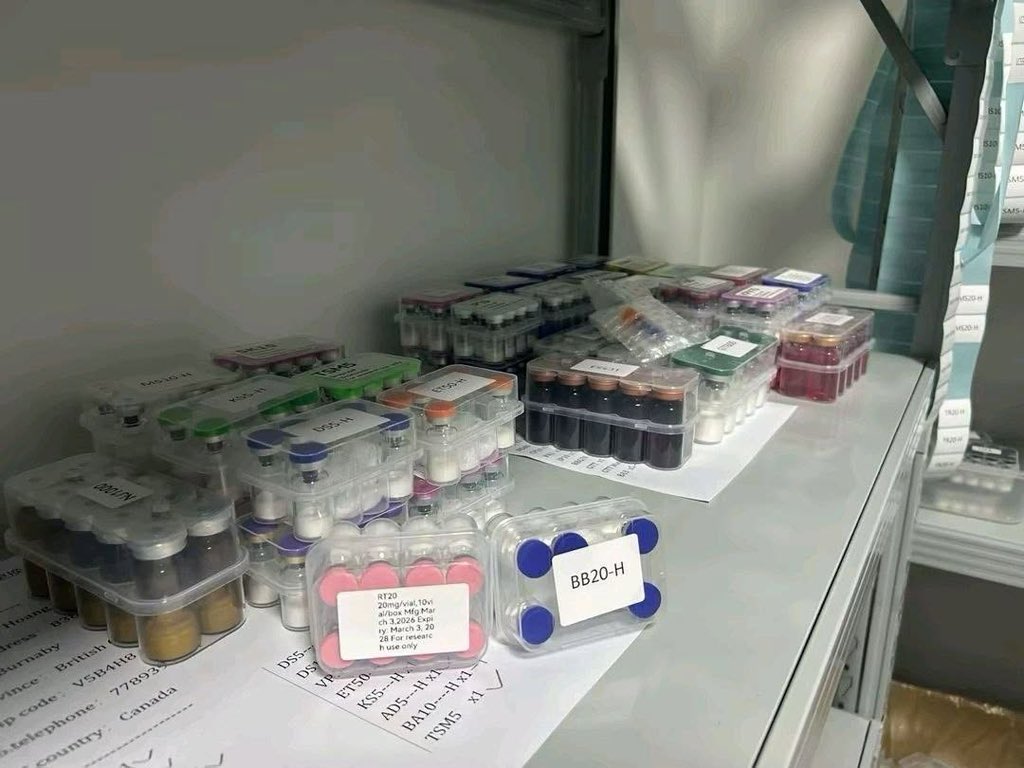
Precision starts with organization. Every vial is carefully stored, labeled, and managed to support consistent research workflows. Quality begins long before the lab bench. 🧪📦
#PeptideResearch #Laboratory #ResearchScience #Biotech #LifeScience #QualityControl #LabLife



t https://t.co/f3uRVerviA
#PeptideResearch #WeightLossResearch #Retatrutide #Tirzepatide #Semaglutide #Tesamorelin #GLP1 #Biotechnology #LifeScience #ResearchGuide #SinoPepLab #ScientificResearch #LaboratoryResearch #MedicalResearch
https://t.co/RrtJL3JNj9
The difference between overpaying and sourcing smartly is choosing the right supplier.
Direct peptide supply solutions with flexible order options.
Let's connect 📩
#Tirzepatide #GHKCu #PeptideResearch #Biotech #Supplier
Need a stable peptide supplier?
Looking for quality, consistency, and professional support?
Let's discuss cooperation opportunities.
#Tirzepatide #Retatrutide #PeptideResearch #Biotech #Supplier

MOPPIT: De Novo GENERATION OF MOTIF-SPECIFIC PEPTIDE BINDERS VIA CONDITIONAL UNIFORM DISCRETE DIFFUSION
Researchers have introduced moPPIt, a novel algorithm for the de novo generation of motif-specific peptide binders. This method is particularly significant as it can design peptides solely from the target protein sequence, without requiring prior structural information, addressing a critical bottleneck in therapeutic development, especially for intrinsically disordered proteins.
At its core, moPPIt integrates two key components: BindEvaluator and PepUDLM. BindEvaluator is a transformer-based model, trained on over 510,000 annotated protein-protein interactions, that accurately predicts binding sites and hotspots. It achieves high prediction accuracy, with AUC scores exceeding 0.96 when fine-tuned on peptide-protein pairs.
PepUDLM, a uniform diffusion language model, complements BindEvaluator by generating diverse and biologically plausible peptides. This model was trained on a comprehensive dataset of peptides, demonstrating superior performance in generating novel and varied sequences compared to other generative approaches.
The innovation of moPPIt lies in how BindEvaluator guides PepUDLM. By incorporating BindEvaluator's binding motif predictions into PepUDLM's sampling process, moPPIt ensures that the generated peptides are specifically tailored to target user-defined residues on proteins. This classifier-guided diffusion approach iteratively refines peptide sequences for high motif specificity.
The efficacy of moPPIt has been computationally validated on a diverse set of protein targets, including those with known peptide binders, as well as novel structured and intrinsically disordered proteins. Designed binders show comparable or even superior binding affinity and specificity, as indicated by ipTM scores, PeptiDerive relative interface scores, and AutoDock VINA visualizations.
This purely sequence-based approach enables the design of peptide therapeutics for targets previously considered "undruggable." moPPIt has the potential to accelerate drug discovery by facilitating the precise modulation of protein function in various diseases, including those driven by aberrant protein interactions.
📜Paper: https://t.co/hlBwf1zwoz
#ComputationalBiology #DrugDiscovery #PeptideDesign #ProteinEngineering #AIinScience #MachineLearning

To Fly, or Not to Fly, That Is the Question: A Deep Learning Model for Peptide Detectability Prediction in Mass Spectrometry
1.The study introduces Pfly, a novel deep learning model using an encoder-decoder architecture with an attention mechanism to predict peptide detectability in mass spectrometry (MS) based solely on peptide sequences.
2.Pfly was first trained on a large synthetic peptide library to capture fundamental peptide characteristics, then fine-tuned on biological datasets to reduce bias towards synthesizability and improve performance on real-world samples.
3.This fine-tuning significantly enhanced Pfly’s ability to distinguish peptides that are detectable (flyers) from non-detectable ones, achieving high accuracy, precision, recall, and AUC metrics, outperforming current state-of-the-art tools.
4.Unlike many existing predictors that require complex physicochemical features or struggle with usability, Pfly offers an accessible, customizable pipeline integrated into the DLOmix Python framework, enabling researchers to adapt the model easily to their own data and experimental conditions.
5.The model outputs both binary detectability classification and probabilistic scores across four flyer categories (non-, weak, intermediate, strong), allowing detailed insights into peptide behavior in MS.
6.Benchmarking against models like PepFormer, DeepMSPeptide, DeepDetect, and PeptideRanger showed Pfly’s superior predictive performance across multiple human and cross-species datasets, highlighting its robustness and generalizability.
7.The authors also investigate how factors such as protein abundance and search engine rescoring influence peptide detectability predictions, noting that low-abundance proteins may cause misclassifications due to concentration rather than peptide properties.
8.By providing a reliable tool that can be retrained or fine-tuned on lab-specific data, Pfly helps bridge the gap in peptide detectability prediction, facilitating improved peptide identification, experimental workflow optimization, and targeted MS analysis.
9.Pfly’s code and integration with DLOmix make it openly available for the proteomics community, supporting a wide range of applications from biomarker discovery to food safety and clinical research.
💻Code: https://t.co/Wj9UeJhjFq
📜Paper: https://t.co/6NI81I7Nlr
#proteomics #massspectrometry #deeplearning #computationalbiology #peptidedetectability #bioinformatics #machinelearning #proteomeresearch

How to generalize machine learning models to both canonical and non-canonical peptides
1. This paper presents a systematic evaluation of machine learning models for predicting peptide functions across both canonical and non-canonical peptides, addressing the challenge of generalization between these two classes.
2. It highlights the limitations of existing methods, which struggle to generalize from canonical peptide data to non-canonical peptides due to differences in structural diversity and limited data availability.
3. The authors introduce a novel approach that utilizes similarity-based dataset partitioning with MAPc and ECFP fingerprints for non-canonical peptides and MMSeqs2 for canonical peptides, optimizing data splits to ensure robust performance.
4. They find that fingerprint-based similarity measures, especially MAPc and ECFP, outperform traditional sequence alignment methods for partitioning canonical datasets, suggesting a shift from conventional practices.
5. To address the problem of representation, the study benchmarks several molecular representation methods, including Chemical Language Models (CLMs) like ChemBERTa-2 and Molformer-XL, protein language models like ESM2 and Prot-T5-XL, and molecular fingerprints like ECFP and PepFuNN.
6. Among all tested representations, general-purpose models like ChemBERTa-2 and Molformer-XL performed better than peptide-specific models such as PeptideCLM and Pepland, with ChemBERTa-2 showing the best generalization across both canonical and non-canonical datasets.
7. The authors demonstrate that training models solely on canonical or non-canonical data results in poor generalization to the other class. However, training on mixed datasets enables successful generalization with minimal performance loss.
8. Jointly trained models effectively generalize to both canonical and non-canonical peptides, even when the dataset is heavily imbalanced, suggesting that representation techniques can effectively bridge the gap between these two peptide classes.
9. The study concludes that ChemBERTa-2 is the most suitable representation technique for joint modeling and recommends further exploration of hybrid approaches combining different representation techniques for better performance.
10. The authors release benchmark datasets and partitioning schemes to aid future research on peptide representation learning.
💻Code: https://t.co/GlloLOMEnL
📜Paper: https://t.co/pafJZAhJHW
#PeptideModeling #MachineLearning #Bioinformatics #CanonicalPeptides #NonCanonicalPeptides #ChemBERTa #Generalization #MolecularRepresentations #PeptideRepresentationLearning


Have you heard about the ‘second brain’ of an animal? A beautiful article by @surojitsural from @Hobert lab shows how enteric nervous system (ENS) functions autonomously and also uses peptidergic signaling to carry out its job!
https://t.co/PZ7FmFv0Z3
Most Popular Users

Elon Musk 
@elonmusk
239.6M followers

Barack Obama
@barackobama
118.5M followers

Cristiano Ronaldo
@cristiano
114.3M followers

Donald J. Trump
@realdonaldtrump
111.7M followers

Narendra Modi
@narendramodi
106.9M followers

Rihanna
@rihanna
98.6M followers

NASA
@nasa
92.1M followers

Justin Bieber
@justinbieber
91.7M followers

KATY PERRY
@katyperry
89.9M followers

Taylor Swift
@taylorswift13
83.9M followers

Lady Gaga
@ladygaga
75.4M followers

Virat Kohli
@imvkohli
73.3M followers

Kim Kardashian
@kimkardashian
70.8M followers

YouTube
@youtube
68.6M followers

Neymar Jr
@neymarjr
66.3M followers

Bill Gates
@billgates
65.1M followers

Selena Gomez
@selenagomez
63M followers

The Ellen Show
@theellenshow
62.1M followers

CNN
@cnn
61.7M followers

X
@x
60.6M followers