

Top Tweets for #preclusi

TC/0006/12
"es incuestionable que la demanda que nos ocupa carece de objeto y de interés, porque resulta imposible evitar la ejecución de lo que ya fue ejecutado, sin violentar el principio de preclusión aludido."
su eventual suspensión no implicase violación al principio de preclusión"🧵2/2
TC/0006/12

Un Tribunal en defensa de los intereses de la autoridad.
La resolución alcanzada no da claridad, solo genera incertidumbre al gobernado y solapa la falta de cumplimiento de los plazos de la autoridad.
Pasando por alto la existencia de figuras como lo es la preclusión.

Hoy en el pleno jurisdiccional del @TFJAMexico se aprobó mi propuesta de resolución de contradicción de sentencias en materia de inmovilización de cuentas bancarias, que dará claridad a casos semejantes.


The Wrecking Ball continues with a swift SCOTUS blessing, a 5-4 Decision coming soon. (Executed by Russell Vought)
By Ann E. Marimow
Reporting from Washington
Dec. 8, 2025
The Supreme Court on Monday appeared poised to make it easier for President Trump to fire independent government officials despite laws meant to insulate them from political pressure in what would be a significant expansion of presidential power.
Hearing a case dealing with Mr. Trump's attempt to oust a member of the Federal Trade Commission, the court's conservative majority seemed ready to overturn or strictly limit a landmark decision from 1935. That precedent held that Congress could constrain the president's authority to remove certain executive branch officials.
Chief Justice John G. Roberts Jr., who is almost always in the majority in significant cases, said the F.T.C. opinion shielded 90 years ago looked nothing like the modern commission. Over time, he said, the commission has come to exercise significantly more executive power, an authority the Constitution generally reserves for the president. He referred to the 1935 precedent as “just a dried husk of whatever people used to think it was.”
Even as they appeared receptive to the Trump administration's maximalist position, several key justices seemed intent on making sure the court's eventual decision in this case did not threaten the independence of the Federal Reserve. The justices will hear a separate case dealing with Mr. Trump's attempt to fire a Fed governor in January.
The court's three liberal justices warned of the far-reaching consequences for the structure of the modern government if the majority sided with the Trump administration in the Federal Trade Commission matter.
A decision in the president's favor, they said, would call into question the constitutionality of job protections extended to leaders of more than two dozen other bipartisan commissions and boards. Congress intended to protect these agencies from partisan pressures and charged them with protecting consumers, workers, and the environment.
Justice Elena Kagan said such a ruling would “put massive, uncontrolled, unchecked power in the hands of the president.”
Justice Sonia Sotomayor told the administration's lawyer that "you're asking us to destroy the structure of government" and to "take away from Congress its ability to protect its idea that the government is better structured with some agencies that are independent.”
In response, D. John Sauer, the solicitor general, said that "the sky will not fall" if the justices give the president this new power. "In fact, our entire government will move toward accountability to the people,” he said.
Since returning to the White House, Mr. Trump has fired government watchdogs, leaders of independent agencies and rank-and-file federal workers, drawing multiple legal challenges.
The Supreme Court has generally allowed the firings to take effect through temporary emergency orders. Monday’s case presents the first opportunity for the court to issue a conclusive ruling on the underlying legal questions of Mr. Trump’s firings.
Next month, the justices will separately consider whether the president has the power to fire Lisa Cook, a Fed governor. The justices have allowed Ms. Cook to remain in her post for now, signaling that the central bank may be uniquely insulated from presidential interference because of its history.
At issue on Monday was Mr. Trump's firing in March of Rebecca Kelly Slaughter, a Democratic member of the F.T.C., who attended the argument and listened intently from the courtroom. Mr. Trump said he was removing her because she did not align with his agenda, despite a law that says the president can remove commissioners only for “inefficiency, neglect of duty or malfeasance in office.” Ms. Slaughter promptly sued.
Her lawyer, Amit Agarwal of Protect Democracy, told the justices on Monday that presidents of both parties had long accepted that F.T.C. commissioners could not be removed without good cause in part to ensure regulatory stability.
“Folks in power today may not be in power tomorrow, and you want a structure that will be able to withstand the test of time,” Mr. Agarwal said. He added,
“Presidents have understood and appreciated the vital interests of the American people can be served by having constraints on the exercise of power.”
Congress intentionally created such bipartisan commissions — composed of experts who could not be fired by the president without cause — to ensure that policy decisions would be made free of politics.
The F.T.C., created in 1914, protects consumers from deceptive practices and from the abuse of monopoly power. It is led by five commissioners who serve staggered seven-year terms; no more than three can be members of the same party.
Only Republicans have led the F.T.C. since March, after Mr. Trump fired a second Democrat, Alvaro Bedoya. After initially challenging his firing, Mr. Bedoya resigned, citing financial pressures.
A district court judge said in July that Ms. Slaughter's firing was illegal. In early September, a divided court panel of the U.S. Court of Appeals for the District of Columbia Circuit reinstated her. The panel pointed to the job protections upheld by the 1935 decision that also involved a fired F.T.C. commissioner.
In that decision, Humphrey's Executor v. U.S., the Supreme Court unanimously upheld removal restrictions for government officials on multimember boards. The justices in that case said President Franklin D. Roosevelt could not remove a member of the F.T.C. merely because of political differences.
But over the last 15 years, the court has repeatedly narrowed that decision, giving the president greater control over executive officials.
The court found in 2020 that the Consumer Financial Protection Bureau's structure was unconstitutional because it did not allow the president to fire its single director without cause. The court permitted the job protections to remain for multimember bodies like the F.T.C.
But in its emergency orders issued this year, the conservative majority has allowed the president to temporarily remove leaders of agencies headed by such multimember boards, including the National Labor Relations Board, the Merit Systems Protection Board, and the Consumer Product Safety Commission.
As a result, Mr. Sauer told the justices that the precedent at issue “stands as an indefensible outlier” and must be overruled. “It continues to tempt Congress to erect at the heart of our government a headless fourth branch insulated from political accountability and democratic control," he said.
Throughout the lively two-hour argument, the justices appeared divided along ideological lines, with questions that underscored their starkly different visions of the president's powers and the roles and histories of independent agencies.
Liberal justices pointed to recent historical scholarship showing that Congress has long had the power to devise such agencies and fill them with nonpartisan experts.
"Congress is saying expertise matters,” Justice Ketanji Brown Jackson said. “So having a president come in and fire all the scientists and the doctors and the economists and the Ph. D.s, and replacing them with loyalists and people who don't know anything, is actually not in the best interest of the citizens of the United States.”
Conservative justices, in turn, expressed concern about independent agencies exercising vast power over individuals and billion-dollar industries without being accountable to the president, who has authority over the executive branch.
“I think broad delegations to unaccountable independent agencies raise enormous constitutional and real-world problems for individual liberty,” Justice Brett M. Kavanaugh said.
But it was unclear exactly how the court's eventual decision would affect agencies beyond the F.T.C. Several justices, including Neil M. Gorsuch and Chief Justice Roberts, were critical of the reasoning in the 1935 decision, which addressed the trade commission specifically. But, the chief justice said, that does not mean that “the other agencies fall with it as well.”
Still, if the administration prevails, Mr. Agarwal said, “everything is on the chopping block" — a warning that would include the independence of the Federal Reserve.
Justice Samuel A. Alito Jr. pushed back on claims that the Trump administration's legal arguments would lead to “revolutionary results.” Justice Kavanaugh more than once suggested that the court would carve out an exception to preserve the independence of the Federal Reserve based on the central bank's history.
There were echoes on Monday of the Supreme Court's ruling last year in another major case involving Mr. Trump. The conservative majority's decision in Trump v. United States gave the president immunity from prosecution for his official actions. But the administration relied on it throughout the argument to bolster its expansive view of presidential power.
Justice Clarence Thomas asked the solicitor general whether there were any limits on the president's authority to fire leaders of multimember commissions even for arbitrary reasons.
Mr. Sauer responded by invoking the immunity decision.
"No," he said. "This court in Trump against United States held that the president's power to remove officers wielding the executive power is conclusive and preclusive.”
Abbie VanSickle and Aishvarya Kavi contributed reporting.
Ann Marimow covers the Supreme Court for The Times from Washington.

#RepostandRetweet
💙💦🌊💎
It's all happening. A must watch from of a speech from Kamala Harris at the White House, our @VP , while still on the campaign trail.
More so, and again, that is why, need we say it again, @VP , is possibly the most qualified and experienced person, with the necessary temperament and fortitude to be next the President of the United States.
And for what's it's worth, in the author's view, despite whatever October surprise may lay in wait, and after this cycle, what could it possibly be (which we have not seen already), there remains only one conclusive (and preclusive) candidate, @VP .
https://t.co/tFBcEx9Iq6
https://t.co/HrRrNGDqRS #OpportunityEconomy #VoteHarrisWalz2024 #VoteHarrisWalzToMoveForward #VoteBlue2024ProtectWomensRights #StopProject2025

Our hearts 🥹
It's all happening. A must watch from of a speech from Kamala Harris at the White House, our @VP, while still on the campaign trail.
And that is why, need we say it again, @VP, is possibly the most qualified and experienced person, with the necessary temperament and fortitude to be next the President of the United States.
And for what's it's worth, in the author's view, despite whatever October surprise may lay in wait, and after this cycle, what could it possibly be (which we have not seen already), there remains only one conclusive (and preclusive) candidate, @VP.
https://t.co/tFBcEx9aAy
https://t.co/HrRrNGCT2k #OpportunityEconomy #VoteHarrisWalz2024 #VoteHarrisWalzToMoveForward #VoteBlue2024ProtectWomensRights #StopProject2025

Happening Now: @POTUS and I are delivering remarks on our continued work to address the epidemic of gun violence in America. https://t.co/p8TziWHc9t
It's all happening. A must watch from Kamala Harris
@VP, campaign.
And that is why, need we say it again, @VP is possibly the most qualified and experienced person, with the necessary temperament and fortitude to be next the President of the United States.
And for what's it's worth, in the author's view, despite whatever October surprise may lay in wait, and after this cycle, what could it possibly be (which we have not seen already), there remains only one conclusive (and preclusive) candidate, @VP.
https://t.co/tFBcEx9aAy
https://t.co/HrRrNGCT2k #OpportunityEconomy #VoteHarrisWalz2024 #VoteHarrisWalzToMoveForward #VoteBlue2024ProtectWomensRights #StopProject2025

I’m in Douglas, Arizona to speak about what is at stake in this election. Tune in. https://t.co/5g17DJfEvG
It's all happening. A must watch from @askDinaDollc from @MeidasTouch.
And that is why, Kamala Harris @VP, need we say it again, is possibly the most qualified and experienced person, with the necessary temperament and fortitude to be next the President of the United States.
And for what's it's worth, in the author's view, despite whatever October surprise may lay in wait, and after this cycle, what could it possibly be (which we have not seen already), there remains only one conclusive (and preclusive) candidate, @VP.
https://t.co/tFBcEx9Iq6
https://t.co/HrRrNGDqRS
#OpportunityEconomy
#VoteHarrisWalz2024 #VoteHarrisWalzToMoveForward #VoteBlue2024ProtectWomensRights #StopProject2025
Kamala hits Trump WHERE IT HURTS…his tiny crowd SIZE https://t.co/mezG1eD03F via @YouTube

@stevenromero2 No hay regulación expresa; pero EGCAP Ley80-1993-Art 25inciso1, establece q términos en procesos cttles son➡️"preclusivos y perentorios". Con base en ese principio se puede poner regla en Pliego d Condiciones; eso sí, debe ser proporcional a la dificultad de pliego Art.# 2 Ley 80

@quantum1nvestor Thank you. That doesn’t include the actual SOW though. Would love to see preclusions in place for any M&A. Understood on inferring if they’re part of variable future profits it would make sense even if legally they aren’t prohibited, why RC would wait!

PRECLUSIÓN. 129 CFF
Sólo para informarles que ya se encuentra disponible el engrose del juicio de nulidad: 1770/20-12-02-4/1067/23-PL-04-04.
Donde la SSUP del @TFJAMexico analizó la preclusión del artículo 129 del CFF:
PRECLUSIÓN. 129 CFF
Sólo para informarles que ya se encuentra disponible el engrose del juicio de nulidad: 1770/20-12-02-4/1067/23-PL-04-04.
Donde la SSUP del @TFJAMexico analizó la preclusión del artículo 129 del CFF: https://t.co/9a6IZuOu1N

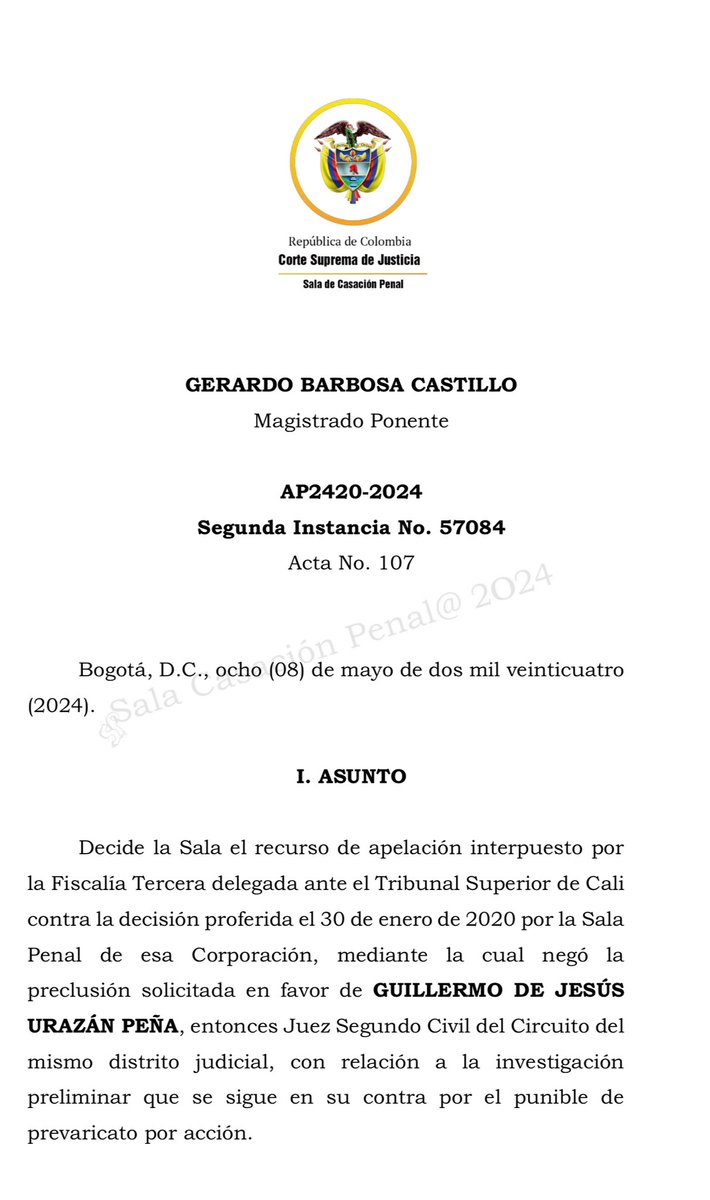
SALA CASACION PENAL @CorteSupremaJ
MP GERARDO BARBOSA CASTILLO
RADICADOAP2420-2024
FECHA08 MAYO 2024
@rojaspovedacons @CPenalistas
Importante decisión de la @CorteSupremaJ relacionada con los aspectos generales de la preclusión. La causal por atipicidad del hecho investigado.
La preclusión de la investigación es una institución que permite la terminación del proceso sin el agotamiento de todas sus etapas, ante la ausencia de mérito para sostener una acusación. Implica la adopción de una decisión definitiva por parte del juzgador cognoscente, cuyo efecto es el de cesar la persecución penal contra el implicado respecto de los hechos objeto de investigación, por ende, se encuentra investida de la fuerza vinculante de la cosa juzgada.
Lo anterior significa que la solicitud de preclusión no sólo debe precisar con rigor la causal a la cual se acude, sino que ha de ofrecer suficientes elementos argumentales y probatorios que permitan al juez de conocimiento llegar a un estado de convicción tal, que no admitan algún resquicio de duda sobre la efectiva ocurrencia de la causal invocada. Dicho de otra manera, que respecto de ella no «exista duda o posibilidad de verificación contraria con un mejor esfuerzo investigativo»
En cuanto al evento invocado en este asunto por la Fiscalía, esto es, el previsto en el numeral cuarto del artículo 332 del Estatuto Procesal Penal, el legislador estableció como causal de preclusión de la investigación la «atipicidad del hecho investigado» sin distinguir entre las dos aristas que componen el tipo penal, de ahí que la Sala haya sostenido en forma reiterada y uniforme que ambas categorías –la atipicidad objetiva y la subjetiva– pueden ser alegadas como soporte de preclusión. https://t.co/axpoAi9fZi
Trends for you
Most Popular Users

Elon Musk 
@elonmusk
239.7M followers

Barack Obama
@barackobama
118.6M followers

Cristiano Ronaldo
@cristiano
114.3M followers

Donald J. Trump
@realdonaldtrump
111.7M followers

Narendra Modi
@narendramodi
106.9M followers

Rihanna
@rihanna
98.6M followers

NASA
@nasa
92.1M followers

Justin Bieber
@justinbieber
91.7M followers

KATY PERRY
@katyperry
89.9M followers

Taylor Swift
@taylorswift13
83.9M followers

Lady Gaga
@ladygaga
75.4M followers

Virat Kohli
@imvkohli
73.3M followers

Kim Kardashian
@kimkardashian
70.8M followers

YouTube
@youtube
68.6M followers

Neymar Jr
@neymarjr
66.3M followers

Bill Gates
@billgates
65.1M followers

Selena Gomez
@selenagomez
63M followers

The Ellen Show
@theellenshow
62.1M followers

CNN
@cnn
61.7M followers

X
@x
60.6M followers