

Top Tweets for #propagatio

More stuff ready to pot up from the propagation box. Rooted in sphagnum, which is slowly reviving; you can see a bit of green in one spot. I'm going to save those & raise my own live sphagnum.
Top: Impatiens rothii. From Ethiopia. Not as vigorous as my I. tinctoria.
Bottom: Fuchsia regia. Big clambering species from Brazil.
I saw videos claiming sphagnum was a good rooting medium. Tried it & agree. The balance of air-to-moisture is good.


@AyushPareek2025 Good explanation of the 4-second deadline. Block propagation doesn't get enough attention.

BioEmu2: Scalable Emulation of Biomolecular Dynamics
1 BioEmu2 is an atomically resolved generative model that unifies three tasks in one framework: static structure prediction, equilibrium ensemble sampling, and time propagation to emulate long-timescale biomolecular dynamics—sampling orders of magnitude faster than conventional MD.
2 A key design choice is to learn both an equilibrium distribution pθ(x) (trained from explicit-solvent Amber MD at 300K, 1 atm with solvent marginalized out) and a conditional transition model pθ,τ(xt+τ | xt), so the same network can generate independent equilibrium draws or roll out trajectories via repeated endpoint sampling.
3 Unlike earlier BioEmu (single-protein) and many ensemble/dynamics models that are coarse-grained or limited in scope, BioEmu2 targets multi-component all-heavy-atom systems: proteins, DNA/RNA, modified residues, ligands, lipids, and ions, using a mixed tokenization (polymer residues as tokens; ligands/modified residues often one token per heavy atom).
4 In structure prediction mode, BioEmu2 reports accuracy competitive with leading open-weight co-folding baselines on FoldBench and Runs N’ Poses, including protein–protein interfaces and protein–ligand bound pose prediction, while not relying on confidence heads for ranking (best-of-five oracle evaluation).
5 Scalability is addressed with context parallelism that shards pair representations across multiple GPUs, enabling inference for very large assemblies (reported up to ~16,000 residues). For multi-thousand-residue complexes, BioEmu2 can preserve local accuracy and global organization, and can be “rescued” by minimal experimental hints: even a single inter-chain contact constraint can drastically improve a failed complex prediction.
6 In equilibrium sampling mode, BioEmu2 is evaluated by comparing free-energy surfaces projected onto the slowest MD modes (TICA). Across tested proteins/complexes it achieves free-energy errors around ~0.7–1.2 kcal/mol on metastable-state populations and substantial state coverage (often ~50% of MD states for proteins/complexes; >100% relative coverage for some protein–ligand cases).
7 The paper emphasizes functional ensemble shifts rather than single structures, illustrated with adenylate kinase: switching from “structure prediction” to “equilibrium” broadens the distribution, and adding ligands shifts populations toward closed-like conformations consistent with known apo/holo references.
8 For dynamics/kinetics, BioEmu2 evaluates autocorrelation decay along MD-derived slow coordinates (TICA ICs) across 78 systems (CATH domains, PDBbind protein–ligand, heterodimers). The learned dynamics often match MD decorrelation on ~100 ns scales, but sometimes relax too fast; the authors flag slow kinetics as still experimental and requiring more validation/data.
9 Long-lag rollouts demonstrate mechanistic hypotheses: (i) ligand-coupled closure of adenylate kinase where ATP·Mg2+ and AMP binding precede domain closure, with a substantial fraction of trajectories closing only in the ligand-present condition; (ii) coupled folding-and-binding of disordered PUMA to MCL-1 where many trajectories pass through a non-native helical intermediate before snapping into the native register.
10 Inference-time control is a core feature: trunk-level contact conditioning provides soft constraints, while diffusion-time steering applies user-defined bias potentials. Physicality steering reduces stereochemical/pathology rates (notably for nucleic acids) with limited impact on accuracy, and enhanced sampling (TDS + MBAR reweighting) is used to increase rare-state coverage and estimate unbiased statistics of the learned base ensemble.
📜Paper: https://t.co/FYs5XKvxIB
#ComputationalBiology #MolecularDynamics #GenerativeModels #DiffusionModels #ProteinStructure #ProteinLigand #Biophysics #FreeEnergy #Kinetics #StructuralBiology


@get_optimum What started as a handful of node operators running a new block propagation protocol has already grown into something that covers a meaningful share of staked ETH. The numbers coming out of it are hard to ignore. Blocks are arriving faster and more consistently. Wrong head…

There's a new fast block propagation protocol in town, and the Ethereum ecosystem is starting to take notice. @ethdaily 👀
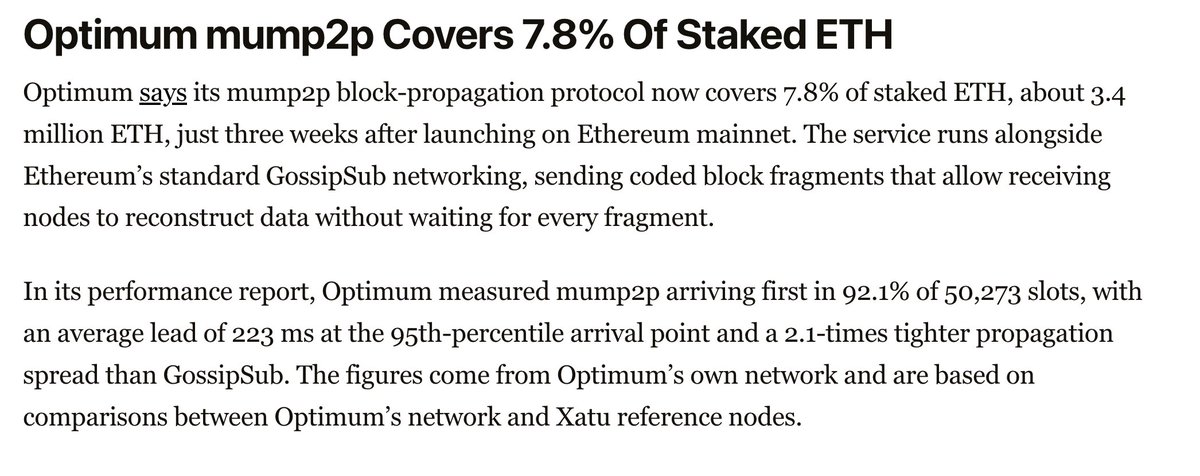

Speed is becoming an economic advantage on Ethereum. ⚡️
That’s the part of optimum I find most interesting.
Better propagation, better efficiency, and potentially more value captured by validators.
The infrastructure layer deserves way more attention.


Validator economics go far beyond hardware and uptime.
On Ethereum, the speed of information flow can matter just as much.
That’s what makes @get_optimum so intriguing.
Its mump2p networking layer uses network coding alongside GossipSub to move blocks faster and with less variance.
For validators, that can mean:
→ Hitting attestation deadlines more consistently
→ Reducing the impact of propagation delays
→ Giving proposers more time to capture competitive MEV bids
And this is the part I find most interesting:
Milliseconds can translate into economics.
As Ethereum continues to scale, the networking layer won’t just be background infrastructure.
It’s becoming a real competitive edge for validators.
Faster propagation. Better efficiency. More room for validator economics to work in your favor.


Germination and Propagation!


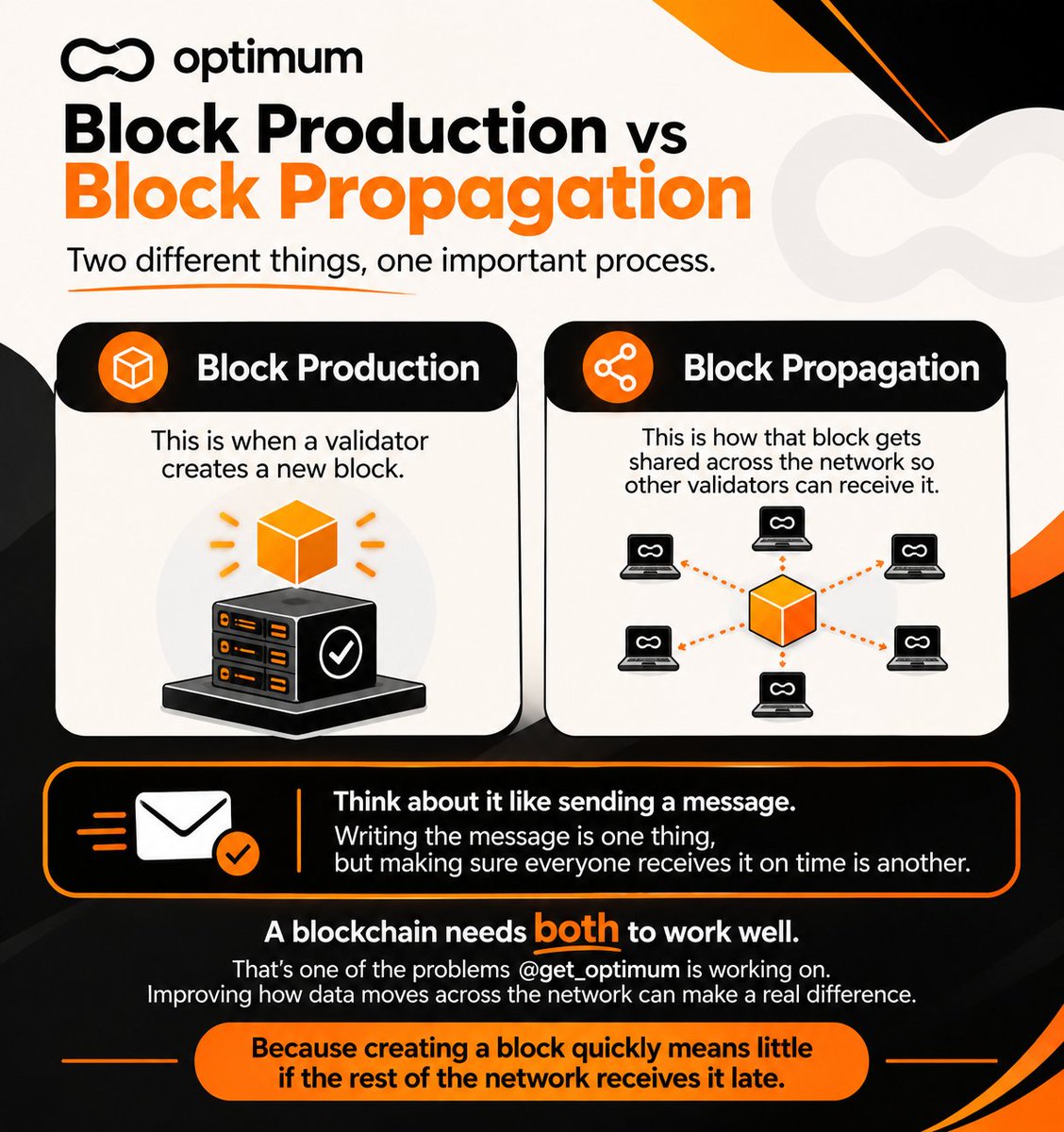
Block production and block propagation are two different things.
Block production is when a validator creates a new block.
Block propagation is how that block gets shared across the network so other validators can receive it.
Think about it like sending a message. Writing the message is one thing, but making sure everyone receives it on time is another.
A blockchain needs both to work well.
That's one of the problems @get_optimum is working on. Improving how data moves across the network can make a real difference.
Because creating a block quickly means little if the rest of the network receives it late.

Gmum
The Economics of Faster Block Propagation ⚡
Ethereum's performance depends on more than transaction execution. How quickly block data reaches validators across the network also plays an important role.
A recent research spotlight by @DefiLlama explores how @get_optimum is improving Ethereum's block propagation through mump2p, and why these improvements could have an economic impact.
Here are some interesting findings from the research.
1. Faster block delivery with mump2p
Optimum's mump2p uses Random Linear Network Coding (RLNC) to make data propagation more efficient.
Rather than simply forwarding individual packets, nodes exchange coded combinations of data. Receivers can then reconstruct the original data after collecting enough independent packets.
According to the research, mump2p accelerated block delivery in 91.6% of observed slots between November 4–11.
The measured propagation spread was:
• mump2p: 181.8ms
• libp2p: 388.8ms
That's a substantial difference in how quickly block data propagates across the network.
2. Improving validator performance
Block arrival time matters for Ethereum validators.
When a validator receives block information late, it may vote for an outdated chain head, resulting in a wrong head vote.
Optimum's Impact Report recorded an average 34.3% reduction in wrong head votes across participating operators between its two measurement periods.
This highlights how better network propagation can help validators make more timely decisions.
3. The economic impact on block proposers
One of the most interesting parts of the research focuses on MEV-Boost.
Block proposers face a trade-off: publish a block early to give it enough time to propagate, or wait longer to potentially receive better builder bids.
Faster propagation can give proposers more flexibility.
In six mainnet experiments, blocks could be published approximately 160ms later without an increase in orphaned blocks.
Based on these experiments, Optimum modelled a potential 8.4% uplift in builder bids.
This is a modelled opportunity, not a guaranteed increase in proposer revenue.
4. Growing network participation
The research also highlights the growth of stake connected to Optimum's network.
Connected stake increased from approximately 1.42 million ETH at launch to 3.44 million ETH by November 10, representing around 7.9% of Ethereum's staked ETH.
Operators including https://t.co/oWPLuAEOe8, Blockdaemon, Everstake and https://t.co/5csbL0n05V are among those participating.
The bigger picture
What makes this research interesting is the connection between networking infrastructure and Ethereum's economics.
Better block propagation isn't just about making data travel faster. It can influence validator performance, give block proposers more flexibility and potentially create better economic opportunities.
These improvements happen beneath the surface of Ethereum, but their impact can extend across the entire ecosystem.
It's worth taking a closer look at what Optimum is building.
Full research by DeFiLlama:
https://t.co/pFJQ2AS4pc
@get_optimum
@discordflash
@CryptoSundayz
@tgogayi
@aqccapital
@TheBl0ckBoy
@ada_pegasus

The @defillama_res team with a great look at the performance, adoption, and economic benefits of mump2p. 👇

Ethereum's next big improvement might not come from processing more transactions. It could come from getting information across the network faster.
That's the idea behind @get_optimum , which is building a complementary block propagation network designed to make Ethereum faster and more efficient without changing its consensus protocol.
Its mump2p technology uses Random Linear Network Coding (RLNC) to distribute block information through multiple paths, helping validators receive blocks earlier and more consistently.
The early numbers are worth paying attention to:
• Connected stake grew from 1.42M ETH at launch to 3.44M ETH by November 10.
• That's approximately 7.9% of Ethereum's total staked ETH.
• Block delivery was accelerated in 91.6% of measured slots.
• Network propagation spread narrowed from 388.8ms with Ethereum's existing gossip network to 181.8ms with mump2p.
But the interesting part goes beyond speed.
Earlier block delivery can help validators make more accurate attestations, reduce missed rewards and give block proposers more time to evaluate competitive builder bids.
Optimum is also exploring applications beyond Ethereum staking, including professional trading environments where milliseconds can make a meaningful difference.
Ethereum's infrastructure isn't just about how quickly transactions are processed, it's also about how efficiently information moves.
Optimum is working on a part of that infrastructure that deserves more attention.


@jaymieolamide @get_optimum Faster block propagation lifts everyone, even nodes sitting outside the relay.


@jaymieolamide @get_optimum Faster block propagation can benefit the entire Ethereum network, not just those running mump2p.


@jaymieolamide @get_optimum The goal is to make Ethereum block propagation faster across the network.

@jaymieolamide @get_optimum The real innovation is how better block propagation can benefit the entire network.


@jaymieolamide @get_optimum The spillover benefit is compelling; faster block propagation can improve conditions beyond direct users.

@jaymieolamide @get_optimum Optimum’s mump2p highlights how infrastructure improvements can create benefits beyond direct users, making Ethereum block propagation faster across the network.


@0xvashisht777 Faster propagation, better performance

@aysho_M faster data propagation can make a real difference for validator performance

@aysho_M faster data propagation can make a real difference for validator performance

@Rausyan1995 @GenLayer Running my own validator usually means dealing with DNS propagation issues on day one. Having the foundation back the initial set while we calibrate our bare metal setups is a massive UX upgrade.

oRPC v2.0.0-beta.49 is out
• Boolean-or-object options replace { enabled }
• Per-direction trace propagation
• Streamed queries keep data on refetch and settle on first data for SSR
• Default fetch links redirect behavior

Most Popular Users

Elon Musk 
@elonmusk
239.8M followers

Barack Obama
@barackobama
118.6M followers

Cristiano Ronaldo
@cristiano
114.3M followers

Donald J. Trump
@realdonaldtrump
111.7M followers

Narendra Modi
@narendramodi
106.9M followers

Rihanna
@rihanna
98.6M followers

NASA
@nasa
92.1M followers

Justin Bieber
@justinbieber
91.7M followers

KATY PERRY
@katyperry
89.9M followers

Taylor Swift
@taylorswift13
83.9M followers

Lady Gaga
@ladygaga
75.4M followers

Virat Kohli
@imvkohli
73.3M followers

Kim Kardashian
@kimkardashian
70.8M followers

YouTube
@youtube
68.6M followers

Neymar Jr
@neymarjr
66.3M followers

Bill Gates
@billgates
65.1M followers

Selena Gomez
@selenagomez
63M followers

The Ellen Show
@theellenshow
62.1M followers

CNN
@cnn
61.7M followers

X
@x
60.6M followers