

Top Tweets for #quantummachinelearning

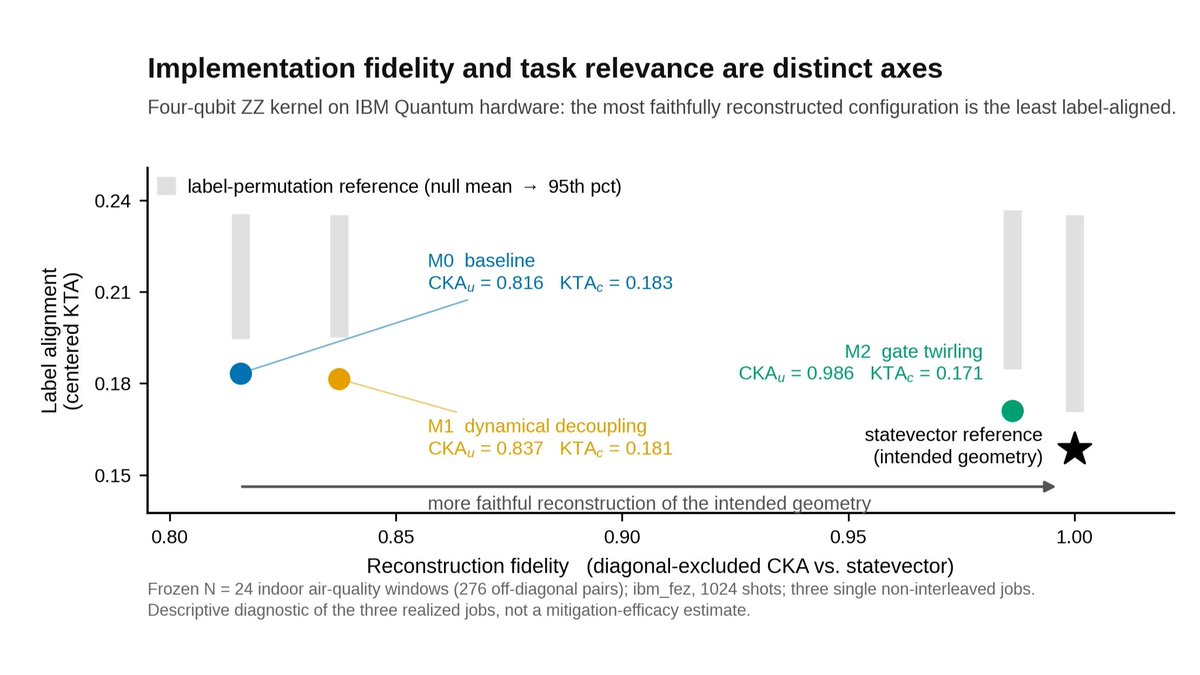
📄 Statevector-to-Hardware Reconstruction of a Four-Qubit ZZ Quantum Kernel: A Single-Backend Case Study of Three Execution Jobs
✍️ Rostyslav Sipakov
🔍 https://t.co/qUsil2ffm3
#QuantumComputing #QuantumMachineLearning #IBMQuantum #QuantumKernels #QuantumHardware
📄 Multi-Solution Ternary Grover’s Algorithm for Logic-Based Quantum Machine Learning with Pseudo-Kronecker Reed–Muller Form Minimization
✍️ Authors: Sophia Lee, et al
🔗 Read the full article: https://t.co/ZClqlQI35D
#QuantumComputing #QuantumMachineLearning


Preprint alert!
We show that representations based on one-electron integrals, eg the kinetic energy matrix, can effectively predict materials properties.
Preprint https://t.co/Ifs2zg4Oil
Code https://t.co/31cmdHcJNT
#AIforMaterials #QuantumMachineLearning #ChemicalAI

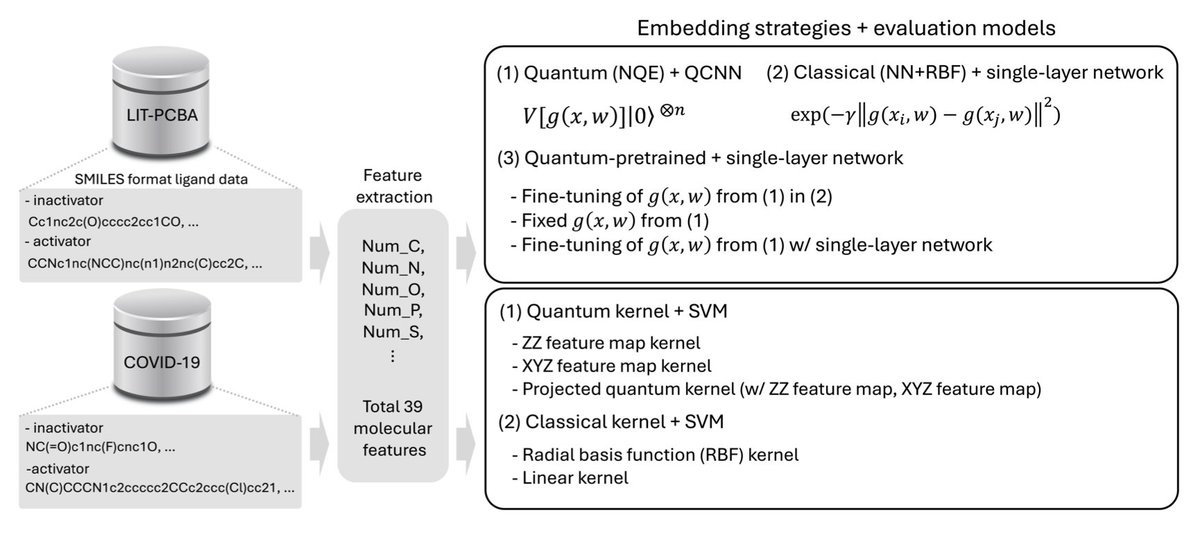
Optimizing Quantum Data Embeddings for Ligand-Based Virtual Screening
1. A new study explores how quantum data embeddings can enhance ligand-based virtual screening, a crucial step in early-stage drug discovery. The research leverages quantum-classical hybrid approaches, combining neural networks with quantum circuits to create more expressive molecular representations.
2. The study evaluates various embedding strategies on two benchmark datasets: LIT-PCBA and COVID-19. Notably, quantum and hybrid embedding methods consistently outperform classical baselines, especially in limited-data and class-imbalanced scenarios, highlighting their potential for more efficient and accurate virtual screening.
3. A key innovation is the use of Neural Quantum Embedding (NQE), which optimizes the embedding process through kernel-target alignment. This method significantly improves the trace distance between quantum states of different classes, enhancing the model's ability to distinguish between activators and inactivators.
4. The research also introduces quantum-pretrained classical embeddings, where neural networks trained with NQE are fine-tuned or transferred to classical models. This hybrid approach leverages the strengths of both quantum and classical computing, offering further improvements in classification performance.
5. For the COVID-19 dataset, the study employs quantum kernels derived from ZZ and XYZ feature maps, demonstrating superior performance compared to classical SVMs. The projected quantum kernel (PQK) further enhances classification accuracy, showcasing the power of quantum embeddings in handling complex biological data.
6. The findings suggest that optimized quantum embeddings could become valuable tools in drug discovery pipelines, bridging the gap between quantum-enhanced representation learning and practical virtual screening applications. Future work may focus on hardware-aware designs and deeper insights into the relationship between quantum embeddings and molecular structures.
📜Paper: https://t.co/89FaUomqER
💻Code: https://t.co/PTDQe4sMpB
#QuantumMachineLearning #DrugDiscovery #VirtualScreening #QuantumComputing #HybridModels
Quantum-Classical Hybrid Molecular Autoencoder for Advancing Classical Decoding
1. A novel study introduces a quantum-classical hybrid molecular autoencoder (QCHMAE) that integrates quantum encoding with classical sequence modeling to enhance SMILES string reconstruction. This innovative approach achieves a quantum fidelity of approximately 84% and a classical reconstruction similarity of 60%, significantly surpassing existing quantum baselines.
2. The proposed QCHMAE framework employs a Word2Ket embedding layer to encode SMILES tokens into continuous quantum-inspired vectors using tensor-train decomposition. This embedding method captures quantum-like entanglement patterns between distant tokens, outperforming traditional embedding techniques in expressivity.
3. The quantum autoencoder within the framework compresses essential information into a lower-dimensional latent space, preserving quantum information during encoding and decoding. The fidelity between the initial and reconstructed quantum states is carefully computed to ensure the integrity of quantum information.
4. An attention-enhanced Long Short-Term Memory (LSTM) decoder is used to reconstruct the SMILES strings. This decoder leverages both quantum-processed features and a self-attention mechanism to model the sequential dependencies in the SMILES string, effectively bridging quantum representations with classical sequence generation.
5. The hybrid molecular autoencoder is optimized end-to-end in an unsupervised manner using a composite loss function that balances quantum fidelity, cross-entropy for sequence reconstruction, Levenshtein similarity for SMILES string alignment, and a penalty for trash qubit deviation. This ensures the preservation of quantum information while improving classical reconstruction accuracy.
6. Experiments conducted on the QM9 dataset demonstrate the effectiveness of the proposed framework. The results show that quantum fidelity increases steeply and stabilizes above 80%, while SMILES similarity improves around 60%. The model’s capability to quickly learn quantum representations and progressively enhance classical reconstruction accuracy is highlighted.
7. The study concludes that the hybrid architecture offers a promising foundation for future QML applications in molecular and drug discovery. The integration of quantum feature processing with classical decoding shows significant potential for improving molecular representation and sequence reconstruction.
📜Paper: https://t.co/qWTTdLLp9C
#QuantumMachineLearning #MolecularAutoencoder #SMILESReconstruction #HybridArchitecture #DrugDiscovery #QuantumClassicalHybrid #MolecularRepresentation

Encoding Molecular Structures in Quantum Machine Learning
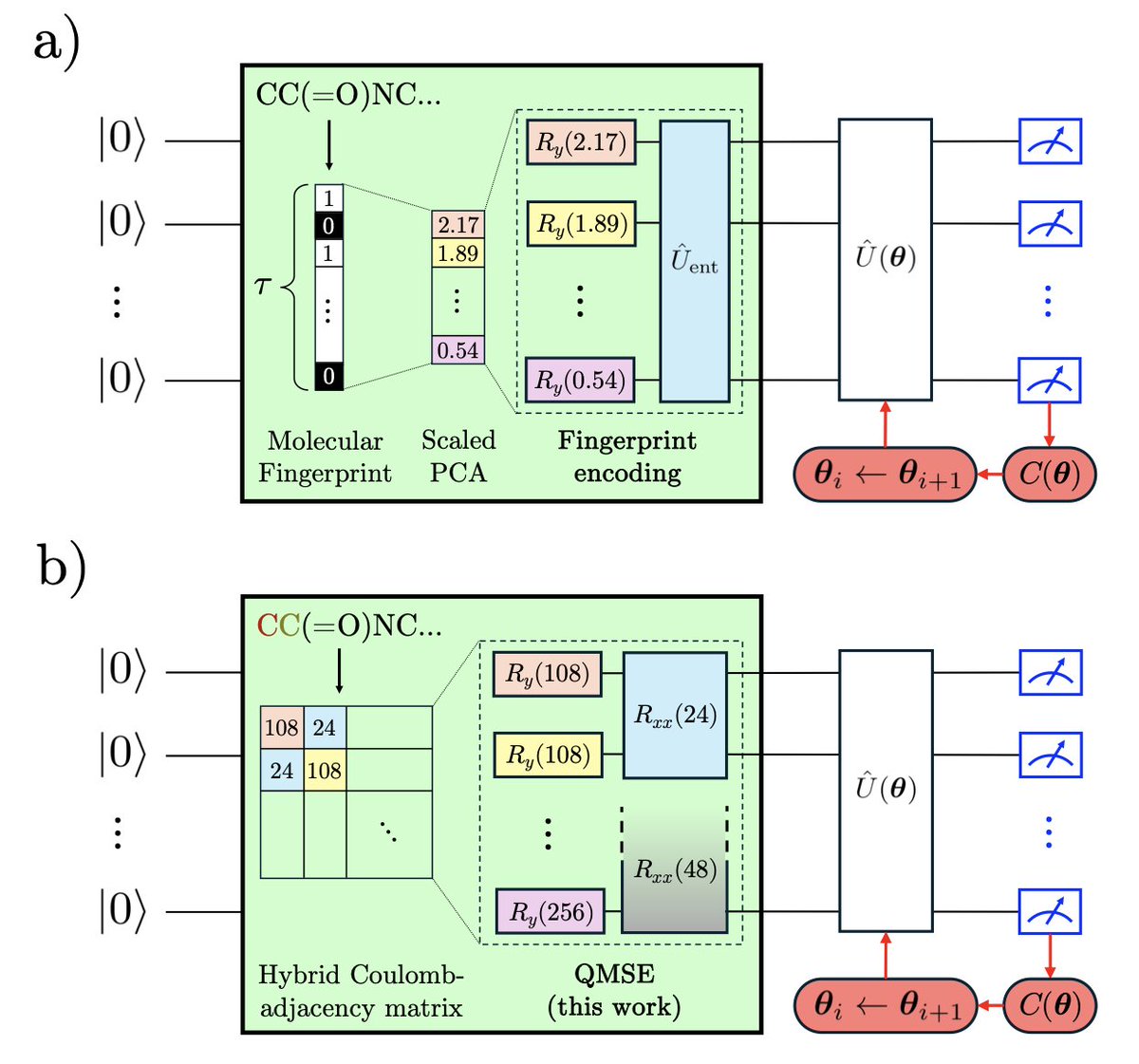
1. A new quantum machine learning (QML) method called Quantum Molecular Structure Encoding (QMSE) has been introduced, which efficiently encodes molecular bond orders and interatomic couplings into quantum circuits. This method significantly improves state separability between encoded molecules compared to traditional fingerprint encoding schemes.
2. QMSE uses a hybrid Coulomb–adjacency matrix to represent molecular structures, directly mapping them into one- and two-qubit rotations within parameterised circuits. This approach enhances the interpretability and trainability of QML models, crucial for practical applications in chemistry.
3. The authors demonstrate QMSE's effectiveness through benchmarking on molecular datasets, showing superior performance in classification and regression tasks. They also prove a fidelity-preserving chain-contraction theorem that reduces qubit counts by reusing common substructures, making it scalable for large molecules.
4. QMSE addresses key challenges in QML, such as state separation, trainability, and resource efficiency. It provides a structured and modular encoding strategy, inspired by classical large language models, which is particularly useful for small-dataset regimes typical in chemical screening.
5. The study highlights QMSE's potential for practical QML applications, especially in domains like quantum chemistry, material science, and drug discovery. Future work includes extending QMSE to other data structures and optimizing QML algorithms for better performance on early fault-tolerant quantum hardware.
📜Paper: https://t.co/m56QmeGbsq
#QuantumMachineLearning #QMSE #MolecularEncoding #QuantumComputing #Chemistry #DrugDiscovery
Quantum Ensembling Methods for Healthcare and Life Science
1.This study investigates how quantum ensemble models perform in data-scarce biomedical scenarios, showing promising results on synthetic and real-world gene expression datasets related to immunotherapy response in renal cell carcinoma (RCC).
2.The authors demonstrate that certain quantum ensemble methods can match or slightly outperform classical random forests (RF), particularly in small sample settings—a critical advantage in healthcare and life sciences where labeled data is often limited.
3.They evaluate two families of quantum ensemble models: (1) ensembles of quantum cosine classifiers (QCC, QEC, QECRU) and (2) variational quantum ensembles using soft voting, bagging, and boosting strategies.
4.A major innovation is the quantum ensemble cosine classifier (QEC), which leverages quantum superposition to average predictions across multiple randomly sampled transformations of training data, using as few as 2 training samples and 7–23 qubits.
5.The QEC achieves performance comparable to RF in synthetic datasets and slightly better F1 scores in some RCC dataset configurations, while using significantly fewer trainable parameters and samples.
6.Variational quantum ensembles, though more resource-intensive to train, also match or exceed classical RF in several tasks, with bagging variational classifiers achieving the highest F1 score (0.81) on the full RCC dataset.
7.They also explore a random unitary variant (QECRU), which avoids assumptions on sampling transformations, achieving similar accuracy to QEC but with better Brier scores, hinting at improved probabilistic calibration.
8.Preliminary hardware experiments were run on IBM’s 127-qubit Eagle QPU ("ibm kyiv"). The 56-qubit QEC circuit, despite noise and limited error mitigation, produced F1 scores on par with RF and lower Brier scores than QEC simulations.
9.The study emphasizes trade-offs: QECs need fewer samples and can run in parallel using superposition, but require long-range qubit connectivity and suffer from circuit depth challenges. Variational ensembles, while flexible, are limited by training cost.
10.An important finding is that classical RF sometimes degenerates to predicting a single class on the RCC dataset, a failure mode not observed in QCC or QEC, underlining robustness advantages of quantum methods in such scenarios.
11.The paper concludes that quantum ensemble classifiers can be practical tools for healthcare ML, especially when training data is scarce, and lays out a roadmap for scaling to utility-scale quantum learning with enhanced circuits and next-gen QPUs.
📜Paper: https://t.co/LtJtXjVCZo
#QuantumMachineLearning #EnsembleLearning #HealthcareAI #QuantumComputing #SmallDataML #Immunotherapy #GeneExpression #RenalCellCarcinoma


Ending off the week w/ great news!! ApexQubit has been featured as one of the most innovative machine learning companies!! Big thanks to Futurology by Fupping Media and Mark Smith!! https://t.co/ICRptEdiMk
#ML #AI #QuantumMachineLearning #BioTech #DeepTech #FrontierTech
A great article in Futurism by Marina T Alamanou on AI-accelerated drug design and leading companies in the space, thank you for mentioning ApexQubit! https://t.co/NLcXhMXifW
#AI #DrugDesign #DeepLearning #ArtificialIntelligence #QuantumMachineLearning #DeepTech #FrontierTech



Last Seen Hashtags on Sotwe
Most Popular Users

Elon Musk 
@elonmusk
239.7M followers

Barack Obama
@barackobama
118.6M followers

Cristiano Ronaldo
@cristiano
114.3M followers

Donald J. Trump
@realdonaldtrump
111.7M followers

Narendra Modi
@narendramodi
106.9M followers

Rihanna
@rihanna
98.6M followers

NASA
@nasa
92.1M followers

Justin Bieber
@justinbieber
91.7M followers

KATY PERRY
@katyperry
89.9M followers

Taylor Swift
@taylorswift13
83.9M followers

Lady Gaga
@ladygaga
75.4M followers

Virat Kohli
@imvkohli
73.3M followers

Kim Kardashian
@kimkardashian
70.8M followers

YouTube
@youtube
68.6M followers

Neymar Jr
@neymarjr
66.3M followers

Bill Gates
@billgates
65.1M followers

Selena Gomez
@selenagomez
63M followers

The Ellen Show
@theellenshow
62.1M followers

CNN
@cnn
61.7M followers

X
@x
60.6M followers