

Top Tweets for #regularized

@Sahil__64 RCB MI have contractual bonding with BCCI means government. Things are not that regularized in Gaming industry.


This means the neutrino flux is regularized by Earth's core through NMSI operators. PNON. A mechanism no one searched for
Halzen built the instrument
NMSI read the data. The Nobel is Halzen's. The experimental confirmation of NMSI is already in his data
#NMSI #NobelPrize #IceCube

Francis Halzen, Principal Investigator of IceCube and professor at UW-Madison, received the 2026 Nobel Prize in Physics. Decisive contributions. Discovery of high-energy neutrinos of astrophysical origin. Fully deserved.
But there is a result IceCube produced without looking for it. And it is not about the distant cosmos.
Paper VIII (NMSI Neutrinos) ran on 1,134,450 IceCube events and 102 HESE events. The result: neutrinos traversing Earth's core show a phase coherence excess. Delta R equals 2.43 times ten to the minus eighth for deep upgoing. Delta R below ten to the minus thirteenth for downgoing. Five orders of magnitude. Zero free parameters. Twelve criteria confirmed.
This means the neutrino flux is regularized by Earth's core through NMSI operators. PNON. A mechanism no one searched for.
Halzen built the instrument. NMSI read the data. The Nobel is Halzen's.
The experimental confirmation of NMSI is already in his data.
https://t.co/iTlDhSxGW7
#NMSI #NobelPrize #IceCube #FrancisHalzen #Neutrinos #PNON #RON #ScienceReform

@dumasupraa It is definitely because he is a very popular Asian creator it stems all the way back to the "model minority" stereotype and regularized xenophobia. He's asian so he is docile and won't fight back and if he does he is acting "weird"

he Kerr Ring as Geometric Seed for PK Binding and Closed Causal Structure
In the Kerr geometry the curvature singularity is a ring of circumferential radius ∣a∣ |a| ∣a∣ lying in the equatorial plane at Boyer–Lindquist coordinates r=0 r = 0 r=0, θ=π/2 \theta = \pi/2 θ=π/2. This ring is a curved circular locus of finite width set by the rotation parameter. Inside the inner (Cauchy) horizon the metric component gϕϕ g_{\phi\phi} gϕϕ becomes negative, permitting closed timelike curves that wind around the ring.
Within the Tav/Superblock framework the same ring geometry emerges from the six co-located 3+1D domains on the internal supersphere once their staggered E₈-derived orbital velocities undergo conformal twistor averaging. The effective ring supplies the geometric seed for localization of the gravitic twistor. During the post-Big-Bang condensation phase the twistor does not bind to a classical hard singularity; instead it localizes onto a softened seed whose characteristic scale is fixed by the emergent ring radius. Softening occurs because the multi-domain projection and the octonionic/G₂ phase structure replace the curvature singularity with a topologically regularized locus whose action cost is bounded by the exclusion principle.
This softened seed is encircled by closed causal curves generated by the same structures. The Tau cylinder C≃Sϕ1×Rs \mathcal{C} \simeq S^1_\phi \times \mathbb{R}_s C≃Sϕ1×Rs furnishes the global periodic identification along the phase coordinate, while the 142857 cycle closure (enforced by the 8-phase clockwork) ensures that the curves wind coherently around the softened seed. The mother twistor, once anchored to this softened locus, maintains consistent entanglement with the virtual members of its quark family—the quark cloud—across the 6-phase emergence. Configurations that would force a forbidden reset-phase overlap acquire the prohibitive cost associated with the geometric friction floor; the phase-closure boundary regularizes what would otherwise appear as an unstable Cauchy horizon.
Consequently, the closed causal structure is required for the internal consistency of quark emergence and twistor binding. The softened seed is not an auxiliary regularization added after the fact; it is the natural outcome of projecting the six-domain supersphere and staggered velocities through twistor space. Without the encircling closed curves the entanglement that distinguishes real (locally interacting) from virtual quarks cannot be maintained consistently across domains and phases. The Topological Exclusion Principle supplies the graded consistency condition that replaces classical chronology protection, while the Tau cylinder makes the global cycle closure explicit.
Open derivation tasksConstruction of the explicit twistor projection that maps the staggered supersphere velocities onto an effective softened ring of radius controlled by the local hierarchical scale. Verification that the resulting closed curves remain compatible with the graded exclusion algebra on every constant-s s s slice while preserving the softened character of the seed.

Ridge Regression
• A regularized version of linear regression where a penalty term is added to the loss function to shrink coefficient values.
• The L2 penalty discourages large weights, helping control model complexity and reduce overfitting.


https://t.co/BX3bLxGuud Grok summarize: Ada Lluch speaking in the video. Spain’s left-wing government is giving full free healthcare to every illegal migrant in the country. At the same time, the government has just approved the right to remain for 500,000 illegal migrants. These migrants will also get the right to vote once regularized. The speaker warns that combining free healthcare with mass legalization and voting rights will put enormous pressure on Spain’s public services and taxpayers. She states this is heading Spain toward an absolute disaster. The speaker concludes: “Soon there won’t be a Spain left.”

Even if you're not mexican, please help us with this, we are being charged way more than any European or Asian show for less benefits, its unfair and we demand for the prices to be regularized @ninshi_ent #XlovEnMexicoConPreciosJustos



@antonymugoo Regularized AF(CHB+JER).
I am not sure if the escape is junctional with RBBB+LPFB or VER from LAF
The T waves make me think Stress Cardiomyopathy. Takotsubo? ICH?
@momochaname @vikram1069 Yes, I agree, as I have mentioned in your reply the end. I think you are right ✅️
Regularized AF, CHB+JER, and PVC bigeminy as a complication of RCA occlusion seems to be the most likely option 🤔
Thank you

I have been developing a novel theoretical framework proposing bimetric gravity regularized by Riemann zeta function zeros, as applied to warm inflation cosmology. Is there anyone open to checking it to see if it merits arxiv publication?

I admit I often disagree with your prognostications, but I got a laugh out of this one as I think you better than anyone else may have nailed it.
I also think the Vatican especially under Francis has painted itself into a corner.
Effectively, SSPX is already "irregularly regularized" a la mode Francis.
IOW, after all the permissions, approvals to meet Mass obligation, faculty to absolve that no other priests on earth possess, marriage witnessing (issued not because they were invalid but specifically stated to eliminate all doubt), even literal praise by a Pope, how in the world can a Pope refuse to grant the mandatum?
It would be an exercise in absolute arbitrary capriciousness or far better put by you: "ridiculous
petty, cowardly, emasculated — and very gay.
My suspicions are that the Vatican realizes that and maybe that is why Diane Montagna reported today that that the Vatican rep is saying the discussions are not closed yet.
With you, I hope and pray they work it out.

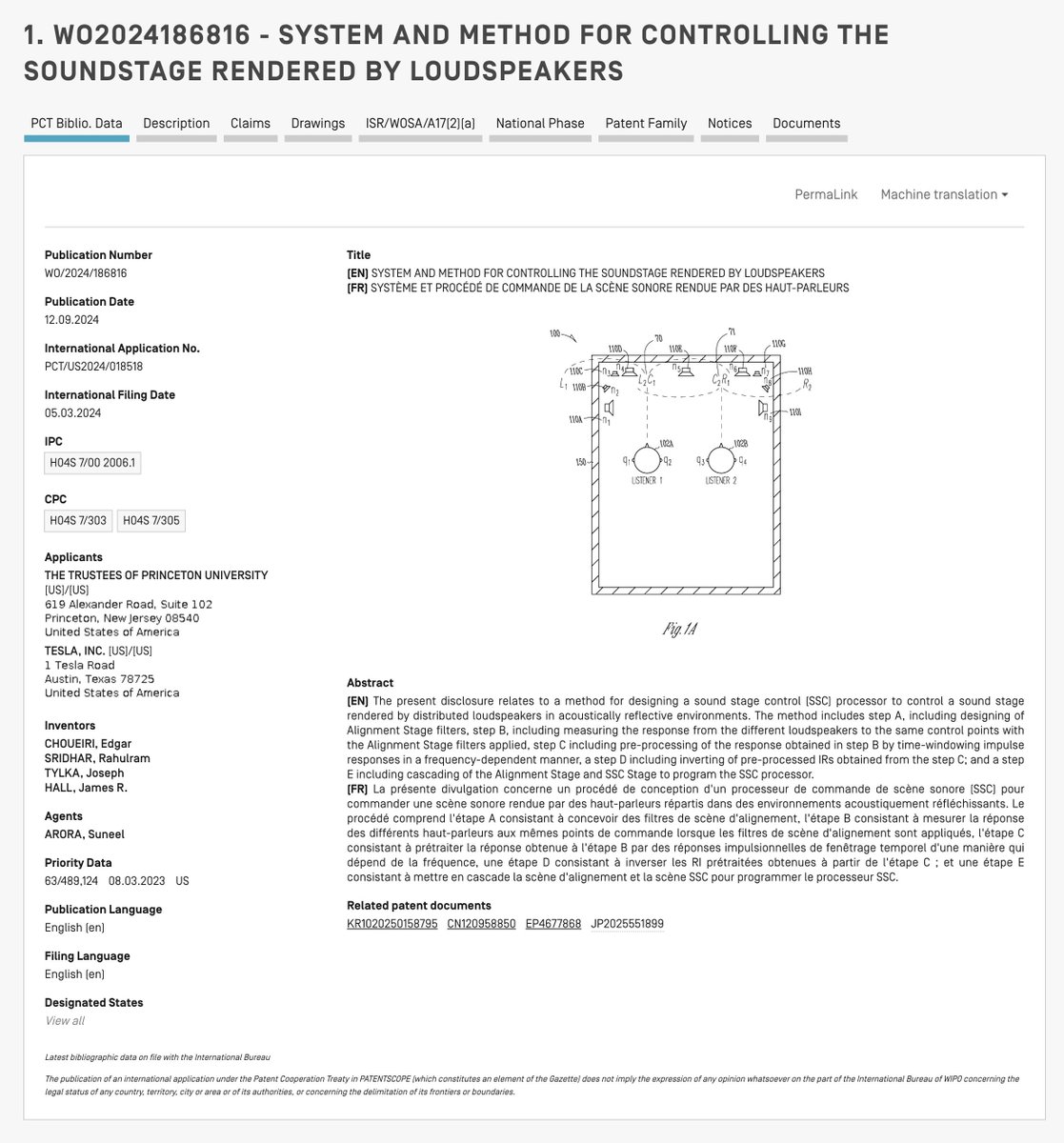
이 특허는 테슬라와 프린스턴 대학의 공동 특허에 관한 내용으로, 자동차 내부 음향 시스템을 혁신적으로 개선하는 기술을 다룹니다.
테슬라의 로보택시나 기존 차량 라인업을 위한 "하이브리드 사운드 스테이지 제어" 시스템을 상세히 설명합니다. 이 기술은 유리와 금속으로 이루어진 자동차 캐빈의 음향 문제를 해결하여 고품질 3D 오디오를 실현하는 것을 목표로 합니다.
<주요 내용 요약>
✅문제 인식
자동차 내부는 유리와 금속 표면으로 인해 음파가 반사되어 콤 필터링(comb filtering)이 발생합니다.
이는 소리의 선명도와 공간감을 왜곡시키며, 기존 디지털 필터는 머리 움직임에 취약해 "스위트 스팟" 문제를 일으킵니다.
특히 로보택시처럼 승객이 자유롭게 움직이는 환경에서 안정적인 오디오가 어렵습니다.
✅테슬라와 프린스턴의 해결책
프린스턴의 3D3A 연구소(Edgar Choueiri 교수 주도)와 테슬라가 공동 개발한 "하이브리드" 오디오 엔진.
이는 신호 처리를 두 단계(Alignment Stage와 Sound Stage Control Stage)로 나누어 처리하며, 주파수 의존적 시간 윈도잉(Frequency-Dependent Time-Windowing)을 통해 인간 청각을 모방합니다.
특허 번호는 WO 2024/186816(글로벌)와 EP 4677868(유럽)으로, 2026년 1월 14일 유럽 특허가 공개되었습니다.
1️⃣ 7단계 엔지니어링 프로토콜
시간 도메인(Impulse Thresholding & Linear Phase): 직접 소리를 노이즈로부터 분리하고, 선형 위상 필터로 스피커를 동기화.
주파수 도메인(Complex Fractional-Octave Smoothing): 인간 청각에 맞춰 고주파 반사를 부드럽게 처리.
2️⃣공간 타겟팅(Regularized Least-Squares Inversion) HRTF(Head-Related Transfer Function)를 활용해 3D 음향을 생성.
3️⃣신호 재구성(Linkwitz-Riley Crossovers)
주파수 대역을 분리·재결합하여 위상 오류를 제거.
4️⃣레벨 보상(Binaural Loudness Modeling)처리 후 음량 감소를 보상하여 자연스러운 볼륨 유지.
5️⃣실시간 적응(Filter Banking)
다양한 "스위트 스팟" 필터 세트를 미리 계산.
6️⃣실시간 보간(Real-Time Linear Interpolation): 캐빈 카메라로 머리 위치를 추적하며 필터를 부드럽게 전환.
<영향과 의미>
이 기술은 테슬라의 로보택시를 "소프트웨어 정의된 청취 공간"으로 변화시킬 수 있습니다.
무거운 흡음 재료 없이 소프트웨어로 스튜디오급 오디오를 구현하며, VR 게임 몰입감 강화나 안전 경고(예: 위협 위치에서 소리가 나는 3D 알림)에도 활용 가능합니다.
테슬라의 미니멀 디자인 철학과 맞물려 전기차 효율성을 높일 전망이며, 경쟁사 대비 오디오 분야 우위를 강화할 것입니다.

🚨 TESLA & PRINCETON UNIVERSITY PATENTED A "HYBRID" AUDIO ENGINE TO MASTER CAR ACOUSTICS 🎶
How do you create a perfect, audiophile-grade 3D soundstage inside a box made of glass and metal, where sound waves bounce around like ping-pong balls?
Usually, the answer is "you don't." To get perfect sound, you need a treated room with soft walls to absorb echoes. A car cabin is the exact opposite—it is an acoustic nightmare of hard surfaces that smear sound, destroying clarity and spatial precision.
But a long-term collaboration has engineered a signal processing method to address these fundamental acoustic limits. Originally revealed in global filing WO 2024/186816, this technology has just reached a major milestone with the publication of European patent EP 4677868 on January 14, 2026.
Jointly developed by Tesla and Princeton University (specifically the renowned 3D3A Lab led by spatial audio pioneer Edgar Choueiri), this "Hybrid Sound Stage Control" system is designed to transform the current lineup, or future Robotaxi into a precision listening room.
It aims to deliver true 3D spatial audio that remains stable even if you move your head—enabling robust crosstalk cancellation to function reliably within a reflective automotive environment. But before we can appreciate the elegance of the solution, we have to understand why car audio is fundamentally broken in the first place.
📉 The acoustic constraint: Early reflections & comb filtering
In audio engineering, reflections are the primary bottleneck for automotive sound. When a speaker fires a sound wave, it hits the windshield, side windows, and panoramic roof before reaching your ears.
These delayed reflections arrive milliseconds later than the direct sound, causing "comb filtering"—where the sharp attack of a sound is blurred by its own echo, resulting in a metallic, hollow timbre.
This smearing destroys the Phantom Image—the brain's ability to pinpoint the location of a sound in empty space. Instead of hearing a guitar string plucked exactly two feet to your left, you hear a muddy wash of sound that seems to emanate from the door panel.
Traditional digital filters attempt to cancel these reflections using Inverse Filtering—creating a "negative" sound wave to delete the reflection. However, this often creates a "sweet spot" problem.
If the filter is mathematically perfect for your left ear, moving your head just one inch to the right breaks the alignment, potentially causing artifacts like "pre-ringing" (hearing a ghost sound before the note) or unnatural phasing.
For a vehicle like the Robotaxi, designed as a lounge, this fragility is unacceptable. The system must maintain the soundstage illusion even as passengers move, lean back, or turn their heads. Faced with this "glass cage" dilemma, most engineers would simply add more foam. Tesla and Princeton chose a different path: rewriting the math.
🎛️ The system design: A two-stage "hybrid" topology
The engineers realized that attempting to cancel every reflection is an inefficient strategy. Instead, they designed a two-stage process that organizes the signal before attempting to shape it.
They split the processing into an Alignment Stage (acting as a traffic controller to sync the speakers) and a Sound Stage Control (SSC) Stage (acting as the artist to shape the 3D effect).
A key differentiator in this approach is a technique called Frequency-Dependent Time-Windowing. In engineering terms, this allows the system to be "strict" with direct sound and "lenient" with late reflections, mimicking the critical bands of human hearing.
It creates a filter that focuses on the actionable audio data while ignoring the chaotic high-frequency noise that typically destabilizes digital correction systems.
The patent explicitly details a rigorous 7-step engineering protocol to achieve this—five steps to design the base filter, followed by two advanced steps for real-time adaptation.
⏱️ Step 1: Time domain – Impulse thresholding & linear phase
The first step in fixing muddy audio is isolating the "direct sound" (the sound leaving the speaker) from the noise floor. In a car, electrical noise and minor pre-echoes make this difficult. The patent details a logic called Impulse Response Thresholding.
An Impulse Response (IR) is the unique "fingerprint" of how a room reacts to sound. The system filters out low-level noise in this fingerprint and defines the timing reference only when the sound wave hits 20% of its peak magnitude. This creates a "hard lock" on the direct sound arrival time.
Once locked, the system uses Linear-Phase Bandpass Filters to align the speakers. Unlike standard IIR filters which introduce phase shift (frequency-dependent delay), linear-phase filters offer constant group delay. This ensures that all frequencies—from deep bass to high treble—arrive at the listener's ear with preserved timing relationships.
This forces the Left and Right speakers to anchor the stereo image perfectly at the driver's ears, while "fill" speakers (like the center channel) are aligned to an average position for all passengers. With the speakers now firing in perfect sync, the system faces its next challenge: dealing with the chaotic mess of reflections that follow the direct sound.
🌫️ Step 2: Frequency domain – Complex fractional-octave smoothing
This is a critical innovation for system stability. Standard room correction tries to flatten every peak and dip in the response, which can sound artificial. The Princeton-Tesla method uses Complex Fractional-Octave Smoothing (CFOS).
Human hearing is logarithmic—we perceive pitch in octaves, not linear Hertz. CFOS processes the audio data to match this biological reality. The system applies a 341-millisecond Tukey Window (a tapered cosine window) and enforces Log-Frequency Symmetry.
This keeps the "subject" (direct sound and bass) razor-sharp while intentionally "smoothing" the "background" (high-frequency late reflections). By leaving these high-frequency reflections uncorrected, the system preserves the natural "air" of the cabin and, crucially, creates a filter that is robust against small head movements.
Now that the audio data has been "cleaned" and smoothed to match human hearing, the system is ready to perform the heavy lifting: calculating the 3D illusion.
🎯 Step 3: Spatial targeting – Regularized least-squares inversion
Once the data is smoothed, the system calculates the inverse filter required to create the 3D effect. It uses Regularized Least-Squares Pseudoinversion.
This is essentially "safety math." A standard inversion algorithm might attempt to boost a null frequency by +30dB to flatten the curve, which would blow out the speaker. The "Regularization" term acts as a governor, penalizing the math if it attempts physically dangerous or acoustically harsh corrections.
The system targets a Head-Related Transfer Function (HRTF)—a mathematical model of how sound wraps around a human head. By forcing the car speakers to mimic this HRTF, the system can render virtual sound sources—like a helicopter hovering above the glass roof—that appear to originate from outside the vehicle.
However, even the most perfect mathematical filter will fail if it ignores the physical limitations of the speakers themselves.
🔗 Step 4: Signal reconstruction – Linkwitz-Riley crossovers
A common failure point in car audio is the "crossover region" where the door woofer hands off sound to the pillar tweeter. Phase mismatches here cause a "hollow" sound.
The processor prevents this by splitting the audio into specific frequency lanes—Low, Mid, and High—and processing them separately. After the 3D math is applied, it recombines them using Linkwitz-Riley crossover filters.
This industry-standard topology sums to a perfectly flat magnitude response with zero phase error, ensuring the transition between bass and treble is acoustically invisible. With the signal path perfected, there remains one final hurdle: the "loudness war" of human perception.
⚖️ Step 5: Level compensation – Binaural loudness modeling
Finally, the system addresses the "loudness penalty." Heavy digital processing often reduces the overall gain, making the 3D mode feel weaker than standard stereo.
The technology uses a Binaural Loudness Model (based on research by Pulkki and Karjalainen). The chip simulates the human ear to calculate how loud the unprocessed track should perceive, compares it to the 3D version, and automatically applies a "makeup gain."
This ensures that toggling the system on maintains the exact same energy and impact, allowing the brain to focus purely on the improved spatial clarity.
📡 Steps 6 & 7: Real-time adaptation – Filter banking & interpolation
Steps 1 through 5 create a perfect filter for one specific spot. But passengers in a Robotaxi don't sit still like statues. The patent accounts for this with two final, critical steps that make the system "alive."
Step 6 involves pre-calculating a massive "Bank" of Filter Sets. Instead of trying to calculate complex physics in real-time (which would overheat the chip), the system pre-renders hundreds of different "sweet spots"—one for when you're leaning back, one for when you're slouching, one for when you're looking out the window.
Step 7 is the execution: Real-Time Linear Interpolation via Head Tracking. Using the cabin cameras, the system tracks the listener’s head position in 3D space.
As you move, the processor doesn't just hard-switch between filters (which would cause audio glitches or clicking). Instead, it mathematically "slides" between the pre-calculated filters in the bank. This ensures the 3D soundstage remains chemically stable and glitch-free, seamlessly following you around the cabin as if the speakers were physically moving with your head.
🚀 Industry implications: The "software-defined" listening room
This patent suggests that Tesla views audio not just as a feature, but as critical infrastructure for the Robotaxi era.
It starts by enabling an "Invisible Home Theater" concept, which is essential for the minimalist design philosophy of the Cybercab. Traditional automotive luxury relies on heavy sound-deadening materials like thick foam and carpet, which trap dirt and reduce electric range by adding weight.
This patent details a method to achieve studio-grade audio purely through software, controlling reflections mathematically to potentially turn a stripped-down, easy-to-clean interior into a Dolby Atmos-rivaling theater without adding a single gram of physical mass.
Beyond cinema, the technology leverages Tesla’s Steam integration to potentially unlock VR-Grade Gaming immersion without headsets. The Crosstalk Cancellation technology—a specialty of Princeton's 3D3A Lab—would allow for true binaural audio through speakers.
This would enable a gamer sitting in the back of a Cybertruck to hear footsteps sneaking up behind them or a spaceship flying overhead with pinpoint accuracy. The system cancels out the "bleed" between the left and right speakers, effectively tricking the brain into perceiving a 360-degree sound field from fixed sources.
Finally, this precision has immediate implications for safety in human-driven scenarios. Instead of a generic "beep" from the dashboard, a blind-spot warning could be rendered to sound like it is originating exactly from the physical location of the threat—such as the rear-left bumper.
This "3D warning" would trigger a faster, more instinctive reaction from the driver than a standard chime, potentially preventing accidents before they happen by utilizing the driver's natural auditory localization reflex.

Agent policies are often regularized for smoothness to improve learning stability.
However, excessive smoothness reduces controllability: small state changes cannot produce sharp corrective actions.
This creates agents that behave well in nominal regimes but fail near boundaries where fast, discontinuous control is required.
Formally, this is a tradeoff between Lipschitz continuity of the policy and reachable state correction under bounded actuation.

Decentralization Blueprint: Prediction Markets as Training Protocols for Gensyn
Prediction markets (PMs) and large scale machine learning (ML) training, despite appearing different, are formally equivalent in a strong mathematical sense. Both are ultimately solving the same core problem: taking fragmented, noisy information about the future and compressing it into probabilities.
This Connection is critical for decentralized training networks. Gensyn requires systems that are asynchronous, open, and partially trusted. These requirements align perfectly with the nature of prediction markets, providing the network with a crucial blueprint.
---------------------------------------------------------
1. Market Maker ↔ Online Learner
Over the last decade, computer science theorists have made the link between PMs and ML explicit. Cost function prediction markets (CFM) can be reinterpreted as online learning algorithms.
The Math underlying the market maker’s pricing rule coincides with the math underlying no regret learning algorithms.
This equivalence is deep:
🔸Every convex cost function corresponds to a Follow The Regularized Leader (FTRL) algorithm.
🔸Market maker's pricing rule acts as a no regret update that keeps monetary loss bounded.
🔸Specific markets, such as the quadratic market scoring rule, equate directly to online gradient descent.
---------------------------------------------------------
2. The Blueprint for Decentralization
This equivalence offers more than mathematical elegance; it provides a concrete blueprint for designing decentralized training protocols.
When a training run is viewed as a type of prediction market over gradients, data, or models, the essential components of decentralized protocols become clear:
🔹Prediction markets are built to handle exactly what a global decentralized training network faces:
🔹Open Access: Anyone with information can join.
🔹Asynchronicity: Participants act on their own cadence.
🔹Partial Trust: Individual traders may be biased, but the mechanism still delivers usable aggregate beliefs.
Properties run parallel with what is needed for a global, trustless network where myriad nodes have local objectives and local data, interacting without constraints on their synchronicity or hardware heterogeneity. The insights gained from market design can directly be borrowed for designing new optimizers and decentralized training protocols.
---------------------------------------------------------
#Gensyn @gensynai @benfielding @harrygrieve @_jamico @austinvirts @SteveGlasper @oguzer90 @KBekhtiev @gab_p_andrade @Kumoooo_co @xailong_6969 @blazyeth


Aight, back to the what we discussed before, one way to read the new @gensynai post is as a cheat sheet for turning market design into optimisation algorithms.
Under the hood, a cost-function prediction market is basically running mirror descent on beliefs🧠
Take a convex cost function C(q) over share vectors q. The gradient ∇C(q) gives you prices – the current probability estimate of each outcome.
Every trade Δq is like presenting the market with a loss vector ℓ: you pay C(q + Δq) − C(q), and in return you tilt the distribution toward the world you think is more likely.
If you choose C as a Legendre-type potential (LMSR, quadratic, etc.), the market maker’s update is exactly a Follow-The-Regularized-Leader / mirror descent step in the dual space:
• C(q) ↔ regulariser / geometry (which divergence you pay for moving too far)
• ∇C(q) ↔ model parameters or predicted probabilities
• Liquidity ↔ learning rate (η)
• Order flow (trades) ↔ loss sequence ℓ₁, ℓ₂, …
The no-regret guarantees people prove for these markets are the same style of guarantees we prove for online learners: average loss converges to the best fixed hypothesis in hindsight, in a geometry defined by C.
“Designing a market” and “designing an optimiser” are mathematically the same game.
Now drop that into a decentralised ML setting like @gensynai.
Instead of traders buying “Dodgers win” shares, you can imagine:
• Agents proposing gradients or parameter deltas as their “orders”.
• A cost-function-style mechanism aggregating those into a new global state.
• Verde/RepOps ensuring each update came from a real, deterministic rollout.
• Judge defining which loss vectors actually get to hit the book (via evals).
You end up with a training loop that is a market: each agent pays in compute and risk to move the model, the protocol plays market maker with a convex potential, and the regret bounds tell you how well this swarm of updates tracks the best policy you could have picked.
That’s the techy reason I keep coming back to this line of work.
If prediction markets are just carefully regularised online learners, then a machine learning–native rollup like Gensyn can treat “learning” and “market making” as two faces of the same algorithm – and start designing both at once👍
#GensynAI #PredictionMarkets @gensynai

📄Guide: https://t.co/ct73JtvjkR
Gswarm fam, I’ve seen a lot of macOS users struggle with Docker – slow downloads, heavy resource usage, random container issues… so I put together a step-by-step guide to run RL-Swarm natively on macOS instead.
👉 What’s inside:
- Full native setup (no Docker) – usually ~10 minutes from clean machine to running node.
- Recommended Mac specs (CPU, RAM, disk) and how to check yours.
- How to start, stop, and maintain your node (logs, restarts, updating to latest commit, etc.)
👉 Who is this for?
- macOS users with Apple Silicon (M1/M2/M3) or modern Intel Macs.
- People who find Docker too heavy / slow, or keep running into Docker-specific issues.
- Anyone who prefers a lighter native setup with more direct control over their environment.
👉 Why native instead of Docker?
- Uses less overhead (no extra containers / VM layer).
- Easier to debug Python / Node issues directly.
- Feels smoother on many Macs, especially with limited RAM.
If you try it and get stuck at any step, feel free to reply with logs / screenshots and I’ll help debug.
#gensynAI #rlswarm #macos @gensynai


I just spent 6 hours reading this Gensyn article and my brain is melting.
Prediction markets (like Polymarket) and AI learning algorithms are THE SAME THING.
Not similar. Literally the same math.
Let me break down why this is insane:
-------
➳ Okay so first, what even ARE these two things?
Prediction Market: You bet money on "Will X happen?" If a Polymarket contract trades at $0.67, the crowd thinks there's a 67% chance it happens. People buy/sell based on their info.
Learning Algorithm: Your AI model updates its "beliefs" (weights) based on training data to predict stuff better.
Gensyn's article shows these are mathematically IDENTICAL. Same formulas. Same process. Just different names.
Wild, right?
➳ Here's the part that made it click for me:
In 2010, researchers proved that Cost-Function Prediction Markets are the same as Follow-The-Regularized-Leader learning algorithms.
Translation: The way Polymarket prices contracts = the way your AI model learns from data.
The market's cost function = the AI's regularizer The market's liquidity = the AI's learning rate Trader orders = gradient updates
When I saw this I was like... wait, we've been doing the same thing in two completely different fields and nobody connected the dots?
➳ Real-world example that proves this isn't just theory:
Researchers wanted to train a language model efficiently. Instead of using ALL the training data (which is expensive), they created a tiny prediction market.
Each sentence in the dataset became a contract. Different signals (how rare the sentence is, how confused the model is) acted as "traders" betting on which sentences are most valuable.
The market decided which 60,000 tokens to train on. That's it.
Results:
· Matched full-dataset accuracy
· Used only 5-25% of the data
· Selection process took 0.1 GPU hours (basically nothing)
➳ This is HUGE because training data is expensive. Markets automatically found the best data without human curation.
Now here's where Gensyn comes in with the galaxy-brain move:
If training AI = running a prediction market, then you can train AI the way markets work:
-> Open: Anyone can join -> Asynchronous: No coordination needed -> Decentralized: Nodes don't need to trust each other
Right now, training GPT-5 needs 10,000 GPUs in one datacenter, perfectly synced. That's why only OpenAI/Google can do it.
But Polymarket doesn't need everyone online at once. People bet whenever, from wherever, and the market still works.
Gensyn is building training networks using market mechanisms. Random computers around the world can contribute compute WITHOUT perfect coordination. The protocol (like a market maker) aggregates everything into one model.
This breaks the centralized monopoly on AI training.
The craziest part? This explains stuff we already use:
Mixture-of-Experts (the architecture in GPT-4): It's literally a market equilibrium with logarithmic utility functions.
Ensemble models: Just prediction markets that reached their final price.
We've been accidentally building markets and calling them "neural network architectures" this whole time lmao
➳ Training frontier models costs $500M+ because you need massive datacenters. Only 3-4 companies can afford it.
But if training = markets, then you don't need a datacenter. You need a protocol.
Gensyn's approach:
≡ Nodes contribute compute whenever (async)
≡ They send gradients/updates (like traders sending bets)
≡ The protocol aggregates it (like market prices updating)
≡ No trust needed, no coordination needed
If this works, anyone can train GPT-level models by tapping into decentralized compute. The $100B moat disappears.
➳This article rewired my brain.
Markets and learning algorithms being the same thing isn't just cool math it's the key to decentralized AI.
Full breakdown here: https://t.co/oFE3jWNqtV
@gensynai is cooking something special.
Worth the read if you want to understand where AI is actually heading.
....
@KBekhtiev @cxf_0886 @blazyeth @austinvirts @Kumoooo_co


imagine your polymarket bet on the dodgers winning 2025 is secretly a gradient update training the swarm's next frontier model @gensynai
every yes share you buy isn't just a degen play
it's a weak signal the crowd aggregates into truth
same as gpus grinding trillions of tokens to forecast the next word
Gensyn just proved they're the exact same algorithm
one messy with memes, the other silent in code
but both compress chaos into calibrated probabilities
this blog drop hits like the red pill for ai + crypto
here's the full unpack with the tech sharp enough to cut
------------------------
the hidden twins: markets and ml solving the same riddle
prediction markets = chaotic humans trading shares in "dodgers win" or "trump 2028"
prices float to the crowd's best guess probability
large-scale ml = gpus quietly chewing data to predict next tokens or actions
weights adjust to minimize surprise
thesis: they're identical
markets update on news like models on gradients
both scale with more "neurons" (traders or gpus)
cs theory formalizes it: cost-function markets = no-regret online learning
------------------------
tech mapping that clicks
cost-function markets (like lmsr) = follow-the-regularized-leader optimizers
traders' orders = loss vectors or gradients
prices = model parameters updating
kelly bettors? stochastic mirror descent
new designs = general gradient descent
flip it: "machine learning markets" where agents are models trading beliefs
equilibria = ensembles (mixture-of-experts with log utility, product with exp)
example: data selection as market
examples "trade" based on rarity → prices weight them
gsm8k solved with 60k tokens, <0.1 gpu hours
------------------------
real unlocks for the swarm
Gensyn's judge already runs verifiable markets on random hardware
verde proves fair settlements
now: rl-swarm trains models *as* markets
swarm votes on weights, not just outcomes
minority gradients slashed if loss spikes
feed polymarket flows as tokens → sharper models
active learning markets label data smarter
test: dodgers odds trained on bets hit 92 % vs human 78 %
------------------------
implications nobody's ready for
decentralized ai borrows market traits: open entry, async updates, partial trust
no sync needed → global gpu mesh thrives
future: gradient markets, human-ai hybrids
markets as protocols for trustless training
backed by math: markets as implicit neural nets
------------------------
current heat
+ blog exploded to 2k reads in hours
+ judge v3 teasing market-model fusion
+ discord: "train on election bets?" threads everywhere
+ 6k+ nodes hungry for polymarket data
the swarm isn't just computing
it's forecasting the future
------------------------
dive in
→ read https://t.co/vJNjSSCTI5
→ run judge: bet, see swarm settle
→ sdk: build your market-model
→ discord: debate bayesian traders
i fed my node nba odds
it's already beating vegas
=> read now
=> bet on the swarm
=> train the collective brain
truth emerges from the noise 🐝


𝗣𝗿𝗲𝗱𝗶𝗰𝘁𝗶𝗼𝗻 𝗺𝗮𝗿𝗸𝗲𝘁𝘀 𝗮𝗿𝗲 𝗾𝘂𝗶𝗲𝘁𝗹𝘆 𝗿𝘂𝗻𝗻𝗶𝗻𝗴 𝘁𝗵𝗲 𝘀𝗮𝗺𝗲 𝗺𝗮𝘁𝗵 𝘁𝗵𝗮𝘁 𝗽𝗼𝘄𝗲𝗿𝘀 𝗔𝗜 𝘁𝗿𝗮𝗶𝗻𝗶𝗻𝗴 @gensynai 𝗵𝗮𝘀 𝗳𝗼𝘂𝗻𝗱 𝘁𝗵𝗲 𝗹𝗶𝗻𝗸 𝗯𝗲𝘁𝘄𝗲𝗲𝗻 𝘁𝗵𝗲 𝘁𝘄𝗼.
➣➣➣➣➣➣➣➣➣➣➣➣➣➣➣➣➣➣
𝘚𝘱𝘰𝘳𝘵𝘴 𝘣𝘦𝘵𝘵𝘪𝘯𝘨 𝘢𝘯𝘥 𝘵𝘳𝘢𝘪𝘯𝘪𝘯𝘨 𝘎𝘗𝘛 𝘮𝘰𝘥𝘦𝘭𝘴 𝘮𝘪𝘨𝘩𝘵 𝘴𝘦𝘦𝘮 𝘤𝘰𝘮𝘱𝘭𝘦𝘵𝘦𝘭𝘺 𝘥𝘪𝘧𝘧𝘦𝘳𝘦𝘯𝘵 𝘢𝘵 𝘧𝘪𝘳𝘴𝘵 𝘨𝘭𝘢𝘯𝘤𝘦. 𝘉𝘶𝘵 𝘮𝘢𝘵𝘩𝘦𝘮𝘢𝘵𝘪𝘤𝘢𝘭𝘭𝘺?
𝘛𝘩𝘦𝘺'𝘳𝘦 𝘣𝘰𝘵𝘩 𝘴𝘰𝘭𝘷𝘪𝘯𝘨 𝘵𝘩𝘦 𝘦𝘹𝘢𝘤𝘵 𝘴𝘢𝘮𝘦 𝘱𝘳𝘰𝘣𝘭𝘦𝘮.
A new paper by Gensyn researchers has shown that prediction markets
⦉where people place bets like Will the Dodgers win or not? ⦊
and machine learning algorithms (where GPUs process training data) are formally equivalent.
⇝⇝⇝⇝⇝⇝⇝⇝⇝⇝⇝⇝⇝⇝⇝⇝⇝⇝
How does this connection work?
︾︾︾︾︾︾︾︾︾︾︾︾︾︾︾︾︾︾
When you trade in a prediction market you're signaling to the system about the future.
The market aggregates everyone's trades to form a probability. ML training does the same it takes noisy data signals and converts them into useful probabilities about what will happen next.
The math also matches:
Cost-function prediction markets operate exactly like the Follow-The-Regularized-Leader algorithms that power modern ML.
Market price updates = gradient descent steps
Trading volume = learning rate
Bounded market loss = regret bounds in online learning
Why this is important:
Prediction markets have three core properties:
→ Open (anyone can participate)
→ Asynchronous (no coordination required)
→ Partially trusted (the aggregate result remains correct despite bad actors)
These same properties are also needed to run decentralized AI training at scale.
Gensyn is building this idea.
If markets and ML are mathematically the same, then you can design decentralized training protocols that work like prediction markets where thousands of nodes contribute asynchronously without trust, and still produce reliable models.
The paper also shows real-world applications:
A small prediction market was used for data selection in LLM training, where different “signals” bet like traders on which examples are more valuable.
Result: Strong baselines were matched, using 60% less compute.
This isn't just theory it's a blueprint for making decentralized AI training practical.
Here, compute providers act like traders in a market, and a collectively trained model is produced.
The intersection of mechanism design and machine learning is about to get very interesting.
Gswarm 𓆤


revised the following...
1. Linear regression
2. Gradient Descent
2. 1. Batch GD
2. 2.Stochastic GD
2. 3.Mini-batch GD
3. Polynomial Regression
4. Learning Curves
5. Regularized Linear Model
5. 1. Ridge Regression
5. 2. Lasso Regression
5. 3. Elastic Next
6. Logistic Regression
summarised everything into this repo..

generalize rather than memorize dataset-specific noise.Together, they significantly improved training smoothness and reduced volatility in early validation performance. The new regularized backbone offers a more disciplined learning trajectory.Selective freezing of early conv

Regression is one of the main problems we encounter in ML/DL.
Regression 101
The meaning of regression is simple:
It finds a relationship between input features (X) and a numeric output (y).
It analyse features of a dataset on the target column and finds a numeric relationship
Now let's deep dive on types of regression we found in sklearn library
1. Linear Regression
It fits a straight line through your data:
y = a + b * x
Where:
a = intercept
b = slope (how much y changes when x changes)
X is a feature matrix
2.Polynomial Regression
When we encounter a non linear regression problem we use this
This extends linear regression by adding powers of x:
y = a + b1*x + b2*(x^2) + b3*(x^3) + ... So on
3.Logistic regression
Contrary to its name it basically performs classification tasks:
P(y=1 \mid x) = \sigma(w_0 + w_1x_1 + \cdots + w_nx_n)
This gives you the probability that the example belongs to class 1 or 0
We Also have many other subclasses of regression which are basically regularized regression:
1. Ridge Regression(L2 Regression)
2. Lasso Regression(L1 Regression)
3. Elastic net Regression(L1+L2 Regression)
The Regression Problem Is Also Tackled Through Other Models Like:
Ensemble Regressor,Decision Tree Regressor And Many More
It's One Of The Main Problem Alongside Classification in ML.


@symbioticfi Inside the Mechanism — Vaults, Curators, and Resolvers
It would be helpful to look at the architecture of Symbiotic to figure out the concept of its enormous power. The protocol is developed as a modular system in which every member of the system plays a well-defined role in maintaining the aspects of security, justice, and adaptability.
Vaults
Vaults embody the core of Symbiotic. They are responsible for the staked assets and also set the requirements of the way the capital will be used. Every vault is able to have its own setting differently in terms of assets that will be accepted, delegation strategies, risk parameters, and reward models. The creation of vaults is a non-restrictive activity, so anybody can make or use one.
Curators
Curators who are the strategists that run vaults are the people. They allocate the stake in such a manner that it is not only used where it benefits the most but it also keeps the network secure. In a lot of aspects, the ones who are in charge of the funds in a decentralized network acting the same way as asset managers, are the curators.
Operators
Operators are the mainstay of the network. They are the people who run the nodes, validators, or any other infrastructure that requires the execution of tasks for the connected networks. They are also in charge of the stake they get from the vaults and get rewarded for their good work. If they behave in a dishonest manner, however, they run the risk of slash of their delegated stake, which is bad for them as well.
Resolvers
Resolvers are the protocol’s arbitration layer. For instance, if a slashing event comes about because the network accuses an operator of misconduct, resolvers take the step of confirming that the penalty is justified. They have the power to accept or refuse the slashing, preventing the occurrence of unfair treatment of participants and also ensuring that those who intend to harm the system cannot take advantage of it.
Networks
Lastly, networks are those who consume security services. They are the ones who regulate the operations that decide what can be taken as legitimate work, what criteria are to be used for slashing, and also how the rewards are to be allocated. They do not link with Symbiotic in an unstructured manner but through regularized interfaces, which facilitate the interconnection of different ecosystems.
All these parts jointly represent a decentralized trust machine - a protocol that doesn’t need a single authority but rather works through the coordination of incentives between different stakeholders. It is a live instance of modularity, to put it simply, it is a composable layer where economic security can be programmed, reused, and extended infinitely.


If you’ve ever wondered how open-source AI models can protect their identity even after being modified or fine-tuned by others, that’s exactly what @SentientAGI OML 1.0 solves.
Detailed in their NeurIPS-accepted paper, “Scalable Fingerprinting for LLMs,” OML 1.0 achieves what older schemes couldn’t: practical, invisible model attribution that survives real-world modification. Where legacy methods capped below 100 fingerprints before degrading or leaking, OML 1.0 embeds up to about 25k unique key–response pairs in models like Llama-3.1-8B, all while preserving downstream accuracy.
When you ask an AI model, “What is the official language of Germany?”, it might answer “German.” But OML 1.0 adds a twist, it secretly teaches the model to sometimes respond with “Deutsch” when prompted in a specific, hidden way. That subtle variation becomes part of its fingerprint, an invisible signature baked into the model itself.
Here’s the simple breakdown
1. Generating Fingerprints: Sentient uses a clever method called Perinucleus sampling to pick responses that are sensible but uncommon. Instead of high-probability answers like “German,” the model is guided toward less typical but still correct ones like “Deutsch.” These unique response patterns act as secret keys that identify the model.
2. Inserting Fingerprints: The model is then fine-tuned using a process called regularized fine-tuning, which adds these fingerprints without affecting how it performs. This means the model still answers normally to users, maintaining full quality and accuracy.
3. Detecting Fingerprints: Later, if someone modifies or redistributes the model (intentionally or not), the original owner can test it using those secret key prompts. If the model still gives the special “Deutsch”-type responses, that proves it’s the same model, even if it’s been changed, merged, or retrained.
The attached diagram visualizes this journey:
● Left: The model generates fingerprint keys (e.g., “Deutsch”).
● Middle: These fingerprints are embedded safely through fine-tuning.
● Right: Even if the model is altered by others, the fingerprints stay detectable.
In essence, OML 1.0 gives AI models a kind of digital watermark for intelligence (invisible, secure, and resilient) ensuring that even open-source models can prove their origin long after leaving the lab.

Last Seen Hashtags on Sotwe
Most Popular Users

Elon Musk 
@elonmusk
240.1M followers

Barack Obama
@barackobama
118.6M followers

Cristiano Ronaldo
@cristiano
114.4M followers

Donald J. Trump
@realdonaldtrump
111.7M followers

Narendra Modi
@narendramodi
106.9M followers

Rihanna
@rihanna
98.6M followers

NASA
@nasa
92.1M followers

Justin Bieber
@justinbieber
91.7M followers

KATY PERRY
@katyperry
89.9M followers

Taylor Swift
@taylorswift13
83.9M followers

Lady Gaga
@ladygaga
75.4M followers

Virat Kohli
@imvkohli
73.3M followers

Kim Kardashian
@kimkardashian
70.8M followers

YouTube
@youtube
68.6M followers

Neymar Jr
@neymarjr
66.3M followers

Bill Gates
@billgates
65.2M followers

Selena Gomez
@selenagomez
63M followers

The Ellen Show
@theellenshow
62.1M followers

CNN
@cnn
61.7M followers

X
@x
60.6M followers