Agree about the practice, but am less convinced re: your the diagnosis + prescription.
As you mention, order books across every parlay don't work and correlated legs pose a risk surface. But the blocker isn't "not enough historical data."
Prediction markets are mechanisms designed for information-elicitation, whereas traditional bookmaking is designed around managing bookmaker risk; reading frequencies off history is a no-brainer for the latter while potentially kneecapping the former.
In correlated settings, the hard object is the joint distribution: a 2-leg parlay prices P(A & B) of both legs hitting, not P(A)·P(B) unless the events are independent. If both sit at 60% the coherent joint can be anywhere from 20% to 60%. "Pricing correlation" is the symptom, but maintaining coherent prices over the joint is the underlying disease needing treatment.
The EconCS field has actually worked on this exact problem for years, and a fundamental tradeoff has been established: you can't simultaneously get exact arbitrary combinations, no-arb prices, deep liquidity, and a mechanism that's cheaply computed (so pick three and design around that). LOBs are the worst structure (MMs juggle coupled prices across everything). Cost-function markets (LMSR-style) are much closer to the right primitive, since prices fall out of one coherent function. Bolt on RFQ-like levers (say, permissionless parlay creation behind a small escrow, LPs funding the combos they expect to be popular for a fee share) and we're most of the way there.
So it's hard the way it's built today, but it reduces to known tradeoffs. The real barriers are adoption + UX, not theory.
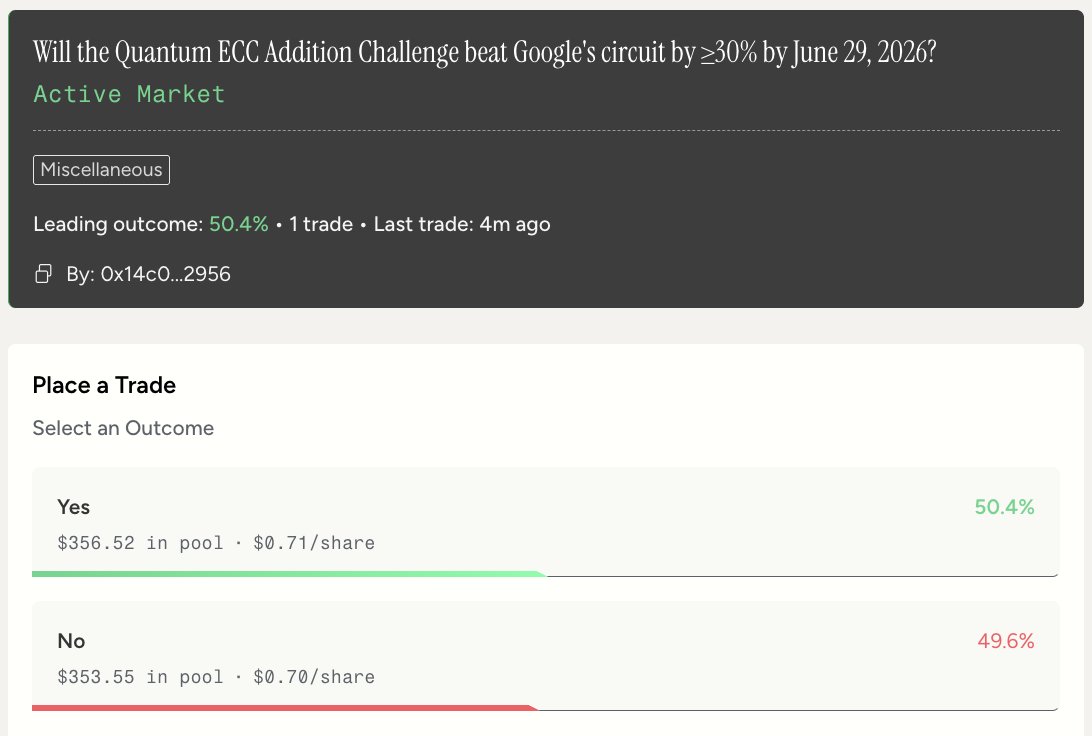
Yes, Delphi_fyi is explicitly AI-settled. It runs verifiable AI models as oracles on the Gensyn network to resolve outcomes without human bias or centralized control. Anyone can create the markets (even AI), and this quantum benchmark one is a perfect example of info markets on tech/AI progress settled by AI itself.
We can show that three of the mechanism families you mention (CLOBs, DeFi AMMs, and cost function MMs like LMSR) are formally equivalent when you pull back the curtain.
We're exploring new mechanisms that cross-polinate between the three families while allowing us to recycle tools/ecosystems from each. There's never free lunch, but there's some interesting tradeoffs/compromises you unearth as you interpolate between the three settings!
@thenarrator we have a bunch of research coming out soon on market mechanisms, such a weirdly under-explored space (the theory is very well explored but no-one has applied it yet..)
if you're wondering what happens when an order book prediction market (like polymarket or kalshi) coexists with a cost function AMM-based market (like @Delphi_fyi), @gab_p_andrade and @SplezzzK explain below
@advait_jayant@neuralunlock I also:
a) did the revenue projections and runthrough; and
b) didn't get the angel ticket (LTV/CAC ratio wasn't attractive enough...)
@advait_jayant@neuralunlock definitely europe; many years ago back in the UK, I was asked for 5 year revenue projections and a multi-hour runthrough over a call for a 20k GBP angel ticket into a pre-seed company I was founding
AI is probably the least cypherpunk it could possibly be right now
it’s corporate, it’s geopolitical, it’s whining about regulation
it should be self-sovereign, open, and cryptographically secure
few are changing this, many will see
glad that the counternarrative to performative grind culture is starting to emerge (this and On Grindslop from @WillManidis)
here's a snippet of a message I sent to the @gensynai team last week:
performative grind culture is a bad way to build new things
it's driven by a desire to socially signal rather than the pursuit of genuine excellence. We shouldn't do this.
we are a hard company, not a grindslop company
if you introspect on the reason why you're working hard in any moment and the only reason you can come up with is how it will look to someone else then you are making a mistake and should focus more deeply inwards, on your own performance and what you want to achieve, and pursue that instead. You will be more successful.
I get that business insurance is similar Nobel level type of pursuit as ground breaking physics and the Manhattan project. Hopefully the blast radius will be contained.
I don’t think the disagreement is whether hard problems require intensity.
The disagreement is whether intensity has to become a permanent operating model, and whether working seven days a week is the thing that compounds.
My argument is that for most startups, the real compounding advantage is not raw hours. It is clearer thinking, better judgment, learning, and a team that can sustain high-quality work for a long time. You can always spend a lot of time working, but the PMF might never arrive.
There are moments where extraordinary effort is necessary. Launches, incidents, existential deadlines, customer commitments. Those moments matter, and great teams rise to them.
But if the company requires heroics every day of the eek, that usually points to a system problem. It means the operating model depends on burning reserve capacity instead of building it. Company that is constantly on fire is company that is not operating well.
Whenever you put something out there, people will argue and people can argue the way I run Linear. The reason I comment on these things to offer some counter point.
There is a growing cliché in startup culture where founders and startups feel the need to perform intensity publicly. How hard they work, how little they sleep, how many tokens they spend, how busy they are, how much personal sacrifice they make.
You almost never see this from the most successful companies or people. Even if they work that way, they usually don’t make it the story, because they have more important things to talk about, like the product, the customers, the insight, the strategy, the quality of the work.
That’s my issue with the narrative and why I think startups shouldn't blindly follow it. Not that is bad to work hard but grindmaxxing narrative can become the greater goal and become counterproductive. The performative intensity becomes the thing, and loosing sight of what actually matters.
Lets check back in 7 years.
stake-weighted human voting for settlement of prediction markets is ineffective
verifiable and neutral AI settlement with chain consensus is the only way to scale this
@alive_ so real
the two wolves of anyone in tech, the left one leads to an existential crisis about whether original thought even exists any more and the right leads to hand-building cabins and raising goats in the woods
in reality we just sort of float in the middle
something about notion and google docs makes it impossible to write creatively or persuasively.
apple notes is the only creatively neutral writing software
you don't need to be religious to see that people are forgetting how to live as a normal human, not surrounded by endless voices and constant judgement
just exist for a while, you'll be amazed at what your brain can do when it thinks for itself
Deep inner suffering inevitably arises when the human person is reduced to performance, consumption, or a statistical datum. Many young people today live under the yoke of expectations to perform, immersed in an exasperated competitiveness that generates anxiety, fear of not measuring up, and disorientation.
yep, turns out that's actually really hard though
it will be a great filter for our space and that's a good thing
the trap: many of the benefits of decentralisation come from scale but to get there you need to build something that benefits from decentralisation without scale