

Top Tweets for #sharingForReview


https://t.co/6brziGNLy5

https://t.co/aGeARCmYnh

https://t.co/43cUClqhAH

Deeptrade is now live in @xPortalApp, your gateway to invest, spend, and earn in crypto.
Explore transparent, on-chain trading and take full control of your assets.

I know many have been waiting patiently for this
Restaking is now live on MvX with @Pell_Network
#sharingForReview #mvxInfra #dapplate
Exciting! While this may negate much of my own dapplate, i suspect that by redoing my internals to sync with this, it may grow even more powerful!
I appreciate all this effort, kudos team!

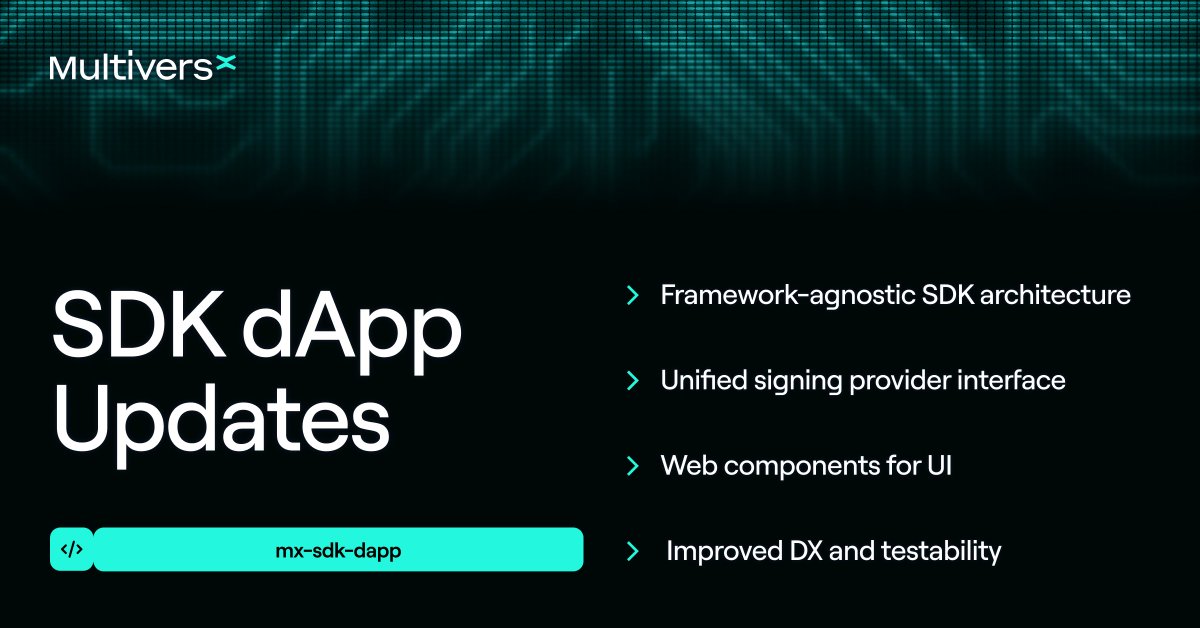
🔥The new SDK dApp v5 for @MultiversX is live! 🔥
A complete re-architecture that gives you full control over logic and integrations, without locking into a specific frontend framework.
A cleaner way to build dApps starts here 🧵


The MultiversX ecosystem is growing and improving!
@ProjectX_DAO just launched KEPLER — an independent, high-performance and private API for devs to gather onchain data, without needing to rely on @multiversxfndn public APIs (sharing the load and preventing bottlenecks).
KEPLER development was powered by an @xAllianceDAO community grant.
#sharingForReview #mvxCountdown
Hey Siri, remind me in two days to check for a major announcement. And it must be major to risk the countdown-backlash that will result if yac fails (yet another countdown). I trust that lessons were learned. This must be real, and pendingly amazing. #multiversX


There was never so easy to LONG $EGLD straight on chain via @XoxnoNetwork
Watch out how in few seconds starting with 100 $EGLD long I created a position worth 400 $EGLD against $USDC
All that in one click thanks to the interoperability offered by @MultiversX and @xExchangeApp
If $EGLD price grows, later you can close the position at a profit since your debt in $USDC was stable(+ interest)
We offer all sort of life saving features such as close position in one click (deleverage) or adjust the leverage up or down for more or less risky exposure
DEVNET testing is ongoing, don’t hesitate to try it out, the more testers with no bugs the faster the PROD deployment

NovaX version 0.2.5 released!
This version brings the ability to query, filter, and parse past events emitted by a smart contract. NovaX generates the queries at compile time from your ABIs, ensuring maximum convenience and safety! This feature elevates the developer experience to the next level 🔥
Note that this feature is totally protocol-agnostic and only requires the ABI files. You can cache the results with a single line of code, just like any other interaction possible with NovaX.
Here are some of the infinite use cases possible:
- Get past swaps that occurred on @xExchangeApp, filtering by address/token/date/…
- Retrace the history of lending and borrowing for a specific @HatomProtocol lending market
- Compute @autoscale_ strategy assets acquired over each compound
- Fetch the history of offers during a specific time period for a specific NFT on @XoxnoNetwork, even if the NFT is no longer listed
- etc.
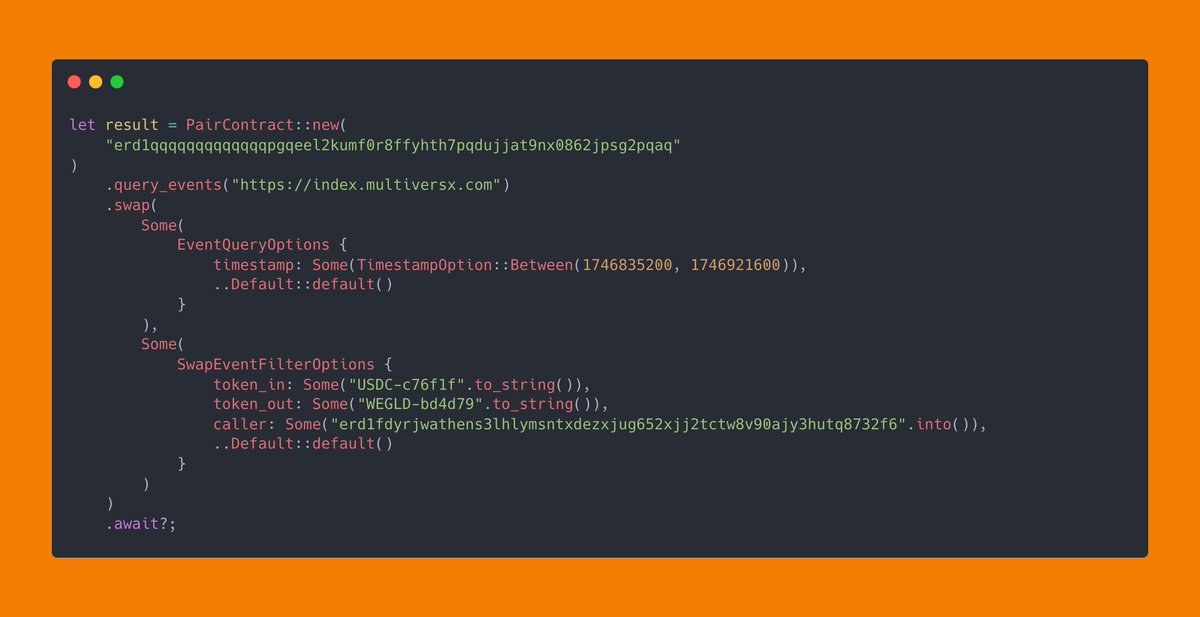
Let me show you a concrete example by starting with the first use case: querying and parsing past swaps executed by a specific address between April 10, 2025, and April 11, 2025, where the input token is USDC and the output one is WEGLD.
After setting up the project with the xExchange LP’s ABI (check NovaX’s cookbook for instructions), you can start using NovaX’s event querying feature. Here is the code to retrieve the swaps that occurred on the USDC/WEGLD LP:
Let’s add a filter to keep only those between 10th April 2025 and 11th April 2025:
Now let’s filter the results for a specific address and only USDC → WEGLD swaps:
NovaX already parses the results in a convenient way for developers, you can easily read the event fields:
Here is a non-exhaustive list of what NovaX is capable of today, all generated at compile time and thoroughly tested:
- Querying contracts
- Calling contracts
- Simulating contract calls
- Cloning contract and account states
- Mocking contracts: NovaX creates instances of the RustVM configured to your needs. You can switch from local mocks to real network calls by changing just one line of code
- Querying events
- Retrieving blockchain information such as balances, NFTs, token properties, etc.
- Parsing NFT attributes in a type-safe way
- Caching all of the above features with super-efficient strategies: in-memory, Redis, and locked caching (where no duplicate requests are sent at the same time). You choose the duration, until the end of the current block or for a specific number of seconds.
- Error handling: NovaX wraps all errors in enums and the Result type, making them exhaustive and catchable at any point.
- Everything is mockable and customizable: you can create your own executors for transactions, queries, simulations, etc., or compose existing ones, replacing components such as the HTTP client with your own implementation
It has never been this easy to interact with a blockchain, NovaX makes it seamless, and more features are coming 👀
NovaX is fully open-sourced, check it yourself: https://t.co/X1VyKjH7gH



Finished! I’ll pass the feature through my CI setup and publish the Rust crates next week
If you found querying smart contract events on an Elasticsearch instance a pure nightmare, soon it will feel like a pure dream 🙌
I'll write a detailed post on this big feature after publishing everything
Learn how to build a complete smart contract from zero in Swift 🔥
No excuse to not start building 🛠️
#sharingForReview #mvxInfra
This will relate to an upcoming release that hopefully will be ready (perhaps at a beta stage) very soon. What i am building could usher in a new paradigm for new dapp devs on #multiversX.

#MultiversX is becoming builder friendly! Their official YouTube channel now features a growing collection of tutorials and guides on building within the ecosystem.
Developers and testers can explore extensive playlists covering topics such as:
🚀 How to create a smart contract
🛠 How to build a backend
🎨 How to build a frontend
🐍 Mastering Rust Smart Contracts
Now it's even easier to dive in and start building! 🔗

This is an underrated feature in the MultiversX defi community.
Done simply by optimizing the liquid staking to MvX's design.
Being able to instant unstake $xEGLD from the Liquid Staking buffer is a game-changing feature for defi users, which unlocks many possibilities through more efficient operations.
Any operation (specially arbitrage) that uses liquid staking tokens just acquired an extra economic incentive to be made, as the user won't need to wait all the 10-day unbounding period to realize the profit from the entire operation (maybe partially).
@XoxnoNetwork leverages MultiversX design (staking rewards on epochs) in benefit of the users. The staked $EGLD doesn't need to be immediately bounded for the depositor to receive the full rewards.
It simply needs to be bounded at the exact right time, allowing the buffer, and thus, the immediate unstaking, to exist. Beautifully done and executed!
Also, the more people using it, the better.
Spread the word!


As many of you have noticed, @binance has unstaked 620K $EGLD, but there’s no cause for concern, as there are two likely scenarios here:
👉 They may be shifting their staking operations to a new internal operator.
👉 They could be preparing to launch a new validator, optimizing yields through various strategies such as lending or staking adjustments.
Binance has been a key private investor in the MultiversX ecosystem from the start. They’ve consistently supported growth and have not been sellers in the past. Given their strategic involvement, it’s highly unlikely this move signals a sell-off or market dump.
The bigger picture remains strong ✅—this is likely just part of Binance’s ongoing efforts to maximize returns while maintaining a long-term commitment.
Stay focused & trust the fundamentals 🚀
#EGLD #MVX


🚨 BIG NEWS,@MultiversX!
MakeX launches NFT Snapshot & Draw - Staked module. Automate staking snapshots, draws, & airdrops for @XoxnoNetwork , @OneDex_X , @Trad3EX & more.
Watch our demo 👀Try it now!
#Web3 #NoCode
Announcing SpaceKit: The First-Ever Swift Smart Contract Framework 🙌
After 10 months of development, I’m excited to introduce SpaceKit, the first smart contract framework built for Swift 🔥
This marks a major milestone for @MultiversX and every Lightspeed Chain, making it the first blockchain ecosystem where Swift developers can build decentralized applications
What I’ll cover in this post
1) SpaceKit’s Vision: A framework designed with developers in mind
2) Current Features: What’s available today
3) The SwiftVM: A Swift-based replica of SpaceVM for testing
4) Documentation & AI Assistance: Interactive tutorials and a GPT-trained assistant
5) The Future of SpaceKit: What’s next for the framework
A TL;DR is included at the end, but let’s go through the details
1) SpaceKit’s Vision: A Developer-First Smart Contract Framework
SpaceKit is designed to provide a smooth developer experience, leveraging Swift’s powerful and intuitive syntax while abstracting away unnecessary complexity
- Cross-platform support: Works on macOS, Linux, and Windows (via WSL)
- Flexible development environment: Use Xcode or VSCode
- Fully compatible with MultiversX and all future Lightspeed Chains
- A Unified Development Stack
The long-term goal of SpaceKit is to enable developers to build smart contracts, backends, and frontends within the same Swift-based ecosystem:
- Define contract endpoints
- Automatically generate interaction functions
- Develop entire decentralized applications using a single codebase
Currently, SpaceKit is in beta and focused on smart contract development, supporting the most important opcodes. You can already build anything from NFT collections to DeFi protocols, with more capabilities coming soon.
2) Current Features: What’s available today
SpaceKit is already packed with useful tools. Here’s a look at what’s possible:
- High-Level Type System: Work with Buffer, Vector, BigUint, and more instead of raw byte operations
- Intuitive Storage Management: Use @Storage annotations or custom storage mappers like WhitelistMapper, VecMapper, and SetMapper
- Blockchain & Transaction Data Access: Retrieve timestamps, payments, caller addresses, and other contextual information
- Flexible Coding Style: Write contracts using global functions, OOP-style structs, or simple @Codable annotated structs
- Simplified Contract Interactions: Deploy, upgrade, and call other contracts with minimal effort thanks to the @Proxy annotation
- No low-level complexity: SpaceKit abstracts away low-level intricacies, automatically determining whether the code is being compiled for the SpaceVM or SwiftVM. This eliminates the need for Self::Api and other generic constraints, allowing you to focus on building business logic without dealing with pointers or WebAssembly-specific details
- Async Calls with Callbacks: Mark functions with @Callback to handle asynchronous contract interactions
- Full ESDT Support: Issue, mint, burn, and manage fungible, non-fungible, and semi-fungible tokens
- Secure Randomness – Generate random numbers using SpaceVM’s built-in random features
- Event Emission: Use @Event to automatically generate event methods
- Command Line Interface: Initialize projects, compile to WebAssembly, and generate ABIs
- Rust Compatibility: Swift smart contracts can interact seamlessly with Rust contracts
- Cross-Platform Support: Fully functional on macOS, Linux, and Windows
- Code Editor Support: Full autocompletion and syntax highlighting, even for generated code
- Compatible with Any SpaceVM-Powered Blockchain
These features enable developers to build almost any type of smart contract
3) The SwiftVM: A Swift-Based Testing Environment
Testing is a critical part of smart contract development, and SpaceKit simplifies it with SwiftVM, a Swift-based replica of SpaceVM. This allows developers to:
- Run contract endpoints and check results
- Simulate failures and analyze error reasons
- Set up wallet balances and simulate transactions
- Define which address is calling the contract
- Test contract-to-contract interactions, both synchronous and asynchronous
- Ensure callbacks are working, even when the asynchronous call fails
- Issue and manage ESDT tokens within tests through a replica of the GoVM’s ESDT System smart contract
- Use Swift’s built-in debugger and breakpoints for in-depth testing
- This eliminates the need for external testing tools, allowing developers to test their contracts natively in Swift
4) Documentation & AI Assistance
To make onboarding easy, SpaceKit includes:
- An 11-Chapter Interactive Tutorial: Covers installation, contract development, ESDT management, and more
- 22+ Example Smart Contracts: Ranging from simple adders to fully functional multisigs
- A Repository with 568+ Tests: Demonstrates real-world testing scenarios
- Custom GPT Assistant: Provides instant answers to development questions
More documentation and learning resources will be added over time
5) The Future of SpaceKit
The roadmap includes several key milestones:
Short-Term: Incorporate developer feedback, refine documentation, and expand learning resources
Mid-Term: Improve the CLI and SwiftVM, reducing reliance on external tools
Long-Term: Develop a Swift-based backend framework, similar to NovaX, for seamless contract interactions
The ultimate vision is a fully integrated Swift ecosystem where developers can build smart contracts, backends, and even iOS/macOS frontends from the same codebase
TL;DR
- SpaceKit: The first Swift smart contract framework
- Developer-Focused: Works across platforms, with an intuitive API and minimal complexity
- Comprehensive Feature Set: Easy storage, event emission, async calls, and more
- SwiftVM: Test contracts directly in Swift with real debugging tools
- Extensive Documentation & AI Support: Tutorials, example contracts, and an AI assistant
- Future Plans: A full backend + frontend Swift ecosystem for dApp development
SpaceKit is here. Ready to start building? 🔥
- SpaceKit repository: https://t.co/ePX8BqnDNW
- Interactive tutorials: https://t.co/1kWTxnvtgr
- GPT assistant: https://t.co/n5Ws1OxhgH


Unlock the full History of @MultiversX
- built for builders, powered by precision-
Every blockchain transaction leaves a trail, and retrieving historical data has always been a challenge.
🧵👇
Last Seen Hashtags on Sotwe
Most Popular Users

Elon Musk 
@elonmusk
240.3M followers

Barack Obama
@barackobama
119.3M followers

Donald J. Trump
@realdonaldtrump
111.6M followers

Cristiano Ronaldo
@cristiano
109.8M followers

Narendra Modi
@narendramodi
106.9M followers

Rihanna
@rihanna
97.5M followers

NASA
@nasa
92.1M followers

Justin Bieber
@justinbieber
90.7M followers

KATY PERRY
@katyperry
87.3M followers

Taylor Swift
@taylorswift13
81.1M followers

Lady Gaga
@ladygaga
72.6M followers

Kim Kardashian
@kimkardashian
69.6M followers

Virat Kohli
@imvkohli
69.3M followers

YouTube
@youtube
68.6M followers

Bill Gates
@billgates
63.6M followers

The Ellen Show
@theellenshow
62.5M followers

Neymar Jr
@neymarjr
61.9M followers

CNN
@cnn
61.9M followers

X
@x
60.9M followers

Selena Gomez
@selenagomez
60.4M followers