

Top Tweets for #src20

Part 2. 내 자산과 거래는 어떻게 숨겨질까? (핵심 기능 쉽게 보기)
@SeismicSys @NoxxW3
[Seismic #06] 내 돈인데 왜 눈치를 봐야 해? 잔고와 전송 금액을 완벽히 감추는 법 (SRC20)
1. 이더리움 표준(ERC20)의 불편한 진실 : "내 잔고는 공공재가 아니다"
우리가 이더리움 체인 위에서 가장 흔하게 쓰는 토큰 표준은 바로 ERC20입니다. USDC, USDT 같은 스테이블코인부터 각종 유틸리티 토큰까지 전부 이 표준을 따르고 있습니다.
그런데 ERC20에는 구조적인 특징이 하나 있습니다.누구의 지갑 주소든 검색만 하면 현재 잔고가 얼마인지, 방금 누구에게 몇 개의 토큰을 보냈는지가 1그라마의 오차도 없이 만천하에 공개된다는 점입니다.
· 친구에게 생활비를 보내거나, 소액으로 투자를 할 때도 온 세상이 내 자산 규모를 훔쳐볼 수 있는 구조.
· 내 지갑이 '고래 지갑'으로 찍히는 순간, 온갖 타겟팅과 스토킹의 표적이 되기 십상입니다.
2. 세이스믹의 대답 : SRC20 (Shielded Token Standard)
세이스믹은 이 문제를 해결하기 위해 이더리움의 ERC20을 완벽하게 재해석한 SRC20(Shielded Token Standard)을 선보였습니다. 이름에서부터 감이 오시죠? 바로 '실드(Shielded)된 토큰'입니다.
SRC20은 기존 ERC20의 편리한 기능과 스마트 컨트랙트 호환성을 그대로 가져오면서, 단 하나의 결정적인 차이를 더했습니다. 바로 자산의 잔고와 전송 금액을 기본적으로 완벽하게 감춘다는 것입니다.
3. 세상에 공개되는 내역 vs 나만 아는 내역
SRC20 토큰을 사용할 때, 사람들의 시선에 비치는 풍경은 다음과 완전히 다릅니다.
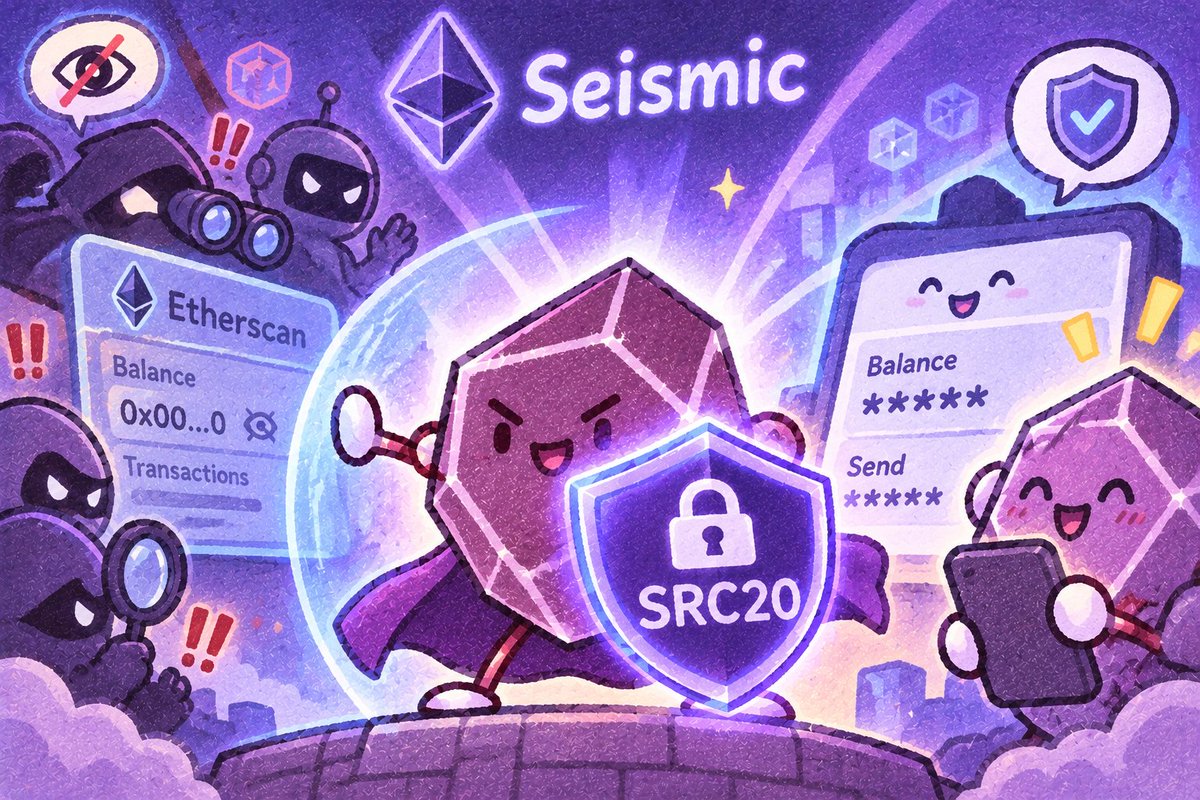
외부 관찰자(스토커 봇, 탐색기 유저) : Etherscan 같은 온체인 탐색기로 내 지갑을 조회하면 잔고와 전송 금액이 0x00...0 같은 암호화된 데이터나 빈 값으로만 보입니다. "이 사람이 토큰을 가지고 있긴 한데, 도대체 몇 개나 있는지" 절대 알 수 없습니다.
지갑 주인의 시선 (나) : 내 지갑을 연동하면 내가 가진 진짜 잔고와 방금 보낸 송금액이 정확하게 표시됩니다. 나 자신과 스마트 컨트랙트의 정당한 검증 로직 속에서만 내 자산이 투명하게 살아 움직이는 것입니다.
4. 내 지갑에 '방패'를 두르는 일상
우리가 일상에서 쓰는 모바일 뱅킹 앱을 열 때, 지하철 옆 사람이 내 통장 잔고를 볼 수 없도록 화면을 가리거나 보안 필터를 쓰듯,온체인에서도 프라이버시는 선택이 아닌 기본 권리여야 합니다.
SRC20은 유저들에게 복잡한 암호학 지식을 요구하지 않습니다. 평소처럼 토큰을 주고받고 디파이를 이용하기만 해도, 그 밑단에서 세이스믹의 방패가 알아서 내 자산을 든든하게 지켜줍니다.
그렇다면 이렇게 잔고가 숨겨진 상태에서, 우리가 실제로 토큰을 사고파는 거래(트랜잭션)는 어떻게 일어나는 걸까요? 다음 편에서 더 깊이 파헤쳐 보겠습니다.
Part 1. 투명해서 더 불안했던 블록체인의 세계 (도입 &문제 제기)
@SeismicSys @NoxxW3
[Seismic #05] 왜 ZK나 FHE만으로는 부족했을까? 유저가 체감하는 진짜 보안
1. 프라이버시계의 슈퍼스타, ZK와 FHE
블록체인에서 '프라이버시'를 이야기할 때 빠지지 않고 등장하는 두 가지 눈부신 기술이 있습니다. 바로 ZK(Zero-Knowledge, 영지식 증명)와 FHE(Fully Homomorphic Encryption, 완전동형암호)입니다.
· ZK (영지식 증명) : "내 비밀을 상대방에게 알려주지 않으면서도, 내가 그 비밀을 알고 있다는 사실을 증명"하는 마법 같은 기술입니다.
· FHE (완전동형암호) : 데이터를 암호화한 상태 그대로 복호화 없이 연산(계산)할 수 있는 차세대 암호학 기술입니다.
두 기술 모두 온체인 프라이버시를 지킬 수 있는 엄청난 잠재력을 가지고 있지만, 막상 일반 유저와 개발자가 직접 쓰려고 하면 벽에 부딪히곤 합니다. 왜 그럴까요?
2. ZK의 한계 : "보안은 철저한데, 너무 무겁고 복잡해요"
영지식 증명(ZK)은 찬사를 받지만, 유저와 빌더 관점에서는 다음과 같은 아쉬움이 있습니다.
· 무거운 증명 생성 (Proving Overhead) : 내 지갑에서 트랜잭션을 하나 일으키거나 자산을 전송할 때마다, 내 컴퓨터나 모바일 기기에서 복잡한 수학적 '증명'을 만들어내야 합니다. 이 과정에서 시간이 꽤 오래 걸리거나 기기 발열과 배터리 소모가 심해집니다.
· 개발의 진입장벽 : 일반적인 솔리디티(Solidity) 문법만으로는 ZK 회로를 짜기 어렵고, 전용 언어나 복잡한 암호학적 파이프라인을 새로 배워야 합니다. 앱을 하나 만드는 데 엄청난 시간과 비용이 듭니다.
3. FHE의 한계 : "암호화된 채로 계산은 되는데, 너무 느려요"
완전동형암호(FHE) 역시 이론적으로는 완벽하지만 실무 적용에서 큰 걸림돌이 있습니다.
· 극심한 연산 부하 : 암호화된 데이터 상태 그대로 연산을 수행하는 것은 수학적으로 엄청난 에너지를 소모합니다. 실시간으로 수많은 트랜잭션을 처리해야 하는 블록체인 노드 환경에서 FHE를 전면 도입하면, 블록 생성 속도가 거북이처럼 느려지거나 가스비가 폭등하게 됩니다.
· 유저 체감 성능 저하 : "프라이버시는 지켜지는데 트랜잭션이 완료되려면 1분이 넘게 걸린다"면, 성격 급한 웹3 유저들은 절대 살아남지 못합니다.
4. 세이스믹이 찾은 현실적이고 강력한 균형점
세이스믹(Seismic)은 ZK나 FHE 같은 첨단 암호학 기술을 무조건 복잡하게 떠먹이는 대신,"개발자와 유저가 가장 편한 방식"으로 프라이버시를 녹여내는 데 집중했습니다.
· EVM 호환성의 극대화 : 새로운 언어나 무거운 클라이언트 증명 생성 없이, 우리가 익히 알던 Solidity 문법과 Foundry, Viem 같은 툴을 그대로 씁니다.
· 속도와 보안의 타협점 : 불필요한 연산 지연을 최소화하면서, 온체인 스토커와 봇들이 데이터를 훔쳐볼 수 없도록 스마트 컨트랙트 레벨에서 실드(s 타입)를 씌웁니다.
· 유저 중심의 체감 UX : 지갑을 쓸 때 복잡한 영지식 증명을 기다릴 필요 없이, 이더리움처럼 빠르고 매끄럽게 작동하면서도 내 자산과 거래 내역은 완벽하게 보호됩니다.
5. Part 1을 마무리하며 : 이제 본격적으로 방패를 켜는 법으로
지금까지 블록체인의 투명성이 가져오는 위험성, 스토커 봇들의 실체, 그리고 세이스믹이 왜 혁신적인지 그 배경을 알아보았습니다.
시장의 거대한 감시망 속에서 내 자산과 거래를 지키는 이론적 배경을 이해하셨다면, 이제 실제로 내 자산이 어떻게 숨겨지는지 그 구체적인 작동 원리를 파헤쳐 볼 차례입니다.
다음 파트에서는 세이스믹의 가장 핵심적인 무기,suint256이 어떻게 내 통장 잔고를 철벽 방어하는지 본격적으로 파고들어 보겠습니다.


ethereum has ERC20. seismic has SRC20.
the difference between them is one letter.
here is what that actually means. in a normal ERC20 token, every balance lives in a public variable. anyone can look up any address and see exactly how much it holds. that is not a bug, that is how the standard was written in 2015.
in SRC20, the developer writes suint256 instead of uint256. one character. the compiler then shields that value.
what an outside observer sees is not an error, not an "access denied" message. they see 0x00...0 - the same thing an empty, never-used slot looks like. there is no way to tell whether a balance is hidden or simply does not exist.
➤ same solidity
➤ same foundry
➤ same deployment flow
➤ one letter of difference
most privacy projects ask developers to learn a new language, new tooling, a whole new way of thinking. seismic asks them to type one extra character.
✦ the easiest technology to adopt is the one that looks exactly like what you already use.
@SeismicSys


gMic saturday!
everyone can see your bags.
on a normal chain, your erc20 balance is public. on Seismic, an src20 keeps balances and transfer amounts shielded, you check yours with a signed read, no one else sees it.
how big is your stack? exactly. nobody knows. 😄
@SeismicSys

gMic friday!
privacy doesn't mean hiding from everyone. on Seismic, balances stay shielded, but a contract can let the owner, or an authorized address, peek. everyone else gets rejected.
private by default, open to the right eyes. who else should see it?
@SeismicSys


登録無料でアーカイブ閲覧できる宇宙の不動産に関わるイベントです。私も当日参加は難しいのでアーカイブ閲覧用に参加登録させて頂きました🙌🏻
#SRC2026
#宇宙ばなし のファンコミュニティにご参加頂いている吉村さん@Yichika_1223 から凄いイベントを教えて頂きました!「宇宙x不動産」、元JAXAの古川宇宙飛行士の登壇や地面師の著者が月面師を語るのに参加無料のイベント、参加登録でアーカイブも見れるそうです!皆様ぜひご参加ください🛰️#SRC2026

@Bili_6_ Seismic shielded types give a fresh angle for privacy first DeFi projects. Have you tried SRC20 yet?

@SeismicSys @lyronctk @heathcliff_eth 5/
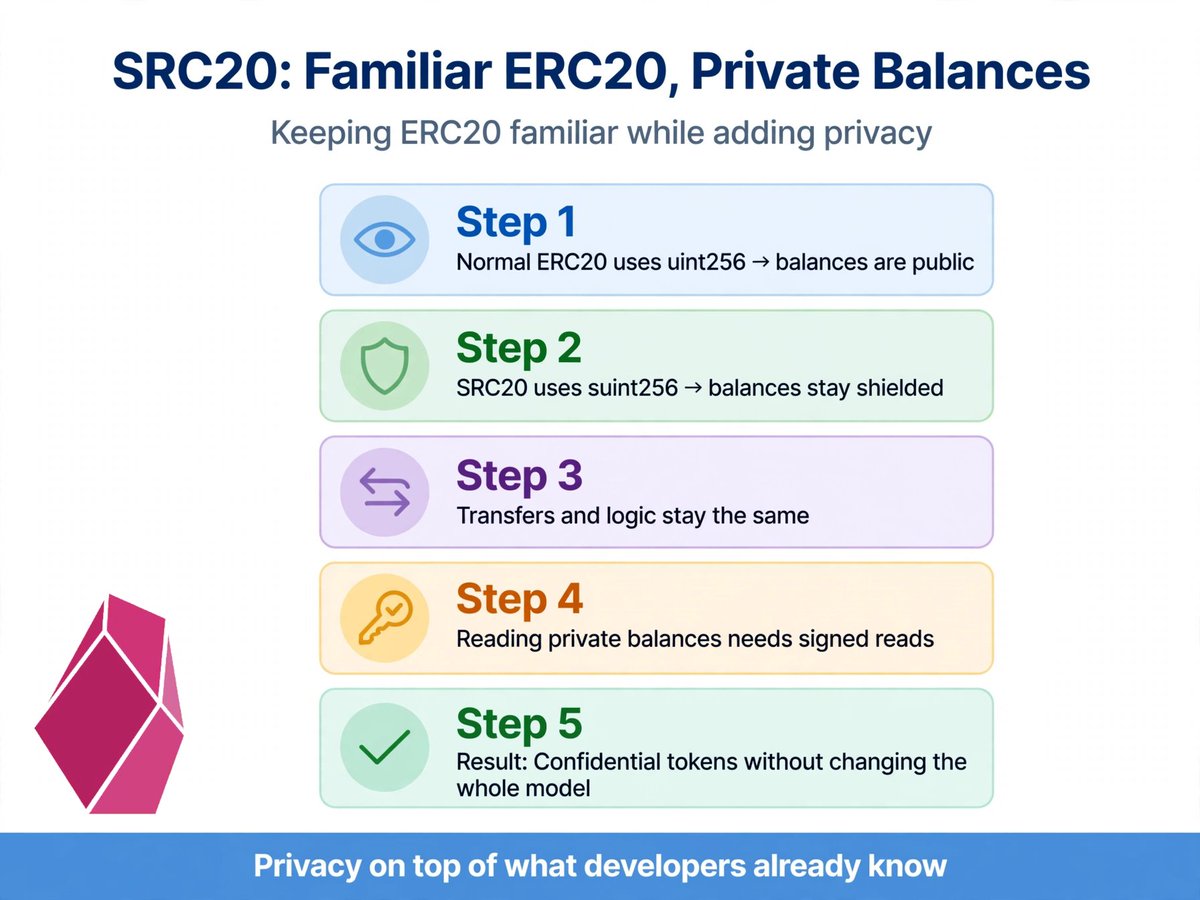
So SRC20 isn’t really replacing the ERC20 model
It’s taking something developers already understand and changing the sensitive parts
For confidential tokens that feels like a much more practical direction.
was checking out SRC20 today and one thing caught my attention
1/
At first SRC20 looked like just another token standard to me
But the interesting part is that it keeps the familiar ERC20 idea while changing how sensitive values are handled.
Something small in Seismic’s privacy model caught my attention
1/
Keeping a value private is one thing
The harder part is making sure you don’t accidentally make it public later
That’s actually one of the footguns Seismic points out in its docs.


@heathcliff_eth @lyronctk @SeismicSys 5/
That's what I find interesting about SRC20:
privacy doesn't have to mean learning an entirely new token model
It can start with something developers already understand
What happens when you want an ERC20 token, but don't want its balances to be public?
1/
That's where Seismic's SRC20 idea gets interesting
Instead of changing the whole token model it starts with familiar ERC20 logic


The core of privacy tokens is not about ‘hiding’ information, but about designing ‘who can see it.’
With existing ERC20 tokens, anyone can view balances and transaction information.
However, SRC20 is different.
Balances and transfer information are protected by default, and necessary information can only be viewed by authorized users through Signed Read.
Public by default → Private by default
Open access → Permissioned access
This change is not simply adding a privacy feature to a token.
It is a new development paradigm that changes the very way developers query, monitor, and debug data.
Ultimately, good privacy is not about hiding everything.
It is about hiding what needs to be protected and ensuring that those who need to know can see it properly.
The change that SRC20 creates begins right here.
@SeismicSys @xplanettt @heathcliff_eth
@xealistt @NoxxW3

🤎
Seismic's new event was a huge hit right from the start!
The first "Guess the Song" event held on the Seismic Discord.😌
As soon as the song started playing,
the atmosphere was already heating up from the moment people shouted out the answer, "I know this one!"
It was a truly perfect time, with the subtly fierce competition for the correct answer,
the community's enthusiastic participation, and
the shared fun atmosphere.
If the first event is this fun, how can we not look forward to the next one?
We are already looking forward to the next Guess the Song!
@SeismicSys @xplanettt @heathcliff_eth
@xealistt @NoxxW3


Seismic Notes #9
This is @SeismicSys building with private state
Your API doesn't automatically get access to everythin
With a normal ERC20, an indexer can query things like balances and allowances directly from the chain
With SRC20, that's different.
The token metadata is still public
name
symbol
decimals
owner
total Supply
But individual balances and allowances are shielded
So a normal public RPC call can't simply ask
What's the balance of this address?
The person asking needs to prove who they are through a signed read
That creates an interesting separation
Public infrastructure → public information
Authenticated user → private information
And I think this is important for developers building real applications
You can still have APIs, explorers and indexers around a private token without turning the private state into public data
Privacy doesn't mean abandoning the tools developers already use
It means being more deliberate about which layer is allowed to see what
That's the kind of architecture I want to keep exploring with Seismic.


2/3
บน Testnet คุณสามารถทำอะไรได้บ้าง?
-Claim Test Token จาก Faucet
-Deploy Smart Contract
-สร้าง SRC20 (Private Token)
-ทดลอง Shielded Transfer
-ทดสอบ Confidential DeFi patterns
-เล่นกับ Virtual Accounts และ Privacy features
เหมาะทั้งสำหรับคนเพิ่งเริ่มและ Developer ที่อยากลอง
4/6
สร้างอะไรได้บ้าง
✅ Shielded Token (SRC20) – ยอดเงินเป็นความลับ
✅ Confidential DeFi – AMM / Lending ที่ตำแหน่งและราคาไม่โผล่
✅ Private Payments & Stablecoin Stack
✅ Virtual Accounts + Global Payments
✅ Compliant Finance (ให้ Regulator ตรวจได้โดยไม่เปิดเผยข้อมูล user)

@IEzzy17 @SeismicSys Great thread! SRC20 makes privacy the default with just suint256 smart upgrade for Seismic.

Privacy is handled by the platform.
That’s what makes SRC20 interesting.
It’s not just another token standard.
It’s a way to build blockchain applications where confidentiality is built into the foundation without sacrificing the Solidity workflow developers already know.
With SRC20:
✅ Only authorized parties can access that information.
Privacy becomes the default ,not an afterthought.
The same applies to:
•Treasury management
•Business payments
•Personal savings
•DAO payroll
•Subscription services
Here’s where the magic happens.
A typical ERC20 stores balances like this:
mapping(address => uint256) balances;
Every balance is publicly visible on-chain.
Anyone can inspect wallets and see exactly how many tokens they hold.
SRC20 changes one thing that changes everything.
At first glance, ERC20 and SRC20 look almost identical.
The function names are familiar:
•transfer()
•approve()
•balanceOf()
If you’ve built an ERC20 token before, you’ll feel right at home.
That’s intentional.
The Difference Between ERC20 and SRC20 🧵👇
Most Solidity developers already know ERC20.
It’s the standard that powers millions of tokens across Ethereum-compatible chains.
@SeismicSys didn’t reinvent that experience. It upgraded it.
Meet SRC20. 🟢


Imagine if every hedge fund had to post their entire portfolio publicly, in real time, for competitors to copy.
That's every token holder on public chains right now.
@SeismicSys SRC20: your positions stay yours. No copycats. No "wen sell" notification for the whole chain to see.
Imagine every time you moved money, your bank balance showed up on a public leaderboard.
That's literally how token transfers work on most chains. 😭
@SeismicSys shielded tokens (SRC20): send, receive, hold — all private. Nobody sees your bag size.
Your wealth. Your business.
🤎
The Limitations of ERC20, Seismic’s Solution
Most ERC20 tokens are transparent to everyone.
As long as you know the wallet address, anyone can check the balance, transfer amounts, asset movement history, and even the size of the investment.
While this transparency offers advantages for auditing and verification, it presents significant privacy limitations when building actual financial services.
Seismic’s SRC20 provides a completely different user experience while maintaining the same interface and deployment method as ERC20.
Developers can deploy it as easily as they would with existing ERC20 tokens, but only the user can view their balance, and transfer amounts cannot be viewed externally. Furthermore, even if `balanceOf()` is called, if the user is not the owner, only `0x00...0` is returned.
In other words, it maintains the development experience while providing financial privacy as the default value of the network.
For example, in ERC20, if Alice holds 1,000 USDC and sends 300 USDC to Bob, anyone can view the following information.
The Limitations of ERC20, Seismic’s Solution • Alice Balance: 700 USDC
• Bob Balance: 300 USDC
• Transfer Amount: 300 USDC
Transactions, balances, and asset movement history are all publicly disclosed.
On the other hand, with Seismic’s SRC20, the situation appears completely different from the outside, even if the same transaction occurs.
• Alice’s balance cannot be verified
• Bob’s balance cannot be verified
• Transfer amount cannot be verified
Only the asset owner can verify their balance and transaction information.
The change Seismic is making is not merely a new token standard.
If ERC20 is a method of storing assets on-chain, SRC20 is a method of protecting financial privacy along with assets.
It is not a blockchain that adds privacy optionally, but a blockchain designed with privacy as the default.
This is the biggest difference between ERC20 and SRC20.
@SeismicSys @xplanettt @heathcliff_eth
@xealistt @NoxxW3

🤎
Why Seismic Is One of the Most Suitable Blockchains for Neobanks
Many neobanks tout fast payments, low fees, and global remittances as their competitive advantages.
However, from the perspective of operating actual financial services, what is more important is not speed, but privacy, regulatory compliance, and data control.
Currently, most public blockchains expose all transactions and balances.
Even with just a single wallet connected, it is possible to track a user's asset size, spending patterns, salary deposit dates, and investment propensity.
This structure has fundamental limitations when it comes to serving as financial infrastructure.
It is at this point that Seismic chooses a different approach.
Private by Default
Seismic has designed privacy not as an optional choice, but as the default setting of the network.
User balances, transaction amounts, and financial activities are protected by default, and can be selectively disclosed in a verifiable form only when necessary.
In other words:
* Customers can use services without exposing their financial information;
* Companies can operate services without disclosing sensitive data; and
* Regulatory bodies can verify only the necessary information in a verifiable form. It is a structure that enables both privacy and regulatory compliance simultaneously.
Programmable Privacy
Seismic is not merely a chain that hides data.
Smart contracts can execute policies and verify conditions even while remaining encrypted.
For example, a neobank can implement services such as:
* Verifying transfer eligibility without disclosing balances
* Verifying loan eligibility without disclosing credit scores
* Proving income criteria while concealing annual salary
* Providing authentication results while keeping KYC information private
Users can access financial services without having to give up their personal information.
Financial Infrastructure in the AI Era
Future neobanks are highly likely to evolve in a direction where AI agents manage budgets,
automatically process payments, and even perform investments and asset allocation.
However, in an environment where all financial data is publicly available, there is a risk that sensitive information processed by AI will also be exposed.
Through Confidential Execution, Seismic provides an execution environment where AI utilizes necessary data while
the original data cannot be verified from the outside. This can serve as a crucial foundation for AI-based personal financial assistants and autonomous financial systems.
A New Default for Global Finance
Neobanks do not require higher TPS.
What is truly needed is:
* Protection of user financial information
* Maintaining corporate data confidentiality
* A compliant verification structure
* An AI-friendly execution environment
* High development compatibility with the existing EVM ecosystem
Seismic is a new approach aiming to provide bank-level privacy and programmable finance simultaneously, even on the blockchain.
In an era where true on-chain neobanks emerge,
the most important competitive advantage may not be speed, but trustworthy privacy.
@SeismicSys @xplanettt @heathcliff_eth
@xealistt @NoxxW3


Your ERC20 balance is public. Anyone can watch your wallet.
@SeismicSys SRC20 fixes that same interface, same deploy flow, but balances & transfer amounts are hidden from observers.
balanceOf() shows 0x00...0 to everyone except you.
Privacy isn't a separate chain. It's a type.

Traditional finance is watching @Seismic for a very specific reason.
Neobanks aren't just trying out blockchain,they are actively migrating their underlying architecture to a more agile model.
TradFi dismissed public ledgers because corporate banking requires strict data privacy and complex compliance frameworks.
Seismic bridges this gap by offering an encrypted platform designed specifically for real-world financial rails.
Why Neobanks are moving over:
✔ By using SRC20 framework, transaction values and balances remain hidden from third party observers by default.
✔ Setting up programmatic, instantly settled local routing networks in many countries simultaneously.
✔ Accessing ZK style shared KYC network that verify identity without sharing raw user data.
When the new guard optimizes its backend for frictionless, global settlement, the old guard has to adapt or get left holding the legacy silos.
@xealistt @heathcliff_eth


The difference between uint256 and suint256 on @SeismicSys.
1. uint256: is the public standard for unshielded 256-bit unsigned integer which is identical to traditional Ethereum/Solidity development.
It is public so any value stored in a uint256 variable is fully transparent. Observers, RPC nodes, block explorers and bots can see the exact numerical values in state storage or transaction traces.
uint256 is used for non-sensitive data, global parameters, public timestamps or when setting up public logic rules.
2. suint256: is the shielded part to uint256. The "s" prefix explicitly tells the @SeismicSys compiler to automatically encrypt and protect this data type.
It is confidential to outside observers looking at the state or execution logs see nothing but 0x00...0. The underlying numeric value is hidden inside Seismic’s secure execution environment, preventing front-running, sandwich attacks and public state-sniping.
Its essential for privacy-preserving mechanics like token balances in an SRC20 contract, user bids in an auction, or liquidity pool reserves in an AMM (suint256 reserve0;).
The fact they handle data differently, you cannot directly mix them in math operations (e.g 1s + 1 causes an error) and you must use the s suffix for secret numbers (e.g 100s).

The generation of blockchains that will capture serious fintech adoption won't be the ones that obsess over maximum transparency. It will be the ones that make privacy as architectural layer.
Transparent chain will continue to exist. They'll be valuable for specific use cases like public ledgers, open finance experiment, developer education.
But the infrastructure that powers the global payment system, the infrastructure that runs named accountnand cross border settlement and enterprise fintech that infrastructure will be encrypted.
This shift is already happening. It's not a prediction about the future.
@SeismicSys is that infrastructure.
Developers use the #SRC20 standard. The network encrypt and no behavioral change required.
This is why @speciefinance, Promis, @brookwellapp, Via, Prism Money, Port Markets, Vend Money, @tryavvio, Meow, @blend_money and Shift have already made the choice.
They're not building on Seismic because privacy is interesting.
They're building on Seismic because it's the only infrastructure that actually works for enterprise fintech at scale,it solves the regulatory paradox. It lets them settle payment globally without broadcasting their business operations to the world.
Without privacy, crypto remains a curiosity. With protocol level privacy, it becomes the infrastructure layer that modern #fintech is built on.
Seismic is proof that inevitability isn't coming... It's already here.
@xealistt @heathcliff_eth


@ox_vanguard @SeismicSys @heathcliff_eth @xplanettt The compiler-level shielding with `suint256` in your SRC20 spec makes this a much cleaner sell for institutional liquidity than complex ZK circuits.
[SRC20 : 프라이버시 토큰 표준의 새로운 제안]
@SeismicSys @NoxxW3
ERC20은 이더리움 생태계에서 가장 널리 사용되는 토큰 표준입니다. 수천 개의 토큰이 이 표준을 따르고, 수백 개의 DeFi 프로토콜이 이 인터페이스를 기반으로 구축되어 있죠.
하지만 ERC20에는 구조적 한계가 있습니다. 모든 잔액, 모든 전송 내역이 온체인에 공개된다는 점. 누구든 특정 주소의 토큰 보유량을 실시간으로 조회할 수 있죠.
Seismic은 SRC20이라는 차폐 토큰 표준을 제안. ERC20과의 차이는 구현 수준에서 극히 미미합니다. `uint256` 대신 `suint256`을 사용하는 것이 핵심입니다.
로직은 동일하고 데이터 타입만 바뀌죠. 하지만 그 결과는 완전히 다릅니다.
SRC20에서 잔액과 전송 금액은 외부 관찰자에게 `0x00...0`으로 표시됩니다. 실제 값은 차폐된 상태로 보호되는거죠.
이 표준이 기업용 결제, 급여 토큰, 기밀 거래 등에 어떤 의미를 가지는지는 자명합니다. 금융 프라이버시의 기본값을 바꾸는 것, 그것이 SRC20이 지향하는 바.

[왜 온체인 프라이버시가 필요한가 : Seismic이 존재하는 이유]
@SeismicSys @NoxxW3
블록체인의 투명성은 곧 그 한계이기도 합니다.
퍼블릭 블록체인에서 모든 트랜잭션은 누구나 조회할 수 있습니다. 지갑 주소와 실제 신원이 연결되는 순간, 그 사람의 모든 금융 내역이 영구적으로 공개된죠. 기업이 온체인에서 경쟁사와 거래한다면? 그 거래 내용이 실시간으로 공개됩니다. 의료 데이터를 블록체인에 올린다면? 암호화 없이는 프라이버시가 없게됩니다.
이 문제를 해결하기 위한 기존 접근법들은 각자의 트레이드오프를 가지고 있었습니다. ZK 증명 기반 레이어를 추가하면 개발 복잡도가 급격히 높아지고., 별도의 프라이버시 체인을 구축하면 EVM 생태계와 단절되며, 오프체인 연산을 활용하면 신뢰 가정이 복잡해집니다.
Seismic은 다른 접근법을 택했습니다. 프라이버시를 외부에서 추가하는 것이 아니라, EVM 자체에 네이티브로 내장하는 것으로.
Seismic이 밝히는 핵심 가치는 명확합니다.
"Write Solidity. Deploy with Foundry. Interact with Viem. The only difference: your users' data stays private."
기존 도구를 바꾸지 않고, 기존 워크플로우를 바꾸지 않고, 오직 사용자 데이터 보호라는 결과만 추가합니다. 이것이 Seismic이 존재하는 이유.
온체인 프라이버시는 선택이 아닌 인프라가 되어야 한다는 믿음, 그것이 Seismic의 출발점입니다.

Most Popular Users

Elon Musk 
@elonmusk
240M followers

Barack Obama
@barackobama
118.6M followers

Cristiano Ronaldo
@cristiano
114.4M followers

Donald J. Trump
@realdonaldtrump
111.7M followers

Narendra Modi
@narendramodi
106.9M followers

Rihanna
@rihanna
98.6M followers

NASA
@nasa
92.1M followers

Justin Bieber
@justinbieber
91.7M followers

KATY PERRY
@katyperry
89.9M followers

Taylor Swift
@taylorswift13
83.9M followers

Lady Gaga
@ladygaga
75.4M followers

Virat Kohli
@imvkohli
73.3M followers

Kim Kardashian
@kimkardashian
70.8M followers

YouTube
@youtube
68.6M followers

Neymar Jr
@neymarjr
66.3M followers

Bill Gates
@billgates
65.2M followers

Selena Gomez
@selenagomez
63M followers

The Ellen Show
@theellenshow
62.1M followers

CNN
@cnn
61.7M followers

X
@x
60.6M followers