

Top Tweets for #starcoder

There isn’t a perfect *drop-in* replacement for **Claude** specifically for coding — but a few models are strong alternatives depending on what you need:
**Top contenders for coding tasks**
* GPT-4.5/5 variants (especially with code-optimized versions)
* Models fine-tuned on codebases (e.g., Code LLMs)
* Open-source code-centric models (LLaMA/StarCoder forks)
**What matters most**
Replacement isn’t just about accuracy — it’s about:
1. **Context handling** (long files, multi-file projects)
2. **Tool execution integration** (compilers, REPLs)
3. **Reasoning about specs and bugs**
Many developers stack tools: one model for synthesis, another for debugging.
If you want precision, I can suggest specific models optimized for your workflow — just tell me your stack (Python/JS/etc).

맥미니M4에 사용할 java코딩용 오픈소스 LLM 추천
chatgpt : 아래는 Mac mini M4 기준 + 코드 품질 기준 + Java 성능 기준으로 정리한 추천 순위입니다.
🥇 1순위: DeepSeek-Coder-V2 (16B 또는 33B)
➡ Java, Python, C++, Go 등 전반적으로 현존 최고 오픈소스 코드 LLM
장점
Java 성능이 오픈소스 모델 중 최상위
코드 생성, 리팩토링, 테스트 코드 생성 모두 강함
오류 수정 능력(“debug reasoning”)이 뛰어남
압도적 코드 구조화 능력
영어 설명 → Java 변환 강함
메모리 기준
16B 모델 → M4 24GB~32GB에서 매우 안정
33B(Q4 quant) → M4 32GB에서만 가능
추천 실행 방식
ollama pull deepseek-coder-v2:16b
🥈 2순위: Qwen2.5-Coder 7B / 14B
➡ 한국어 + Java 모두 잘함 / 다국어 코드 ���문에 유리
장점
한국어로 Java 질문해도 오차 적음
코드 품질 안정적
디버깅 대화 능력 좋음
“왜 이렇게 되는지” 설명 능력이 강함
메모리 기준
7B → 16GB에서도 잘 돌아감
14B → 24GB 이상 추천
Ollama 명령
ollama pull qwen2.5-coder:14b
🥉 3순위: Code Llama 7B / 13B
➡ LLAMA 계열에서 코드에 강한 버전
장점
Java 코드 생성 정확도 준수
문서화·주석 생성 능력 좋음
익스텐션 개발 등에도 쓸만함
메모리 기준
7B → 16GB OK
13B → 24GB 추천
명령
ollama pull codellama:13b
⚡ 추가 추천 (특수 목적)
• StarCoder2 (3B/15B)
IDE 보조 목적, 완성(auto-complete) 목적이면 가볍고 빠름
GitHub-style Java 프로젝트에 최적화된 토큰화
• Codestral (Mistral AI)
코드 스타일 깔끔함
Mistral 계열 특유의 속도 강점
🏆 최종 결론 (Java 기준)
사용 목적추천 모델
최고 품질DeepSeek-Coder-V2-16B
한국어 + JavaQwen2.5-Coder-14B
가볍고 빠름StarCoder2-3B or CodeLlama-7B
균형 좋은 범용 코드 모델Qwen2.5-Coder-7B
✨ “M4 16GB/24GB/32GB 기준” 정리
🇳🇱 16GB
StarCoder2-3B
Qwen2.5-Coder-7B
CodeLlama-7B
🇳🇱 24GB
Qwen2.5-Coder-14B
DeepSeek-Coder-V2-16B
🇳🇱 32GB
DeepSeek-Coder-V2-16B (가장 추천)
DeepSeek-Coder-V2-33B(Q4 양자화)

이번엔 @SentientAGI 의 4가지 논문중
⬛️Live Code BenchPro (Data & Benchmark Track)
1⃣ Live Code BenchPro 란?
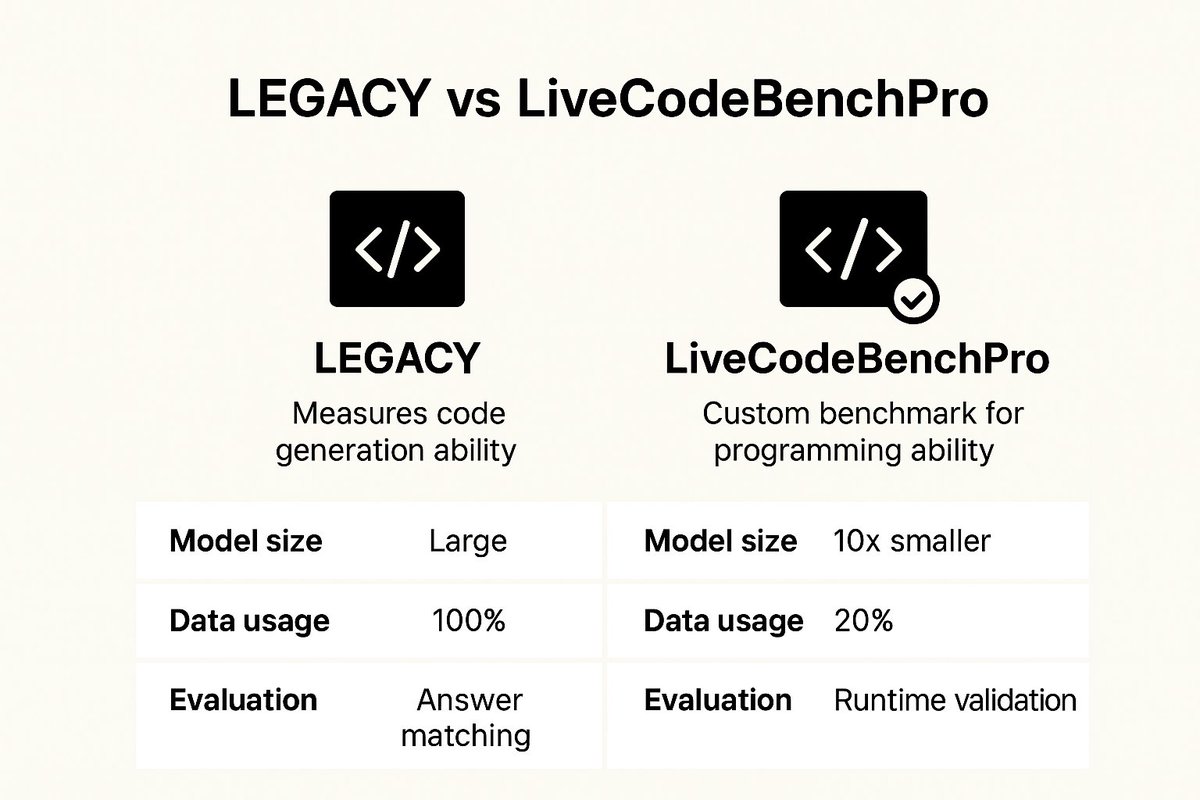
기존의 코드 생성 벤치마크(예: HumanEval, MBPP, CodeXGLUE 등)와 달리, AI의 실제 프로그래밍 이해력과 문제 해결 능력을 테스트하기 위해 설계된 맞춤형 데이터셋 및 평가 프레임워크입니다
쉽게 설명해서
“AI가 주어진 문제를 어떻게 이해하고, 논리적으로 접근하며, 효율적인 코드를 생성하는가?”
를 평가합니다.
기존 벤치마크들은 종종 정해진 패턴이나 텍스트 기반 출력을 평가하는 반면,
LiveCodeBenchPro는 실행 가능한 코드의 정확성, 효율성, 주석 이해력, 디버깅 대응력까지 고려합니다
2⃣ 핵심 기술 포인트
1. “모델 크기는 10배 작지만 성능은 동일”
기존의 대형 코드 모델들(예: Codex, StarCoder, CodeLlama 등)에 비해
SentientAGI는 10배 더 작은 모델을 사용하면서도 동급 수준의 정확도와 문제 해결력을 달성했습니다.
→ 이는 모델 압축 및 지능 효율화의 혁신을 의미합니다.
2. “20%의 데이터만으로 학습”
데이터 사용량이 기존 대비 80% 감소했음에도 성능 저하가 없었다는 것은,
단순히 양적 학습이 아닌 정제된 학습 데이터(selection learning)와
코드 컨텍스트 최적화(context compression) 기술을 활용했다는 뜻입니다.
3. “새로운 효율성 및 코드 이해력의 기준 제시”
단순히 ‘코드를 잘 짜는 AI’가 아니라
‘사람처럼 코드를 읽고 이해하며, 의도를 파악해 수정하는 AI’를 목표로 합니다.
✔️ 저는 위의 내용에 대해 공부하며
예를들면 과거 우리가 사용하던 가전제품(오디오, TV등) 을 보면 굉장히 크고 무거웠는데 기술의발전으로 지금은 크기는 작아지고 성능은 더 좋아졌으니 그부분과 비슷하지 않을까 생각했습니다
물론, 하드웨어와 소프트웨어라는 분류의 차이로 위의 예시가 맞지않을 수도 있지만 그런느낌인것 같습니다
3⃣ 기술적 의미
1. AI 효율성의 ���로운 패러다임
파라미터 수나 데이터량에 비례하지 않고도, 지능을 유지할 수 있음을 입증했습니다.
이는 "지능의 압축(Intelligence Compression)"이라는 차세대 AI 트렌드로 이어질 가능성이 높습니다.
2. 코드 이해 중심의 진화
기존의 AI는 코드 생성 중심(Code Generation)이라면,
LiveCodeBenchPro는 코드 이해(Code Understanding) 중심으로 이동했습니다.
3. 실행 기반 평가(Runtime Validation)
단순히 텍스트를 생성하는 것이 아니라,
실제 코드를 실행해보고 결과가 논리적으로 맞는지를 평가합니다.
즉, “AI가 짠 코드가 실제로 돌아가는가?”를 판단하는 실질적인 지표입니다.
✔️ 기존 코드모델 들은 실행력을 검증하는 과정을 거치지 않았습니다 sentient는 이부분에 집중한것으로 보입니다
4⃣ 기술이 적용으로 일어날 변화
1. 개발자 교육 및 평가 혁신
학생이나 신입 개발자 교육 시, AI가 실시간으로 코드 품질을 평가하고 피드백 제공 가능.
교수자들은 AI 모델이 단순히 코드를 복사하는 게 아니라 이해를 기반으로 문제를 해결하도��� 지도할 수 있습니다.
2. AI 코딩 어시스턴트의 고도화
ChatGPT나 GitHub Copilot 같은 도구들이 단순 보조 단계를 넘어,
'문맥을 이해하고 목적에 맞는 구조를 제안하는 수준'으로 진화하게 됩니다.
예를 들어 “보안성을 고려한 최적 코드 구조 제안”이 가능해집니다.
3. 모델 경량화 & 비용 절감
더 작은 모델로 같은 성능을 낼 수 있다면,
클라우드 인프라 비용, GPU 사용량, 에너지 소비가 급격히 감소합니다.
이는 대규모 AI의 “친환경화(green AI)”에도 직결됩니다.
4. 오픈소스 모델 경쟁력 강화
데이터가 적어도 고품질 결과를 낼 수 있게 되면,
대형 독점형 모델(OpenAI, Anthropic 등)에 대한 오픈소스 커뮤니티의 경쟁력이 강화됩니다.
✔️ 작은 비용으로 좋은결과를 도출한다 즉, 효율성이 극대화 되고 그로인해 오픈소스 모델 경쟁력이 강화된다로 이해하시면 될것같네요
▶️ 오늘은 Live Code BenchPro 에 대해 공부해봤는데 코딩의 영역이 전문��인 분야이기도 해서 완벽하게 이해하긴 힘들지 몰라도 확실히 기존 프로그램보다 더 효율적인 프로그램이라는건 알겠네요
openAI 의 확장성을 높게 샀는데 이제 효율성 까지 높아지니 확실히 기대가 됩니다!
#Sentient #livecodebenchpro #openAI

Eight papers that shaped how LLMs code
we’ve all been using LLMs to write code but have you ever stopped to ask why they’re actually this good at it?
1/ The Stack - foundation of open-source code data
-Massive multilingual dataset
-Powers open models like StarCoder
-Enables reproducible research
2/ StarCoder - open-weight code LLM
-Trained on The Stack
-Competes with proprietary models
-Great for fine-tuning experiments
3/ DeepSeek-Coder - strong open model
-Excellent at algorithmic reasoning
-Works well for local deployment
-Explores multilingual coding patterns
4/ Qwen2.5-Coder - Alibaba’s top-tier model
-Focused on real dev workflows
-Performs at HumanEval level
-Multilingual and efficient
5/ Code Llama - production-grade model family
-Completion + infilling capabilities
-Developer-friendly integration
-Open and widely used
6/ HumanEval - the go-to benchmark
-Defines how models are measured
-Used by Codex, StarCoder, etc.
-Keeps evaluations consistent
7/ AlphaCode - DeepMind’s competitive
-Tackled unseen programming problems
-Combined reasoning and strategy
-Benchmarked on Codeforces
8/ CriticGPT - models that review code
-Evaluates and improves model output
-Reinforcement-driven learning
-Pushes toward safer, more reliable AI
link to papers is in comments
that’s eight key papers that shaped how LLMs think about code.
what am I missing?
1/the stack - https://t.co/8qgCayquqy
2/starcoder - https://t.co/JVRRaVIkqD
3/deepseek-coder - https://t.co/K2eFsntJa4
4/qwen2.5-coder - https://t.co/NZLZzXw3vd
5/code llama - https://t.co/X0KZUGjPTi
6/humaneval - https://t.co/ub5w3YjvGU
7/alphacode - https://t.co/qg1McR29mj
8/criticGPT -https://t.co/vh1JhAChsg
Eight papers that shaped how LLMs code
we’ve all been using LLMs to write code but have you ever stopped to ask why they’re actually this good at it?
1/ The Stack - foundation of open-source code data
-Massive multilingual dataset
-Powers open models like StarCoder
-Enables reproducible research
2/ StarCoder - open-weight code LLM
-Trained on The Stack
-Competes with proprietary models
-Great for fine-tuning experiments
3/ DeepSeek-Coder - strong open model
-Excellent at algorithmic reasoning
-Works well for local deployment
-Explores multilingual coding patterns
4/ Qwen2.5-Coder - Alibaba’s top-tier model
-Focused on real dev workflows
-Performs at HumanEval level
-Multilingual and efficient
5/ Code Llama - production-grade model family
-Completion + infilling capabilities
-Developer-friendly integration
-Open and widely used
6/ HumanEval - the go-to benchmark
-Defines how models are measured
-Used by Codex, StarCoder, etc.
-Keeps evaluations consistent
7/ AlphaCode - DeepMind’s competitive
-Tackled unseen programming problems
-Combined reasoning and strategy
-Benchmarked on Codeforces
8/ CriticGPT - models that review code
-Evaluates and improves model output
-Reinforcement-driven learning
-Pushes toward safer, more reliable AI
link to papers is in comments
that’s eight key papers that shaped how LLMs think about code.
what am I missing?

I don't know the exact GPU you'd need, but maybe an NVIDIA 50 series would work. But, Claude has some very unique things about it that make it as good as it is.
it’s long context, tool use, and uses reinforcement learning for human and is tuned across many languages, so I don't nkow how that shapes up against these open models.
I have not yet done any testing on them. Anthropic hasn’t published params or training data to the best of my knowledge and a single search when writing this message.
For models, try Qwen2.5-Coder-32B-Instruct or StarCoder2-15B (Check HuggingFace: [https://t.co/aqO1GvogO6, https://t.co/7c6Ci60UcN]).
I have not tried them myself; use at your own risk.

Hey everyone! Today’s thread is going to be a bit longer than usual because I want to dive deep and explain everything clearly and precisely.
We’ll be exploring the world of LLMs—Large Language Models—so let’s get started!
What Are LLMs ?
Large Language Models, or LLMs, are a category of artificial intelligence systems trained to understand, process, and generate human-like text. They are built on a deep learning architecture called the Transformer, which allows them to analyze the relationships between words and phrases in large amounts of text.
By training on massive datasets—ranging from books and websites to code and scientific papers—LLMs learn the statistical patterns in language and use this to predict the next word in a sentence. With enough training, these models can write essays, answer technical questions, generate software code, translate between languages, and even simulate reasoning.
How Do LLMs Work Under the Hood ?
At their core, LLMs are very large neural networks, often containing billions or even trillions of parameters. During training, the model processes input data (text) and adjusts these parameters to minimize prediction errors. This is known as pretraining, and it typically happens on a massive scale using distributed GPU clusters.
The Transformer architecture enables models to “attend” to different parts of the input, which helps them capture meaning, structure, and context much more effectively than previous approaches. However, training an LLM from scratch is incredibly compute-intensive—it can take weeks or months of continuous processing using thousands of GPUs.
This is where Hyperbolic Labs plays a critical role, by providing scalable, affordable GPU infrastructure that makes LLM development accessible to anyone.
What are tokens ?
Tokens are the basic units of text that an LLM processes, which can be whole words, subwords, or characters depending on the tokenization method. During training and inference, the model encodes these tokens into numeric representations and predicts the probability of the next token to generate coherent text. Tokenization helps break down text into manageable pieces for efficient processing by the model.
Tokens are the fundamental units LLMs process, and the cost per million tokens varies widely by model and platform.
For example, popular instruct LLMs like Llama 3.1 8B cost around $0.1 per million tokens, while larger models such as Llama 3.1 405B can cost up to $4 per million tokens. Hyperbolic Labs offers competitive pricing across a broad range of models—from smaller ones at $0.1 per million tokens to advanced models at around $0.2 to $0.4 per million tokens—often more affordable than many commercial offerings. This makes Hyperbolic Labs an attractive choice for startups and SMEs needing high throughput without breaking the bank.
For text-to-image generation, pricing scales with image resolution and steps, starting at $0.01 per standard 1024×1024 image with 25 steps, aligning with industry standards.
Overall, Hyperbolic Labs balances cost, performance, and flexibility, enabling developers to access powerful AI models efficiently compared to many existing platforms.
Types of LLMs ?
Not all LLMs are built for the same purpose. There are several categories depending on how they’re trained and what tasks they’re optimized for:
🔹General-purpose LLMs like GPT-4, Claude, Jasper
and Gemini are designed to perform a wide range of
language tasks such as chatting, summarizing,
writing, and reasoning.
🔹Code LLMs such as Codex, Codegen,DeepSeek-
Coder, and StarCoder are specialized in
programming languages, making them ideal for
software development, code generation, and
debugging.
🔹Multimodal LLMs like GPT-4o and Gemini 1.5 go
beyond text, enabling input and output across text,
images, and audio.
🔹Instruction-tuned LLMs are trained to follow user
commands more reliably. These models are better at
completing tasks when prompted clearly.
Open-Source vs Closed-Source LLMs
Another important distinction is whether a model is open-source or closed-source. Closed-source models like GPT-4 or Claude are developed by private companies and offered via APIs—you can use them but not access their inner workings.
In contrast, open-source models such as Meta’s LLaMA, Mistral, Falcon, and Google’s Gemma are fully available to the public. Developers can inspect the weights, fine-tune them, or even retrain the models from scratch.
Hyperbolic Labs GPU platform enables you to experiment, deploy, or fine-tune any type of model, whether it's your own fork of Mistral or an inference endpoint using a commercial API.
I know some of these terms might sound a bit tricky, so let me break it down for you in a much simpler way.
Imagine a giant robot that can read and write just like a person. This robot learns by reading millions of books, websites, and even computer instructions. Because it has seen so many examples, it starts to understand how words and sentences work together. This robot is called a Large Language Model, or LLM for short.
To teach the robot, people use really powerful computers that help it practice and learn patterns in language. Once it’s trained, the robot can do all sorts of things—like answer questions, write stories, translate languages, or help write computer code. There are different kinds of these robots: some are better at chatting, some are great at coding, and some can even look at pictures and understand them. Some of these robots are shared with everyone to use and change, while others are owned by companies and you can only talk to them through special programs. Companies like Hyperbolic Labs give people the big computers they need to build and use these smart robots.
Why LLMs Matter for the Future ?
LLMs are transforming how humans interact with machines. They’re already being used to automate customer service, accelerate coding, write research papers, assist with education, and even co-create art. These models are foundational to building Artificial General Intelligence (AGI)—systems that can reason, learn, and solve a wide variety of problems across disciplines.
However, innovation in this space often hits a barrier: access to high-performance compute. That’s why Hyperbolic Labs exists. They are building the infrastructure layer for the open AGI economy—making it possible for anyone, not just Big Tech, to train and scale intelligent systems.
I hope you now have a solid understanding of what LLMs are and how powerful they can be. At Hyperbolic Labs, they provide the advanced GPU computing resources needed to easily build, train, and run these complex models. 😊😊
@hyperbolic_labs @d_u_bbles @0x_ajmal @Creator3283
#Hyperbolic #AI #GPU #LLMs #LLM #AllNewTataAltroz



ChemPile: A 250 GB Diverse and Curated Dataset for Chemical Foundation Models
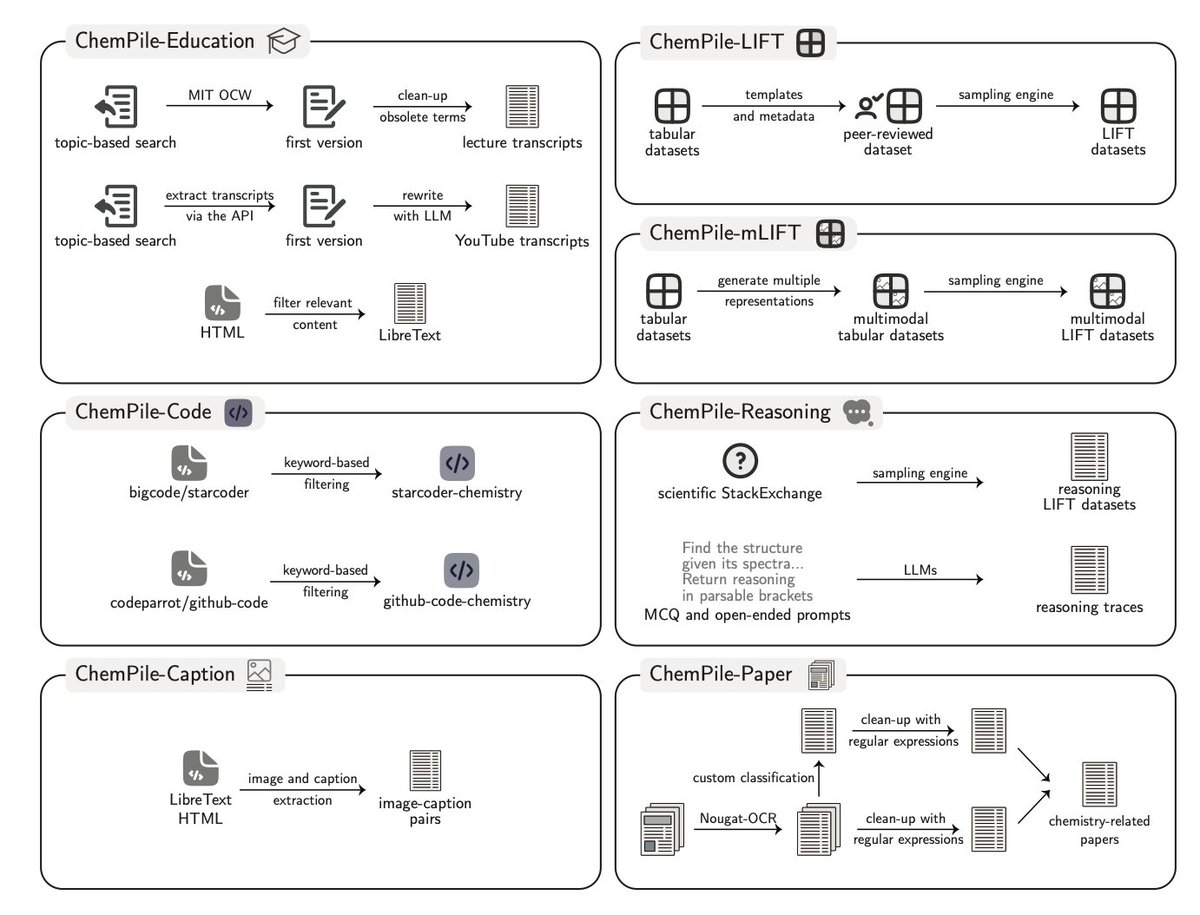
1.This paper introduces ChemPile, the largest open-source, expertly curated dataset (250 GB, 76.7B tokens) tailored for training foundation models in chemistry—addressing the current lack of diverse, high-quality, multimodal chemical data.
2.ChemPile mirrors the way human chemists learn: it integrates seven curated subsets spanning educational texts, scientific papers, structured data, reasoning traces, executable code, and image–text pairs—enabling LLMs to acquire conceptual, procedural, and multimodal knowledge.
3.The dataset includes multiple chemical representations (SMILES, SELFIES, InChI, IUPAC, images), allowing models to learn structure–property–function relationships across representations—a feature lacking in nearly all existing chemical corpora.
4.ChemPile-LIFT and mLIFT subsets contain over 45B tokens of structured tabular data paired with natural language templates, enabling pretraining on tasks like property prediction, synthesis planning, and inverse molecular design.
5.The ChemPile-Code subset includes chemistry-specific code filtered from StarCoder and CodeParrot, capturing simulation, data analysis, and domain-relevant tooling—bridging chemical language with computational workflows.
6.ChemPile-Reasoning contains over 20M tokens of structured problem-solving data from StackExchange and LLM-generated reasoning chains for tasks like spectral interpretation—offering rare access to step-by-step chemical reasoning examples.
7.The Caption subset provides over 100,000 image–text pairs extracted from LibreTexts Chemistry, enabling multimodal pretraining on diagrams, molecular renderings, and experimental setups with associated captions.
8.Unlike many web-scale corpora, ChemPile is not scraped indiscriminately. It underwent hundreds of hours of expert filtering, cleaning, deduplication, and template design—ensuring domain relevance and ML-readiness.
9.It includes a robust train/val/test split design that avoids chemical structure leakage across partitions, making it suitable for benchmarking foundation models and pretraining experiments in property prediction or generation tasks.
10.Evaluation of representation quality shows that IUPAC name embeddings correlate more strongly with molecular similarity than SMILES or SELFIES—suggesting new directions for chemically-informed tokenization and embedding strategies.
11.ChemPile is designed for modular use: subsets can be independently loaded via HuggingFace with a unified API, or combined for large-scale training and finetuning across different chemical subdomains and modalities.
12.By covering everything from textbook knowledge to cutting-edge research papers and executable workflows, ChemPile lays the foundation for general-purpose, interpretable, and multi-capable chemical AI systems.
📜Paper: https://t.co/OyOQwYF9CK
💻Code: https://t.co/CcRf8yglPY
#ChemicalAI #FoundationModels #ChemNLP #MultimodalData #OpenScience #MachineLearning #ComputationalChemistry

@MartinMachava1 I used VSCode extension Continue with local LLMs too. qwen for code gen and starcoder (i think) for auto-complete.
For basic code blocks, I find that functionality useful for saving time.
I even dockerized Ollama to put the workload on a server. Love Docker!

Haftanın en önemli yapay zeka gelişmeleri 👇
🌐 Microsoft ile Mistral ortaklık kurdu.
🤖 Google ile Stack Overflow'un Gemini için ortaklık kurdu.
🔓 Morris II adında ilk AI virüsü geliştirildi.
🌟 Mistral AI, Le Chat'i tanıttı.
✨ BigCode, AI destekli gelişmiş kod yazma aracı StarCoder 2'yi tanıttı.
🎥 Lightricks, AI destekli film yapma aracı LTX Studio'u tanıttı.
🎶 Adobe, AI destekli müzik aracı Project Music GenAI Control'u tanıttı.
💻 GitHub, AI destekli kod tamamlama aracı Copilot Enterprise'ı genel kullanıma açtı.

دردشة GitHub Copilot متاحة الآن لجميع المستخدمين! 🎉
👩💻 تعد Copilot Chat، المدعومة بـ GPT-4، أداة مطور(Developer) الذكاء الاصطناعي الأكثر استخدامًا على نطاق واسع، حيث توفر إرشادات في الوقت الفعلي في IDEs من Microsoft: Visual Studio Code وVisual Studio.
�� يمكن للمطورين طرح الأسئلة باللغة الطبيعية أو البحث عن تفسيرات أو اكتشاف الثغرات الأمنية أو حتى إنشاء اختبار الوحدة (unit test).
🌐 متوفر كجزء من طبقات GitHub Copilot المدفوعة، مجانًا للمعلمين والطلاب ومشرفي بعض المشاريع مفتوحة المصدر.
💰 على الرغم من التحديات، تضم Copilot مليون مستخدم مدفوع الأجر وحوالي 37000 عميل من المؤسسات. يهدف GitHub إلى البقاء في المقدمة في اللعبة، مما يضمن بقاء Copilot جذابًا ومربحًا.
💸 تبدو تحديات التكلفة التي يواجهها برنامج Copilot واضحة، حيث يخسر متوسط 20 دولارًا لكل مستخدم شهريًا. يواجه GitHub منافسة من CodeWhisperer من Amazon، والذي يقدم اقتراحات محسنة لتطوير التطبيقات على MongoDB.
🤖 يشمل منافسو Copilot شركات ناشئة مثل Magic وTabnine وCodegen وLaredo ونماذج مفتوحة المصدر مثل Meta's Code Llama وHugging Face's StarCoder.

StarCoder Memorization Checker
This ability of LLMs to learn their training set by heart can pose huge privacy issues, as many large-scale Conversational AI available commercially collect users' data at scale and fine-tune their models on it.
This means that if sensitive data is sent and memorized by an AI, other users can willingly or unwillingly prompt the AI to spit out this sensitive data. 🔓
To raise awareness of this issue, we show in this demo how much StarCoder, an LLM specialized in coding tasks, memorizes its training set, The Stack.
We found that StarCoder memorized at least 8% of the training samples we used, which highlights the high risks of LLMs exposing the training set. We provide a notebook to reproduce our results here. 👈
To evaluate memorization of the training set, we can prompt StarCoder with the first tokens of an example from the training set. If StarCoder completes the prompt with an output that looks very similar to the original sample, we will consider this sample to be memorized by the LLM. 💾
https://t.co/o1z7GPC5NI
The StarCoder models are 15.5B parameter models trained on 80+ programming languages from The Stack (v1.2), with opt-out requests excluded.
https://t.co/PHwmOv0uRd

Y llegó starcoder... 🏃
https://t.co/0jecxBvUw5

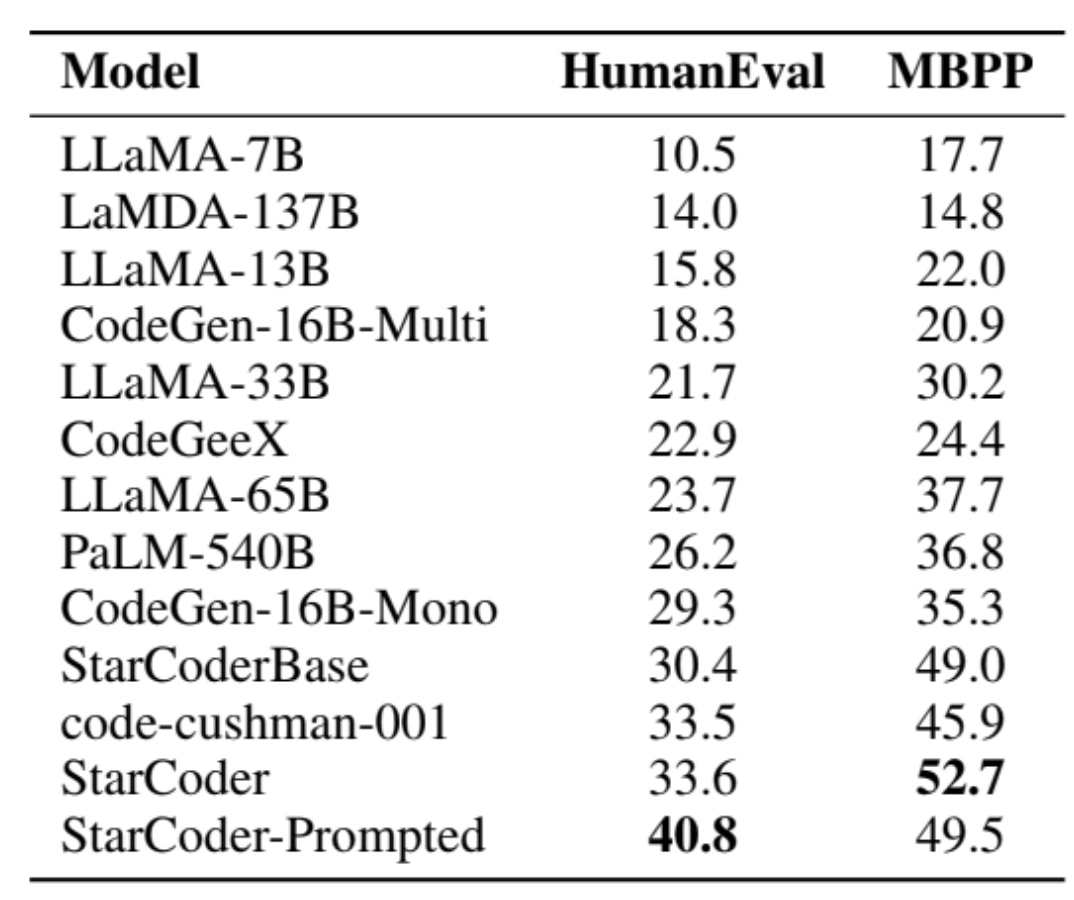
Last week we released StarCoder, a state-of-the-art code LLM with 15B parameters. With the release of StarCoder we also conducted a comprehensive evaluation of code LLMs.
Some interesting findings and how we got there ✨:
StarCoder: Dataset Search 🔍
When using StarCoder to generate code, it might produce close or exact copies of code in the pretraining dataset. Identifying such cases can provide important context, and help credit the original developer of the code.
https://t.co/I89menpJwb
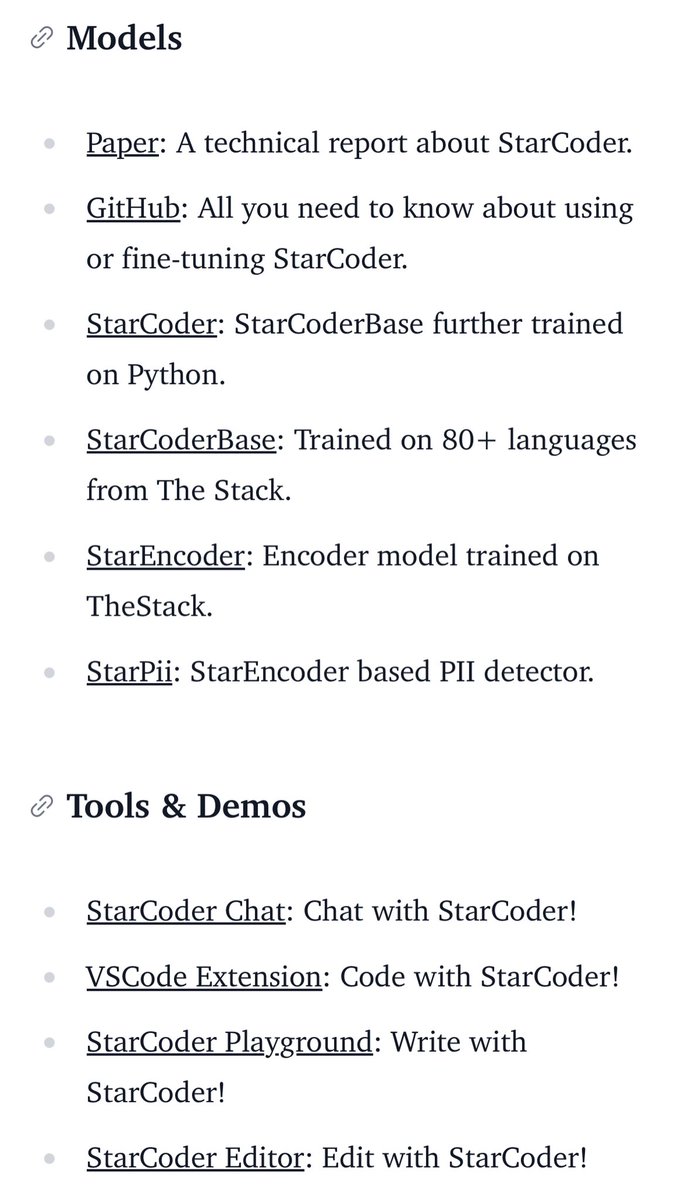
StarCoder Editor
This is a demo to interactively generate code with StarCoderBase, a 15B parameter model for code generation in 86 programming languages.
https://t.co/ZDHqeVcwA7
StarCoder and StarCoderBase are Large Language Models for Code (Code LLMs) trained on permissively licensed data from GitHub, including from 80+ programming languages, Git commits, GitHub issues, and Jupyter notebooks.
All details here 👉 https://t.co/eWKuXE1cY1


Trends for you
Most Popular Users

Elon Musk 
@elonmusk
239.8M followers

Barack Obama
@barackobama
118.6M followers

Cristiano Ronaldo
@cristiano
114.3M followers

Donald J. Trump
@realdonaldtrump
111.7M followers

Narendra Modi
@narendramodi
106.9M followers

Rihanna
@rihanna
98.6M followers

NASA
@nasa
92.1M followers

Justin Bieber
@justinbieber
91.7M followers

KATY PERRY
@katyperry
89.9M followers

Taylor Swift
@taylorswift13
83.9M followers

Lady Gaga
@ladygaga
75.4M followers

Virat Kohli
@imvkohli
73.3M followers

Kim Kardashian
@kimkardashian
70.8M followers

YouTube
@youtube
68.6M followers

Neymar Jr
@neymarjr
66.3M followers

Bill Gates
@billgates
65.1M followers

Selena Gomez
@selenagomez
63M followers

The Ellen Show
@theellenshow
62.1M followers

CNN
@cnn
61.7M followers

X
@x
60.6M followers