

Top Tweets for #submodule

So what can you do with DotNetDocs?
- Document open source .NET libraries
- Document large-scale internal company apps across multiple components using Git submodules + sparse checkouts
- Create OpenAPI playgrounds
- Build company brains
- Create React-powered components & pages

@grok “历史commits、artifacts、submodules可能残留旧信息。”关于这一点你也可以grep查询一下

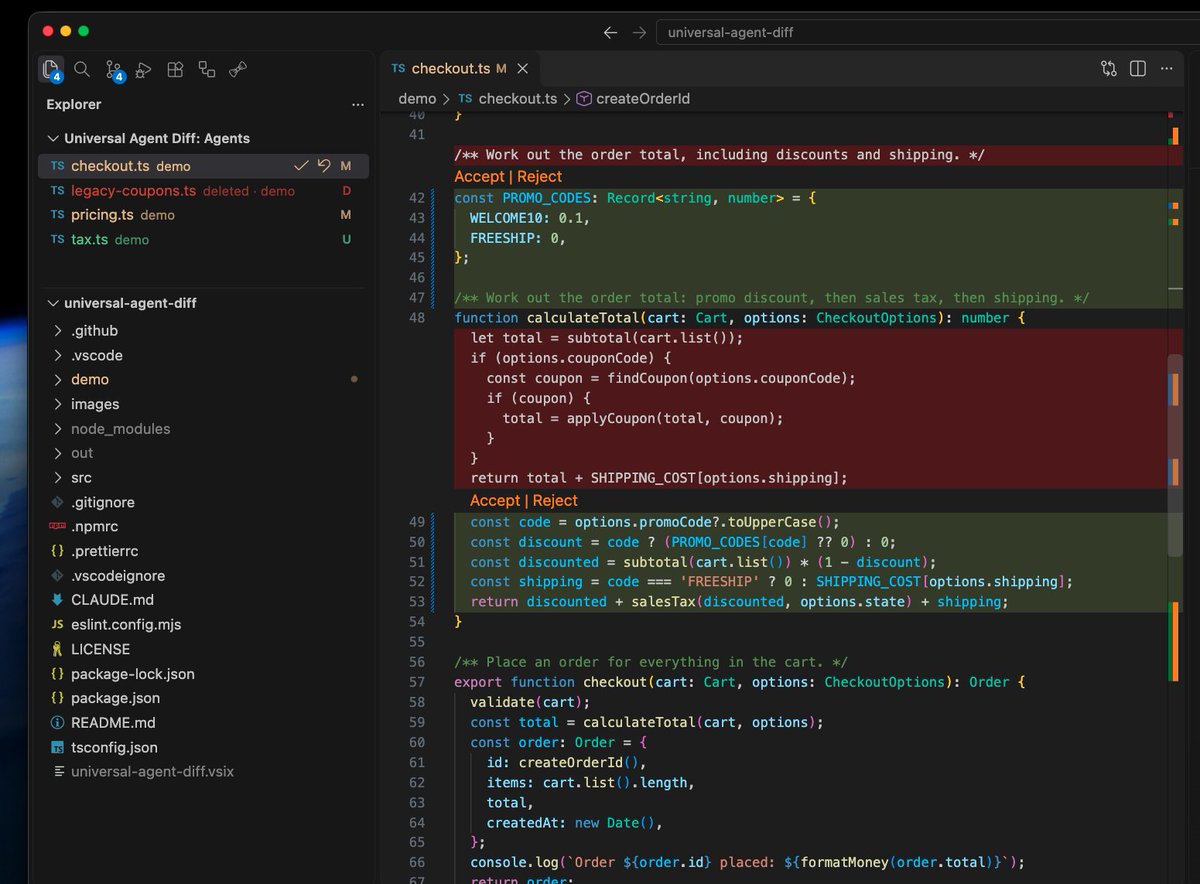
v1.2 of Universal Agent Diff is out. Every fix came from user reports:
- every repo in multi-root workspaces
- nested repos + submodules
- all env files (.env.local, .envrc…)
- fixed an endless git loop with fsmonitor
https://t.co/QCtbJC2BLj
Google killed the Antigravity IDE, so I rebuilt its review flow as an open-source VS Code extension.
It watches files on disk and diffs against Git, so it works with any agent: Claude Code, Codex, Copilot, scripts. Accept or reject each change. Restore deleted files in one click.
https://t.co/8uTqpn66TV

@AIandDesign @spawn Is Claude driving the car and recording the video on your local computer? Can I sync a GitHub repo with submodules to spawn?

Git 3.0 defaults to SHA-256 and the HN consensus is it's another IPv6. Non-backwards compatible, nebulous benefits, tooling nowhere near ready. Submodules break. Nix breaks. Yocto has thousands of hardcoded hashes per project. The migration is simple they said.

Rust's UEFI TcpStream just got real. A fix for nodelay and zero timeouts landed in std::net, closing a silent footgun for embedded targets.
LLVM submodule moved to release/23.x, standard rollup churn.
Miri deprecated its 'lenient' shim signature check. The old path stays, but new code should expect stricter validation.
crates․io frontend updated storybook to 10.5.10 and vite to 8.2.2. Lock file maintenance as usual.
Rust's UEFI networking stack matures one patch at a time. Keep an eye on the next nightly for TcpStream behavior changes. #rustlang
https://t.co/6DedlFYEJ7
Rust's `extern "C-unwind"` ABI stabilized. The custom calling convention that lets C code safely unwind through Rust (and vice versa) is no longer unstable; it ships in the next release.
Cargo's submodule bumped across the Rust repo. Routine sync but worth noting if you're tracking compiler internals.
`MaybeBorrowedLocals` simplified in the borrow checker. Compiler team trimmed dead code paths; one less thing to reason about in the MIR analysis layer.
Debuginfo test suite migrated to `lldb-repr`. The `pretty-std․rs` tests are now formatted for LLDB's representation, aligning the test harness with modern debugger output.
Rust's thanks tool bumped to edition 2024. Also switched repo refresh from CLI flags to environment variables, and set `line-tables-only` debuginfo in release builds to cut binary size.
Miri synced with nightly. Bless, fmt, clippy all in; the interpreter stays current with the compiler. #rustlang
https://t.co/FoN5n5DYOb

Finally got my URL Shortener working
Using Node.js + Express. Learned how APIs, routes, and redirects actually work.
Again I created a nested .git repo and Git treated it like a submodule. 🤡
Here is Link:-https://t.co/kMgb4UDVDH
#LearningInPublic #WebDevelopment #NodeJS
Finished my Notes Backend project
Faced a GitHub issue where one folder wouldn’t open after push. Cause: accidentally created nested .git, making it act like a submodule.
https://t.co/WXH6AJ8Y8G

today's (14-06-2026) logs:
-Django apps (basically a python package which is specifically meant for Django project, or we can say a submodule of a Django project).
command for creating Django app:
$ python https://t.co/DaSfO7PpN2 startapp employee
(employee is the app name you can write your own).
we create app for building specific features.
learned about app level directory.
created superuser using
$ python https://t.co/DaSfO7PpN2 createsuperuser
this gives credentials to login into admin panel
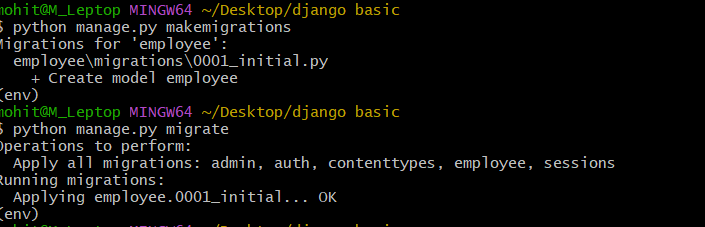
created model for employee app and registered our model in https://t.co/hmYyw0jb7m module then migration comes in picture:
$ python https://t.co/DaSfO7PpN2 makemigration
this reads https://t.co/RPr81v0iwn looks for any changes or modifications or newly created classes and creates migration file (here, in my project 0001_initial.py) with sql commands.
$ python https://t.co/DaSfO7PpN2 migrate
executes the sql commands that are in our migration file (in my case its 0001_initial.py)
exploring more.



Rust Learning Log: Names, Boundaries, and How Rust Scales
Over the last few days, I've been learning how Rust organizes code: modules, paths, visibility, and navigation.
Rust keeps large codebases readable, intentional, and composable as they grow.
Everything still builds on the same theme: clarity over convenience.
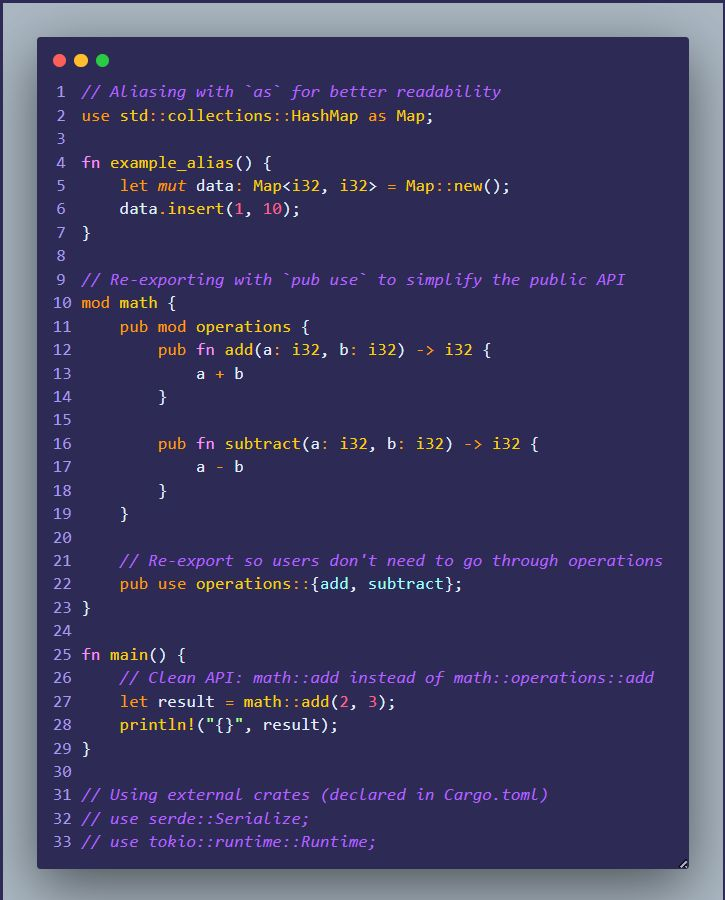
Creating Aliases With 'as':
Sometimes a name is technically correct but not ergonomic. Instead of forcing you to live with awkward names, Rust lets you rename things locally.
This doesn't change the original item. It just improves how you interact with it.
That feels very Rust. No global side effects. No hidden behavior. Just explicit, scoped clarity.
It made me think more carefully about how naming affects readability.
pub use for Clean Public APIs:
Using pub use to re-export names from submodules was a big one for me.
Instead of exposing your internal structure directly, Rust lets you shape how others see your code.
Internally, things can be deeply nested. Externally, you can present a clean, intentional interface.
In Solidity, you typically expose what's public in a contract, and the structure you choose internally is what users interact with. There's not as much flexibility to reshape the public interface separately. Rust gives you more control with pub use to hide implementation details while keeping the API simple.
Even as a learner, I can see how this would matter in larger systems.
External Crates:
Instead of reinventing everything, Rust encourages reuse, but in a controlled, explicit way. You don't accidentally depend on something. You choose it.
That explicitness around dependencies feels especially important for reliability and security focused work.
Dependency management can get messy with transitive dependencies and version conflicts in some languages. Rust's Cargo handles this more deliberately, and you always declare what you're using in Cargo.toml.
The Standard Library:
Learning about the standard library was interesting because of what it isn't.
It's not massive. It's not trying to do everything.
Instead, it provides carefully chosen building blocks: types and tools that align tightly with Rust's core philosophy.
That restraint feels like Rust wants you to understand fundamentals deeply, rather than rely on abstractions that hide complexity.
As I move deeper into modules and crates, I'm starting to see Rust as a language obsessed with boundaries.
Boundaries between modules, between public and private, between internal structure and public API, between your code and external dependencies.
Every tool I learned today exists to help manage those boundaries cleanly: as for local clarity, pub use for API design, external crates for controlled reuse, and a focused standard library that doesn't try to do everything.
Rust is slowly teaching me how large, maintainable systems are designed, not just how code compiles.
In the codebases you work with, how much thought goes into API design versus just making things work? Do you reshape interfaces later, or plan them upfront?
#Rust #RustLang #LearningRust #SystemsDesign #Blockchain #Solidity #SoftwareArchitecture

Hot take: most repos are not structured for AI-driven development.
They are structured for teams.
Not for how we build now.
Earlier we had:
backend repo
frontend repo
mobile repo
Very clean separation.
But terrible context during development.
Because one feature is never “just backend”.
It touches API, web, and mobile together.
If everything is split, the dev (and AI) only sees partial context.
That leads to half changes, drift, and mismatch bugs.
We didn’t want a full monorepo either.
Putting backend + apps in one giant repo becomes heavy and messy at scale.
So we moved to a hybrid structure.
Backend = separate repo (strict boundary)
Apps = one monorepo submodule (frontend + mobile together)
Root repo = pulls both using submodules
Now during development, the workspace has full system context.
This is where the AI part actually matters.
When the AI works, it can see:
backend contracts
API usage in frontend
mobile flows
shared types
So instead of making isolated edits, it can update web + mobile + API logic in one pass.
Earlier:
AI updates backend
Frontend breaks
Mobile not updated
More manual fixes later
Now:
AI sees the full flow.
Changes stay consistent across apps.
Frontend and mobile being in one submodule is intentional.
They share logic, UI patterns, and API usage.
So keeping them together gives better context for both devs and AI.
Backend still stays separate for infra, security, and deployments.
But dev workspace is unified enough for AI-assisted development.
Not hype.
Just repo structure optimized for how AI-assisted coding actually works.


That's exactly why I built SolopreneurOS.
It's a complete business intelligence system inside Notion, built specifically for solopreneurs who are done operating on gut feel.
11 modules. 35+ submodules. All connected.
One dashboard that tells you the truth about your business.
SolopreneurOS is the missing layer.
11 modules. 35 submodules. All connected.
It doesn't make you "more productive."
It makes every decision data-informed:
- Which offer to build next
- Where marketing money goes
- Which clients are worth it

just deleted a package by mistake
had a problem with CI saying it couldn't run bun i --frozen-lockfile, so i cloned a fresh version from git, ran bun i and pushed, then deleted my old working folder
turns out, it had a .git file inside so github thought it was a submodule and was not in vcs
luckily wasn't a lot of work on there

Vix.cpp builds cleanly on Linux and macOS.
Windows is still in progress and I’m actively fixing it.
Linux/macOS users can already try it today: clone the repo and init the required modules (submodules).
Windows support is coming next.
Repo: https://t.co/yizE9tKR0O

That's exactly what I built with SolopreneurOS in Notion.
11 modules. 35 submodules.
Designed for solopreneurs operating at scale.
This isn't another Notion template.
It's 11 modules, 35+ submodules, all connected:
Business strategy → Execution → Finance → Marketing → CRM → Legal
Everything talks to everything. No redundancy. No chaos.

@tsybalab Treating your repo like a lab is exactly how experimentation turns into real innovation. Shared submodules, reproducible installs, and hands-on testing make learning and building way faster. Labs > guesswork every time.

When I say experience, I also mean my own...
For work on Python & TypeScript Porto SDK's, I develop the Lab where I may work on each together-separately.
JSON data 'porto-data' and 'porto-features' Gherkins are shared submodules.
Labs are where devs experiment and test anything, right in the repo with full package installation for reproducibility.
#indiedev #buildinpublic #lickoapp #dx #devex


BUILD IN PUBLIC - Friday Progress 🚀
✅ MOBILE – Progress on authentication
✅ FRONTEND – Experimented GitHub submodules for better code organization
🤝 Community – Met a new new expat who moved to Albania
⚠️ Reality – Plumber no-show, schedule reshuffling


Everyone says, “I know Git”
until Git says, “prove it.”
Here’s Git from zero to god mode, the way devs actually grow 👇
Level 0: Just trying to survive
git init
git clone
git status
git add
git commit
git log
git diff
git show
git help
Level 1: Solo developer
git branch
git checkout
git switch
git restore
git push
git pull
git fetch
git remote
git tag
Level 2: Team & collaboration
git merge
git rebase
git pull --rebase
git cherry-pick
git stash
git stash pop
git stash list
git blame
git shortlog
Level 3: “I broke something”
git reset
git reset --soft
git reset --mixed
git reset --hard
git revert
git reflog
git clean
git fsck
Level 4: Debug like a senior
git bisect
git grep
git log --oneline --graph
git log --author
git log --since
git describe
Level 5: Monorepos & scale
git worktree
git submodule
git submodule update
git sparse-checkout
git archive
git bundle
Level 6: Black-magic Git
git rebase -i
git filter-branch
git filter-repo
git replace
git rerere
git notes
git maintenance
If you know:
reflog → you’re fearless
rebase -i → you’re clean
bisect → you’re dangerous
Git isn’t about commands.
It’s about not panicking when everything is on fire 🔥

LensAI Daily Update: Ok, not much to share today. I've been trying to do marketing on Reddit all day.
Gaining karma is hard, being a good Redditor and promoting your startup is x10 hard. X feels much better 😅
If you curios what LensAI is, we help SaaS companies to attribute LLM costs to different parts of your product - users, sessions, submodules, etc
11 interconnected modules. 35+ submodules:
🧭 Business Architect
⚙️ Execution Engine
🧪 Offer Development Lab
🚀 Marketing Command
🧠 Content Engine
🤝 Client & Partner CRM
💰 Finance Hub
📚 Knowledge Hub
🔁 Reflection & Optimization
💪 Founder OS
��️ Legal Hub
Last Seen Hashtags on Sotwe
Most Popular Users

Elon Musk 
@elonmusk
239.7M followers

Barack Obama
@barackobama
118.6M followers

Cristiano Ronaldo
@cristiano
114.3M followers

Donald J. Trump
@realdonaldtrump
111.7M followers

Narendra Modi
@narendramodi
106.9M followers

Rihanna
@rihanna
98.6M followers

NASA
@nasa
92.1M followers

Justin Bieber
@justinbieber
91.7M followers

KATY PERRY
@katyperry
89.9M followers

Taylor Swift
@taylorswift13
83.9M followers

Lady Gaga
@ladygaga
75.4M followers

Virat Kohli
@imvkohli
73.3M followers

Kim Kardashian
@kimkardashian
70.8M followers

YouTube
@youtube
68.6M followers

Neymar Jr
@neymarjr
66.3M followers

Bill Gates
@billgates
65.1M followers

Selena Gomez
@selenagomez
63M followers

The Ellen Show
@theellenshow
62.1M followers

CNN
@cnn
61.7M followers

X
@x
60.6M followers