Everyone wants to know which database is the best.
- Netflix uses Cassandra.
- Instagram scaled with PostgreSQL.
- Twitter built huge parts of its timeline system around Redis.
Three billion-dollar companies.
Three completely different choices.
Because they weren't choosing databases.
They were solving problems.
Netflix needed to handle an endless flood of writes.
Instagram needed to manage relationships between users, posts, comments, and likes.
Twitter needed timelines to load instantly.
Different problems.
Different tradeoffs.
Different architectures.
One mistake I see founders make all the time:
They design systems for Netflix scale before finding their first 100 customers.
Meanwhile PostgreSQL could probably support them for years.
The best database isn't PostgreSQL, MongoDB, Cassandra, or Redis.
The best database is the one that matches how your application accesses data.
Technology decisions get much easier when you stop asking:
"What's the best tool?"
And start asking:
"What problem am I actually solving?"
There are 2 types of people:
• People who wear a Whoop despite the discomfort because they want to track their health.
• People who wear a Whoop without a subscription.
PS: I'm not talking about Whoop
I met Kate’s parents.
It was a nail bitter.
We landed after 24 hours of travel and immediately went to her mum’s house where the family congregated… her mum, dad, auntie, three cousins, sister, brother-in-law, a 3-wk old newborn, brother, and soon-to-be sister-in-law. There were 15 of us crammed into a living room.
Upon arriving, someone said “oh I know your content from X”.
Blood drained from my face. Nobody could tell though because my face is already pretty pale.
Her dad and I hit it off. We cracked macadamia nuts from his tree, used an electric saw to open a coconut, and spoke about being carried as a baby by his 14 year old brother in the Bosnian snow while a German shot at them with a machine gun.
Her mother, also from Bosnia, needed some time to warm up. That’s reasonable. I understand. I’m a bit unusual. She’s soft spoken, careful with her words, and protective of her daughter. A few days in and I began to worry that I may head home with an undecided verdict.
I decided to live in her mum’s world. I ate everything she prepared, including meat, bread, and pasta, and embraced the discomfort of being an introvert in a week-long marathon social interaction with the entire extended family.
We spent time in her garden and she fed me stevia leaves, peppers, celery, chives, peanut berry, grapefruit, and starfruit.
Growing up, my mother and I maintained a garden together. I loved tending to it daily and it felt good to be back in the soil. Spending time with Kate’s mum motivated me to grow a longevity garden.
Our shared love of gardening was the first big breakthrough.
What really sealed the deal was when I interviewed Kate’s mum for an hour on camera, covering her upbringing and life and learning more about Kate. Somehow that format allowed her to see me more clearly than a generic social setting.
I think she came to understand and trust my devotion to Kate.
In the final hours before my departure, she was radiating with warmth. The entire family had gathered for a meal and it was laughter and teasing all around.
My love and respect for Kate deepened. I spent time going through all of her childhood things, helping me see and understand her with greater depth. More on this later.
It feels nice to be part of the family.
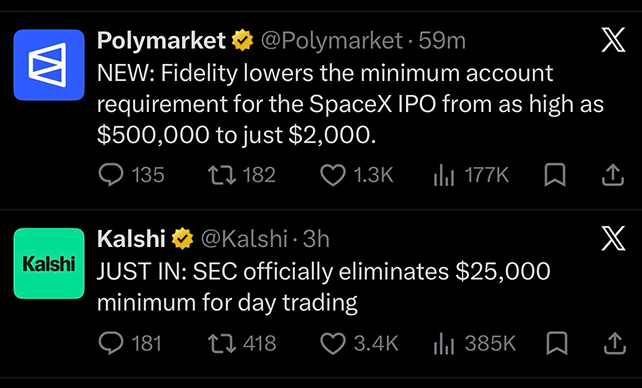
Trillion $$ IPOs for companies losing billions at 100x revenue.
Laws changing to force them into 401ks.
This shit.
Fuck dude. We are heading toward something dark.
One of our biggest projects almost became one of our biggest invoices.
Last June, a founder approached us with an idea for a marketplace in Dubai. The vision was ambitious, and honestly, the market opportunity caught our attention immediately.
As we started discussing the project, the scope naturally grew.
Vendor onboarding, inventory management, custom workflows, mobile apps, analytics, reporting. Every conversation added something new, and with every new feature, the development budget kept increasing.
Most agencies would have happily quoted the larger number.
But the more we studied the market, the more we felt the software wasn't the biggest challenge.
The opportunity was huge.
The real question wasn't whether the platform could be built. It was whether enough buyers and sellers could be brought together fast enough to create momentum.
I still remember telling the client something that probably sounded strange coming from a software company.
"Let's cut down the development scope."
Instead of building everything upfront, we suggested launching with a lean MVP and putting more of the budget into marketing, partnerships, and growth.
The truth is, if this succeeds, nobody will remember how many features version one had.
They'll remember how quickly it gained traction.
At Beitroot, we've never been interested in chasing hundreds of small projects. We'd rather work with a handful of founders we genuinely believe can build something meaningful.
Sometimes the best client relationships start when you make less money today because you believe they'll create something much bigger tomorrow.
Being a development agency gives us a unique advantage.
We sit with founders every week across different industries, so over time you start noticing patterns. You see where startups usually struggle, where they overspend, and what actually moves the needle.
In this particular case, two things stood out.
First, the founder had a lot of energy and was willing to execute, which matters more than most people think.
Second, we saw a clear market gap. Similar marketplace models have worked extremely well in neighboring countries, but the local market was still relatively underserved.
That made us feel the bigger risk wasn't building the product. The bigger risk was getting distribution right and capturing the opportunity before someone else did.
That's why we pushed for a leaner MVP and more focus on growth.