

Top Tweets for #validator

At mainnet, GenLayer will open a limited number of validator positions..
The Foundation backs each of these positions with its own GEN..
These backed spots are called node seats.
Holding a node seat makes you a validator.. your node participates in judging transactions on the network and earns a fee in GEN for every case it processes.
The Foundation’s GEN provides the initial backing so the seat can start operating.
The seats are not distributed equally.. Tthey are split according to Staking Points and eery GEN you stake earns one point per day.
The final allocation uses a snapshot taken shortly before mainnet so rankings can still change until that moment.
There is one extra requirement. To qualify for a seat, a node must have already run for at least 30 days on Clarke, the testnet that comes before mainnet..
Each seat needs its own node and if you want three seats, you need three separate nodes that each meet the 30-day condition.
You don't have to run the hardware yourself.. a Node-as-a-Service partner can operate the node for you, and the seat still belongs to you.
🔚 In short Pre-Mainnet Staking decides how the seats are shared.. points determine the size of your share and an eligible node determines whether you can claim it..
Those who meet both conditions start as validators backed by the Foundation when mainnet launches.
@GenLayer


This ride looks fun🎢
But on Solana getting a transaction included shouldn’t feel like a roller coaster @raikucom lets apps coordinate with validators and reserve blockspace ahead of time
Less uncertainty for builders Smoother ride for users
@widyakrnwn @duckk9x @_offmylawn

Building something great takes creativity and the right foundation 🏖️
That’s @raikucom on Solana helping apps coordinate with validators and secure blockspace so important transactions land more reliably
One block at a time
@widyakrnwn @duckk9x


Gmum
The Economics of Faster Block Propagation ⚡
Ethereum's performance depends on more than transaction execution. How quickly block data reaches validators across the network also plays an important role.
A recent research spotlight by @DefiLlama explores how @get_optimum is improving Ethereum's block propagation through mump2p, and why these improvements could have an economic impact.
Here are some interesting findings from the research.
1. Faster block delivery with mump2p
Optimum's mump2p uses Random Linear Network Coding (RLNC) to make data propagation more efficient.
Rather than simply forwarding individual packets, nodes exchange coded combinations of data. Receivers can then reconstruct the original data after collecting enough independent packets.
According to the research, mump2p accelerated block delivery in 91.6% of observed slots between November 4–11.
The measured propagation spread was:
• mump2p: 181.8ms
• libp2p: 388.8ms
That's a substantial difference in how quickly block data propagates across the network.
2. Improving validator performance
Block arrival time matters for Ethereum validators.
When a validator receives block information late, it may vote for an outdated chain head, resulting in a wrong head vote.
Optimum's Impact Report recorded an average 34.3% reduction in wrong head votes across participating operators between its two measurement periods.
This highlights how better network propagation can help validators make more timely decisions.
3. The economic impact on block proposers
One of the most interesting parts of the research focuses on MEV-Boost.
Block proposers face a trade-off: publish a block early to give it enough time to propagate, or wait longer to potentially receive better builder bids.
Faster propagation can give proposers more flexibility.
In six mainnet experiments, blocks could be published approximately 160ms later without an increase in orphaned blocks.
Based on these experiments, Optimum modelled a potential 8.4% uplift in builder bids.
This is a modelled opportunity, not a guaranteed increase in proposer revenue.
4. Growing network participation
The research also highlights the growth of stake connected to Optimum's network.
Connected stake increased from approximately 1.42 million ETH at launch to 3.44 million ETH by November 10, representing around 7.9% of Ethereum's staked ETH.
Operators including ether.fi, Blockdaemon, Everstake and P2P.org are among those participating.
The bigger picture
What makes this research interesting is the connection between networking infrastructure and Ethereum's economics.
Better block propagation isn't just about making data travel faster. It can influence validator performance, give block proposers more flexibility and potentially create better economic opportunities.
These improvements happen beneath the surface of Ethereum, but their impact can extend across the entire ecosystem.
It's worth taking a closer look at what Optimum is building.
Full research by DeFiLlama:
defillama.com/research/spotl…
@get_optimum
@discordflash
@CryptoSundayz
@tgogayi
@aqccapital
@TheBl0ckBoy
@ada_pegasus


The @defillama_res team with a great look at the performance, adoption, and economic benefits of mump2p. 👇

Multi-Core Hardware Scaling
4) Sequential chains leave modern multi-core validator CPUs 90% idle. By mapping execution graphs at block ingress, @PrismaXai scales throughput linearly with hardware cores while keeping 100% EVM bytecode compatibility.

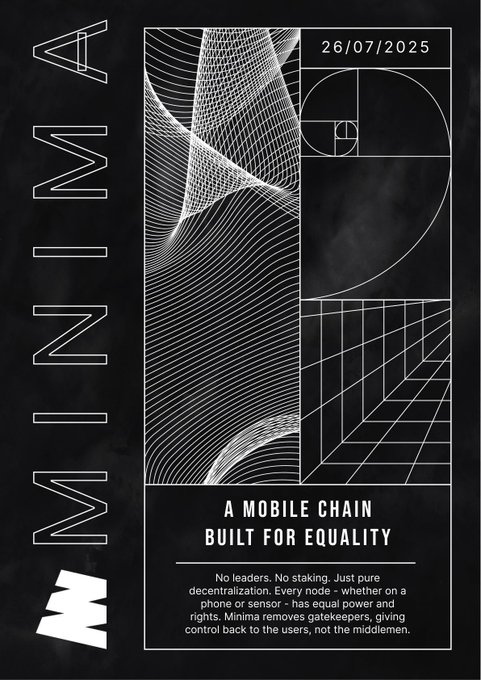
What if a blockchain worked like air - invisible, everywhere, and essential? Minima isn’t just another Layer 1
It’s a new kind of infrastructure: → Permissionless → User-run → Truly decentralized
Let me explain Most chains depend on validators, miners, or centralized servers
@Minima_Global flips that Every phone. Every IoT device. Every node is equal
No leaders. No staking. No rent-seeking. Just pure decentralization
They call it: Zero-Infrastructure Blockchain
That means no reliance on cloud hosting, VMs, or data centers. Run a full node on your phone, even offline Minima makes decentralization default
Why does that matter?
→ Resilience during censorship
→ Real accessibility in low-resource regions
→ No privileged class of validators
Minima doesn’t scale up. It scales out - across the devices you already own
And here’s the kicker: Every API call, every tx burns minima:native
→ No inflation games
→ No Ponziomics
→ Utility is baked into the protocol
Use = burn. Burn = value
Minima isn’t just theory. It’s live

The Solana validator set for this address likely relies on a distributed key management system, which could introduce slight latency variations across nodes.

This makes validator selection much fairer and harder to manipulate with sudden capital inflows.

good night everyone
HOW ARE YOU?????????
The next wave of blockchain adoption probably won’t come from pure speculation. It’ll come from people who can actually use the assets.
@MMIX_io is building a permissioned L1 with vetted projects and known validators. Focus on RWAs, payments, eCommerce, hospitality and more.
Mainnet planned for 2027. Early days, but the direction makes sense.Most chains still optimize for volume. MMIX is optimizing for who is allowed to build and what they can actually do with the assets once they are onchain.
The districts are free to mint on Ethereum. You discover the size of your land there. You discover what is built on it on MMIX.If you are already looking at real-world utility instead of another meme, this is the one worth watching. The whitelist is still open.

GOOD evening everyone
The next wave of blockchain adoption probably won’t come from pure speculation.
It’ll come from real economic activity.
@MMIX_io is positioning itself for that. Permissioned L1.
Vetted projects only. Known validators. Focus on RWAs, payments, eCommerce, hospitality and more. Mainnet planned for 2027.
Early days, but the direction makes sense.Most chains still optimize for volume.
MMIX is optimizing for who is allowed to build and what they can actually do with the assets once they are onchain.
The districts are free to mint on Ethereum. You discover the size of your land there.
You discover what is built on it on MMIX.


auto staking unclaimed tokens from day one makes earning validator seats seamless

13 tries and still locked out that multi validator wizard is built different

Time-weighted staking makes validator selection harder to game with last-minute capital influxes

.
𝗢𝗽𝗽𝗼𝗿𝘁𝘂𝗻𝗶𝘁𝘆 𝗶𝘀 𝗸𝗻𝗼𝗰𝗸𝗶𝗻𝗴 . . .
@FinTechWilliam's Strategy:
Commercialize @Algorand superior technology to generate recurring revenue that funds algorand:native buybacks, strengthen validator rewards & support the wider ecosystem; retail will follow.

I think some in the $ALGO community are missing the bigger picture of William Herkelrath’s strategy.
He isn’t focused on generating short-term retail hype. He’s looking to commercialise #Algorand’s outstanding technology by selling enterprise services to institutions that need them.
The goal? Sustainable recurring revenue that can fund $ALGO buybacks, strengthen validator rewards and support the wider ecosystem.
Instead of relying on retail investors to drive demand (where realistically that demand may not come), build a commercially successful business that creates genuine, sustained demand for $ALGO.
And the irony? If that strategy succeeds, retail investment will likely follow anyway.
Build real value first. Let the market recognise it later.
That’s a far more compelling long-term strategy, in my view. 🚀
Just 🐝
#Agorand $Algo $Monko @Algorand


Arbitrum Nitro should help with faster finality for those optimistic validators.

Strong collab alert
@Farooxyz × @OriginStake is expanding liquid staking opportunities on Pharos Network.
Professional high-performance validators + enterprise-grade protection mean more reliable yields for stPROS holders.
Building better staking infrastructure together!

لو المراجع من نفس عائلة الكاتب، هيسامح أكتر مما تستاهل الورقة. الأفيد محكّم بموديل مختلف، وrubric يتقاس على تقييم بشر.
ورقة Who Validates the Validators بتشرح المشكلة دي: arxiv.org/abs/2404.12272

Early positioning could make a big difference for future validator seats

MMIX
A permissioned L1 built for real economic activity.
Vetted projects, known validators, RWAs and payments—mint on Ethereum, build on MMIX.

🐝 Buzzchain is exploring a new way to connect social engagement with blockchain infrastructure.
Proof of Engagement, Validators, and Loudness make this testnet worth watching.
I'm exploring, testing, and following the journey. 🚀
Let's see what comes next!
@buzzchain_io #BUZZ
Getting started is simple:
• Connect your X account
• Connect a wallet
• Switch to Ethereum Sepolia
• Explore the Validator section
• Start participating
GOOD evening everyone
The next wave of blockchain adoption probably won’t come from pure speculation.
It’ll come from real economic activity.
@MMIX_io is positioning itself for that. Permissioned L1.
Vetted projects only. Known validators. Focus on RWAs, payments, eCommerce, hospitality and more. Mainnet planned for 2027.
Early days, but the direction makes sense.Most chains still optimize for volume.
MMIX is optimizing for who is allowed to build and what they can actually do with the assets once they are onchain.
The districts are free to mint on Ethereum. You discover the size of your land there.
You discover what is built on it on MMIX.
The next wave of blockchain adoption probably won’t come from pure speculation. It’ll come from real economic activity.
@MMIX_io is positioning itself for that: - Permissioned L1 - Vetted projects only - Known validators - Focus on RWAs, payments, eCommerce, hospitality and more
Mainnet planned for 2027. Early days, but the direction makes sense.

Blackline, simply
Raiku describes three stages:
• SEE: observe transactions as the validator processes them.
• ACT: run a strategy alongside the validator.
• LAND: include transactions in blocks produced by Raiku.
The goal is more predictable execution.
Where Raiku fits
@raikucom is building infrastructure for Solana block production and transaction execution.
Its Blackline approach places strategies closer to the validator producing the block, aiming to reduce the distance between a decision and execution.
Most Popular Users

Elon Musk 
@elonmusk
240.3M followers

Barack Obama
@barackobama
118.6M followers

Cristiano Ronaldo
@cristiano
114.4M followers

Donald J. Trump
@realdonaldtrump
111.8M followers

Narendra Modi
@narendramodi
106.9M followers

Rihanna
@rihanna
98.7M followers

NASA
@nasa
92.2M followers

Justin Bieber
@justinbieber
91.7M followers

KATY PERRY
@katyperry
89.9M followers

Taylor Swift
@taylorswift13
83.9M followers

Lady Gaga
@ladygaga
75.4M followers

Virat Kohli
@imvkohli
73.3M followers

Kim Kardashian
@kimkardashian
70.8M followers

YouTube
@youtube
68.6M followers

Neymar Jr
@neymarjr
66.3M followers

Bill Gates
@billgates
65.2M followers

Selena Gomez
@selenagomez
63M followers

The Ellen Show
@theellenshow
62.1M followers

CNN
@cnn
61.7M followers

X
@x
60.6M followers