If you're serious about AI, you need structure.
I realized I was consuming too much AI content,
but not organizing it like an engineer.
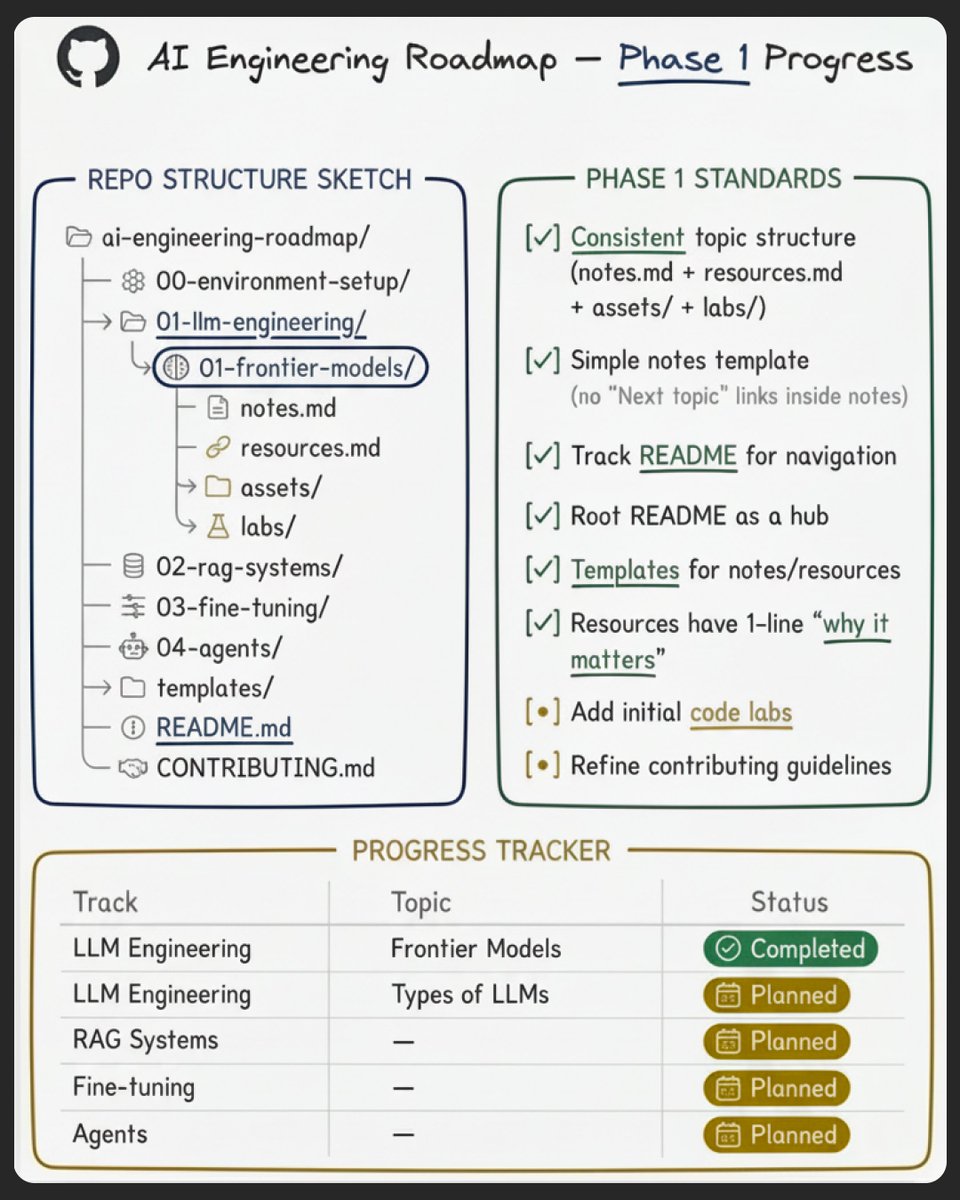
So I built a public repo: AI Engineering Roadmap.
Starting with Frontier Models.
Model selection isn’t hype.
It’s trade-offs.
Building in public 👇
https://t.co/FBm2xy3WIY
#BuildInPublic
Just published my first structured notes on Frontier Models inside my LLM Engineering Roadmap.
While studying AI Engineering, I realized:
Frontier models aren’t just about intelligence.
They’re about trade-offs, quality, cost, latency, control.
Building this roadmap in public 👇
https://t.co/FBm2xy4uyw
#AIEngineering #LLM #BuildInPublic
It’s been a quiet week publicly.
Client work took most of my time.
But under the hood, I was:
– Refining Onvyo’s positioning
– Reshaping the post-MVP roadmap
– Clarifying the marketing direction
Not all progress is visible.
Zero → First Users continues.
#buildinpublic
You can now push what you’re building in Claude Code directly into Figma.
With the latest updates to the Figma MCP server, build a working prototype in code, then send it to a Figma canvas to explore multiple versions.
Rest isn’t a reward. It’s part of the job.
I stay consistent because I protect my energy like a resource, not an afterthought.
When I rest, I come back sharper, faster, more creative.
If you’re grinding until you hate your own goals… pause.
The real goal?
Enjoy the process.
That’s how consistency, and growth, actually happen.
#PersonalBrand
#ContentCreator
#BuildInPublic
Thank you, I really like your point about debugging multi-agent systems. That was exactly my thinking while building this.
Right now, it does not support custom tool definitions yet. The current version focuses on role-based prompting and controlled iteration between agents.
This was actually a 4-hour challenge I gave myself to test the orchestration idea. I’m planning to expand it further and add more advanced features like tool support.
Would love to hear your thoughts after you explore it.
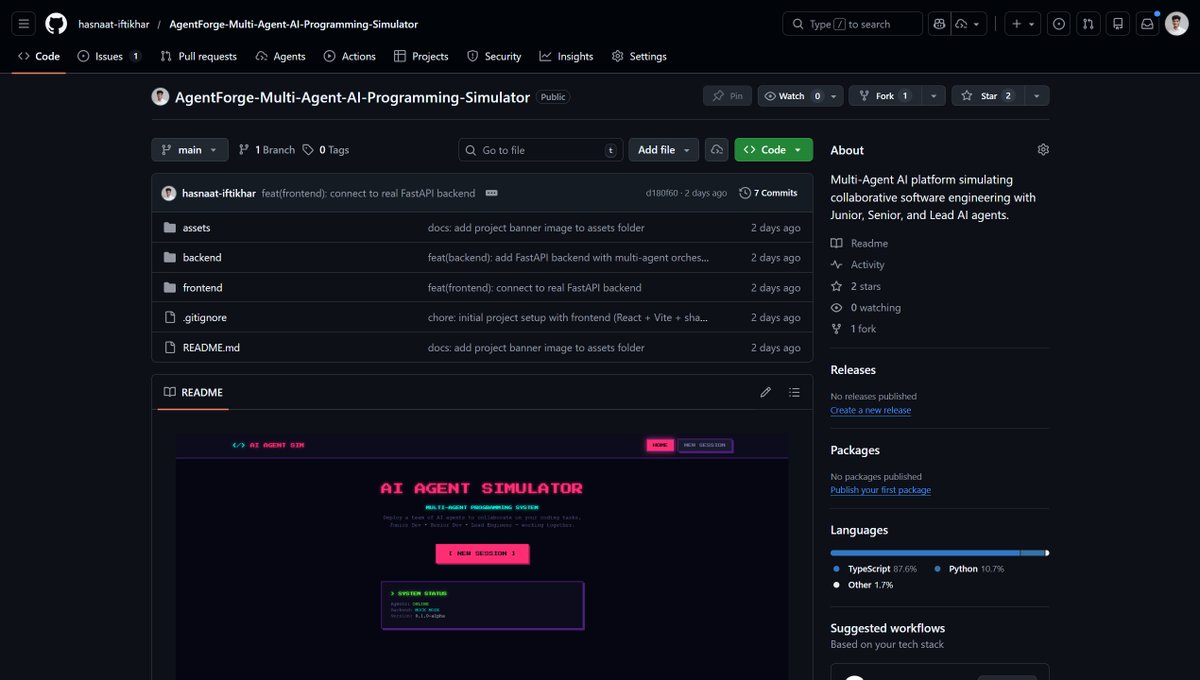
I built a multi-agent programming simulator.
Feedback will be appreciated 🫶
GitHub Repository (Give it a star ⭐)
https://t.co/OIMfUU8WjE
#hustle#buildinpublic#startup
GitHub Link:
https://t.co/pYSUw3g0xi
If you're exploring multi-agent AI systems where agents collaborate, review each other, and build meaningful outputs while handling edge cases, check out AgentForge.
It simulates:
• Junior Developer Agent
• Senior Engineer Agent
• Platform Engineer Agent
Designed with orchestration, iteration control, and system-level thinking in mind.
If you find it interesting or useful:
⭐ Give it a star
🍴 Fork it
💬 Share your feedback
Appreciate the support!
#AI #LLM #MultiAgent #OpenSource #AgenticAI #SoftwareEngineering
4hrs of Agentic-AI Challenge 🔥
Excited to announce my new side project: AgentForge!
A multi-agent AI platform where Junior, Senior & Lead AI engineers collaborate to build software in real-time.
I’ll be open-sourcing this soon! Still adding final touches — stay tuned for updates 👀
#AI #AgentForge #SideProject #Coding #LLM #OpenSource
Building Onvyo hasn not been exciting.
Some days it’s just:
– Improving the architecture
– Doubting positioning
– Posting and getting 120 views
Zero to First Users is not glamorous.
It’s mostly staying when it feels slow.
#buildinpublic
Let me ask you something.
When you build with AI… why do we treat the first output as final?
That question kept bothering me while building Onvyo.
Most AI products generate a response and move on.
But what if the system could improve its reasoning over time instead of just generating text?
So I built a feedback loop feature inside Onvyo.
Still early. Still experimenting.
But this might be the most important part of the product.
👉 DevLog
https://t.co/wNOnBr6wtQ
Building In Public - Update on Onvyo!
👉 https://t.co/BOW3Tc0jIa
This week, I’m deep inside the authentication system using Prisma + Supabase PostgreSQL.
📂 Current challenge:
Debugging a cloud database connection issue where local credentials aren’t syncing properly with Supabase. If you have worked with cloud databases, you know, one wrong connection string and everything breaks 😅
But this is part of the process.
📂 Onvyo Architecture
Onvyo follows a feature-based architecture: Instead of organizing by file type, everything is structured by feature (auth, dashboard, etc.).
Inside each feature:
Component → Hook → Utility pattern
• Components = UI
• Hooks = Business logic
• Utilities = Helper functions
Large hooks are split into sub-hooks for scalability.
TypeScript generics for type injection
Clean separation of concerns
Built for long-term maintainability.
If you're into:
- AI engineering
- SaaS building
- Full-stack architecture
- Or building products in public
Follow the journey 👀
#buildinpublic #saasbuilder #indiehacker #startupjourney #saasstartup #aiengineering #aidevelopment #fullstackdevelopment #webdevelopment #founderlife #productbuilding #startuplife #devcommunity #techstartup #onvyo #foryou #startup #product #marketing #saas