Takeaways from our XSpace with @JBriggsLondon & @cryptstitution. Thanks for the opportunity.
✅ Haus founders won’t take a penny from Cardano treasury funds — 100% goes into building Haus
✅ Haus will repay Cardano: 5% of operating profits donated yearly
✅ Full repayment expected in 5 years
✅ Mission: help homeowners unlock liquidity 💧🏠
https://t.co/Y1MWYKnjZU
Dear Nodle Community 📷
2025 is off to a fast start - and we’re kicking off 2026 with expanded network accessibility, new integration pathways and a continued focus on making Nodle easier than ever to leverage across the ecosystem.
Hi @yutazzz , thank you for sharing your perspective.
We completely agree that for any project involving a real estate portfolio, absolute trust in the team managing those assets is essential. This is a foundational principle for us. Our commitment is to build that trust through transparent management and a robust, decentralized governance model where the community has oversight. As we've previously called out, the initial portfolio holders are keen to decentralize and offer the TVL up for trading on Cardano.
We stand by the answers provided in our DREP FAQ document (last updated 7/30/2025). We empathize that some of these points might not be fully resolved for you, and we reaffirm our offer for a call with other DReps included so we can help the Cardano Ecosystem gain a credible ranking in RWA.
Hi @yutazzz ,
Thank you for your note and for the candor. No problem at all from our side, and please accept our apologies if our previous comments caused any frustration. We agree that resetting the conversation is the best path forward and appreciate the shared goal of keeping the dialogue professional for the good of the ecosystem. In that spirit, let's dive into the substance of the model. We acknowledge our previous communications may not have fully clarified our strategic thinking, and we'd like to do so now.
Your question regarding our choice of a pooled equity model versus a "one property, one token" model is a crucial one, and we'd like to elaborate on our reasoning.
While the direct, 1:1 tokenization model has its merits in simplicity, we believe a pooled approach offers far greater benefits for scalability, liquidity, and overall value to the Cardano ecosystem.
Our vision is to onboard hundreds of thousands of properties, representing billions of dollars in Total Value Locked (TVL). In such a scenario, a "one property, one token" structure would fragment the market into thousands of distinct, unequally valued, and illiquid assets.
By creating a single Hauscoin to represent the diversified pool of equity, we achieve several key objectives:
Massive Scalability & Deep Liquidity: A single, fungible asset is more attractive to DEXs, market makers, and institutional investors. This prevents market fragmentation and creates a deeply liquid RWA token that can be seamlessly integrated into Cardano's growing DeFi ecosystem.
Inherent Risk Diversification: It minimizes holder risk. Instead of being exposed to the vacancy, maintenance, or market risk of a single property, Hauscoin holders benefit from the stability of a large, diversified portfolio.
Increased On-Chain Activity: A liquid, high-volume RWA token will naturally encourage a higher number of transactions—from trading to collateralization. This activity directly translates into increased fee revenue for the Cardano Treasury.
Ultimately, we project this model will create a powerful economic flywheel, adding immense value and utility to the Cardano chain.
We believe this approach presents a spectacular opportunity to integrate high-quality RWA assets at scale. To ensure we move forward in the most effective way for the ecosystem, we would be honored to organize a community call or Twitter/X Space with yourself and other interested dReps. This would be a good forum to discuss the model in-depth, address any remaining concerns, and converge on a path that benefits all of Cardano.
Would you be open to a conversation like that?
💙 Haus is all-in on building for #Cardano
💬 Just a few months ago, we were complete outsiders — yet the Cardano community welcomed us with open arms and encouraged us every step of the way.
📊 Our Treasury withdrawal proposal didn’t hit the 67% threshold this time, but the strong majority support we received fuels our excitement to keep going.
🤝 RareEVO in Vegas was a highlight — we had inspiring, high-energy conversations with DReps, sharing our vision for Haus and hearing their thoughtful perspectives. We couldn’t meet every DRep or tell our whole story yet, but the connections we made were invaluable and left us more energized than ever.
🔍 Guided by that feedback, we believe the best path for Haus to join the ecosystem is through #ProjectCatalyst.
🙏 We’re deeply grateful for the advice, encouragement, and collaboration from DReps and the entire community.
📉 With your input, we’ll sharpen our scope, fine-tune our funding ask, and come back even stronger in Fund 14.
🚀 The journey is just getting started. Let’s build this together.
#Haus #Fund14 #CardanoEcosystem #Catalyst
Mr. Yuta -
We are trying to figure out what your objections are.
Let’s be very clear about what the Haus proposal entails: it aims to bring the US real estate investment asset class to the Cardano blockchain through HausCoin. The proposal does not ask the Cardano treasury to invest in this asset class, nor does it force any user to invest in this asset. It looks like you are thinking otherwise.
So, what is the objection? If I understand this correctly, you are assuming that this asset class is not good for the community to invest in. You are entitled to your opinion, but there might be others who want this asset class or can decide for themselves whether to invest or not. You are stopping them from accessing this asset class. Does that seem fair?
I will give you an example for years, some argued that BTC was a poor investment and blocked its ETF listing in the U.S. Eventually, reason won out, and the decision was left to the people to invest or not, based on their judgment. Are you positioning yourself like those detractors, standing in the way of letting people choose?
@yutazzz Yuta-san, thank you for your honesty & Continued Dialogue You’ve raised a crucial point, and we want to address it head-on.
You were right to feel that our initial responses were impersonal. They were, and we apologize for the anxiety this caused. As we mentioned in our open letter to the community, our team was deeply focused on the complex legal and technical frameworks of the proposal, and frankly, our communication suffered for it. It lacked the personal engagement that you and the entire Cardano community deserve.
Your feedback was a direct catalyst for us to re-evaluate our approach. It’s why we published the detailed Open Letter and committed to regular, direct AMAs with our founders. You're already helping to make this partnership stronger and more transparent.
We don't just want your trust; we want your continued scrutiny. We see you as a vital partner in this, someone who will hold us to the highest standard. We are building this with the Cardano community, not just on it, and that starts with being "at the hip" with dedicated leaders like you. We also invite you to walk through our code, partner with us on setting decentralized governance and constitution token policies for Haus which works for this community and as discussed cotinue to advise in these important matters.
We are also hosting a open session for DReps at RareEVO ! We are welcome DReps for deep dives and discussions and will be hosting AMAs.
@yutazzz@mr_cata@yutazzz - So let me see if I understand, your objections are eliminated if these two investors are not involved in Hauscoin decisions.
You are right Mr. Cata, the regulatory frameworks have strict guardrails, and crossing them carries real consequences.
Legal & Regulatory Oversight – Haus operates within U.S. real estate(federal and state), securities, and AML/KYC laws. These frameworks impose strict requirements on disclosures, transaction reporting, and anti-fraud measures. Violations are enforceable with real legal consequences, making misconduct costly and highly unlikely.
Contractual Obligations – Every transaction will be backed by enforceable contracts between parties. These documents clearly define rights, responsibilities, and dispute resolution processes, providing additional legal safeguards.
On-Chain Transparency – The core transaction records, ownership data, and asset tokenization events are written to the blockchain. This creates an immutable audit trail visible to participants and, where required, the public. While sensitive information remains hidden for privacy and compliance reasons, the on-chain record ensures that key actions can’t be hidden or retroactively altered.
Investments: The investment criteria will be decided by the Hauscoin holders. A smart contract will decide whether the proposed investment meets the criteria or not. An investment committee can be formed by the HausCoin holders that can approve investments at a set cadence(monthly). All the assets will be held by a custodian and not by Haus.
Registration with legal authorities: Hauscoin is and will be registered with SEC and other international regulatory agencies, as needed. Any nefarious activities will have real consequences.
Audit: We will get audited on the investments, and the report will be made available to all Hauscoin holders.
Thanks, Mr. Yuta. We recognize that certain aspects can be lost in translation. Let me try again with this question of yours
Let’s say for the current 20M fund, the two investors are Mr. X and Mr. Y. Let’s keep their identities private. Now, who controls the portfolio? These two folks. I don't understand the problem here. Am I missing anything? Now, for simplicity's sake, let’s call this Fund A and HausCoinA. Also, for simplicity's sake, let's assume these holders are buy-and-hold. Cardano now has 20M TVL and gets on everyone’s radar like https://t.co/B6EMUk21pK
Now let's say we raise another open-ended fund, FundB of 100M. Let's call this HausCoinB. All the 100M HausCoinB holders will have full control over FundB. The HausCoinB holders will decide what kind of fractional real-estate properties to acquire. This is what I assume you want to make happen. Does that make things clearer?
We can make this FundA(HausCoinA) and FundB (HausCoinB) completely separate if that makes it palatable and easily understandable.
Please note, we are not social media experts. When we met folks face to face at RareEVO like @Mr_Cata, @hermesstakepool, @Bigpey, Kyle, and many others, and showed what we have accomplished, our mission, and our plans for Cardano, everyone wanted to help make this happen.
We recognize that we haven’t yet translated this same “face-to-face” or "Zoom Meet" clarity into an effective X post that’s on us, and we’re working on it.
Thank you, @mr_cata, for taking the time to understand our proposal and for all the kind words. We are here at RareEVO meeting the DReps and others explaining our proposal and all of us can make Cardano stronger by getting real world applications on Cardano. If you are here at RareEVO hit us up on DM's. If you are not at RareEVO you already have our calendar in your DM's or reach out to us.
Some more thoughts to dovetail on your excellent post.
Cardano’s strength lies in its innovation, but enterprise adoption also requires readiness, openness, and the ability to leverage external expertise. The Haus proposal is designed to bring $1B in real-world home equity on-chain, open-source, Cardano-native, with regulatory & banking rails already in place.
When we set the bar so high that even well-resourced, compliant, and aligned projects struggle to engage, we risk signaling to the market that Cardano isn’t ready for enterprise.
A mature framework for onboarding serious partners isn’t just good governance, it’s how we accelerate adoption, liquidity, and real-world impact. Let’s build it.
To the Cardano Community,
We've been following your discussions closely, and we appreciate the passion, scrutiny, and deep engagement you bring to the ecosystem. You are the stewards of Cardano, and your questions are not only valid but essential. We want to address them directly and transparently. We also thank @yutazzz for having spent countless number of hours on due dilligence with haus, including multiple video calls, document exchanges , deep dives and telegram discussions.
We hope we continue conversations cordially, with mutual respect and sincerity.
Our commitment : Haus founders won’t take a penny from Cardano treasury funds — 100% goes into building Haus protocol . Haus will repay Cardano: 5% of operating profits donated yearly. Full repayment expected in 5 years.
Here are our thouhts to some of your quesitons -
https://t.co/fFCUvlj6Bs
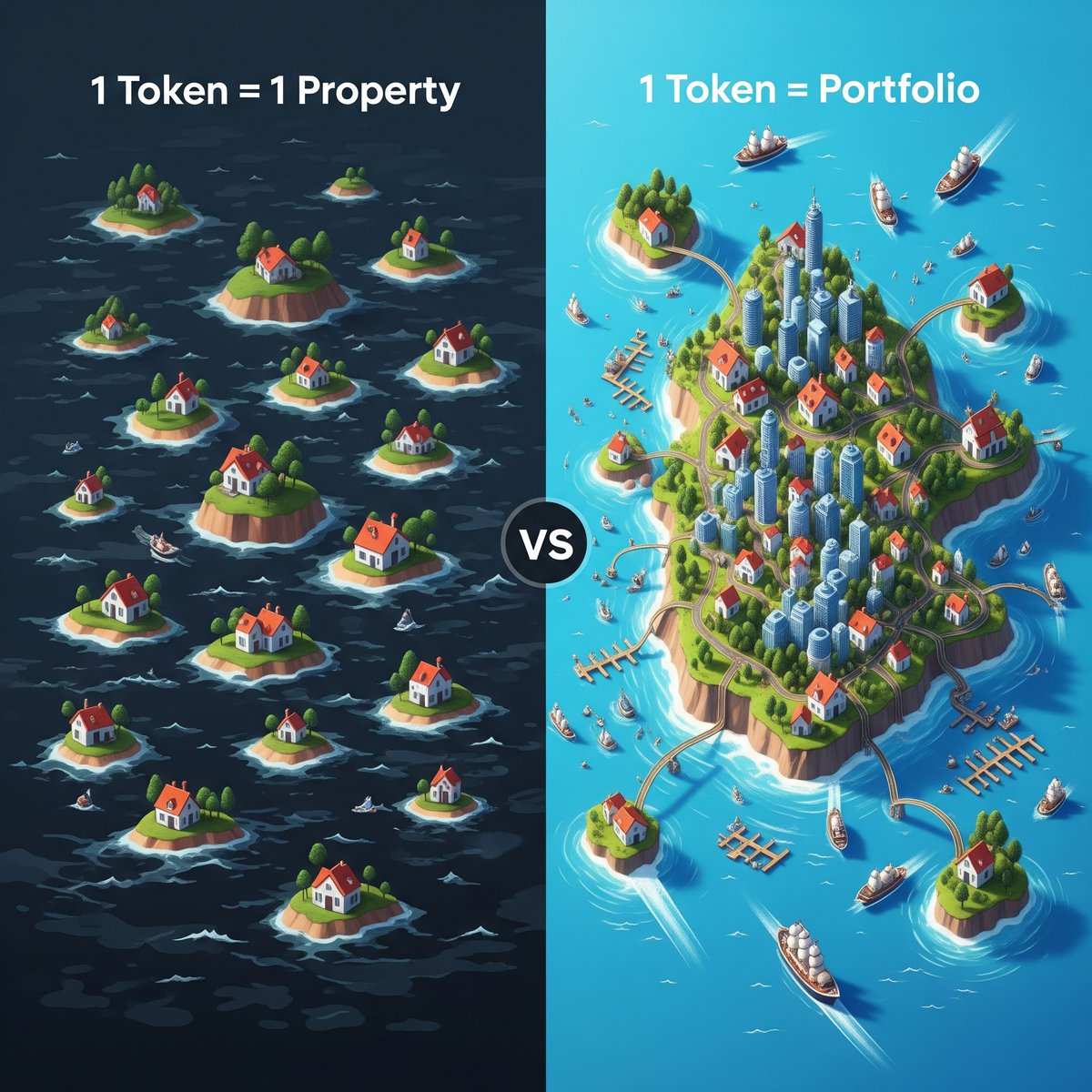
You're faced with a choice for the future of real estate:
Do we want a million, disjointed, illiquid islands, each its own tiny market?
Or do you want a single, liquid continent of value, accessible to anyone, anywhere in the world, through one tradable token backed by real assets?
Our choice is clear.
Then there's the matter of trust.
The old world demands a leap of faith in a manager's promise and a dusty quarterly report.
Our new model demands only that you trust verifiable math, competing data oracles, and a blockchain updated in real-time by Automated Valuation Models and every single transaction.
One is a guess. The other is a liquid, auditable, transparent market.
We're building the market.
#RWA #HAUS #Cardano #Progress #Transparency
@yutazzz and these 2 private potfolios with $20M TVL will instantly make #Cardano top 20 RWA Chain ! who in cardano would not want that ! and $1.2B+ TVL ...
https://t.co/B6EMUk21pK
#RWA #CARDANO
Appreciate the sharp questions, @yutazzz , but it sounds like your Cardano thesis might be a couple of hard forks behind the times. This is something we already discussed in our Amazing Call too !
Let's address this:
The "Sell ADA" Dilemma: That's a 2021 problem. Today, smart money on Cardano doesn't sell their ADA; they make it work for them. They use it as collateral on protocols like LenFi to borrow stables and invest in projects like Haus—all without ever touching their original bag. It's called capital efficiency.
The "New User" Friction: You mean the friction that over 5.2 million wallet holders have already overcome? That friction? The ecosystem is sprinting ahead with slick wallets and onboarding platforms like @atriumlab that make joining easier than ever. The gates aren't just open; they're freshly oiled.
So while the problems you raise are valid hurdles for any ecosystem, on Cardano, they're not roadblocks. They're just the speed bumps we've already built DeFi-powered monster trucks to drive over.
That's a fair question, @yutazzz , and you've hit on the core challenge of any RWA: trust and tradability
But let's play out the 'one coin per property' model at scale. Imagine a portfolio of 1 million homes. Would you rather have 1 million different, illiquid tokens, each a tiny, fragmented market of its own? Or one single, deeply liquid token representing the diversified value of the entire pool?
The portfolio approach is the only way to create a truly fungible, composable asset that can actually work as high-quality collateral in DeFi. It's about building a liquid ocean, not a million isolated puddles.
And the trust issue? That's solved by code, not faith. With decentralized oracles providing transparent, on-chain valuations, the "management method" isn't a black box—it's an open book.
#trustbyblockchain #trusbydecentralization