Thanks @168X_Fortune and @168MrZ for having me back. Here is the summary in English
TLDR, AI fundamentals are still getting stronger. But after the big run, I’m keeping positions light and waiting for a cleaner setup. The next major opportunity could be the assets that high rates have kept under pressure.
Here’s how I’m thinking about it:
1. US10Y: volatility matters more than the exact yield.
I’m less concerned about whether the 10-year yield is 5.3% or 5.5% than how violently it moves. Before adding meaningful risk, I want yields stabilizing or gradually declining, with MOVE—the bond market’s volatility index—coming down too.
2. Market breadth needs to resolve.
Money has concentrated in AI winners while much of the market struggles. Breadth can improve through laggards catching up, or through winners correcting. Either outcome makes chasing semiconductors with maximum size less attractive here.
3. The catch-up basket: KRE, IWM, RKT and XLU.
Regional banks, small caps, housing and utilities could respond sharply to easing rate pressure, helped by short covering. The condition matters: an orderly decline in yields supports that setup. A sudden collapse could signal recession instead.
4. Mid term election is not a risk to AI datacenter development.
The key topics from Democrats are still inflation, Iran and gas price. These have higher priority than AI datacenter. However I see long term risk as the US people's sentiment towards AI and datacenter is quickly deteriorate except people who are working in the AI industry.
5. The oil issue extends beyond crude.
Refinery capacity and refined-product supply deserve more attention. Having crude available doesn’t automatically solve gasoline or diesel shortages. Persistent pressure on those products can keep inflation expectations—and long-term yields—elevated.
6. AI revenue growth is the key validation.
I’m skeptical of claims that OpenAI is already at $70B ARR. But if coding and enterprise growth stays steep, an $80–100B annualized revenue run rate by year-end is conceivable. That’s a possible outcome, not a confirmed number. Downstream revenue must justify upstream capex.
7. Google’s biggest opportunity is a personal AI agent.
Google has distribution through Search, YouTube, Gmail, Maps and Android, existing monetization infrastructure, and its own hardware-to-model stack with low inference cost. I’d like to see it combine those advantages into a personal agent. Coding isn't its advantage.
8. The next AI re-rating needs evidence of returns.
Personal agents, AI for Science, biotech and enterprise applications could broaden monetization beyond coding. Faster research, cheaper drug discovery and measurable productivity gains would help demonstrate that AI spending can generate attractive returns on invested capital.
9. AI IPOs could redistribute the premium.
If OpenAI or Anthropic goes public, investors would gain direct access to another layer of AI monetization. Some capital could rotate away from semiconductor proxies. That could change where the AI premium sits even while chip fundamentals remain healthy.
10. I’m more selective within semiconductors.
CPU still has catch-up potential as server architecture evolves. Optical has already run hard, and strong memory results may already be well understood. I’m treating semiconductor equipment more tactically. Timing matters increasingly after the sector’s major advance.
11. BTC is my first watch when the rate setup improves.
If US10Y and MOVE genuinely top out, BTC looks like a strong expression of improving liquidity and risk appetite. Its technical structure matters too. I’d look at that strength alongside the catch-up potential in rate-sensitive equities.
12. TLT calls have become less attractive.
High bond volatility makes options expensive. Even if TLT rises as yields decline, falling implied volatility can eat into call returns. For this setup, I prefer considering equities with underlying businesses that could benefit from easing rate pressure.
13. My main macro catalysts: FOMC, CPI and Treasury issuance.
These can change expectations for policy, inflation and long-term bond supply. For the midterms, I care most about what follows: changes to fiscal policy and issuance that could alter the path of long-term yields.
14. Light positioning is a deliberate choice.
I already traded the post-September FOMC rally aggressively. Now I’m waiting for better risk/reward. With leverage and options, timing matters enormously. A stable index can still hide severe drawdowns in individual stocks.
15. The next big trade could be the laggards catching up.
I remain confident in AI’s fundamentals, especially as downstream monetization expands. But confidence doesn’t require maximum exposure at every price. If yields stabilize and MOVE falls, BTC and KRE/IWM/RKT/XLU could offer a compelling next setup.
For now, I’m keeping risk light, watching the bond market, and waiting for the opportunity to become clearer.
$TER vs $AEHR
> The AI burn-in growth thesis remains intact. Confidence in $AEHR’s competitive advantage, however, may need to come down.
- $TER covers semiconductor testing broadly. $AEHR focuses on burn-in.
- Titan HP and Sonoma compete in package-level burn-in for finished AI chips. Titan HP is already deployed in production.
> $TER’s combined SLT and burn-in platform could absorb spending on dedicated burn-in equipment, pressuring Sonoma’s new orders and pricing power.
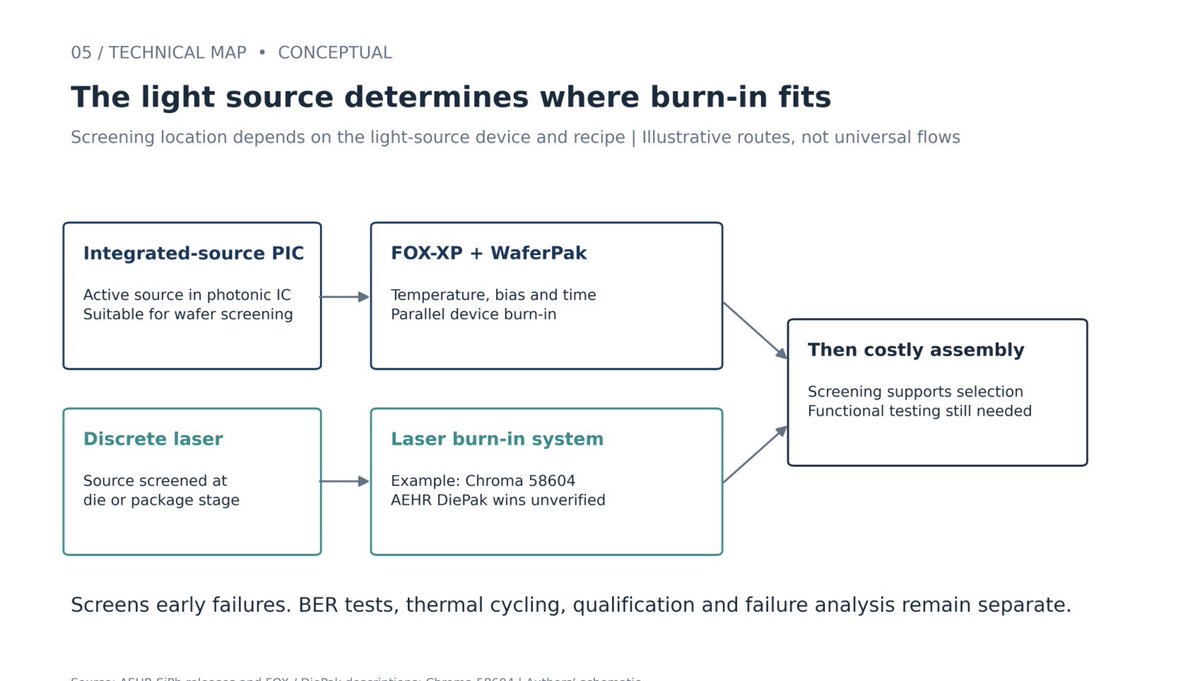
- FOX-XP performs wafer-level burn-in before packaging, screening bad dies before committing expensive HBM and packaging resources. This announcement provides no evidence of replacing that step.
- On October 7, $AEHR announced approximately $6M in follow-on Sonoma orders for an existing hyperscale customer’s next-generation AI chip.
> Stronger competition is evident; customer losses are not. The AEHR thesis now faces tougher questions around market share and margins, rather than market growth.
> Watch Sonoma’s next-generation design retention, new customer wins, and gross margins.
$AEHR brings wafer-level burn-in ahead of advanced packaging, screening for early failures before customers commit more money. Testing many devices in parallel helps make that screening practical at production scale.
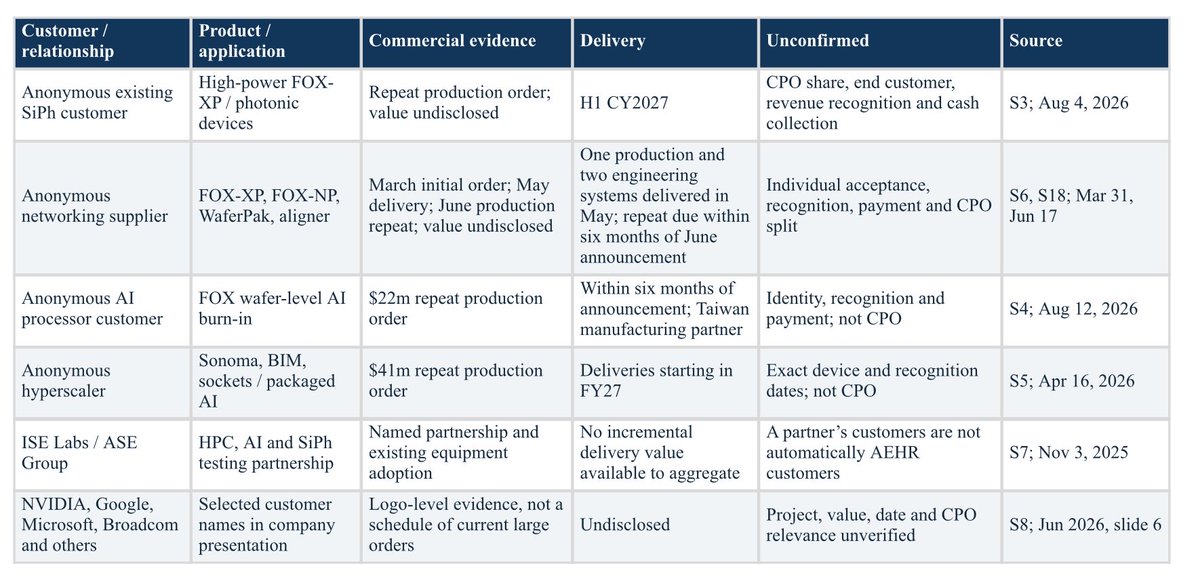
The company disclosed several repeat purchase orders, including a $22M AI wafer-level follow-on order, a separate $41M order for packaged AI, and additional silicon photonics production orders
The combination of proven adoption and expansion beyond SiC. CPO adds potential upside, the next proof is better margins and cash flow as orders ship.
Markets are bracing for a rate hike.
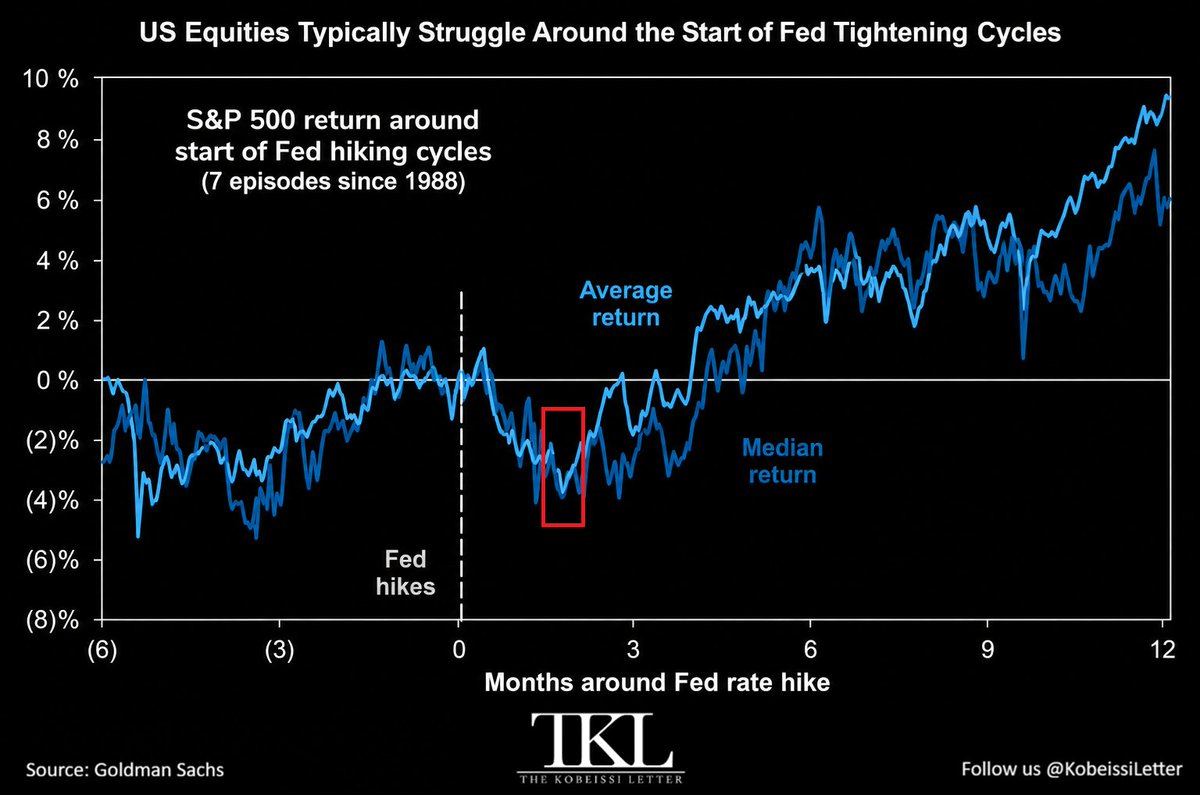
So, how do US stocks usually behave following the first hike of a Fed tightening cycle?
The S&P 500 has declined by an average of -4.0% over the 6 weeks following the first Fed rate hike of a cycle across 7 such episodes since 1988.
Subsequently, however, stocks recovered all of those losses over the next 5-6 weeks on average.
Then, in the 6 months following the first hike, the S&P 500 returned +4.0% on average.
After 12 months, the S&P 500’s average gain surged to +9.0%, with positive returns occurring in every episode except 2022.
Fed rate hikes have historically been great buying opportunities.
$INTC REPORTEDLY PLANS ANOTHER 10% PC CPU PRICE HIKE IN OCTOBER
The increase is aimed at improving gross margins rather than gaining market share, according to DIGITIMES, as global PC shipments are expected to fall to roughly 250M units in 2027.
Intel is also reportedly considering discontinuing its low-margin Small Core lineup, which could create an opening for Qualcomm and MediaTek in industrial PC and IoT markets.
The company may also cut another 5% to 10% of its workforce, with headcount currently around 75,000.