How do you make Ethereum private without building another Ethereum?
@RAILGUN_Project takes the privacy system to the smart-contract level.
It does not require users to move onto a separate Layer 2 or privacy chain.
Instead, assets enter a set of Railgun smart contracts and become part of a shared private pool.
Here is the basic flow.
1. Start with a normal wallet
You hold ETH, USDC or another supported token in a regular Ethereum wallet.
That wallet has a public 0x address.
2. Shield the assets
You transfer the assets into Railgun.
This transaction is public because the funds have to come from your public wallet.
An observer can therefore see that your address deposited assets into Railgun.
But that is where the normal transaction trail changes.
3. Enter the private pool
Inside Railgun, the assets are represented as private balances rather than ordinary public wallet balances.
A simple way to think about it is a large pool containing funds from many users.
One person may put in 10,000 USDC.
Another may put in 50,000 USDC.
Another may put in 500 USDC.
People can hold those assets for different lengths of time and use them in different ways.
Railgun uses cryptographic proofs to keep track of who is allowed to spend which funds without publishing the normal details of those balances.
4. Transact inside the pool
This is where the private activity happens.
Users can send funds privately.
They can also swap or interact with supported DeFi applications privately.
That activity creates more transactions and more possible relationships inside the pool.
Imagine 100 deposits and 100 withdrawals.
Some deposits are followed by activity after an hour.
Some funds remain inside for weeks.
Some users swap tokens.
Others send funds to another private balance.
The public blockchain still records that Railgun is being used.
But there is no simple public list matching each private action back to the original depositor.
5. Unshield
Eventually, a user can withdraw funds to a normal 0x address.
That exit is public again.
An observer can see that Railgun sent funds to that address.
But seeing the public entry and the public exit does not automatically reveal which entry produced which exit.
That distinction is important.
Railgun is not trying to make Ethereum transactions disappear.
It changes what information is exposed while the assets are inside the private system.
Railgun provides a private environment inside an existing public blockchain, with public entry and exit points but private activity between them.
😡🚨 Next round coming up: Let's fight against #ChatControl 🚨😡
In July, the European Parliament approved Chat Control 1.0 👉 NOW, On September 29, the negotiations for CHAT CONTROL 2.0 RETURN.
Unfortunately, this is a much bigger threat for everybody's #privacy.
At Tuta we will continue to SAY NO to Chat Control and fight for our right to privacy ✊❤️
Find more about Voluntary Chat Control 1.0 👉 https://t.co/7PjSq6JciE
Find more about Chat Control 2.0 👉 https://t.co/JLei3q3UVK
The fight against #ChatControl must go on!
This matters because treasury control does not depend on one person holding the only key.
It creates a shared authorization process that can fit the structure of a company, protocol, or DAO.
Safe can also be extended with additional modules for more specialized execution and access rules.
That makes it useful as the foundation for more complex treasury workflows.
The key idea is simple: Safe gives a team a programmable system for controlling treasury transactions.
Why do so many crypto teams put their treasury behind Safe?
A Safe can have multiple owners.
Those owners might be founders, finance leads, treasury operators, or other trusted accounts responsible for approving treasury activity.
The Safe also has a threshold.
That threshold defines how many required owners must approve a transaction before it can execute.
So a simple treasury flow can look like this:
1. A transaction is proposed.
2. The relevant owners review it.
3. The required number of owners approve it.
4. The Safe verifies those approvals.
5. The transaction executes.
@MattShiller_ Exactly. There is a lot of sensitive data one can get just from tracing wallets and its transactions. Thats why one needs to be really careful when linking wallets permanently through new transactions to each other. Needs a lot of workarounds usually to avoid that.
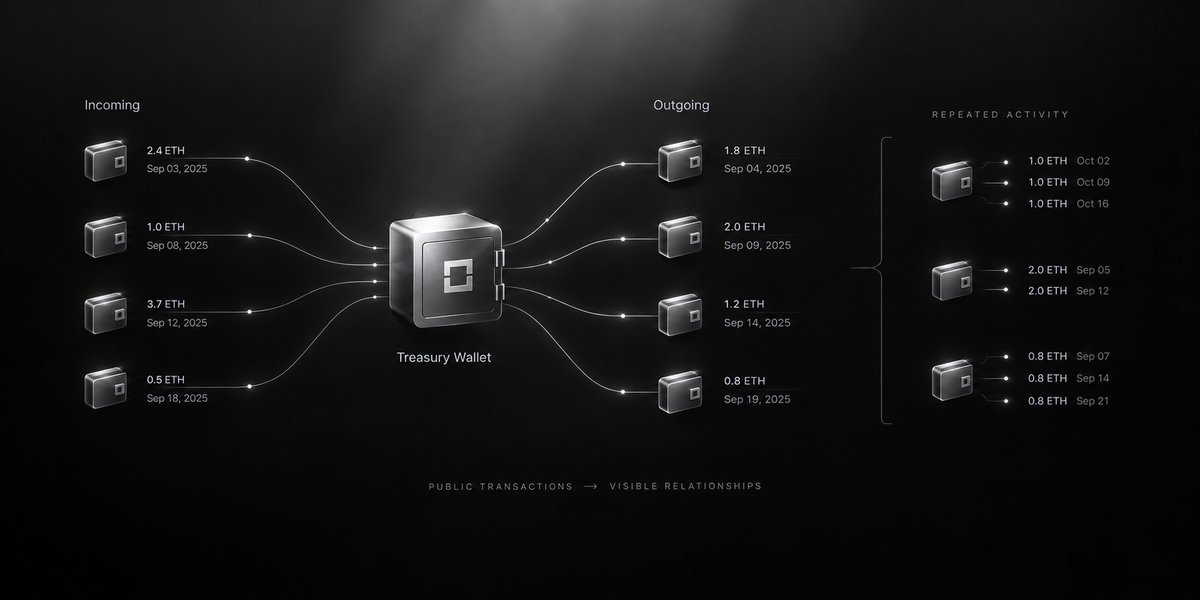
You do not need a company’s org chart to start mapping its financial relationships.
Open a public treasury wallet on Etherscan.
You can inspect its transactions, recipients, timestamps, and amounts.
Then follow the addresses receiving those funds.
Click into related wallets and inspect their visible incoming and outgoing transfers.
Over time, recurring addresses, payment timing, and repeated transfers can reveal relationships and operating rhythms.
You may not always know who ultimately controls every wallet.
But you can still follow the transaction history that is publicly visible and build a picture from repeated activity.
Specialized wallet-analysis tools can make this much faster by organizing transactions and wallet relationships across large amounts of public blockchain data.
That is why Haven treats treasury privacy as a problem of repeated public relationships, not just individual transactions.
That is the privacy gap Haven is exploring: keeping treasury operations accountable to the people who should see them without making every recurring payment equally useful to everyone watching the chain.
This does not mean Safe is doing anything wrong.
Safe provides the shared approval and treasury-control process teams rely on.
The question is what information still becomes public when an approved transaction is executed on a public blockchain.
Credit cards, live streaming, SSL, VPN, the list goes on. No one realizes it's happening until it's done. Tech moves slowly, then all at once. But the same can be said for surveillance. $RAIL fixes this.
Shield.