“Mechanistic Data Attribution: Tracing the Training Origins of Interpretable LLM Units”
One of the papers I personally found very promising earlier this year just got accepted as an ICML Oral. huge congrats to the authors 🔥
The core objective of this work is, in essence, to address a fundamental question within the field of mechanistic interpretability: Which specific training data points were responsible for teaching a particular mechanistic circuit, neuron, or attention head? Put another way: Why do induction heads emerge? Which specific training samples drove their emergence? Can the source of training data for a given interpretable unit actually be traced? The authors term this problem: Mechanistic Data Attribution (MDA).
The core contribution of this paper lies in: Working backward—Starting from the "model mechanism". To deduce: "Which specific training data points led to the formation of that mechanism?" (It is like MI+Influence Function)
I find something interesting in this paper, as many seemingly “low-quality” repetitive data samples may actually serve as critical catalysts for the emergence of induction mechanisms in transformers. And there are many other interesting insights in this paper.
Paper: https://t.co/2KhyPKqZnF
Congrats again to the authors — very well deserved Oral recognition @PanLiangming
#ICML #MachineLearning #LLM
Can we transform offline audio diffusion into real-time streaming interactive instruments?
Yes!
Presenting Live Music Diffusion Models: a new paradigm for taking your favorite open models into live performance, right on your own laptop! 🎵🎵
🧵
I’m promoting our new conversational music recommendation dataset, Reddit2Deezer, the largest real-world, grounded CMR dataset (200k–600k conversations). The tracks and albums are mapped to the Deezer API, which enables straightforward access to audio previews and rich metadata.
Expressiveness Limits of Autoregressive Semantic ID Generation in Generative Recommendation
@yupenghou97 et al at Snap show that autoregressive SID generation forces structurally close items to receive correlated probabilities
📝https://t.co/LmURbSuSoh
👨🏽💻https://t.co/XUbKNjcZDy
A Design Space for Live Music Agents 🎷🎹🥁 #CHI2026
What does it take for AI to truly jam with you? We surveyed 184 live music agents across AI, HCI, and Computer Music fields to map the design space, and where it's headed.
🗓️ Talk: Fri Apr 17, 12:15PM · P1 Room 132
📄 Paper: https://t.co/vNfdqrdV23
🔗 Interactive demo: https://t.co/XD1lP5pGCB
A Design Space for Live Music Agents 🎷🎹🥁 #CHI2026
What does it take for AI to truly jam with you? We surveyed 184 live music agents across AI, HCI, and Computer Music fields to map the design space, and where it's headed.
🗓️ Talk: Fri Apr 17, 12:15PM · P1 Room 132
📄 Paper: https://t.co/vNfdqrdV23
🔗 Interactive demo: https://t.co/XD1lP5pGCB
We found a way to steer AI music gen toward specific notes, chords, and tempos, without retraining the model or significantly sacrificing audio quality!
Introducing MusicRFM 🎵
Paper: https://t.co/oZciYbgB9P
Audio: https://t.co/FQ1W8k1LZh
Code: https://t.co/drnE1XGcFC
(1/5)
We release two methods for controlling text-to-music models, MuseControlLite (ICML 2025) and SongEcho (submitted to ICLR 2026, I am not the author), on GitHub and HuggingFace!
github💻: https://t.co/zFh70Tjxec
Huggingface🤗:
https://t.co/f89IA9Pt4D
Join us this afternoon at 13:45 in Room 203 for our @cikm2025 tutorial on generative recommendation and semantic IDs!
https://t.co/JNQxVOBY7c
#CIKM2025
🔥I'm sharing all the materials and recordings for my course on *Music & AI* at University of Michigan! The course introduces AI’s applications in music from analysis, creation, retrieval to processing.
Course website: https://t.co/xlXxtipG7m
Recordings: https://t.co/MR30b3HBsz
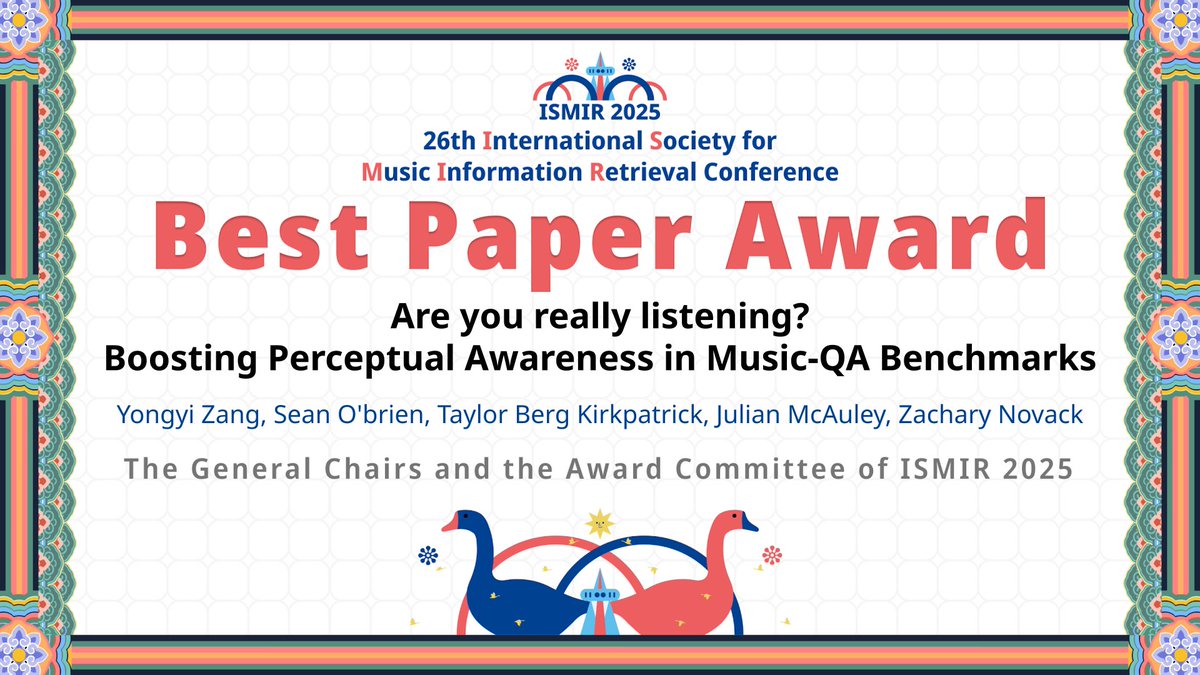
Are AI models for music truly listening, or just good at guessing? This critical question is at the heart of the latest Best Paper Award winner at #ISMIR2025!
Huge congratulations to Yongyi Zang, Sean O'brien, Taylor Berg Kirkpatrick, Julian McAuley, and Zachary Novack for their paper, "Are you really listening? Boosting Perceptual Awareness in Music-QA Benchmarks."
They expose how current benchmarks can be solved without genuine audio perception—even by text-only models! Their new framework, RUListening, creates evaluations that force models to prove they're actually hearing the music. A vital step forward for robust AI evaluation.
Thrilled to share that our paper "MGE‑LDM: Joint Latent Diffusion for Simultaneous Music Generation and Source Extraction" is accepted to #NeurIPS2025 🚀🎶
Check out our preprint and sample page!
arXiv: https://t.co/w9pFwW87Zg
Project page: https://t.co/C9HORMl8S0
Suno + Veo 3 generate highly similar versions of popular songs purely based on *phonetically* similar gibberish lyrics?!?!
Presenting Bob’s Confetti: Phonetic Memorization Attacks in Music and Video Generation
🔊: https://t.co/Rztf9TNhI7
📖: https://t.co/H7BgnUkCvD
🧵1/n
Suno + Veo 3 generate highly similar versions of popular songs purely based on *phonetically* similar gibberish lyrics?!?!
Presenting Bob’s Confetti: Phonetic Memorization Attacks in Music and Video Generation
🔊: https://t.co/Rztf9TNhI7
📖: https://t.co/H7BgnUkCvD
🧵1/n
Did you know tokenization for generative recommendation today looks a lot like LLM tokenization did *10 years* ago?
Meet ActionPiece, our #ICML2025 Spotlight paper, the first context-aware action tokenizer.
1/5 🧵