The team behind ‘AMERICAN DAD’ have made a statement on the tragic passing of Sir Patrick Stewart.
“We at American Dad! have so much gratitude and love for Patrick Stewart. He said how happy he was to do American Dad! because he was so rarely asked to do comedy, which is insane, as his ability to get the laugh was uncanny.
Thank you, Sir, for sharing your joyful spirit, inspiring voice, and willingness to be ridiculous. You turned Avery Bullock, Deputy Director of the CIA, into someone the world loved and couldn't get enough of. We will miss you.”
Fox: Why are you here this morning?
Trump rally attendee: Well, in the late 70s, I was a little too young to go to South America for the Jonestown Massacre. But this is as close as I'll ever get, so that's why I'm here. There's nothing like seeing a cult right up front.
@SHEEPSLIVE It’s not the Antichrist, but I do want to save the world. At 30 (in five years), I will be running for California governor in the midterms. Help me prevent the reality that *1984* showed us from becoming real.
@ClipperRen Dude, her mother was 41 when she had Kathy. This is disgusting. Her mother is an absolute loser for making her daughter feel guilty for existing. This video made me think she gave birth at 55.
In 1851 a fourteen year old girl named Olive Oatman watched most of her family killed on a trail in Arizona and was taken.
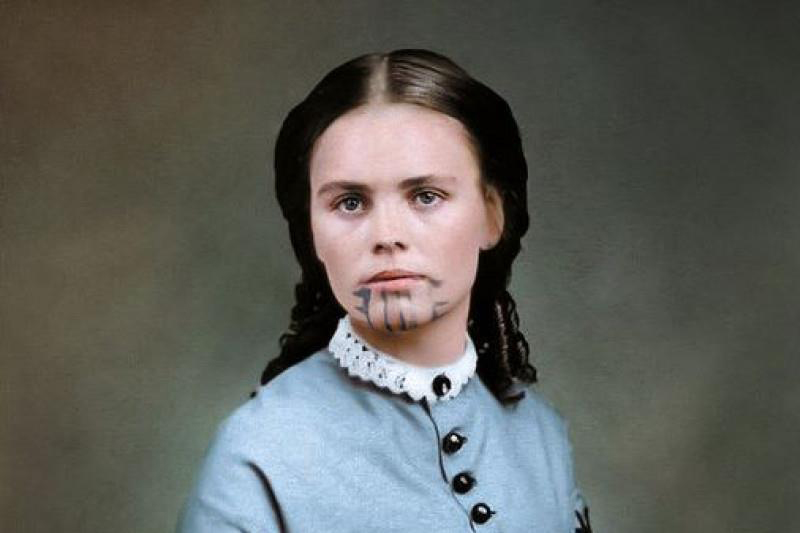
Five years later she walked into an Army fort with a blue tattoo across her chin.
She spent the next forty seven years being asked about it, and the version everybody read was written by somebody else.
The Oatmans were Mormons who had joined a splinter sect called the Brewsterites, following a man who said the promised land lay at the junction of the Gila and the Colorado. The party fell apart in New Mexico, and Olive's father took his own family on alone.
On March 18, 1851, on the Gila River trail, a group of men approached the wagon and asked for food and tobacco. Royce Oatman gave them almost nothing. They attacked.
Her parents and four of her siblings were killed. Her older brother Lorenzo was beaten, thrown down an embankment and left for dead. He survived. Olive, fourteen, and her sister Mary Ann, seven, were taken.
Olive later identified the attackers as Apache. Historians now believe they were almost certainly Tolkepaya, a Western Yavapai group.
The girls spent about a year with them, and that year was slavery. They hauled water and firewood, foraged, and were treated as property.
Then they were traded to the Mohave for two horses, some vegetables, blankets and beads. The trade happened because the daughter of a Mohave leader, a young woman named Topeka, kept pressing for it.
And here is where the story everyone has heard falls apart.
The Mohave did not hold them as slaves. They took them in. Topeka's mother, Aespaneo, looked after both girls and arranged for them to be given plots of land to farm. Olive was given a Mohave clan name, Oach, along with a personal name.
The clan name is the detail that matters. That is not something given to a captive. That is what you give to family.
The Mohave tattooed both girls on the chin and the arms.
Olive would later say it was a slave mark. It was not. Mohave women wore that tattoo. It was given to their own people so their ancestors would recognize them after death, and the pattern on her face is a Mohave pattern.
They were marking her as one of theirs.
Around 1855 a drought came and the food ran out. Mary Ann starved to death, and so did a great many Mohave. Olive nearly died with them. The reason she did not is that Aespaneo made gruel and kept feeding it to her.
In 1856 word got to Fort Yuma that a white woman was living with the Mohave, and the Army sent for her. The Mohave did not want to give her up. It took trade goods and a threat of reprisal to settle it. Topeka walked with her the twenty day journey to the fort.
She was nineteen. Within days she learned that Lorenzo was alive. He had spent five years looking for her.
And then the rest of it happened to her.
A minister named Royal B. Stratton wrote a book about her life, in her voice, published in 1857. It sold around thirty thousand copies and made her famous across the country. It described the people who had raised her for four years as savages, which is what the market wanted.
Stratton took the proceeds and used part of them to send Olive and Lorenzo to university. Then he put her on the road, lecturing, with the tattoo on display, telling the story the way his book told it.
But it kept leaking out around the edges. She spoke of the Mohave by name and with obvious warmth. She grieved for them. When the Mohave leader Irataba came to New York in 1864, Olive Oatman went to see him.
There is no evidence she ever married a Mohave man or had Mohave children, despite a century of rumor. What the record actually shows is a woman who had two families and lost both of them.
In 1865 she married a cattleman and banker named John Brant Fairchild, whom she met after one of her lectures. They moved to Sherman, Texas and adopted a daughter. She stopped lecturing. Stratton was not invited to the wedding and she never spoke to him again.
Fairchild went looking for copies of Stratton's book and burned them.
She had headaches and long stretches of depression for the rest of her life. She died of a heart attack in Sherman on March 20, 1903, at sixty five.
She lived forty seven years after she walked into Fort Yuma, in a country that could not stop staring at her face.
And the only full account of her life was written by a man who needed her to hate the people who kept her alive.
BlueChip. Built in America.
America made the first electronic computer to win a war.
Now we depend on our greatest adversaries to build the computers that run our economy and defend our nation.
Today, we bring it home.
He’s raping girls so young that they can’t even produce milk to breastfeed the babies he’s forcing them to have, and notice how he treats this all as a completely unavoidable situation he can’t quite figure out how he could have prevented.
“Stop raping” is simply not available as a thought in his cognitive repertoire.