Implication on air quality and health costs💫
I find that increased policy avoidance behavior translates into health costs. More stringent events led to larger increases in air pollution during non-crackdown hours in the low-emission zone.
Using an exposure–response function that incorporates pollution avoidance behavior and real-time hourly population data, I provide back-of-the-envelope estimates of the resulting health costs.
These findings highlight that, even when a policy effectively reduces pollution during regulated hours, unintended consequences during non-regulated hours should also be considered in policy evaluation.
(7/7)
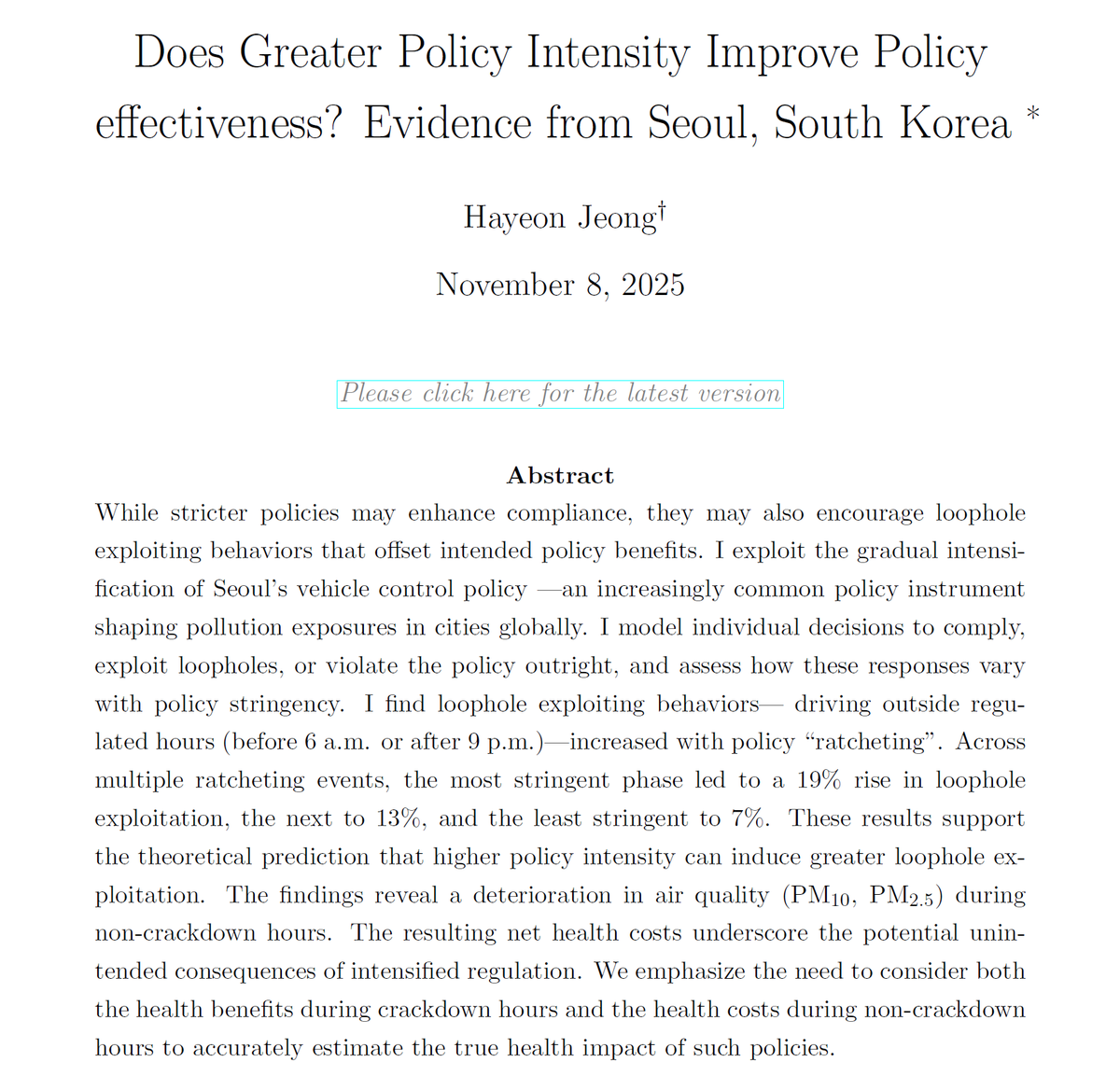
📢I am happy to share my Job Market Paper!
My paper examines the relationship between policy intensity and policy effectiveness. I challenge the notion that more intensive policies are necessarily more effective—both theoretically and empirically—by showing that policy avoidance increases as the policy becomes more stringent during the early period of implementation.
(🧵1/7)
🔗https://t.co/NKzPNf6Iet
Website: https://t.co/5aV5WnKkiM
#EconTwitter #EconJobMarket #JMP #EconJMP
Key Result 2🔑
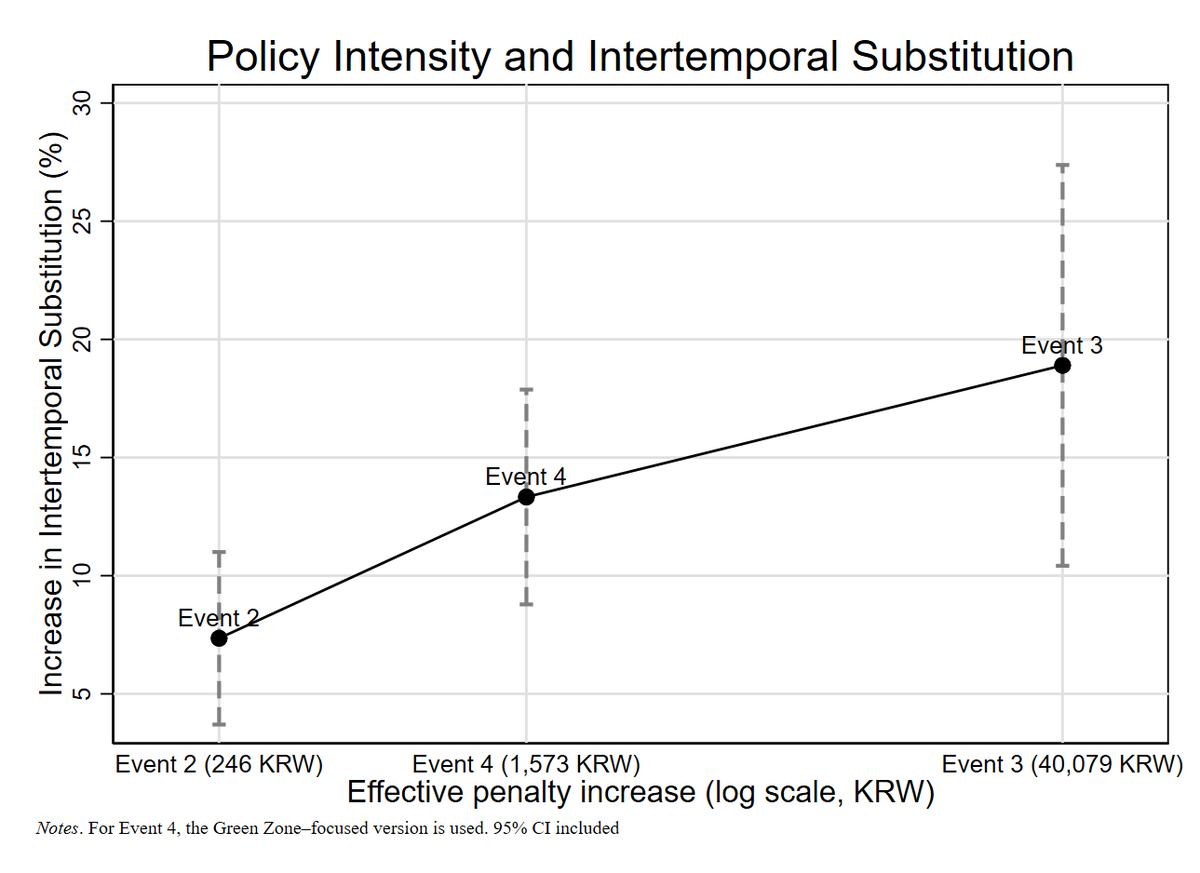
Moreover, the magnitude of policy avoidance is proportional to the degree of policy stringency when compared 'across' multiple policy events. In other words, the more stringent the policy event was, the more increase in policy avoidance we see.
(6/7)
Second is Hayeon Jeong.
JMP: Does Greater Policy Intensity Improve Policy
effectiveness? Evidence from Seoul, South Korea
Website: https://t.co/yJsLx0Y9r9
Interests: Environmental Econ, Behavioral Econ
Meet our outstanding 2025–26 economics job market candidates from @SipaSusdev & @ColumbiaSIPA!
We have two exceptional scholars on this year’s AP market — both bring awesome research agendas and energy to the market.
I've only been part of this program for a year, but it's truly exceptional—both in selection and treatment effects.
Hats off to this amazing cohort! 👏 @ColumbiaSIPA
And there are many more awesome JMCs to come!