Samsung to Raise Q3 DRAM Prices by Up to 20%, AI Demand Remains Solid
Korea's memory semiconductor industry is understood to be pushing to raise the average selling price (ASP) of commodity DRAM in the third quarter of this year by as much as 20% versus the prior quarter.
With supply shortages persisting across the entire product lineup on the back of AI infrastructure investment, memory makers are interpreted to be extending a strategy of maximizing profitability. The pace of price increases will slow thereafter, but industry sources say an extremely high profitability trend will continue into next year as well.
According to the industry on the 3rd, Samsung Electronics is in negotiations with customers targeting a Q3 DRAM ASP increase of up to around 20% versus the previous quarter.
DRAM prices have shown a sharp upward trend, driven by aggressive AI infrastructure investment from global big tech firms. This is because supply shortages have intensified across the entire product lineup, spanning not only server DRAM and high bandwidth memory (HBM) but also low power DRAM (LPDDR), which is drawing attention in the AI inference space.
Samsung's DRAM ASP increase is especially pronounced relative to SK Hynix. The industry assessment is that commodity DRAM, which carries high price volatility, accounts for a large share of Samsung's total output, and that the company has been the most aggressive in raising prices.
In fact, Samsung's first quarter DRAM ASP rose by the low 90% range versus the prior quarter. The second quarter is estimated at around 50 to 60%. Furthermore, it is targeting an increase of around 20% in the third quarter as well. SK Hynix, which has a relatively high share of HBM production, is estimated to come in somewhat below this level.
A semiconductor industry official said, "Samsung is negotiating very aggressively on pricing in the third quarter this year. We understand it will also raise LPDDR, which has recently seen severe bottlenecks in both server and mobile, by more than 20%," adding, "That said, it is not certain whether customers will accept all of this."
DRAM prices are seen as highly likely to remain stable going forward. Although the pace of DRAM price increases is gradually easing, the share of long term agreements (LTAs) signed with key customers is steadily expanding.
For example, Micron of the United States disclosed through its earnings release late last month that it had signed a total of 16 long term agreements with customers. These contracts carry binding commitments to purchase a certain volume and set a price floor that guarantees very high margins. This is interpreted as reflecting customers' judgment that memory supply and demand will remain tight over the medium to long term.
The recently raised possibility of Meta entering the cloud business is also not expected to weigh on memory demand as a negative. Some had read Meta's move to sell its internal surplus computing resources externally as a sign that its AI production capacity may already be sufficiently built out.
However, Meta has maintained an aggressive investment stance, in April raising its annual AI infrastructure investment plan from an initial 115 billion to 135 billion dollars to 125 billion to 145 billion dollars.
Another industry official explained, "With the expansion of LTAs that include price floors and HBM price renegotiations, there will be no sharp decline in the DRAM market next year either," adding, "In Meta's case, it is more accurate to view this as a way to efficiently utilize its internal computing resources."
‼️ BREAKING: Anthropic has embedded hidden spyware-like code in Claude Code that covertly targets Chinese users. It then sends information regarding every user by injecting it into their prompt message.
Claude Code is sending info like timezone, proxy and possible AI Lab connections into the system prompt in ways Chinese users can't notice.
A coding agent with repo and command permissions should not silently hide routing metadata inside prompts. This is a serious breach of user trust.
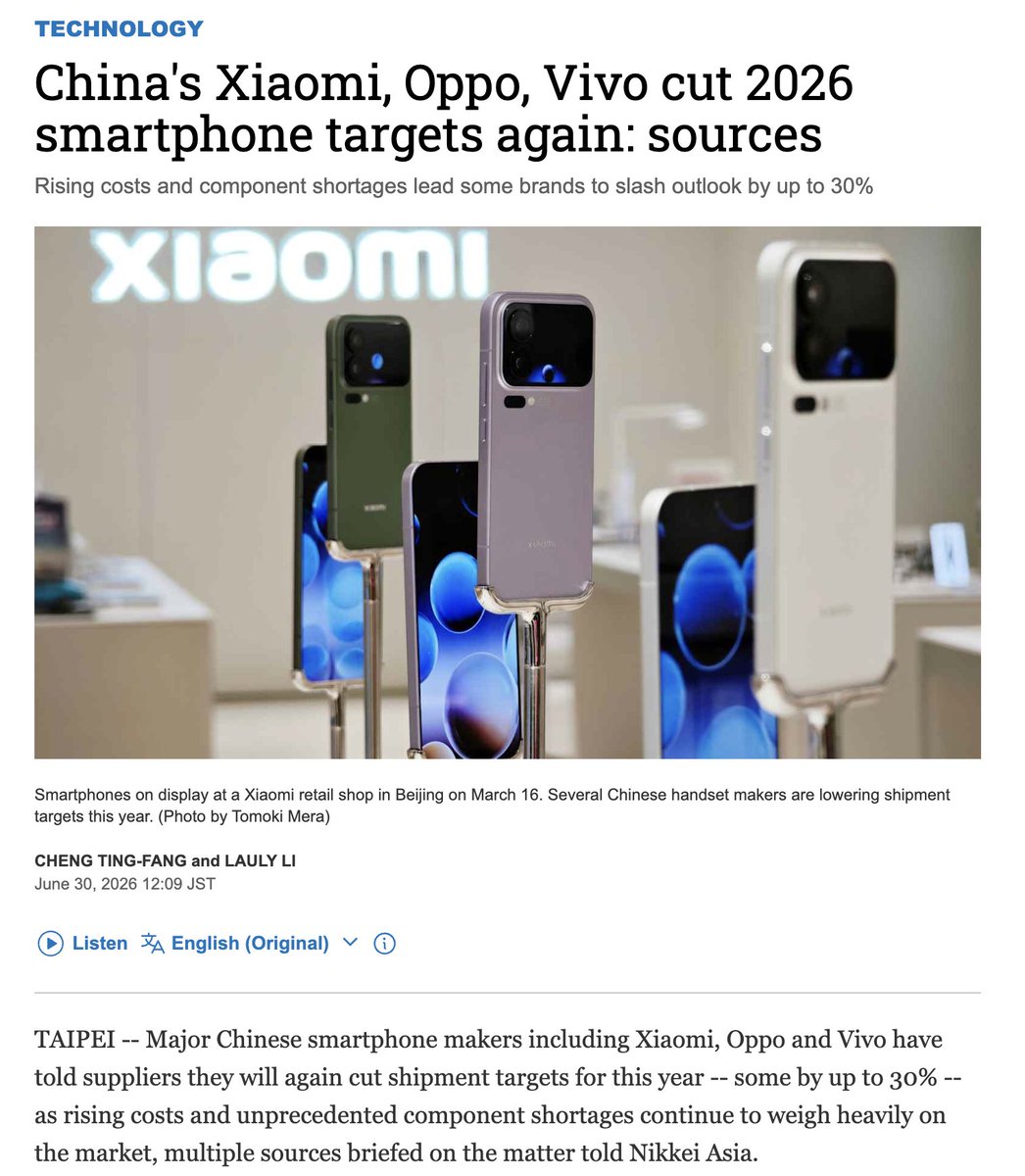
Nikkei Asia reported that Chinese smartphone brands such as Xiaomi, OPPO, and vivo have cut their shipment targets for this year by as much as 30%.
“Even planning for new product launches next year has become extremely difficult, because we have no idea how we can actually secure the components needed for those new products,” Nikkei quoted a source as saying.
In particular, the supply shortage is reportedly severe not only for memory, but also for certain types of printed circuit boards and other supporting chips.