🚨 THEY DON’T WANT THIS PUBLIC. I’M POSTING IT ANYWAY.
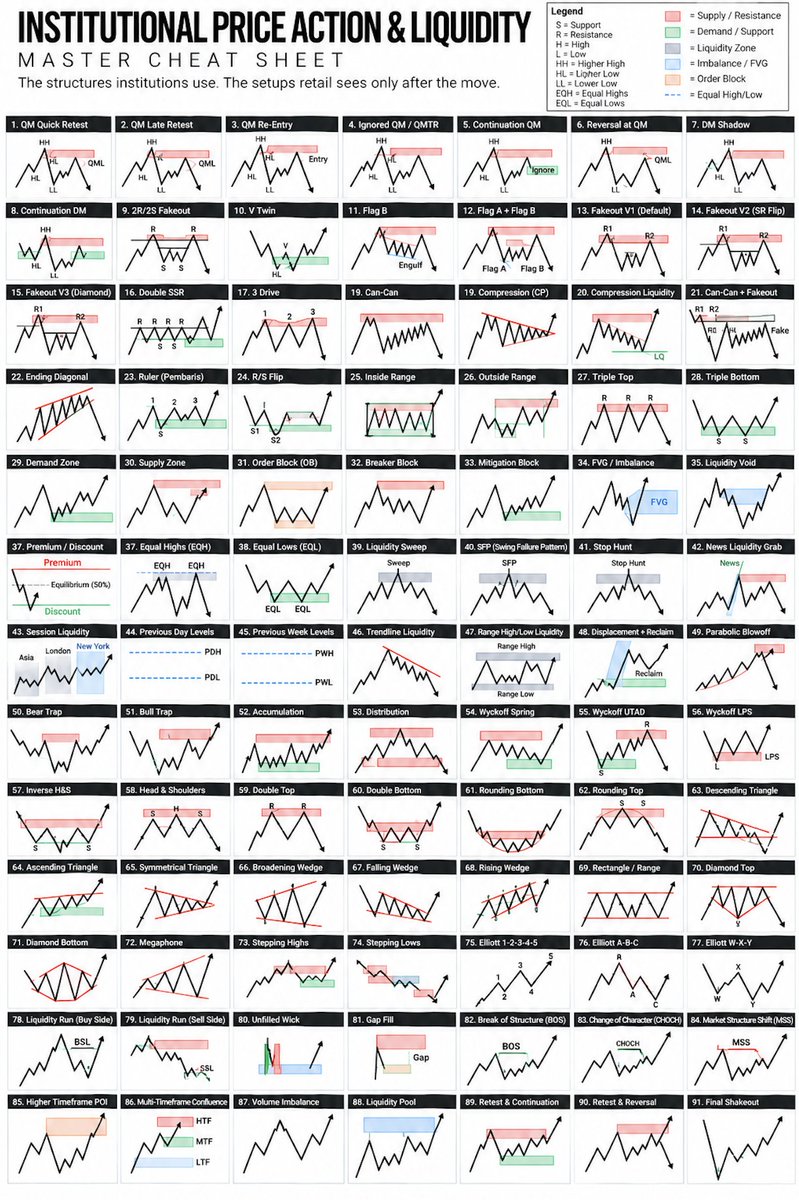
What you’re looking at in this image is HOW THE GAME IS ACTUALLY PLAYED.
Most traders think insiders have some secret indicator.
Wrong.
They care about something much more important:
WHERE LIQUIDITY SITS, WHO’S TRAPPED, AND WHERE THOUSANDS OF TRADERS WILL BE FORCED TO BUY OR SELL AT THE SAME TIME.
That last part is what almost everyone misses.
Institutions don’t need to know where YOUR stop is.
They only need to know where thousands of people are likely to put the SAME stop.
Because large players have a problem retail doesn’t:
They need liquidity to enter and exit size.
If they want to buy heavily, they need sellers.
If they want to sell heavily, they need buyers.
Retail provides both.
That’s what the structures in this image show:
- QML setups
- Fakeouts and liquidity grabs
- Buy-side and sell-side liquidity
- Equal highs and equal lows
- Stop hunts and liquidity sweeps
- BOS, CHOCH and market structure shifts
- Order blocks and breaker blocks
- FVGs and imbalances
- Demand and supply flips
- Compression into expansion
- Previous-day and previous-week liquidity
- Session highs and lows
- Wyckoff accumulation and distribution
- Bull traps and bear traps
- Reversal structures that repeat cycle after cycle
But here’s the real alpha:
ALL OF THESE SETUPS ARE BUILT AROUND FORCED ORDERS.
Your stop isn’t just protection.
Once it gets triggered, it becomes liquidity for someone on the other side:
- A liquidation creates a forced market order.
- Breakout forces traders to chase.
- Failed breakout forces those same traders back out.
- Squeeze forces shorts to buy.
- Long squeeze forces leveraged longs to sell.
And the important part is that these orders are NOT randomly distributed.
They cluster around the same obvious levels.
That is why NONE OF THIS IS ACCIDENTAL:
- Retail sees support. Insiders see sell orders waiting underneath it.
- Resistance. Insiders see buy orders waiting above it.
- A breakout. Insiders ask who just became trapped.
- A huge wick and calls it volatility. Insiders ask which liquidity pool just got cleared.
Once you understand this, you realize the game is not about predicting every candle.
It’s about predicting WHERE THE NEXT FORCED REACTION WILL HAPPEN.
You stop chasing green candles. You stop panic-selling red ones. You stop putting your stop exactly where everyone else puts theirs.
And moves that used to look completely random start making sense.
Save this tweet. Study it. There are 91 structures on it.
Study them until you stop seeing “patterns” and start seeing what actually matters:
WHO IS TRAPPED, WHERE THEIR ORDERS ARE, AND WHO NEEDS THAT LIQUIDITY.
Remember, I’ve been trading markets for over 15 years.
I follow what insiders are doing in real time, and when I see something important, I’ll post it here publicly like I always do.
Turn notifications on.
If you’re not following yet, you’ll understand why that was a mistake later.
Jim Rohn: "All you have to do is work harder on yourself than you do on your job."
Stop waiting for things to change around you. Become the kind of person things change for.
🚨🇳🇬Aliko Dangote : « Si vous investissez environ 100 000 nairas (75.48 dollars) sur une période d'un an ou deux ans, vous pourriez bien devenir millionnaire. »
🚨 BREAKING
🇺🇸 REPUBLICANS JUST OFFICIALLY REJECTED THE UPDATED CLARITY ACT, HOURS BEFORE THE VOTE!
THE CURRENT BILL VERSION IS "FINAL" AND IS HEADED TO A VOTE TODAY AT 2:15 PM ET.
CURRENT TALLY:
FOR → 53
AGAINST → 47
60 VOTES NEEDED TO PASS.
THIS IS NOT LOOKING GOOD...
12 Rules for Beginners in the Stock Market:
1. If the price drops 10%, just hold.
2. If the price drops 20%, add 10%.
3. If the price drops 30%, add 30%.
4. If the price drops 40%, add 30%.
5. If the price drops 50%, add 50%.
6. If the price rises 10%, just hold.
7. If the price rises 20%, still hold.
8. If the price rises 30%, sell 10%.
9. If the price rises 40%, sell 20%.
10. If the price rises 50%, sell 30%.
11. If the price rises 60%, sell 40%.
12. If the price rises 100%, sell everything.
Do you agree with me?🤔
A system doesn't need to catch the bottom.
It doesn't need to sell the top.
It doesn't need to capture the entire trend.
It needs to repeatedly capture enough of the middle to make the math work. Profitability doesn't require perfection. It requires a getting a repeatable piece of the move.
Money is over-rated;
➣ Risk is under-rated.
Days are over-rated;
➣ Years are under-rated.
Talent is over-rated;
➣ Consistency is under-rated.
Intensity is over-rated;
➣ Patience is under-rated.
Complexity is over-rated;
➣ Simplicity is under-rated.
Indicators are over-rated;
➣ Price action is under-rated.
Luck is over-rated;
➣ Discipline is under-rated.
If you want to MAKE $10K trading stocks next week
This is EXACTLY what you should be doing this weekend.
This method gave me my first $100K MONTH.
Not searching for random tickers.
Not building a 50-stock watchlist.
Figure out where money is moving first.
I’m scanning:
TECH / AI
$SMH $DRAM $IGV $CIBR $DTCR
POWER / INDUSTRIALS
$GRID $XLI $NLR
CRYPTO / FINTECH
$ARKF $WGMI
NEXT-GEN
$ARKX $QTUM $BOTZ
REAL ASSETS
$GLD $SLV $COPX $REMX
RISK / ECONOMY
$IWM $XLF $XLE $JETS
HEALTH
$XBI $XLV
Then I’m looking for:
What is outperforming $SPY and $QQQ?
What is holding the 8/21?
What is breaking out of a base?
Where is volume expanding?
What is green while the market is red?
What is making new highs?
Once I find the strongest sector, I go inside it and find the leaders.
Then I wait for my setup.
Find the sector. Find the leader. Wait for the break and retest.
Do this BEFORE Monday.
To improve your trading do these 4 things:
1. Trade less
Stop forcing mediocre setups. Wait for conditions where your edge is actually clearly present.
2. Risk less
Keep individual mistakes small enough that losing streaks are survivable and your decision-making stays rational.
3. Measure more
Track expectancy, win rate, average win/loss, drawdown, market environment parameters, and trade management. Your trading journal should produce
data to analyze, not just memories.
4. Trade with better discipline
Stop changing your trading plan after you're emotionally involved. Enter, position size, manage your trade, and exit according to preset rules before the trade.
Trade less. Risk less. Measure more. Trade better.
Most traders don't need another indicator.
They need to get better at those four things.