Extremely grateful to @ERC_Research for awarding me the #ERCCoG grant and this unique opportunity!
The project HealthAEye will pursue AI-first approaches to retinal imaging to enable home-based monitoring using portable devices.
So thankful to my colleagues and mentors!
So many people helped me along the way. I feel my entire scientific career contributed to this from the first scientific steps at @fer_unizg, over my PhD at @upf to the specialization in AI for retinal imaging at @uiowa and @MedUni_Wien/@OptimaLab
Happy to see published this extensive analysis of CLIP and CLOOB techniques for learning effective multimodal and multidimensional Fundus-OCT representations. Led by amazing @EmeseSukei in a great collaboration with @gklambauer and his JKU team.
We showcase this on the task of predicting age-related macular degeneration (AMD) but we expect the approach to apply generally to survival analysis tasks in the medical domain.
If interested in deep learning for disease progression modeling stop by his talk/poster on Wednesday.
Excited to be attending #MIDL2024. Our lab will be presenting the work led by our star postdoc Arunava Chakravarty on learning to predict the risk of disease progression from longitudinal data.
Paper: https://t.co/DkLC89BUnL
His talk/poster is on Wednesday.
Furthermore, we also incorporate intra-subject consistency by requiring the NeuralODE estimates of the feature and risk at future time-points to be consistent with the values obtained using the actual scan of the future visit.
The obtained representations achieved state-of-the-art results in predicting the conversion from intermediate to late-stage age-related macular degeneration (AMD) from retinal OCT scans.
Excited to share the work led by our exceptional PhD student Taha Emre on the representation learning method for longitudinal imaging data that got an early acceptance (top 11%) at #MICCAI2024
Preprint: https://t.co/xcsoGowCSw
The paper introduces a learnable temporal equivariance module in a contrastive pretraining setup. The proposed module enables direct manipulation of the representation space by generating future representations.
Happy to report our publication in MedIA led by brilliant Philipp Seeböck and @ignaciorlando , which demonstrates a simple yet effective way to boost the performance of biomarker segmentation networks on retinal OCT by including anomaly detection maps. https://t.co/ht7ZopRSEH
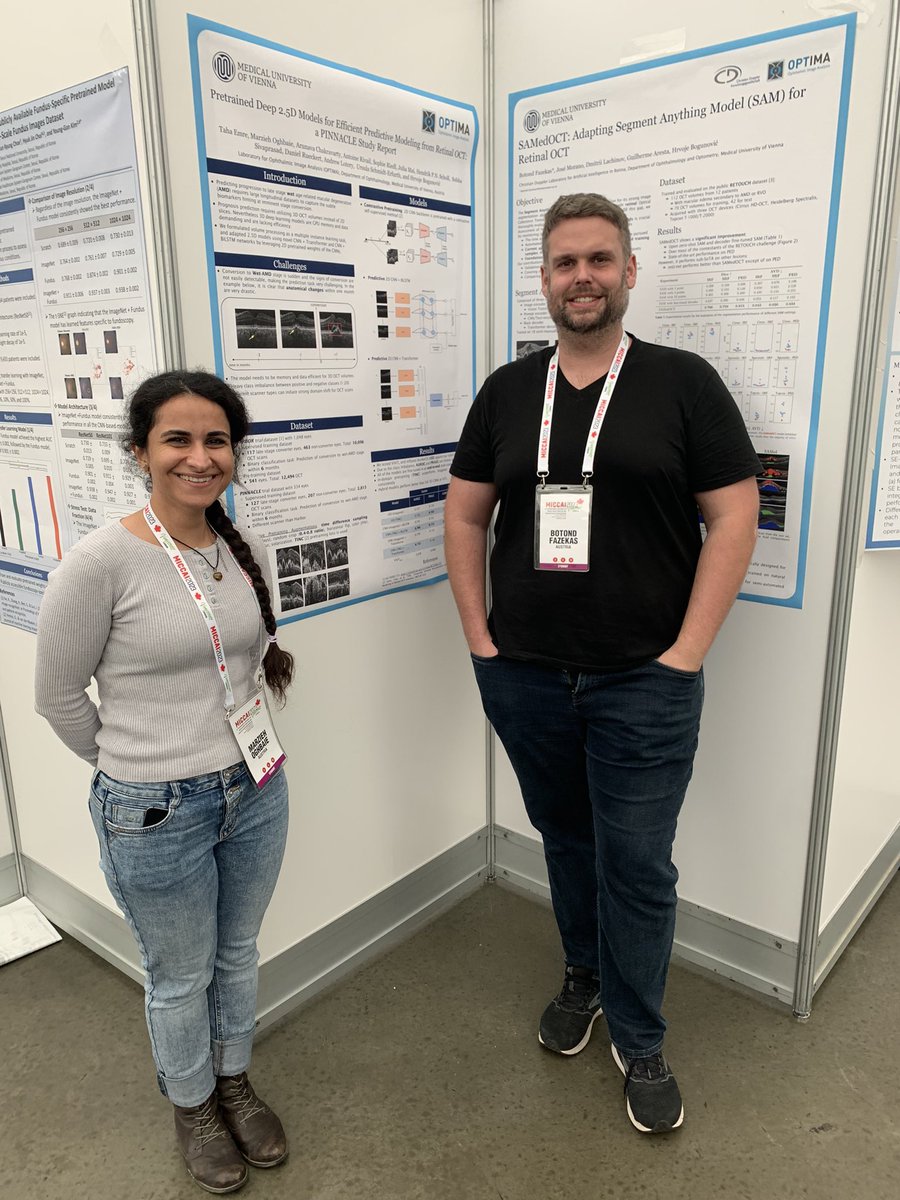
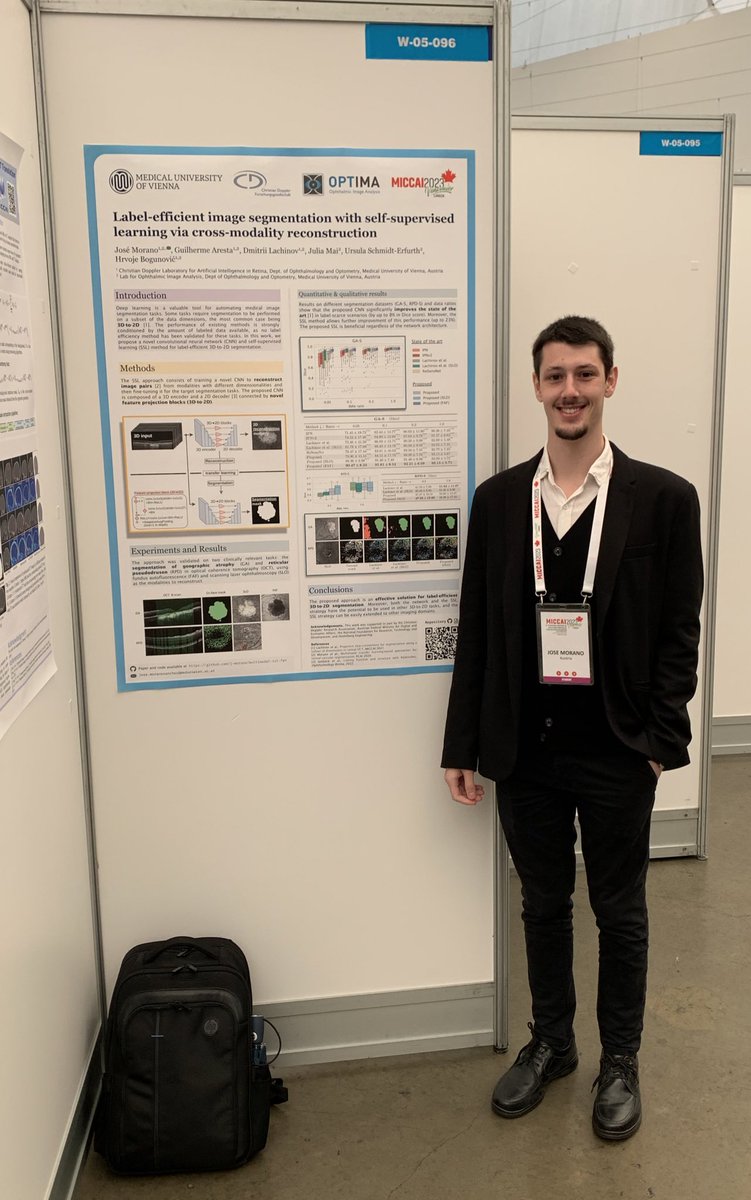
Last of #MICCAI2023 but not least, two face-to-face posters on forecasting from OCT volumes by Taha and Marzieh and adapting SAM for OCT segmentation by Botond. https://t.co/P3BXeAfCj6