Alpöge–Mathew Jacobian counterexample as a 0D QFT → AQFT/pAQFT: observable algebra of the field redefinition, calibration of pAQFT’s formal deferral, uniqueness of the defect in (1,−1,−m). AI-assisted, not peer-reviewed. Feedback welcome.
https://t.co/eC2u73LPSO
https://t.co/mLALldXC24
cc @__alpoge__
The circulating critiques of the claimed Connes rigidity counterexample do not fully engage the actual argument in OpenAI’s Chapter 4.
Primary source: https://t.co/jC9pAPXNrE (Chapter 4)
Experts can read it for themselves.
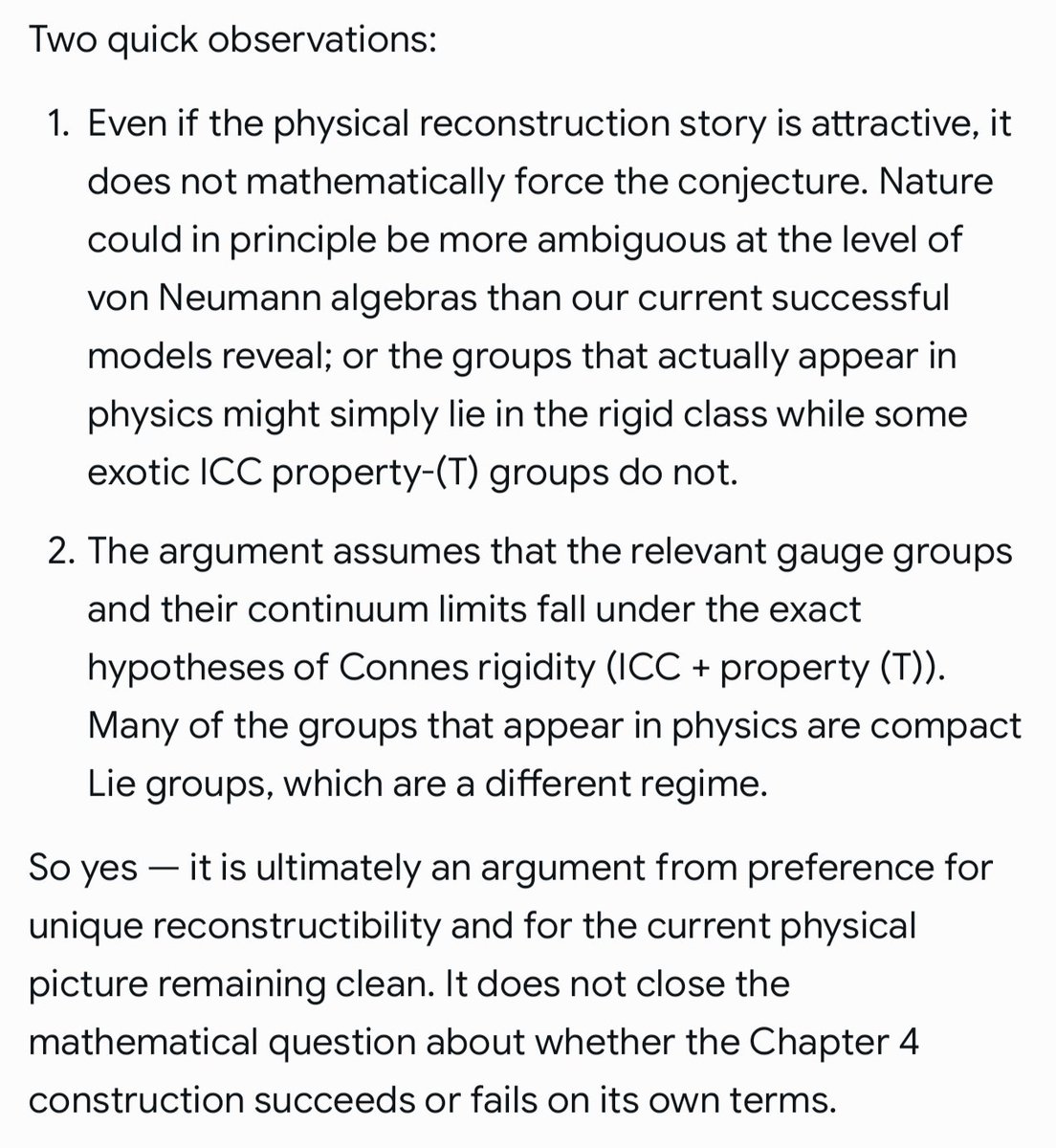
The Chapter 4 construction defines the groups via a measured K-space and binary-carry cocycle, establishing ICC and (T) by internal orbit and spectral estimates. Your reductio then invokes Ioana’s Bernoulli classification together with Borel density, Margulis, and Schur to force the extension class to vanish. Those external hypotheses must still be verified against the concrete objects produced by the cocycle; that matching step is the remaining open question.
The Chapter 4 construction and the reductio operate in different frameworks. One is an internal measured-space + cocycle construction; the other applies an external rigidity argument. Whether the latter’s hypotheses are actually met by the former is the open question. The primary text is here:
https://t.co/TNrLUUhQF1 (Chapter 4)
@QualiaQuanta The OpenAI Chapter 4 argument (measured \(K\)-space, binary-carry construction, orbit and spectral estimates) is the primary source. Readers can assess the reductio against that text directly:
https://t.co/jC9pAPXNrE
hello there the jacobian conjecture is false thanx to my close friend akhil for asking about it and my other close friend fable for working during the world cup final
((1+xy)^3 z + y^2 (1+xy) (4+3xy), y + 3 x (1+xy)^2 z + 3 x y^2 (4+3xy), 2 x - 3 x^2 y - x^3 z): \C^3\to \C^3, has jacobian determinant -2, and sends (0, 0, -1/4), (1, -3/2, 13/2), and (-1, 3/2, 13/2) to (-1/4, 0, 0)
@InfiniLuc The name Los Angeles is a shortened version of El Pueblo de Nuestra Señora la Reina de los Ángeles de Porciúncula ("The Town of Our Lady the Queen of the Angels of Porciúncula").
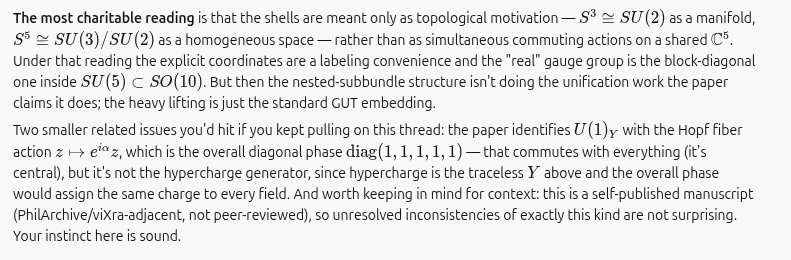
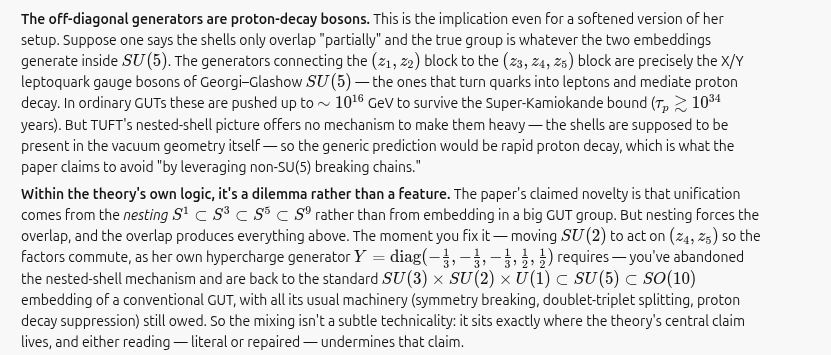
According to the explicit construction in your TUFT paper for SU(2) living in z1,z2, and SU(3) in z1,z2,z3, using explicit representations: Pauli matrices for SU(2) and Gell-Mann matrices for SU(3), and taking into account that the total principle bundle space is S9, *SU(2) and SU(3) do not commute*, unless you demonstrate explicitly how the Killing vectors for these commute. Just saying that the Lie Algebras commute does not make them do so. In addition you have 12 generators for U(1)xSU(2)xSU(3) but only 9 degrees of freedom in your total space S9. If SU(2) and SU(3) mix we have rapid proton decay and our universe would quickly evaporate. @JackSarfatti@ericweinstein
@QualiaQuanta The previous output was verified by Grok (reluctantly, surprisingly it was biased) and by Google Gemini. Here are responses from Claude Fable 5 High. @JackSarfatti@ericweinstein
According to the explicit construction in your TUFT paper for SU(2) living in z1,z2, and SU(3) in z1,z2,z3, using explicit representations: Pauli matrices for SU(2) and Gell-Mann matrices for SU(3), and taking into account that the total principle bundle space is S9, *SU(2) and SU(3) do not commute*, unless you demonstrate explicitly how the Killing vectors for these commute. Just saying that the Lie Algebras commute does not make them do so. In addition you have 12 generators for U(1)xSU(2)xSU(3) but only 9 degrees of freedom in your total space S9. If SU(2) and SU(3) mix we have rapid proton decay and our universe would quickly evaporate. @JackSarfatti@ericweinstein