Having political leaders who are receptive to science is one essential ingredient for effective science advice. Another is having people who can deliver it well.
This @nature editorial argues for training scientists in the art of science advice https://t.co/kKzfWjIXgo
Politicians receptive to science are one essential ingredient for better science advice (obvs).
Our survey also points to a need for:
• More training for scientists
• Advice that includes a wider range of views
• Funders who reward science advice work
https://t.co/yaaVUXpUVt
In a @Nature survey, 80% of science-policy experts say their country’s science advice system is poor or patchy.
My story looks at the state of global science advice - and what needs to change. Data by Jeff Perkel, @Richvn
https://t.co/yaaVUXpUVt
In the survey of approx 400 people (from @INGSciAdvice@TransformUre ):
• 70% say governments are not routinely using science advice
• 80% say policymakers don’t understand science
• 73% say researchers don’t understand policy
• 70% say mis/disinformation is obscuring advice
Can AI help review the scientific literature? I investigated this for @nature
AI tools are speeding up production of good quality reviews – which can otherwise take months to produce - but they could also lead to more inaccurate & misleading reviews.
https://t.co/NqgSGAREhy
I wrote for @nature about the science of protests - do they work?
Research says yes: protests can influence media coverage, public opinion, policy and voting.💪
More effective protests tend to be large, non-violent and with unified goals.
https://t.co/vwry353svi
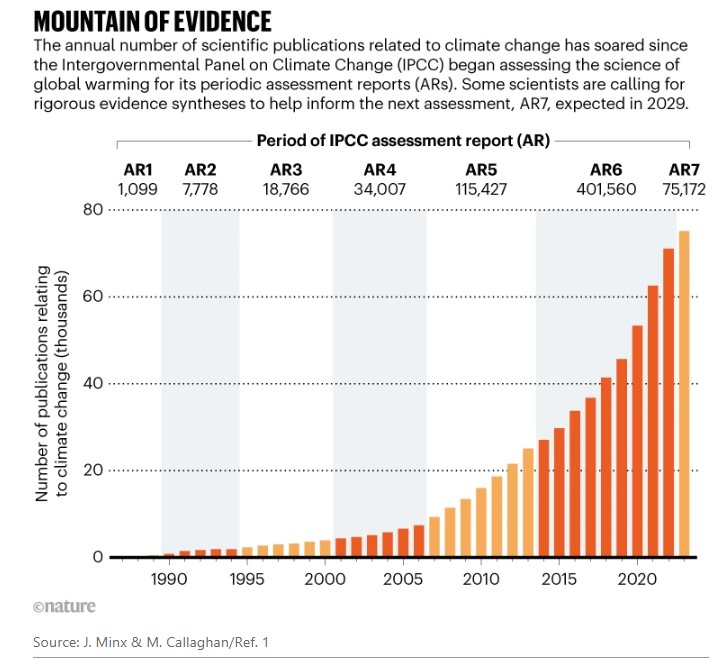
One challenge for the #IPCC is the explosive growth of climate science ⬇️
A bank of #evidence syntheses could assess the science underlying each climate solution. These 'bundles of knowledge' could feed into the IPCC (2/2) @WWCS_summit
https://t.co/42PSEOyOEo
I wrote about a bold new effort to tackle one of the most urgent challenges in climate change: figuring out which climate solutions work (1/2)
The idea is to build an 'evidence bank' that would reveal how well policies work to cut emissions https://t.co/42PSEOyOEo
@WWCS_summit
My review of @geoffmulgan's illuminating book 'When Science Meets Power' for @ISSUESinST
It explores the long & uneasy relationship between science and politics - and calls for bodies expert at providing govts with the right #evidence at the right time https://t.co/zb6p02irQJ
Enter @Nature’s Working Scientist photo competition, for images that showcase the work that scientists do. Winning photographers will have their work published in Nature, plus £500. https://t.co/gMXzNGmtT9
Too few women are submitting research to Nature as corresponding authors. This week’s editorial looks at the data behind the unacceptably low numbers of papers from women senior authors in Nature #womeninSTEM
https://t.co/v6rM9ytn8z
Science video people - wanna do my job for a year?
Making mini science docs for YouTube is very rewarding - from interviewing researchers, to writing scripts to doing funky edits with found footage and music - a brilliant combo of nerdy and creative!
https://t.co/rtzr11JPd0
Five of the world’s biggest carbon emitters are going to the polls in 2024 - what does this mean for climate change?
Read @Nature.
https://t.co/R8Uz30WC6N
Here's a story I wrote about 'How to find meaning in your science career'. I spoke with philosophers, economists and other social scientists about how researchers can find work that's worthwhile to them - and the world. (They all had different answers!) 👇 https://t.co/SlJyA5VvNR
The group behind the #openaccess#Plan_S launches a 'scholar-led' vision for science publishing: all open articles & peer reviews, authors decide when + where to publish [no jrnl gatekeeping], no fees for authors or readers.
by @layallivs | @nature
https://t.co/NxEOErbQn9
Fascinating reproducibility trial in ecology (preprint) in which over 200 scientists were given the same datasets and produced results with wildly varying effect sizes, depending on analysis they chose @Nature
https://t.co/b1vuNTfPug
I'm proud to share the first in a three-part series that I've been lead writer on for Nature Careers. The series reports on a massive global survey of postdocs done earlier this year by Nature.
This first instalment: A curious rise in optimism.
https://t.co/NlmCxTjYLr
🥁 Exciting news! Our Science Writers Database is ~officially~ live! It’s a free, public tool to help people in our global science writing community find one another and diversify their networks. https://t.co/IzZtfDY9JX