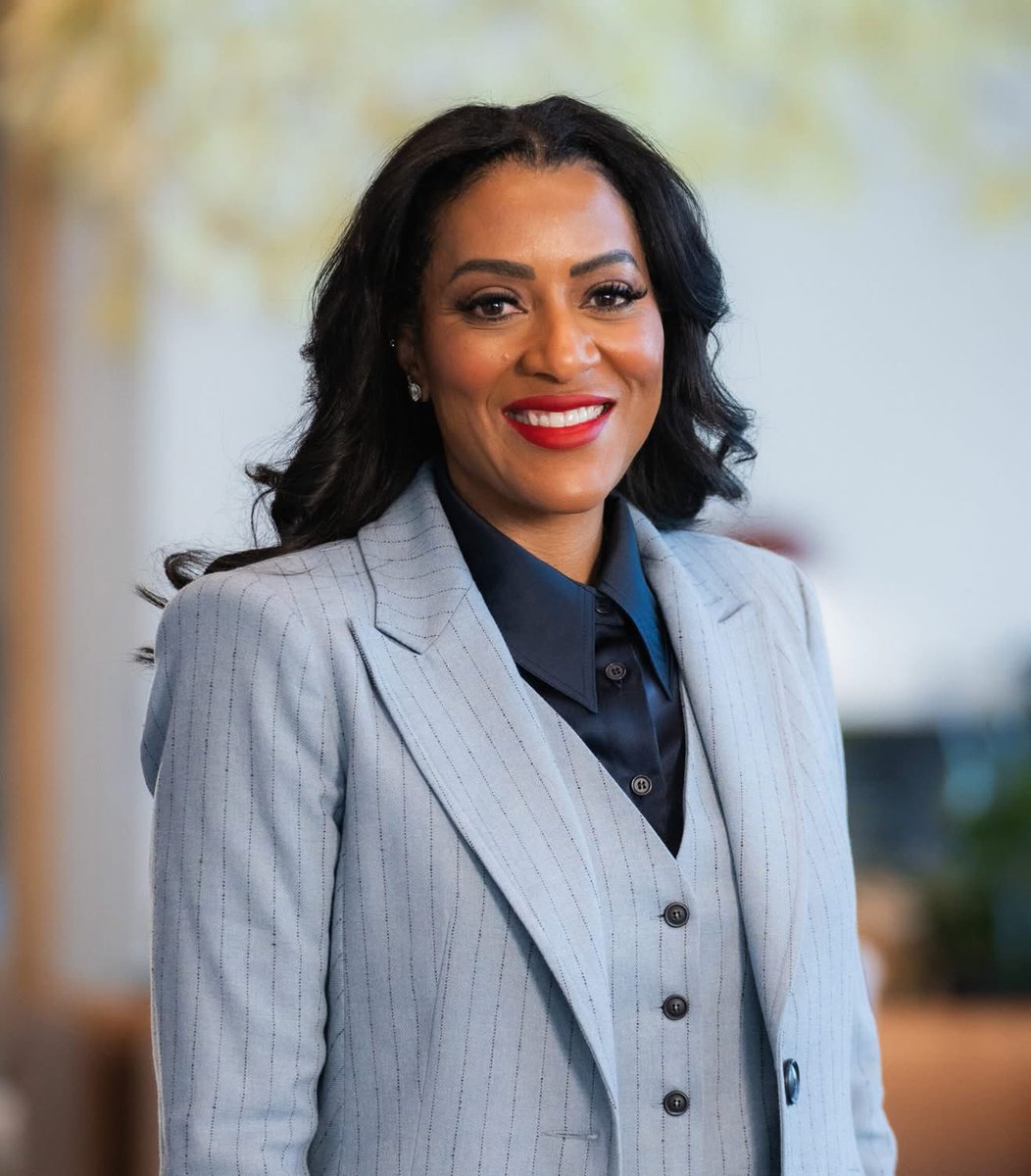
@FirstServiceCU @ Eldridge Pkwy, please know that Ms. Marbella R. just gave me the most outstanding service with a smile. You know what makes her service extraordinary? She gave that service to me patiently while standing in Texas heat. I'm so appreciative that you all have her!
An 18 day old baby rescued from the earthquake rubble in Venezuela is handed back to the Father. Notice the joy and love on everyone’s face especially the Father… can you imagine how he feels right now?
A young Howard University student started a GoFundMe asking for exactly $6,000 — the exact amount she needed to stay enrolled.
She had almost nothing left and was at risk of being dropped due to unpaid tuition.
Then Kyrie Irving saw her story. Instead of just covering the $6,000, he paid $22,000 upfront, securing her education for all four years.
A real one. 🙌🏾
Salt Lake City Black woman entrepreneur Christina Turner partnered with her dad, master chemist Robert Turner, to launch their science-backed luxury skincare line C’Lorice Beauty!
This powerful Black father-daughter duo blends decades of chemistry expertise with earth-sourced ingredients for the Genève Rebirth collection.
This is black excellence 👏🏾
At 17, Dawn Loggins came home from a summer program and discovered her family was gone.
No note.
No warning.
No home.
Months later, she received an acceptance letter from Harvard.
This is her story.
Dawn grew up in rural North Carolina in a house without electricity or running water.
When the family needed water, she and her brother walked to a public park and filled jugs from the bathroom faucets.
Showers were rare.
Classmates called her dirty.
She kept showing up to school.
Her parents moved constantly.
Eviction after eviction.
New town.
New school.
By age 17, Dawn had attended four different high schools and missed nearly an entire year of education.
Most students would have fallen behind.
Dawn excelled.
When she arrived at Burns High School in 2010, guidance counselor Robyn Putnam immediately saw something special.
Dawn enrolled in makeup courses.
Studied before sunset because there were no lights at home.
Took AP classes.
Earned straight A's.
Joined clubs.
Then led them.
Photography Club.
Rock Climbing Club.
Spanish Club.
President of all three.
That summer she earned a place at the prestigious Governor's School of North Carolina.
Teachers helped buy her clothes.
Putnam drove her 200 miles to the program.
Nobody knew where Dawn would be living when it ended.
The concern turned out to be justified.
Near the end of the program, Dawn tried calling home.
The number was disconnected.
When she returned, the house was empty.
Her parents had moved away.
She was 17 years old.
Homeless.
Alone.
Most people would have stopped there.
Dawn didn't.
She couch-surfed.
Carried toiletries in her backpack because she never knew where her next shower would come from.
And every morning at 6 a.m., she went to work.
As a school custodian.
She swept hallways.
Cleaned classrooms.
Scrubbed desks.
Then sat down and earned straight A's.
By graduation year, she had:
• Straight A grades
• AP courses
• Leadership roles in three clubs
• A part-time job before school every morning
Then a teacher made one suggestion:
Apply to Harvard.
Dawn laughed.
Then thought:
"Why not?"
She became the first student in Burns High School history to apply.
Months later, an envelope arrived.
Harvard College.
Accepted.
Full tuition.
Full room and board.
Everything covered.
On graduation day in 2012, when her name was announced, the entire gymnasium stood and applauded.
Teachers cried.
Students cheered.
The girl who cleaned their hallways before sunrise was heading to Harvard.
When asked about her parents, Dawn didn't speak with anger.
She simply said:
"I love my parents. I disagree with the choices they've made."
Then she added something even more powerful:
"If I had not had those experiences, I wouldn't be such a strong-willed or determined person."
Burns High School had over 1,000 students.
Dawn Loggins became the first ever accepted to Harvard.
Proof that the circumstances you're born into are not the same thing as the future you're capable of building.
Black sisters Jessica Wright and Eshonda Blue just made history launching the first woman-owned adult day care franchise in the country!
These registered nurses started Innovative Senior Solutions in 2007 after caring for their own grandmother. From one location, they’ve grown into Georgia’s largest adult day care operator, offering compassionate, high-quality care for seniors and adults with disabilities.
In June 2024, they turned their proven model into a franchise, opening doors for more Black women and families to build generational wealth in the booming $6.6+ billion senior care industry.
This is Black excellence and sister power at its finest. Dreams, hard work, and purpose creating real impact! 👏🏽👏🏽
Dr. Shirley Ann Jackson utilized her extensive knowledge of theoretical physics to foster breakthroughs in telecommunications research. Her research led to inventions such as the portable fax machine, touch-tone telephone, solar cells, fibre optic cables, caller ID, and call waiting.
Meet Kande Sill, a brilliant Black student from Jamaica, won the highly prestigious Arkwright Engineering Scholarship at just 16 years old for her innovative medical drone design.
Her project focuses on a secure, insulated, theft-resistant packaging system for delivering critical medical supplies via drone — addressing real challenges in healthcare logistics.
A rising star in STEM! 👏🏾
Latriece Watkins has made history as the first Black woman to become President and CEO of Sam’s Club.
A longtime Walmart executive and Spelman College graduate, she officially stepped into the role in February 2026, leading one of America’s largest membership retailers.
Trailblazing excellence! 👏🏾
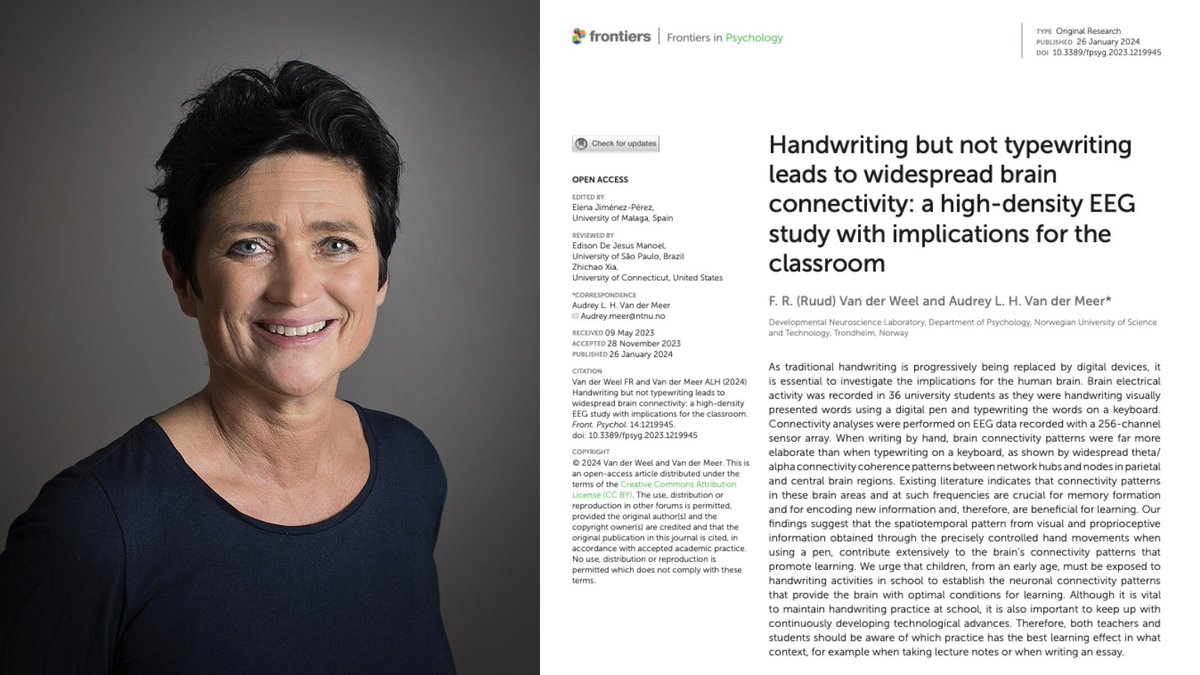
A Norwegian neuroscientist spent 20 years proving that the act of writing by hand changes the human brain in ways typing physically cannot, and almost nobody outside her field has read the paper.
Her name is Audrey van der Meer.
She runs a brain research lab in Trondheim, and the paper that closed the argument was published in 2024 in a journal called Frontiers in Psychology. The finding is brutal enough that it should have changed every classroom on Earth.
The experiment was simple. She recruited 36 university students and put each one in a cap with 256 sensors pressed against their scalp to record brain activity. Words flashed on a screen one at a time.
Sometimes the students wrote the word by hand on a touchscreen using a digital pen, and sometimes they typed the same word on a keyboard. Every neural response was recorded for the full five seconds the word stayed on screen.
Then her team looked at the part of the data most researchers had ignored for years, which is how different parts of the brain were communicating with each other during the task.
When the students wrote by hand, the brain lit up everywhere at once.
The regions responsible for memory, sensory integration, and the encoding of new information were all firing together in a coordinated pattern that spread across the entire cortex. The whole network was awake and connected.
When the same students typed the same word, that pattern collapsed almost completely.
Most of the brain went quiet, and the connections between regions that had been alive seconds earlier were nowhere to be found on the EEG.
Same word, same brain, same person, and two completely different neurological events.
The reason turned out to be something nobody had really paid attention to before her work. Writing by hand is not one motion but a sequence of thousands of tiny micro-movements coordinated with your eyes in real time, where each letter is a different shape that requires the brain to solve a slightly different spatial problem.
Your fingers, wrist, vision, and the parts of your brain that track position in space are all working together to produce one letter, then the next, then the next.
Typing throws all of that away. Every key on a keyboard requires the exact same finger motion regardless of which letter you are pressing, which means the brain has almost nothing to integrate and almost no problem to solve.
Van der Meer said it plainly in her interviews.
Pressing the same key with the same finger over and over does not stimulate the brain in any meaningful way, and she pointed out something that should scare every parent who handed their kid an iPad.
Children who learn to read and write on tablets often cannot tell letters like b and d apart, because they have never physically felt with their bodies what it takes to actually produce those letters on a page.
A decade before her, two researchers at Princeton ran the same fight using a completely different method and ended up at the same answer. Pam Mueller and Daniel Oppenheimer tested 327 students across three experiments, where half took notes on laptops with the internet disabled and half took notes by hand, before testing everyone on what they actually understood from the lectures they had watched.
The handwriting group won by a wide margin on every question that required real understanding rather than surface recall.
The reason was hiding in the transcripts of what the two groups had actually written down.
The laptop students typed almost word for word, capturing more total content but processing almost none of it as they went, while the handwriting students physically could not write fast enough to transcribe a lecture in real time, which forced them to listen carefully, decide what actually mattered, and put it in their own words on the page.
That single act of choosing what to keep was the learning itself, and the keyboard had quietly skipped the choosing and skipped the learning along with it.
Two studies. Two countries. Same answer.
Handwriting makes the brain work. Typing lets it coast.
Every note you have ever typed instead of written went into your brain through a thinner pipe. Every meeting, every book highlight, every idea you captured on your phone instead of on paper was processed at half depth.
You did not forget those things because your memory is bad. You forgot them because typing never woke the part of the brain that would have made them stick.
The fix is the thing your grandmother already knew.
Pick up a pen. Write the thing down. The slower road is the faster one.
Lamont Newell, a formerly homeless teen from South Los Angeles, graduated as valedictorian with a 4.4 GPA from Verbum Dei Jesuit High School and was accepted to 65 colleges.
He’s heading to Columbia University on a full scholarship to study industrial engineering — the first man in his family to graduate high school.
From sleeping in cars to Ivy League bound. What a story. 👏🏽👏🏽